


Why Civil Rights Groups Fight New Federal Grant Cuts
By Darius Spearman (africanelements)
Support African Elements at patreon.com/africanelements and hear recent news in a single playlist. Additionally, you can gain early access to ad-free video content.
The Modern Showdown Over Federal Grant Cuts
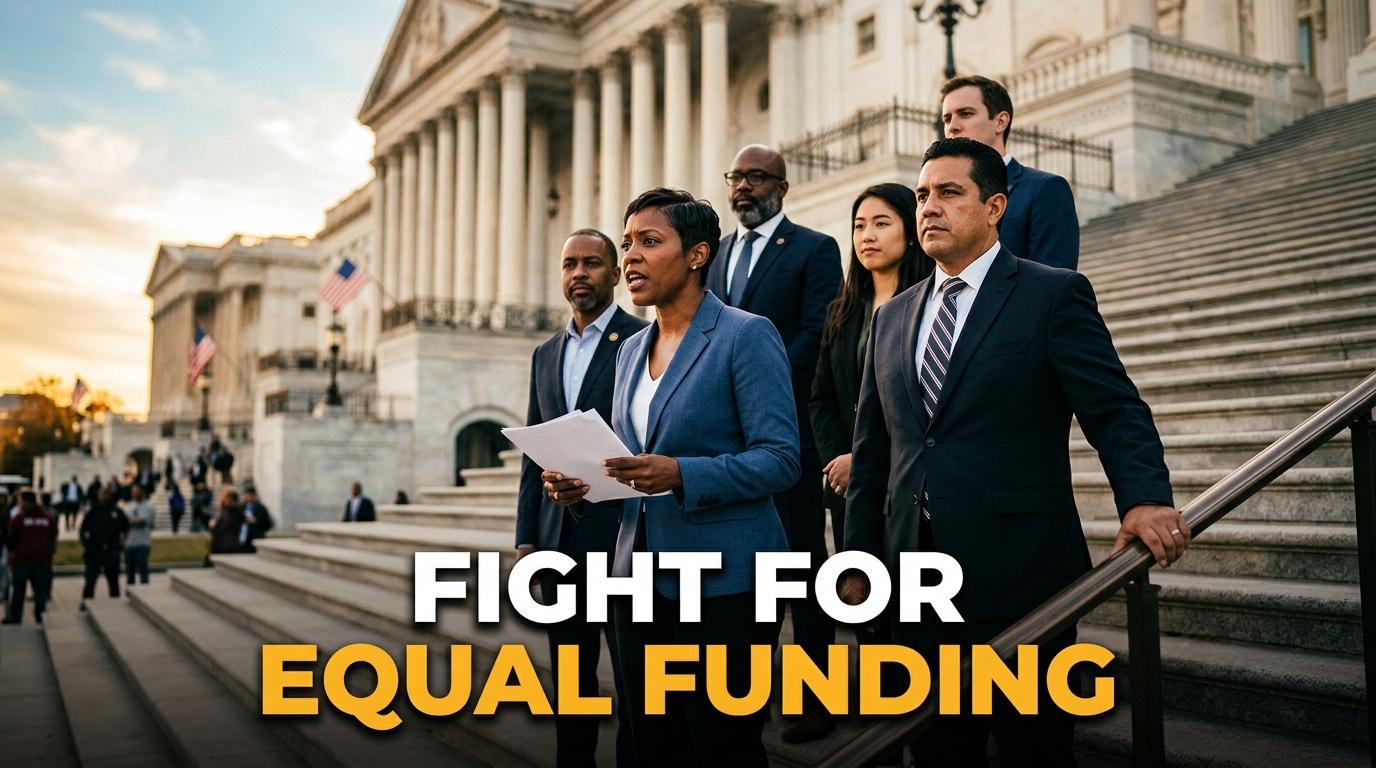
The battle over federal resources has reached a critical boiling point. On July 13, 2026, a powerful alliance of advocacy groups filed a formal challenge against the federal government (earthjustice.org, latinojustice.org). Led by the NAACP Legal Defense and Educational Fund, LatinoJustice PRLDEF, and Earthjustice, these organizations are fighting a sweeping regulatory overhaul (earthjustice.org, latinojustice.org). The White House Office of Management and Budget has introduced rules that threaten the very survival of critical public programs (latinojustice.org).
According to the coalition, federal agencies have already flagged, frozen, or canceled more than $1.5 billion in funding (latinojustice.org). These cuts directly target services that improve healthcare, child welfare, and equal opportunity for Black and Latino communities (latinojustice.org). Consequently, advocacy groups are warning that these policy changes will devastate historically marginalized neighborhoods. This battle highlights the ongoing struggle to protect civil rights in the modern era.
The Power of the Purse and the Lessons of History
To understand the gravity of this showdown, one must look at how the American government is structured. Historically, the U.S. Constitution gives Congress the sole power to decide how public money is spent (congress.gov). This system relies heavily on the balanced sharing of power between national and state governments. Under Article I, Section 8, the legislative branch controls the federal budget (congress.gov). However, history shows that the executive branch often tries to bypass these constitutional limits.
During the early 1970s, President Richard Nixon frequently refused to spend money that Congress had already approved (congress.gov). This practice was known as impoundment. In response, Congress passed the Congressional Budget and Impoundment Control Act of 1974 to stop executive overreach (congress.gov). The current administration is attempting to use administrative rules to bypass Congress once again (latinojustice.org). By allowing political appointees to suspend active grants mid-project, the administration is ignoring these long-standing legal limits (latinojustice.org).
Where the Cuts Hurt Most
Distribution of the $1.5 Billion Flagged, Frozen, or Canceled Federal Grants
Title VI and the Battle for Equitable Public Funding
Historically, federal funding has not always been distributed fairly. For decades, minority communities were systematically excluded from public investments. The practice of redlining, which was institutionalized in the 1930s, offers a stark example of this exclusion (shelterforce.org). Redlining is the systemic and discriminatory practice of denying financial services, such as home mortgages, to entire neighborhoods based on their racial or ethnic demographics (shelterforce.org). This policy prevented families of color from building generational wealth and left public services underfunded.
To combat these structural inequities, the civil rights movement fought for strict legal protections. Their efforts culminated in Title VI of the Civil Rights Act of 1964, which prohibits discrimination in any program receiving federal money (justia.com). Since then, advocates have used Title VI to ensure federal funds serve as a tool for equity. However, the current grant cuts target programs designed to help marginalized groups (latinojustice.org). Activists argue that these actions represent a dangerous shift in the political narrative of equal opportunity.
The Rise of Uniform Guidance and Nonpartisan Peer Review
For many years, federal grantmaking was managed through a confusing web of different agency rules. To simplify this process, the Office of Management and Budget created the Uniform Guidance in 2013 (thompsongrants.com). Officially known as 2 CFR Part 200, this framework established a fair and predictable administrative system for federal funding (thompsongrants.com). It designed clear standards to ensure that grants are distributed based on merit rather than political favoritism.
Historically, a nonpartisan peer-review system has protected scientific, educational, and medical research from political interference (gwdocs.com, acls.org). Independent experts evaluate grant applications objectively (acls.org). However, the new proposed rules seek to dismantle this protection (thompsongrants.com). Under the new guidelines, political appointees would gain broad authority to reject or cancel grants that do not align with the president’s political goals (thompsongrants.com). This change represents a major threat to the independence of public research.
The Automated AI “DOGE” Audit Process
How active grants were systematically flagged and canceled using algorithms
Keyword Search Database
Staffers inserted terms like “BIPOC”, “gender”, and “equality” into ChatGPT detection systems to isolate active projects.
Pretextual DEI Flagging
The AI automatically flagged approximately 1,400 National Endowment for the Humanities grants as non-compliant.
Unconstitutional Termination
Acting NEH leadership canceled $100 million in funding before a federal district court ordered its full restoration.
The DOGE Audits and the Weaponization of AI
The current crisis escalated rapidly following the second inauguration of President Donald J. Trump in January 2025 (newsweek.com). He immediately created the Department of Government Efficiency via Executive Order 14158 (newsweek.com). While it was structured as a temporary advisory organization, it wielded immense influence over federal agencies (newsweek.com). Under this directive, agency leaders began aggressively auditing active grants (democracyforward.org, authorsguild.org).
To speed up the audit process, staffers used artificial intelligence tools to flag grants for termination (authorsguild.org). They entered grant descriptions into ChatGPT to find programs that mentioned diversity, equity, and inclusion (authorsguild.org). The algorithm targeted words like “BIPOC,” which stands for Black, Indigenous, and People of Color (authorsguild.org). Consequently, the federal government canceled approximately 1,400 humanities grants in a matter of days (democracyforward.org). In response, the American Council of Learned Societies filed a major lawsuit to stop these cancellations (democracyforward.org).
Overturning Unconstitutional Viewpoint Discrimination
The legal challenge resulted in a major victory for civil rights advocates in May 2026 (democracyforward.org, authorsguild.org). In American Council of Learned Societies v. McDonald, a federal court delivered a sharp rebuke to the administration (democracyforward.org, authorsguild.org). The lawsuit named Michael McDonald, the Acting Chair of the National Endowment for the Humanities, as a primary defendant (democracyforward.org, newsone.com). Court discovery revealed that McDonald had ceded his authority to temporary staffers who used AI to draft termination letters (authorsguild.org).
Judge Colleen McMahon of the Southern District of New York ruled that the cancellations were unconstitutional (democracyforward.org, authorsguild.org). She declared that the administration had engaged in unlawful viewpoint discrimination under the First and Fifth Amendments (authorsguild.org, courthousenews.com). The court ordered the immediate restoration of all affected grants (democracyforward.org, authorsguild.org). This ruling proved that the administration lacked the legal authority to unilaterally cancel approved funding (democracyforward.org, authorsguild.org).
Milestones in Federal Grantmaking Equity
Key historical events shaping modern public funding protections
The Civil Rights Act
Title VI outlawed discrimination in all federal grant-receiving initiatives.
Impoundment Control Act
Congress restricted the president from unilaterally refusing to spend mandated funds.
Creation of Uniform Guidance
Established standard, nonpartisan rules to protect funding from political whims.
The July 13 Opposition
Leading civil rights coalitions launch formal resistance against new OMB rules.
The Destabilizing Legacy of Historical Economic Barriers
Despite the court victory, the administration continues to target essential social programs. These funding cuts disproportionately affect communities that already face historical barriers to economic freedom. For example, researchers at Child Trends lost critical funding for their work on Hispanic families (latinojustice.org). Similarly, Head Start programs across the country have faced intense pressure to remove words like “disability” and “women” from their funding requests (latinojustice.org).
Furthermore, environmental justice programs have been severely disrupted (earthjustice.org). Communities of color are more likely to live near hazardous waste sites due to historical redlining (shelterforce.org, earthjustice.org). Federal grants from the Environmental Protection Agency help clean up these polluted areas (earthjustice.org, environmentalprotectionnetwork.org). Cutting these funds directly threatens public health. These actions demonstrate that modern funding decisions continue to replicate old systems of inequality.
The Fight for Homeless Assistance and Local Autonomy
The ideological crackdown has also targeted the nation’s housing crisis. The U.S. Department of Housing and Urban Development has attempted to alter its funding rules (shelterforce.org, endhomelessness.org). Under the direction of Secretary Scott Turner, the agency sought to dismantle support for the “Housing First” model (shelterforce.org, endhomelessness.org). This approach prioritizes placing unhoused individuals into permanent housing without strict preconditions (endhomelessness.org).
HUD attempted to cut federal funding for permanent supportive housing projects significantly (shelterforce.org). In response, a broad coalition of twenty-four states filed a federal lawsuit to block the new rules (wa.gov). State officials argued that eliminating these grants would force thousands of vulnerable people back onto the streets (endhomelessness.org). This state-level resistance highlights the deep national opposition to the administration’s funding policies (wa.gov).
A High-Stakes Constitutional Showdown
The formal opposition filed on July 13, 2026, marks a critical turning point in this ongoing battle (latinojustice.org). If the proposed Office of Management and Budget rules take effect on October 1, 2026, they will permanently reshape how federal funding is distributed (thompsongrants.com). Civil rights organizations are prepared to take this fight back to the federal courts (latinojustice.org). They argue that the administration cannot use administrative rules to bypass the Constitution.
This conflict is about more than just numbers and budgets. It is a fundamental struggle over whether the federal government will use its resources to promote equal opportunity or enforce political agendas (latinojustice.org). As the final deadline approaches, the nation faces a major constitutional showdown. The outcome will decide the future of public services and the protection of America’s most vulnerable populations.
About the Author
Darius Spearman is a professor of Black Studies at San Diego City College, where he has been teaching for over 20 years. He is the founder of African Elements, a media platform dedicated to providing educational resources on the history and culture of the African diaspora. Through his work, Spearman aims to empower and educate by bringing historical context to contemporary issues affecting the Black community.
