


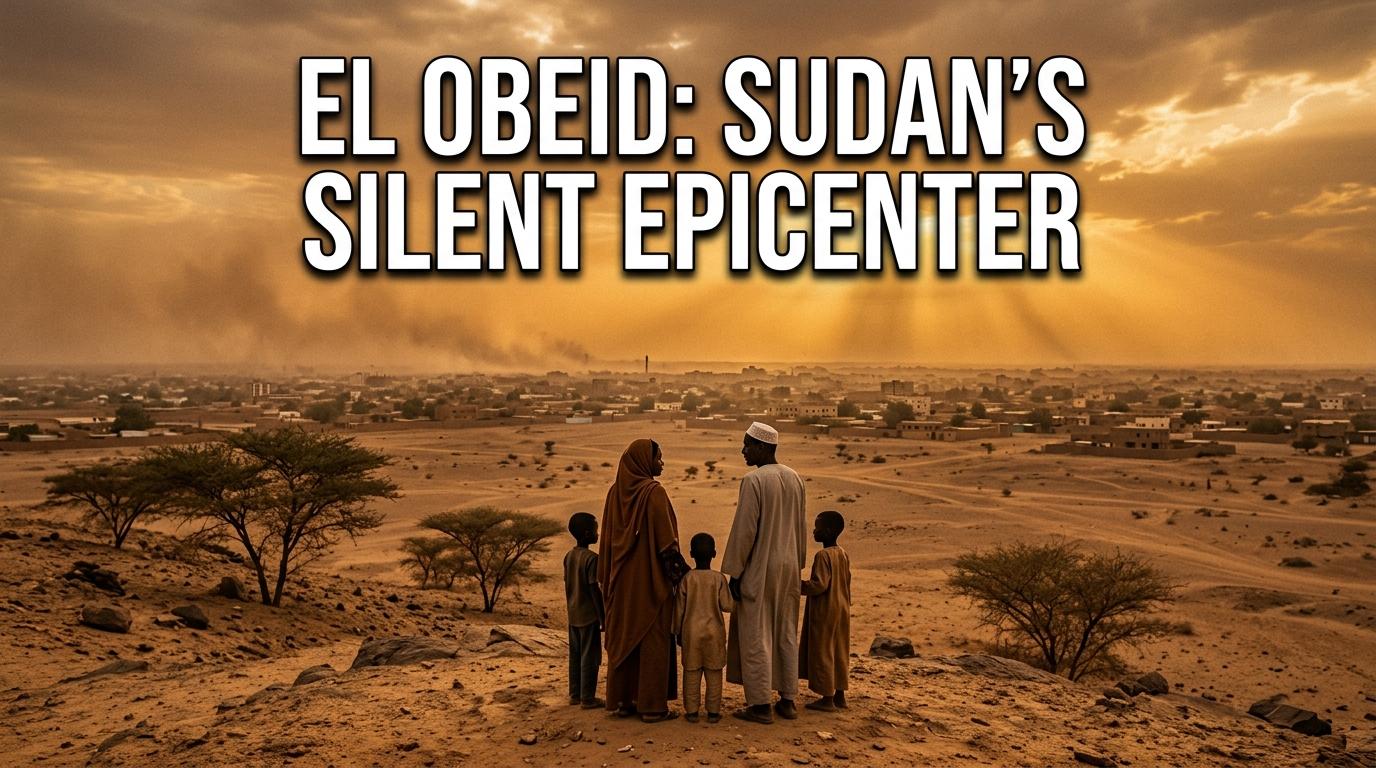
Why El Obeid Emerges as Sudan Civil War Escalation Epicenter
By Darius Spearman (africanelements)
Support African Elements at patreon.com/africanelements and hear recent news in a single playlist. Additionally, you can gain early access to ad-free video content.
The Siege of El Obeid: A City Trapped in the Crosshairs
El Obeid is the capital of North Kordofan state in central Sudan. The city has emerged as a major humanitarian epicenter in the ongoing civil war across the nation (aa.com.tr, iom.int). Over half a million residents live inside the city boundaries (iom.int). In addition to permanent residents, between 100,000 and 200,000 internally displaced persons fled to El Obeid seeking safety from earlier massacres in Darfur and South Kordofan (iom.int, iom.int).
Today, those civilians face a dual nightmare. The paramilitary Rapid Support Forces (RSF) have established a tight outer siege around the perimeter of the city (newlinesinstitute.org, 3ayin.com). At the same time, the Sudanese Armed Forces (SAF) maintain strict internal control over civilian movement (hrw.org, civilianprotectiontrends.org). Human rights groups report that military authorities effectively restrict residents from escaping (hrw.org). This tactic turns the civilian population into human shields to prevent a full ground assault (hrw.org). These dynamics mirror broader patterns of economic exploitation that historically target marginalized African populations.
From Janjaweed to RSF: The Deep Roots of the Factions
The conflict raging across Sudan is not an unexpected outburst of violence. Rather, it is the result of state-sponsored militia creation and broken military alliances (wikipedia.org, worldwithoutgenocide.org). The origins of the RSF trace back to the early 2000s in Darfur (wikipedia.org, hmh.org). The autocratic regime of President Omar al-Bashir armed Arabic-speaking nomadic militias to fight non-Arab African rebels (wikipedia.org, worldwithoutgenocide.org). These brutal fighters were known as the Janjaweed (wikipedia.org, hmh.org). The term Janjaweed translates roughly to “devils on horseback” (wikipedia.org, hmh.org).
The Janjaweed executed a systematic scorched-earth campaign across Darfur (worldwithoutgenocide.org, hmh.org). They committed widespread massacres, sexual violence, and village destructions (worldwithoutgenocide.org, hmh.org). In 2013, President Bashir formalized these militias into an official state security apparatus called the Rapid Support Forces (wikipedia.org, csbsju.edu). Commander Mohamed Hamdan Dagalo, known as Hemedti, assumed control of the group (wikipedia.org, csbsju.edu). In 2019, popular protests forced the military to depose Bashir (wikipedia.org, wikipedia.org). Hemedti then aligned with SAF General Abdel Fattah al-Burhan (wikipedia.org, wikipedia.org). Together, they launched a military coup in October 2021 that destroyed Sudan’s democratic transition (wikipedia.org, wikipedia.org). However, their alliance collapsed in April 2023 over disputes regarding how quickly the RSF should integrate into the regular army (wikipedia.org, wikipedia.org).
Identity and Power: Unpacking “Arab” and “African” in Sudan
Western reporting often describes the Sudanese conflict as a simple battle between Arab and African groups. However, identity in Sudan is complex and deeply rooted in historical state building (worldwithoutgenocide.org, leeds.ac.uk). All communities involved in this conflict are phenotypically Black and geographically African (leeds.ac.uk, csbsju.edu). The distinction between Arab and African identities relies primarily on language, lifestyle, and historical self-identification (leeds.ac.uk, csbsju.edu).
Historically, colonial rulers and post-independence regimes in Khartoum built a rigid social hierarchy (leeds.ac.uk, csbsju.edu). This hierarchy privileged riverine Arab-identifying groups over non-Arab ethnic communities (leeds.ac.uk, csbsju.edu). Sedentary agricultural tribes in western Sudan, such as the Fur, Masalit, and Zaghawa, retained indigenous languages and identified as African (worldwithoutgenocide.org, csbsju.edu). In contrast, nomadic camel-herder groups spoke Arabic and identified as Arab (leeds.ac.uk, csbsju.edu). The Bashir regime exploited these cultural divisions to suppress non-Arab rebellions (worldwithoutgenocide.org, csbsju.edu). Consequently, indigenous communities faced systemic displacement in their long struggles for liberation.
The Economics of Conflict: Gum Arabic and War Assets
El Obeid holds vital economic and strategic value that makes it a prime target for both warring factions (wikipedia.org, britannica.com). The city functions as the commercial heart of North Kordofan (wikipedia.org, britannica.com). Most importantly, El Obeid serves as the primary global hub for gum Arabic (wikipedia.org, britannica.com). Gum Arabic is a natural resin harvested from acacia trees (britannica.com, britannica.com). International food, beverage, and pharmaceutical corporations rely heavily on this material as an essential stabilizer (britannica.com, britannica.com). Sudan supplies between 70% and 80% of the entire world supply (britannica.com, britannica.com).
Local African farmers harvest acacia sap under grueling environmental conditions (wikipedia.org, britannica.com). Yet, these workers receive minimal financial return for their labor (wikipedia.org, britannica.com). Instead, military commanders and armed militias control the supply routes (wikipedia.org, britannica.com). Both the SAF and the RSF extort transit fees, seize farmlands, and trade stolen gum Arabic to finance their weapons purchases (wikipedia.org, britannica.com). Furthermore, a major pipeline carrying crude oil from South Sudan to Port Sudan runs directly through El Obeid (wikipedia.org, britannica.com). Controlling this logistical junction provides immense leverage over regional energy flows (wikipedia.org, britannica.com).
High-Tech Warfare and Foreign Proxies
The siege of El Obeid features an escalating campaign of heavy artillery and high-tech weaponry (newlinesinstitute.org, civilianprotectiontrends.org). According to safety monitoring organizations, North Kordofan experienced a dramatic spike in drone strikes during 2026 (civilianprotectiontrends.org). Over half of these strikes occurred after June 2026, targeting civilian areas in El Obeid (civilianprotectiontrends.org). Drones have repeatedly hit power stations, water treatment facilities, and public markets (msf.org, ceobs.org).
Foreign intervention fuels the intensity of this war (aljazeera.com, adf-magazine.com). The United Arab Emirates acts as the primary backer of the RSF (aljazeera.com, fdd.org). The UAE supplies advanced Chinese-made CH-95 drones, armored vehicles, and heavy artillery to Hemedti’s forces through supply lines in Chad (aljazeera.com, source-material.org, fdd.org). Additionally, Russia’s Wagner Group has delivered anti-aircraft missiles and ammunition to the RSF (atlanticcouncil.org, adf-magazine.com). On the other side, Iran supplies the SAF with Mohajer-6 combat drones (adf-magazine.com, eurasiareview.com). Turkey and Egypt have also provided the SAF with Baykar TB2 drones and aviation support (adf-magazine.com, almendron.com).
Human Rights Violations and the Threat of Mass Atrocities
International observers warn that El Obeid faces an immediate threat of ethnically targeted massacres (worldwithoutgenocide.org, genocidewatch.com). Human rights groups report that the RSF uses a proven playbook of destruction (hrw.org, amnesty.org). By cutting off access to clean water and fuel, the RSF creates artificial famine conditions (msf.org, unocha.org). Non-Arab displaced populations who survived previous genocidal attacks in Darfur are at extreme risk if the RSF breaches city defenses (worldwithoutgenocide.org, hrw.org).
Simultaneously, the SAF military regime impedes humanitarian aid from reaching trapped civilians (hrw.org, unocha.org). The SAF-run Humanitarian Aid Commission delays visas, blocks travel permits, and halts aid trucks at checkpoints (hrw.org, unocha.org). In May 2023, the United States and Saudi Arabia brokered the Jeddah Declaration to protect civilians and open aid channels (state.gov, peaceagreements.org). However, both factions completely ignored the agreement (state.gov, dabangasudan.org). Combatants continue to occupy medical facilities and target civilian infrastructure in violation of international law (msf.org, hrw.org). The deliberate destruction of entire communities reflects patterns seen in historical racial violence.
Mutual Aid on the Frontlines: Emergency Response Rooms
While international institutions struggle to deliver aid, local citizens have organized their own survival networks (paxforpeace.nl, ids.ac.uk). Known as Emergency Response Rooms (ERRs), these grassroots networks operate across Sudan (paxforpeace.nl, mastercardfdn.org). ERRs originated from the youth-led Neighborhood Resistance Committees that organized the 2018 anti-government protests (ids.ac.uk, mastercardfdn.org). Volunteers pivoted from political activism to mutual assistance during active war (ids.ac.uk, mastercardfdn.org).
This decentralized structure draws on nafeer, a traditional Sudanese culture of shared community effort (paxforpeace.nl, ids.ac.uk). Over 26,000 ERR volunteers manage communal kitchens, run neighborhood health clinics, and repair damaged water lines under heavy gunfire (paxforpeace.nl, ids.ac.uk, mastercardfdn.org). In areas where international relief agencies cannot operate, ERRs provide emergency care and document human rights abuses (paxforpeace.nl, ids.ac.uk). Their bravery exemplifies effective grassroots organization in the face of state collapse.
Decentralized youth networks providing survival governance across Sudan when international aid is blocked.
Why Global Media Ignores the World’s Worst Crisis
The humanitarian situation in Sudan represents the largest displacement crisis on Earth (iom.int, iom.int). Over 21 million Sudanese face acute food insecurity (un.org, unocha.org). Famine conditions have already taken hold in parts of Darfur and Kordofan (un.org, unocha.org). Despite these catastrophic numbers, the UN humanitarian appeal of $2.9 billion remains severely underfunded at under 39% (un.org, unocha.org).
This massive 61% funding gap stems from several factors (brookings.edu, stimson.org). Western news outlets give overwhelming coverage to conflicts in Europe and the Middle East, sidelining African crises (brookings.edu, stimson.org). Furthermore, major donor governments exhibit geopolitical bias by prioritizing aid to regions of immediate strategic interest (brookings.edu, stimson.org). Recent budget cuts to foreign assistance programs, including USAID, have further reduced available funds (stimson.org, care.org). Finally, military blockades and targeted attacks on aid workers make distribution dangerous, leading some donors to withhold support (hrw.org, care.org).
About the Author
Darius Spearman is a professor of Black Studies at San Diego City College, where he has been teaching for over 20 years. He is the founder of African Elements, a media platform dedicated to providing educational resources on the history and culture of the African diaspora. Through his work, Spearman aims to empower and educate by bringing historical context to contemporary issues affecting the Black community.
