

Why the COP31 Climate Summit Collapsed Without a Deal
By Darius Spearman (africanelements)
Support African Elements at patreon.com/africanelements and hear recent news in a single playlist. Additionally, you can gain early access to ad-free video content.
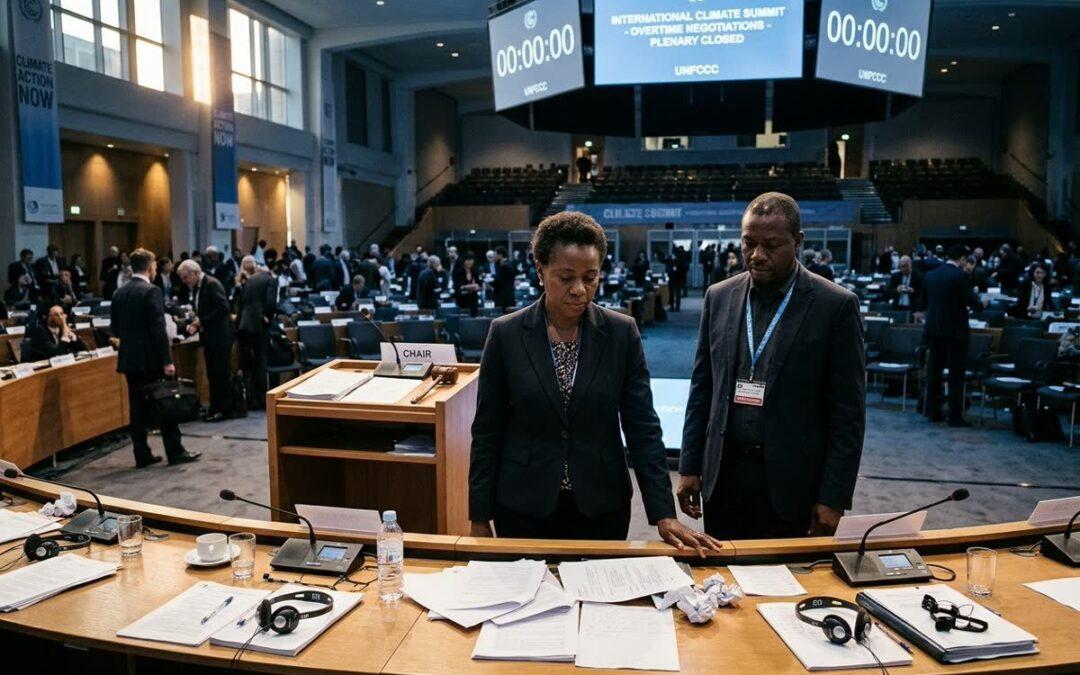
The gavel fell in Antalya, Turkey, after negotiations stretched past forty-four hours of overtime (tickernews.co). The thirty-first United Nations Climate Change Conference, known as the COP31 climate summit, officially became the longest conference in United Nations history (ground.news). Yet, delegates left the venue without an overarching agreement (commondreams.org). Exhausted negotiators packed their bags as key agenda items stalled under irreconcilable divisions over finance and fossil fuels (tickernews.co). The unresolved questions were deferred across the Mediterranean and the Red Sea to Africa (ifa.gov.et).
The sudden breakdown at the Antalya climate talks shocked many casual observers around the world (ground.news). However, the failure was neither an accident nor an isolated breakdown (odi.org). It was the direct outcome of unresolved structural disputes that have plagued international environmental diplomacy for more than thirty years (wikipedia.org). These divisions trace back through generations of broken institutional promises and economic disparities between the industrialized North and the Global South (odi.org).
The COP31 Antalya Deadlock and the 44-Hour Collapse
The conference operated under an unusual joint governance framework (wikipedia.org). Turkey served as the official logistical host under Environment Minister Murat Kurum (wikipedia.org). Australia led the diplomatic negotiations under Climate Change Minister Chris Bowen (wikipedia.org). This divided structure faced severe friction from the opening gavel (tickernews.co). Deep disagreements emerged between fossil-fuel-producing states and vulnerable developing nations (ground.news, tickernews.co).
The central breaking point centered on the political cover text (commondreams.org). An alliance of small island states and European delegates demanded enforceable language to wind down oil, gas, and coal (ground.news, tickernews.co). Major petroleum-exporting nations resisted any target dates or binding restrictions (ground.news). Simultaneously, African delegates insisted on guaranteed public funding to protect communities from droughts, floods, and shoreline erosion (odi.org). When the final draft dropped specific funding commitments, negotiations fractured completely (commondreams.org, tickernews.co).
With positions hardened, the Australian negotiating leadership could not bridge the divide (tickernews.co). Australian negotiator Chris Bowen acknowledged that parties faced unbridgeable red lines (tickernews.co). Under United Nations Framework Convention on Climate Change (UNFCCC) Rule 16, items that fail to reach agreement automatically transfer to the following summit (unfccc.int). As a result, the COP31 Antalya deadlock concluded without a final declaration (ground.news).
Record Negotiation Overtime at UN Climate Summits
Structural Stalls and the UNFCCC Consensus Rule 42
To grasp why these international meetings stall, one must look at the rules written at the founding of the climate treaty (wikipedia.org). When world leaders gathered at the 1992 Earth Summit in Rio de Janeiro, they drafted basic ground rules for international diplomacy (wikipedia.org). However, delegations failed to reach an agreement on how voting should occur (wikipedia.org). A proposed measure, titled Draft Rule 42, suggested that a two-thirds or three-quarters majority could pass substantive decisions if all efforts to achieve unanimity failed (wikipedia.org). Major oil-exporting nations and powerful industrialized states rejected the proposal outright (wikipedia.org).
Because delegations never formally adopted that voting article, the United Nations operates under strict consensus (wikipedia.org). Under this practice, every single recognized government holds an effective veto (wikipedia.org). A lone country or a small economic bloc can halt agreements supported by nearly two hundred other nations (wikipedia.org). This institutional design forces negotiators toward the lowest common denominator, often watering down texts to protect commercial interests (wikipedia.org, odi.org).
History shows repeated breakdowns caused by this rule (wikipedia.org). At COP6 in The Hague in 2000, talks collapsed over disagreements between the United States and the European Union concerning carbon credits for forests (wikipedia.org). Negotiations were suspended for eight months until diplomats met again in Germany to salvage the rules (wikipedia.org). Similarly, COP15 in Copenhagen in 2009 ended in public chaos when several countries objected to an agreement negotiated by a small private group (wikipedia.org). As a result, the conference could merely note the agreement rather than formally enact it (wikipedia.org).
“The structure of consensus decision-making grants disproportionate leverage to fossil fuel exporters, preventing clear and binding collective action.”
Source: (wikipedia.org)
The 30-Year Battle for a Fossil Fuel Transition Roadmap
The second root of the impasse involves the explicit naming of extraction industries (wikipedia.org). Neither the original 1992 treaty nor the landmark 2015 Paris Agreement contained the words “coal,” “oil,” “gas,” or “fossil fuels” (wikipedia.org). Petrochemical economies spent decades keeping direct references to extraction off the official diplomatic records (wikipedia.org). Only at COP26 in Glasgow in 2021 did governments finally reference the phasedown of unabated coal power (wikipedia.org).

African History Series • Volume II • Anti-Colonial Resistance & Sovereignty
Africa Reclaimed: Overcoming the Legacies of the Colonial Machine
By Professor A. Darius Spearman • 353 Pages • ISBN: 979-8-9924836-4-2
Colonialism in Africa was never passively endured—and its extractive machinery did not simply vanish when independence flags were raised. Professor A. Darius Spearman traces the unbroken arc of African political power from 19th-century indigenous statecraft and mid-20th-century liberation wars to contemporary battles against neo-colonial debt and resource imperialism.
The issue resurfaced at COP28 in Dubai, where countries approved an agreement calling on parties to transition away from fossil fuels in energy systems (wikipedia.org). However, the declaration lacked binding milestones, financial guarantees, and compliance mechanisms (wikipedia.org). Developing nations pointed out that transitioning requires technical infrastructure that poorer countries cannot construct without capital (odi.org). When European negotiators at Antalya pushed for a strict fossil fuel transition roadmap, major petroleum producers removed the phrasing from the working text entirely (ground.news, tickernews.co).
This dynamic reflects an unequal historical ledger (odi.org). Industrialized economies built wealth through more than a century of unconstrained coal, oil, and gas consumption (odi.org). Meanwhile, the African continent generated less than four percent of cumulative carbon pollution since the Industrial Revolution (odi.org). Despite this minimal footprint, African societies suffer severe heatwaves, catastrophic crop losses, and infrastructure destruction (odi.org). Demanding rapid decarbonization from nations lacking basic electricity access without financial support produced an inevitable stalemate (odi.org).
Cumulative Historical Emissions Share (1850–Present)
Why Frontline Nations Demand Grant Based Climate Finance
The issue of financing stands at the center of the North-South diplomatic divide (odi.org). In 2009 at COP15, developed countries promised to mobilize one hundred billion dollars annually by 2020 for developing nations (wikipedia.org, odi.org). That target arrived two years late in 2022 and consisted primarily of commercial loans rather than direct grants (odi.org). At COP29 in Baku, nations agreed on the New Collective Quantified Goal to supply three hundred billion dollars annually by 2035 (odi.org). Developing states rejected that amount as insufficient, pointing out that actual needs exceed 1.3 trillion dollars each year (odi.org).
African leaders and the African Group of Negotiators firmly reject loan-based funding (odi.org). More than half of the nations on the continent face severe sovereign debt distress (odi.org). Multiple governments spend more revenue servicing foreign debt than they spend on public healthcare, education, and climate adaptation combined (odi.org). Providing environmental aid as loans forces vulnerable populations to pay interest on disasters generated by foreign industries (odi.org). This cycle compounds poverty and erodes fiscal autonomy, echoing older patterns of economic extraction explored in grassroots labor struggles across the continent (odi.org).
Negotiators ground their position in the concept of climate debt (odi.org). Articulated at the 2010 Peoples’ World Conference on Climate Change in Cochabamba, Bolivia, this principle argues that industrialized countries overconsumed the atmospheric commons (odi.org). Because wealthy nations used the majority of the global carbon budget, non-repayable transfers are compensatory responsibilities rather than discretionary charity (odi.org). At Antalya, African negotiators demanded an explicit commitment of 120 billion dollars per year for public grants (odi.org). Wealthy nations refused, deadlocking the conference hall (tickernews.co).
Public Climate Finance Instruments Provided to the Global South
Labor, Civil Rights, and the Just Transition Framework
The phrase “just transition” has become a central piece of international debate (amnestyusa.org). The concept originated during the 1970s labor movement under trade unionist Tony Mazzocchi and the Oil, Chemical and Atomic Workers Union (amnestyusa.org). Mazzocchi proposed a “Superfund for workers” to guarantee financial security and retraining for employees displaced by toxic facility closures (amnestyusa.org). The concept merged with the environmental justice movement during the 1991 First National People of Color Environmental Leadership Summit (amnestyusa.org). Delegates there established seventeen principles demanding an end to the racialized dumping of industrial waste (amnestyusa.org).
Today, networks such as the Climate Justice Alliance, the Indigenous Environmental Network, and the NAACP Environmental and Climate Justice Program maintain this vision (amnestyusa.org). For Black and frontline neighborhoods, a clean energy transition cannot simply substitute wind turbines for oil refineries while maintaining economic exclusion (amnestyusa.org). Historical practices like redlining placed polluting petrochemical plants beside Black neighborhoods (amnestyusa.org). True transition requires community ownership, clean mass transit, local wealth building, and an end to systemic environmental harm (amnestyusa.org). These efforts connect to the broader work of civil rights activists fighting for local democratic control (amnestyusa.org).
“A transition away from fossil fuels without equity guarantees replicates colonial power dynamics, leaving marginalized communities with the environmental burdens.”
Source: (amnestyusa.org)
Federal policy reversals inside the United States show the fragility of institutional safeguards (amnestyusa.org). Political shifts and industrial lobbying have rolled back environmental regulations, targeting initiatives like the Justice40 framework (amnestyusa.org). That initiative directed federal clean energy benefits toward historically disadvantaged communities (amnestyusa.org). Dismantling those standards harms Black fenceline communities along industrial belts like Cancer Alley in Louisiana (amnestyusa.org). Globally, American retrenchment weakens financial pledges to the Green Climate Fund and the Loss and Damage Fund, cutting vital aid from vulnerable communities across Africa (amnestyusa.org, odi.org).
African Leadership and the Road to COP32 Addis Ababa
The failure in Turkey shifts the diplomatic center of gravity directly to Africa (ifa.gov.et). In November 2027, Ethiopia will host COP32 in Addis Ababa, the diplomatic capital of the continent and headquarters of the African Union (ifa.gov.et, voe.et). This summit marks the first African-hosted climate conference since COP27 in Egypt in 2022 (wikipedia.org). African delegations have historically delivered major breakthroughs during moments of systemic diplomatic crisis (wikipedia.org).
At COP17 in Durban, South Africa, African diplomats broke the post-Copenhagen deadlock (wikipedia.org). They negotiated the Durban Platform for Enhanced Action, which formed the legal architecture for the 2015 Paris Agreement (wikipedia.org). Eleven years later at COP27 in Sharm el-Sheikh, African delegations led a coalition that established the historic Loss and Damage Fund, overcoming three decades of resistance from wealthy polluters (wikipedia.org). Addis Ababa will require similar diplomatic unity to resolve the leftover texts from Antalya (ifa.gov.et, tickernews.co).
| Diplomatic Conference | Host Location | Major Multilateral Outcome |
|---|---|---|
| COP17 (2011) | Durban, South Africa | Established Durban Platform leading directly to Paris Agreement |
| COP27 (2022) | Sharm el-Sheikh, Egypt | Secured historic creation of the Loss and Damage Fund |
| COP31 (2026) | Antalya, Turkey | Ended in deadlock; deferred unresolved transition texts |
| COP32 (2027) | Addis Ababa, Ethiopia | Mandated to resolve Rule 16 finance and energy transition roadmaps |
Ethiopia enters the presidency with distinct domestic experience in clean development (ifa.gov.et). The nation generates more than ninety percent of its electricity from renewable sources, primarily hydroelectric dams, wind facilities, and solar farms (africaevsummit.com). Through its Green Legacy Initiative, the country has planted billions of seedlings since 2019 to reverse land degradation and combat desertification (voe.et, ethioembassy.ca). In addition, Ethiopia became the first nation to ban internal combustion vehicle imports to accelerate fleet electrification (africaevsummit.com). These programs mirror broader domestic initiatives for institutional reform across Africa (ifa.gov.et).
Under Foreign Minister Gedion Timothewos, appointed COP32 President-Designate, Ethiopia plans to shift the diplomatic narrative (ifa.gov.et). Timothewos intends to connect clean energy transitions directly to financing terms and development infrastructure (ifa.gov.et). The Ethiopian presidency aims to demonstrate that developing economies cannot phase out fossil energy without affordable, debt-free capital (ifa.gov.et, odi.org). By hosting the conference at the home of the African Union, Ethiopia provides the Global South with a unified platform to demand accountability and equity (ifa.gov.et, voe.et).
About the Author
Darius Spearman is a professor of Black Studies at San Diego City College, where he has been teaching for over 20 years. He is the founder of African Elements, a media platform dedicated to providing educational resources on the history and culture of the African diaspora. Through his work, Spearman aims to empower and educate by bringing historical context to contemporary issues affecting the Black community.
