
West African Migration: 16 Nations Back New Labor Pact
By Darius Spearman (africanelements)
Support African Elements at patreon.com/africanelements and hear recent news in a single playlist. Additionally, you can gain early access to ad-free video content.
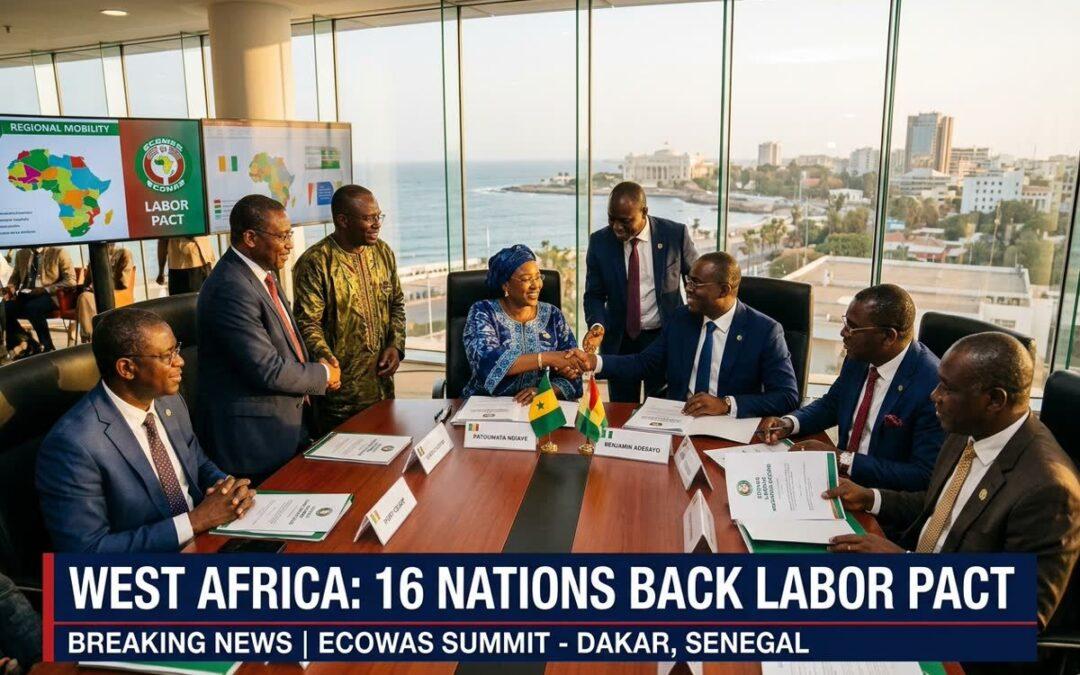
In late November 2026, government ministers and migration delegates representing 16 West African countries assembled in Dakar, Senegal. Working alongside the International Organization for Migration, these officials took an assertive diplomatic step by launching a collective regional mechanism known as the Dakar Process (iom.int, iom.int). Their objective was straightforward: establish concrete legal structures that govern labor mobility, coordinate vocational skills certification, and secure labor protections for citizens on the move (iom.int, iom.int).
International headlines regularly portray West African migration as a perpetual crisis directed toward Europe. However, that portrayal ignores the reality on the ground. Most people moving across West Africa stay within the region itself, seeking formal work, informal trade, and agricultural wages (iom.int, iom.int). By establishing a structured, home-grown initiative, these 16 nations seek to reclaim authority over their borders while building sustainable economic pathways (iom.int).
The Dakar Declaration on Migration and Regional Realignment
The Dakar platform concluded with the adoption of the Dakar Declaration on migration and an operational Regional Roadmap spanning 2027 through 2028 (iom.int, iom.int). The coalition includes Mauritania alongside all 15 members of the Economic Community of West African States: Benin, Burkina Faso, Cabo Verde, Côte d’Ivoire, The Gambia, Ghana, Guinea, Guinea-Bissau, Liberia, Mali, Niger, Nigeria, Senegal, Sierra Leone, and Togo (iom.int, iom.int). Together, these governments have committed to establishing mutual skills recognition, formal work permits, and cross-border protections for seasonal laborers (iom.int, iom.int).
The strategic framework also links directly with the wider ECOWAS Labour Migration Strategy and Action Plan for 2025 through 2035 (ecowas.int, ecowas.int). Rather than treating human mobility solely as a national security issue, the declaration frames labor circulation as an essential engine for economic integration and community resilience (iom.int, iom.int). As communities throughout the Sahel confront climate instability, resource loss, and rural unproductivity, structured labor mobility offers an alternative to clandestine journeys (iom.int, iom.int).
“Most people who move in West Africa stay in the region, and many of them are looking for work. Too many young people are still risking their lives on dangerous journeys, and we can’t wait any longer to act. Countries need to work together along these routes and invest in jobs, skills and development. This can’t only be about stopping dangerous journeys. It has to be about creating opportunities at home, opening safe and legal ways to move across borders, and keeping people safe every step of the way.”
— Amy Pope, Director General of the International Organization for Migration, Source: (iom.int)
This cooperative agreement marks an intentional break from decades of reactive border containment. By shifting institutional focus toward vocational credentials and reciprocal employment agreements, the participating governments intend to lower cross-border trade friction (iom.int, iom.int). In doing so, they seek to transform unmonitored human flight into a source of organized regional prosperity (iom.int).
Pre-Colonial Corridors to the ECOWAS Free Movement Protocol
To understand the current platform, one must examine centuries of mobility patterns across the region. Before European empires imposed rigid national boundaries during the 1884–1885 Berlin Conference, mobility was a foundational feature of West African life. Pastoralist groups practiced seasonal transhumance, moving cattle across savannahs to escape dry spells. Simultaneously, diverse merchant caravans carried gold, salt, and kola nuts between the Sahara and coastal forests. Borders did not interrupt these dynamic commercial networks.

African History Series • Volume I • Pre-Colonial Civilizations
Sand, Clay, and Iron: Africa’s Journey from the Stone Age to the Dawn of European Colonization
By Professor A. Darius Spearman • 313 Pages • ISBN: 979-8-9924836-2-8
African history does not begin with European contact. Synthesizing archaeology, paleoclimatology, genetics, and oral traditions, Professor A. Darius Spearman charts how indigenous African societies transformed shifting Saharan sands, engineered ceramic and agricultural revolutions, anchored Nile Valley statecraft, and forged the iron empires of West Africa and the Swahili Coast.
European colonization fractured these cultural and economic ecosystems. Colonial administrators divided territories between British and French zones without regard for established ethnic boundaries. They used forced labor policies and head taxes to channel workers from the interior into coastal plantation systems. Sahelian laborers from Upper Volta (now Burkina Faso), Mali, and Niger were compelled to clear cocoa, coffee, and timber fields in Côte d’Ivoire and Ghana. This structural imbalance between landlocked suppliers of labor and coastal extraction hubs shaped modern economic conditions, much like the cross-border labor migration patterns that developed across the African diaspora.
Following independence in the late 1950s and 1960s, newly sovereign nations confronted severe economic difficulties. Fragile governments regularly turned to protectionist policies that scapegoated migrant communities. In 1969, Ghana enforced the Aliens Compliance Order, expelling hundreds of thousands of undocumented foreign nationals, primarily Nigerians, Togolese, and Burkinabé. The disruption showed how vulnerable foreign workers were when domestic markets contracted.
In response to fragmented markets, 15 West African nations formed ECOWAS in 1975 under the Treaty of Lagos (refworld.org, ecowas.int). In 1979, the community approved its foundational milestone: the ECOWAS free movement protocol, formally titled Protocol A/P.1/5/79 (colex.es, refworld.org). The instrument introduced three sequential phases to ensure full integration (colex.es):
- Phase I (Right of Entry): Visa-free entry for up to 90 days for any citizen holding valid travel credentials (colex.es).
- Phase II (Right of Residence): The legal right of community citizens to reside in another member state to take up formal employment (colex.es).
- Phase III (Right of Establishment): The authority to establish commercial enterprises, businesses, and services without discrimination (colex.es).
Despite this progressive framework, domestic instability continued to produce major political setbacks (ijsshr.com). In 1983 and 1985, an economic downturn and collapsing petroleum revenues led Nigeria to expel over two million undocumented immigrants, over half of whom were Ghanaian (ijsshr.com). The episode, remembered by the phrase “Ghana Must Go,” demonstrated that legal protocols alone could not stop deportations when political and economic tensions peaked (ijsshr.com).
Establishing Safe Legal Labor Pathways Across Frontiers
The Dakar platform targets these historical shortcomings by converting legal rights on paper into functional cross-border systems (iom.int). While Phase I of the 1979 protocol established visa-free entry, Phases II and III have encountered bureaucratic friction for decades (colex.es, ecowas.int). Migrants frequently face arbitrary checkpoint charges, police harassment, and non-recognition of foreign labor status when seeking employment in neighboring states (iom.int, ecowas.int).
Under the 2027–2028 Roadmap, states will develop safe legal labor pathways through streamlined seasonal work authorizations and portable labor permits (iom.int, iom.int). These formal mechanisms allow agricultural workers, tradespeople, and technicians to work across borders legally without falling into the hands of unlicensed labor brokers (iom.int, iom.int). In parallel, the platform establishes mutual recognition for vocational qualifications, helping workers from Francophone, Anglophone, and Lusophone systems transfer their credentials seamlessly (iom.int).
This skills harmonization program connects directly with national Technical and Vocational Education and Training authorities (iom.int). An electrician or nurse certified in Togo or Ghana will be able to verify their credentials in Mauritania or Côte d’Ivoire without repeating certification exams (iom.int). Standardizing vocational standards mirrors broader historical efforts seen in decolonizing institutional frameworks across the African continent.
Evolution of West African Labor Frameworks
The Impact of EU Border Externalization in the Sahel
Modern West African labor mobility cannot be understood without examining the policy of EU border externalization in the Sahel (swp-berlin.org). Border externalization is a policy whereby destination countries outsource border enforcement, migration policing, and migrant processing to third-party transit states (swp-berlin.org). Following the 2006 “Cayucos Crisis,” in which tens of thousands of West Africans took wooden fishing boats to Spain’s Canary Islands, European authorities turned toward interception agreements (iom.int, swp-berlin.org). The 2015 Valletta Summit accelerated this shift, allocating billions of euros to transit nations in exchange for stricter enforcement (swp-berlin.org).
Under heavy external pressure, transit countries enacted strict anti-smuggling laws (swp-berlin.org). The most prominent was Niger’s Law 2015-036, which criminalized the transportation, housing, and facilitation of individuals traveling north through transit centers such as Agadez (swp-berlin.org). The policy devastated the local economy, which had catered to trans-Saharan travelers for decades (swp-berlin.org). Instead of stopping journeys, the ban pushed transport networks onto remote, treacherous desert tracks, increasing migrant deaths from heat exposure and vehicle breakdowns (swp-berlin.org).
European governments paired development assistance with requirements for biometric border registration and detention centers in the Sahel (swp-berlin.org). By outsourcing these controls, European states intercepted travelers thousands of kilometers before they could reach international waters or claim legal asylum (swp-berlin.org). This securitized framework disrupted traditional regional mobility and placed migrants in danger of extortion and human rights abuses (swp-berlin.org).
The human cost of these policies reflects historical struggles for economic justice across the diaspora, where vulnerable laborers have often shouldered the burden of restrictive policy decisions. Many West African civil society groups have argued that externalized policing turned intra-regional travel into a crime, directly undermining the letter and spirit of African mobility agreements (swp-berlin.org).
Dangers Along the Trans-Saharan Migration Routes
The closure of regular migration pathways has fueled dangerous travel along clandestine corridors (iom.int, swp-berlin.org). On the trans-Saharan migration routes toward Libya and Algeria, travelers face kidnapping, forced labor, and armed robbery at the hands of illicit trafficking networks. Those who reach coastal departure points often risk perilous crossings in unseaworthy vessels along the West African Atlantic Route heading toward the Canary Islands (iom.int, swp-berlin.org).
Despite heavy coastal surveillance in Senegal and Mauritania, irregular migration has continued (iom.int). When naval patrols sealed off traditional departure beaches in 2025 and 2026, smuggling networks simply shifted their operations south to The Gambia and Guinea (iom.int). This lengthened the open-ocean voyage to over 2,200 kilometers (iom.int). As a result, shipwrecks and fatalities remained high even as total arrivals on the Canary Islands dropped significantly (iom.int).
| Mobility Corridor | Primary Transit Points | Core Operational Hazards |
|---|---|---|
| Central Trans-Saharan Route | Agadez, Dirkou, Sebha | Dehydration, vehicle breakdown, armed militias, arbitrary detention (swp-berlin.org) |
| West African Atlantic Route | Kayar, Banjul, Nouadhibou | High-seas capsizing, hypothermia, long voyages up to 2,200 km (iom.int) |
| Coastal Gulf Corridor | Lagos, Cotonou, Abidjan | Informal border fees, document extortion, undocumented labor status (colex.es, ecowas.int) |
To reduce these risks, the Dakar Declaration sets up emergency assistance and legal protection mechanisms along transit routes (iom.int). The roadmap calls for standardized cross-border consular support, coordinated search-and-rescue protocols, and specialized care for unaccompanied minors and trafficking victims (iom.int, iom.int). The objective is to ensure that individuals in distress can access legal and humanitarian assistance regardless of their geographic location (iom.int).
Political Friction: Alliance of Sahel States and ECOWAS
Implementing the Dakar platform faces major political challenges, especially the divide between the Alliance of Sahel States and ECOWAS. Following military takeovers in Mali (2020 and 2021), Burkina Faso (2022), and Niger (2023), relationships with coastal ECOWAS governments deteriorated rapidly. ECOWAS imposed economic sanctions and closed borders, which alienated the landlocked interior states.
In September 2023, Mali, Burkina Faso, and Niger formed the Alliance of Sahel States (AES). By January 2024, they announced their immediate withdrawal from ECOWAS, an exit consolidated through a formal confederation treaty in July 2024. This diplomatic rupture directly threatens the legal protections granted under the 1979 free movement protocol (colex.es). If the AES nations formally walk away from these treaties, millions of their citizens living in Ghana, Côte d’Ivoire, and Nigeria could lose their legal residency, right to work, and commercial status.
The Dakar conference brought ministers from all three AES nations into the same room with their coastal counterparts (iom.int, iom.int). Technical migration cooperation through the International Organization for Migration has offered a rare channel for continued dialogue (iom.int). Maintaining this consensus will require persistent diplomacy, particularly as border tensions and security disputes threaten cross-border cooperation.
Core Pillars of the Dakar Roadmap (2027–2028)
Operationalizing seasonal work permits, portable work rights, and regular labor access.
Mutual recognition of vocational credentials across Anglophone and Francophone states.
Standardized consular aid, referral networks, and humanitarian assistance on transit routes.
Targeting rural environmental loss with local adaptation jobs and community reintegration.
Dakar Declaration on migration: Funding Dependencies and the Path Forward
A central question hanging over the Dakar platform is sustainable financing. Historically, regional migration frameworks in West Africa have relied heavily on external capital from the European Union and bilateral European donors (swp-berlin.org). That financial dependency has often redirected regional initiatives away from development and toward European border-policing goals (swp-berlin.org). When external funding drives migration programs, African priorities such as intra-regional mobility, worker protection, and economic integration can end up sidelined (swp-berlin.org).
To avoid repeating these patterns, participating governments must commit their own domestic resources to the 2027–2028 Roadmap (iom.int). National parliaments will need to harmonize domestic labor statutes with the new regional standards and eliminate informal checkpoint levies that burden cross-border traders (ecowas.int). These structural reforms echo the historical promises of Reconstruction, when legal protections required sustained political will and dedicated resources to remain effective.
The Dakar Declaration represents an important diplomatic pivot (iom.int). By recognizing that migration is primarily an economic reality within the African continent, these 16 nations are turning away from reactive containment (iom.int, iom.int). In revitalizing the original vision of regional mobility, the coalition seeks to ensure that moving across borders serves as an engine of regional development, dignity, and shared prosperity (iom.int, iom.int).
About the Author
Darius Spearman is a professor of Black Studies at San Diego City College, where he has been teaching for over 20 years. He is the founder of African Elements, a media platform dedicated to providing educational resources on the history and culture of the African diaspora. Through his work, Spearman aims to empower and educate by bringing historical context to contemporary issues affecting the Black community.
