



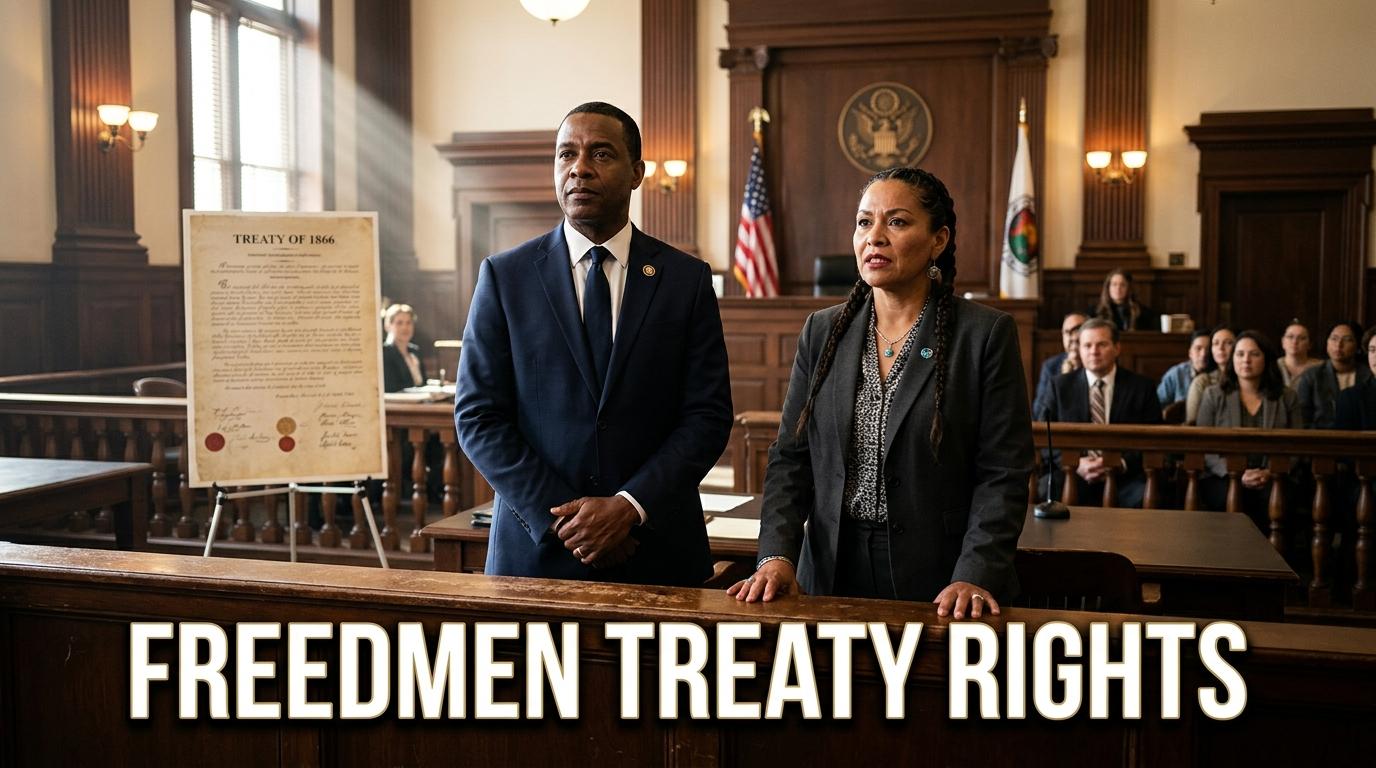
Inside the Muscogee Freedmen Lawsuit for Rights
By Darius Spearman (africanelements)
Support African Elements at patreon.com/africanelements and hear recent news in a single playlist. Additionally, you can gain early access to ad-free video content.
A Federal Lawsuit Escalates the Battle in Oklahoma City
On July 23, 2026, Black Creek Freedmen descendants took a decisive step by filing a landmark federal lawsuit in Oklahoma City (washingtonpost.com, justiceforblackcreeks.com). The civil rights action targets Muscogee (Creek) Nation Principal Chief David Hill and the tribal Citizenship Board (washingtonpost.com, tulsaflyer.org). Leaders Rhonda K. Grayson and Jeffrey D. Kennedy filed the complaint on behalf of the Muscogee Creek Indian Freedmen Band (washingtonpost.com, 1866creekfreedmen.com). The plaintiffs state that tribal executive leadership refuses to obey binding treaty obligations and tribal court decisions (washingtonpost.com, justiceforblackcreeks.com).
This legal confrontation erupted exactly one year after a historic judicial victory inside the tribal court system (tulsaflyer.org, 1866creekfreedmen.com). On July 23, 2025, the Muscogee Nation Supreme Court issued a unanimous ruling affirming full citizenship rights for Black Freedmen descendants under the Reconstruction Treaty of 1866 (tulsaflyer.org, mvskokemedia.com). However, tribal administrators halted enrollment processing shortly after the court ruling (tulsaflyer.org). In August 2025, Principal Chief Hill issued an executive order pausing the issuance of citizenship cards (tulsaflyer.org, mvskokemedia.com). By May 2026, the tribal supreme court closed the case, stating that implementation belonged to executive and legislative officials (tulsaflyer.org). Left without tribal legal options, Freedmen descendants turned to federal court to demand enforcement (washingtonpost.com, justiceforblackcreeks.com).
Enslaved Labor, Forced Removal, and the Trail of Tears
The connection between Black people and the Muscogee Nation began in the American Southeast centuries ago (wikipedia.org, wikipedia.org). In early history, the Muscogee held captives of war in servitude, but allowed captive descendants full inclusion into tribal towns (wikipedia.org). However, contact with European settlers transformed this practice into plantation chattel slavery (wikipedia.org, wikipedia.org). In 1811, the Muscogee Nation enacted written statutes to formally codify racialized slavery (wikipedia.org, wikipedia.org, wikipedia.org). Enslaved Black people performed hard labor on cotton plantations while building wealth for elite tribal families (wikipedia.org, wikipedia.org).
When the United States federal government forced the Muscogee from Alabama and Georgia during the 1830s, enslaved Africans made the journey too (wikipedia.org, nps.gov). During this forced migration known as the Trail of Tears, enslaved Black people endured starvation, bitter cold, and fatal diseases alongside Native citizens (wikipedia.org, nps.gov). Upon arrival in Indian Territory, enslaved laborers cleared thick timber, constructed homesteads, and cultivated fields (wikipedia.org, wikipedia.org). Their historical struggles closely align with broader historical discussions regarding federalism and Black political struggles for constitutional recognition (wikipedia.org, wikipedia.org).
The Treaty of 1866 and the Era of Full Inclusion
The American Civil War created deep ideological fractures within the Muscogee Nation (wikipedia.org, wikipedia.org). In 1861, official tribal leaders signed a treaty with the Confederate States of America (wikipedia.org, wikipedia.org). Conversely, hundreds of traditional Muscogee citizens and Black allies joined the “Loyal Creeks” to fight for the Union Army (wikipedia.org, wikipedia.org). After Union forces prevailed, the federal government compelled former Confederate allies to negotiate new peace agreements (washingtonpost.com, 1866creekfreedmen.com, govinfo.gov).
The resulting Treaty of 1866 established fundamental civil guarantees for former slaves and their offspring (washingtonpost.com, govinfo.gov). Article II explicitly declared that Freedmen shall have and enjoy all the rights and privileges of native citizens (washingtonpost.com, 1866creekfreedmen.com, govinfo.gov). This guarantee included equal shares in national funds, land distribution, and full voting rights (washingtonpost.com, govinfo.gov). For decades, Black Creeks held influential political positions (washingtonpost.com, wikipedia.org). They served as tribal council members, town leaders, and judges (washingtonpost.com, wikipedia.org). For example, Jesse Franklin served as a respected judge on the Muscogee Supreme Court during this era of total inclusion (wikipedia.org, abhmuseum.org).
Bureaucratic Segregation and the Dawes Commission
In the late nineteenth century, federal policy shifted toward dissolving tribal land holdings (wikipedia.org, escholarship.org, wikipedia.org). Congress passed the Curtis Act of 1898, mandating the division of communal tribal lands into individual 160-acre allotments (wikipedia.org, escholarship.org, wikipedia.org). To execute this massive task, federal officials established the Dawes Commission to register every resident living in Indian Territory (wikipedia.org, escholarship.org). However, government enrollment officers introduced rigid racial classifications into the official registries (wikipedia.org, abhmuseum.org, escholarship.org).
Commissioners divided citizens onto two separate administrative lists: the “Creek by Blood” roll and the “Creek Freedmen” roll (wikipedia.org, escholarship.org, wikipedia.org). Administrators relied heavily on physical appearance and societal prejudices (abhmuseum.org, escholarship.org). Under the strict “one-drop” rule of racial categorization, agents placed anyone with visible African features onto the Freedmen roll (abhmuseum.org, escholarship.org). They systematically ignored Muscogee lineage and blood quantum for Black individuals (abhmuseum.org, escholarship.org). Although created solely for land allotments, these artificial lists established a dangerous mechanism for future discrimination (wikipedia.org, escholarship.org).
The 1979 Constitution and Four Decades of Disenfranchisement
For nearly a century, separate enrollment lists did not restrict participation in tribal governance (washingtonpost.com, wikipedia.org). That stability collapsed in 1979 when the Muscogee Nation adopted a new constitution (washingtonpost.com, tulsaflyer.org, 1866creekfreedmen.com). The 1979 document restricted tribal citizenship exclusively to individuals who could prove direct lineal descent from an ancestor on the “Creek by Blood” Dawes roll (washingtonpost.com, tulsaflyer.org, 1866creekfreedmen.com). This deliberate constitutional change completely excluded descendants listed on the historical Dawes Freedmen roll (washingtonpost.com, tulsaflyer.org).
Consequently, thousands of Black Creek citizens lost their rights to vote, run for public office, and access tribal services (washingtonpost.com, tulsaflyer.org). This disenfranchisement reflected broader historic patterns concerning the systemic denial of voter representation to Black populations (washingtonpost.com, tulsaflyer.org). Although the federal Bureau of Indian Affairs approved the 1979 constitution, federal officials added an explicit reservation (doi.gov, govinfo.gov). The agency noted that approval did not authorize tribal actions that violated federal law or existing treaty obligations (doi.gov, govinfo.gov). Nevertheless, tribal leaders maintained the exclusion for over forty years (washingtonpost.com, tulsaflyer.org).
The Modern Legal Battle: From Tribal Courts to Federal Claims
Freedmen descendants refused to accept their illegal exclusion (washingtonpost.com, justiceforblackcreeks.com, tulsaflyer.org). Following a landmark 2017 federal court victory by Cherokee Freedmen, Muscogee activists launched renewed legal challenges (tulsaflyer.org, 1866creekfreedmen.com, wikipedia.org). In September 2023, Muscogee Nation District Judge Denette Mouser ruled in favor of plaintiffs Rhonda Grayson and Jeffrey Kennedy (tulsaflyer.org, 1866creekfreedmen.com, mvskokemedia.com). Judge Mouser ruled that the Citizenship Board must process Freedmen applications under the mandatory provisions of the 1866 Treaty (tulsaflyer.org, mvskokemedia.com). During trial proceedings, Judge Mouser even sanctioned tribal prosecutors for using intimidation tactics against plaintiffs (tulsaflyer.org).
The tribal government appealed the decision, but on July 23, 2025, the Muscogee Supreme Court unanimously affirmed Judge Mouser’s ruling (tulsaflyer.org, mvskokemedia.com, mvskokemedia.com). The tribal supreme court declared that the “by blood” requirement was void from its inception because it directly violated treaty agreements (tulsaflyer.org, mvskokemedia.com). Despite this absolute legal victory, tribal executive officials stalled implementation and refused to issue citizenship cards (tulsaflyer.org, mvskokemedia.com). The administrative deadlock forced activists to reevaluate their Black political strategy choices and seek federal court intervention in July 2026 (washingtonpost.com, justiceforblackcreeks.com, tulsaflyer.org).
Tribal Sovereignty Versus Federal Treaty Obligations
The July 2026 federal lawsuit creates a major test regarding the boundary between tribal self-determination and federal law (washingtonpost.com, tulsaflyer.org, narf.org). Tribal leadership contends that determining citizenship criteria is an inherent sovereign right reserved strictly for Indigenous nations (tulsaflyer.org, mvskokemedia.com, narf.org). Principal Chief David Hill argues that updating enrollment policies requires formal constitutional amendments passed by tribal voters rather than judicial decrees (tulsaflyer.org, mvskokemedia.com).
Conversely, Freedmen legal representatives maintain that federal treaties represent supreme federal law under Article VI of the U.S. Constitution (washingtonpost.com, justiceforblackcreeks.com, govinfo.gov). Lead attorney Damario Solomon-Simmons stressed that Black citizens should not have to win the same basic rights twice in separate courtrooms (washingtonpost.com, justiceforblackcreeks.com). Federal courts possess clear authority to enforce treaty compliance when sovereign entities breach bilateral agreements (washingtonpost.com, govinfo.gov, narf.org). Because plaintiffs exhausted every available remedy inside the tribal court system, federal judges now hold jurisdiction to enforce compliance (washingtonpost.com, justiceforblackcreeks.com).
The Broader Impact on Black Creek Descendants
The resolution of this federal case holds profound consequences for an estimated 100,000 Black Creek descendants nationwide (gao.gov, blavity.com, theblackwallsttimes.com). According to a January 2026 report from the U.S. Government Accountability Office, total Freedmen descendants across the Five Tribes range between 146,400 and 395,400 people (gao.gov). Official tribal recognition grants access to federally funded healthcare through the Indian Health Service, tribal housing grants, and higher education scholarships (gao.gov, freedmen5tribes.com, theblackwallsttimes.com).
Beyond financial benefits, citizenship restores a cherished identity stripped away by racial prejudice and administrative manipulation (washingtonpost.com, justiceforblackcreeks.com, 1866creekfreedmen.com). As federal proceedings unfold in Oklahoma City, Freedmen leaders remain steadfast in their mission (washingtonpost.com, justiceforblackcreeks.com). Their courage proves that treaty guarantees endure across centuries (washingtonpost.com, govinfo.gov). By demanding full recognition from the Muscogee Nation, Black Freedmen are honoring their ancestors and protecting basic civil rights for future generations (washingtonpost.com, justiceforblackcreeks.com, 1866creekfreedmen.com).
About the Author
Darius Spearman is a professor of Black Studies at San Diego City College, where he has been teaching for over 20 years. He is the founder of African Elements, a media platform dedicated to providing educational resources on the history and culture of the African diaspora. Through his work, Spearman aims to empower and educate by bringing historical context to contemporary issues affecting the Black community.
