


Inside the Mass Nigeria Military Rescue of Kidnapped Citizens
By Darius Spearman (africanelements)
Support African Elements at patreon.com/africanelements and hear recent news in a single playlist. Additionally, you can gain early access to ad-free video content.
The News Behind the Headlines
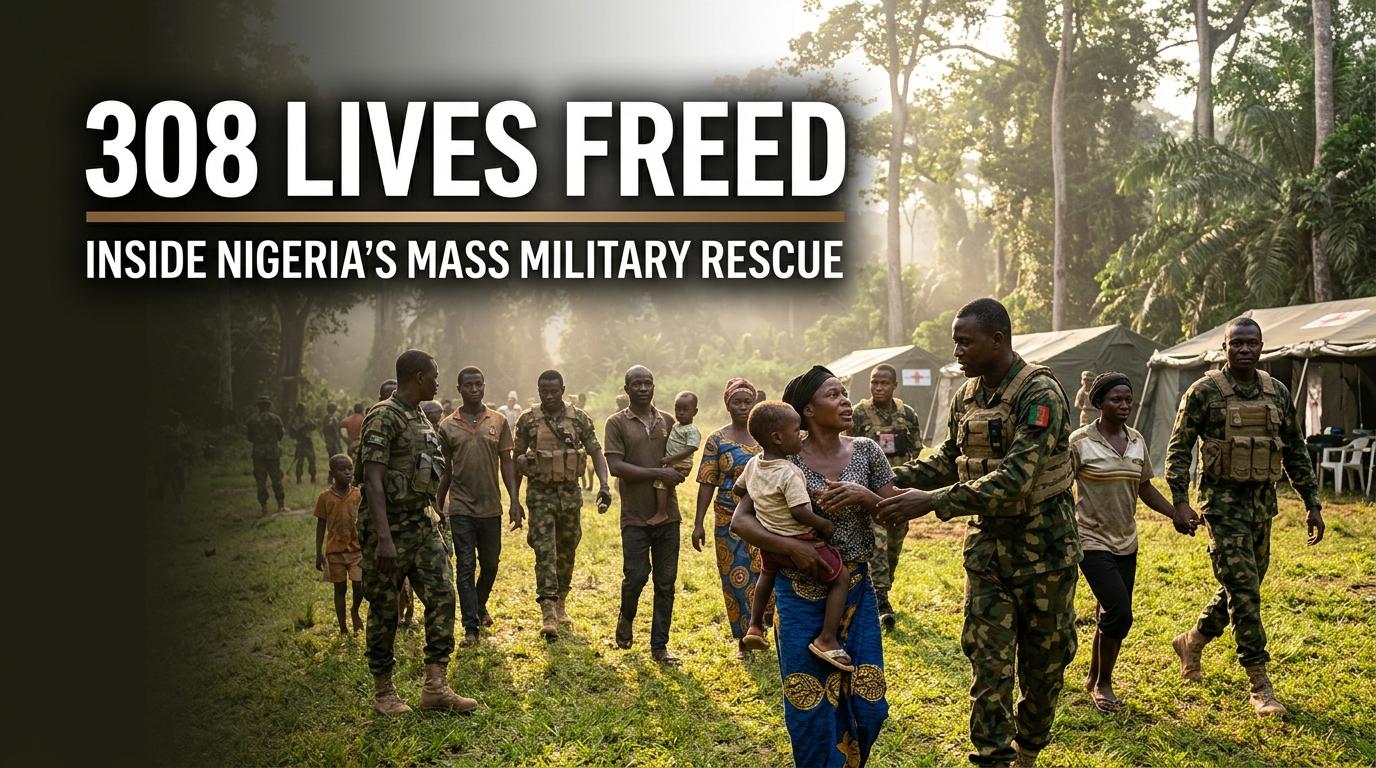
A dramatic security operation recently made headlines across West Africa and the globe. Joint military and intelligence forces in Nigeria successfully liberated 308 abducted citizens during a single coordinated mission (von.gov.ng, defence.gov.ng). The rescued hostages included 163 residents kidnapped during a violent raid on the agrarian village of Woro in Kwara State (guardian.ng). An additional 145 victims were taken during concurrent attacks in neighboring Niger State (von.gov.ng, guardian.ng). Armed forces extracted the captives from deep inside the Kainji Lake National Park Forest (von.gov.ng, punchng.com). President Bola Ahmed Tinubu commended the inter-agency operation as a major victory for national defense forces (statehouse.gov.ng).
To fully understand this operational success, one must look far beyond the immediate news story. Mass abductions across West Africa have evolved over several decades. What began as localized political hostage-taking in the early 2000s has transformed into a complex criminal economy and a weapon of violent extremism. For observers across the global Black diaspora, examining security dynamics in Nigeria connects directly to broader historical struggles over systemic oppression and injustice. Understanding the structural forces driving this insecurity reveals how local struggles reflect global challenges of human rights, governance, and community stability.
The Four Historical Phases of Nigeria’s Abduction Crisis
The contemporary phenomenon of kidnapping in Nigeria developed through distinct historical stages. During the early 2000s, militant groups in the oil-rich Niger Delta, such as the Movement for the Emancipation of the Niger Delta, began taking foreign oil executives hostage (wikipedia.org). These initial actions served political ends. Armed groups used high-profile captives to demand a greater distribution of oil revenues and local community investment (wikipedia.org). Ransom was initially secondary to political leverage.
The tactical landscape shifted dramatically around 2009 with the rise of Boko Haram in Northeastern Nigeria (wikipedia.org). Violent extremist organizations recognized that mass abductions generated terror, secured steady funding, and created significant political pressure. The landmark turning point occurred in April 2014, when Boko Haram kidnapped 276 schoolgirls from Chibok in Borno State (wikipedia.org). This tragedy demonstrated to non-state actors that targeting innocent civilians could command global media attention and force government concessions (wikipedia.org).
Over the past decade, climate change, land degradation, and expanding drought pushed pastoral Fulani herders southward into farming lands cultivated by Hausa communities (ajcr.pub, accord.org.za). Intense competition over shrinking fertile soil and water resources disrupted traditional peace agreements (accord.org.za). Rogue warlords and opportunistic gangs, known locally as bandits, exploited these intercommunal tensions (africacenter.org). These criminal groups shifted rapidly from cattle rustling to systematic mass kidnappings for profit (africacenter.org).
Armed syndicates eventually established operational hideouts inside vast, ungoverned forest reserves (humanglemedia.com). Remote enclaves such as Kainji Lake National Park, Kamuku Forest, and Sambisa Forest provided natural protection against ground patrols (wikipedia.org, humanglemedia.com). Sprawling across state lines, these forest sanctuaries allowed armed networks to launch surprise cross-border raids into peaceful rural communities (humanglemedia.com).
Political hostage-taking of foreign oil workers in the Niger Delta demanding resource distribution.
Boko Haram turns abductions into terror tactics, highlighted by the 2014 Chibok schoolgirl raid.
Climate strain and communal friction give rise to armed gangs conducting commercial mass kidnappings.
Syndicates occupy ungoverned national parks, prompting intelligence-led military rescue operations.
The Human and Economic Toll of Ransom Syndicates
The growth of rural banditry and kidnapping networks has inflicted severe economic and human suffering across Northern Nigeria. Independent conflict monitoring organizations, such as the Armed Conflict Location & Event Data Project, document the massive scale of this violence (acleddata.com, acleddata.com). ACLED tracked over 660 major kidnapping incidents in Northwestern Nigeria between 2019 and 2023 (acleddata.com, acleddata.com). ACLED operates as an independent non-profit research entity that compiles conflict datasets through rigorous verification protocols (acleddata.com, mediabiasfactcheck.com).
Financial metrics illustrate that hostage-taking has expanded into a multi-billion naira industry (cfr.org). Economic data reveals that Nigerian citizens paid over 2.2 trillion naira, or approximately 1.42 billion dollars, in ransom demands between mid-2023 and mid-2024 (cfr.org). Millions of naira extracted from victimized families continuously fund the procurement of heavy weaponry, vehicles, and operational equipment by criminal cartels (cfr.org).
| Nigeria Insecurity & Ransom Metrics | |
|---|---|
| Metric | Data / Value |
| Annual Insecurity Cost (2023–2024) | ₦2.2 Trillion ($1.42B+) in Ransoms Paid |
| Northwest Kidnapping Incidents | 660+ recorded events (2019–2023 ACLED) |
| Displaced Population (Northeast/West) | > 2 Million citizens displaced |
| Woro Attack Casualties (Feb 2026) | 150–165 residents killed |
| August 2026 Single-Day Rescue Operation | 308 Citizens Freed (163 Kwara, 145 Niger) |
| Military Rescues (July 2026 Total) | 393 Kidnap victims rescued nationwide |
This thriving criminal enterprise exists despite firm legal prohibitions. Under federal law, including the Terrorism Prevention and Prohibition Act, paying ransom to kidnappers is explicitly illegal to prevent funding violent groups (nctc.gov.ng). However, desperate communities and relatives often negotiate privately when civilian lives are at stake. This ongoing crisis parallels historical battles for economic survival where marginalized communities face immense systemic risks. Additionally, international relief organizations report that persistent rural insecurity has internally displaced more than two million people throughout Northern Nigeria (reliefweb.int).
Tactical Execution of the Kainji Lake National Park Raid
The liberation of 308 citizens in August 2026 represented an important milestone for joint military operations (von.gov.ng, defence.gov.ng). The operational background began in February 2026, when armed militants launched a devastating attack on Woro community in Kwara State (guardian.ng, truthnigeria.com). The assault resulted in upwards of 150 resident deaths after the village refused to submit to extortion (guardian.ng, truthnigeria.com). Attackers then abducted scores of women and children, marching them into the wilderness alongside victims captured in nearby Niger State (von.gov.ng, guardian.ng).
Strategic planning for the rescue mission was led by the National Counter Terrorism Centre, operating under the Office of the National Security Adviser (defence.gov.ng, nctc.gov.ng). The center synchronized intelligence inputs from the Department of State Services, the Armed Forces of Nigeria, and the Nigeria Police Force (defence.gov.ng, nctc.gov.ng). As the principal domestic intelligence agency, the Department of State Services tracked the movements of the kidnappers to pinpoint hostage holding sites deep inside Kainji Lake National Park (defence.gov.ng).
Joint forces executed a tactical surrounding maneuver within the park forest to prevent captors from executing hostages (von.gov.ng, defence.gov.ng). During such high-risk operations, military units routinely engage armed bandits in heavy skirmishes (defence.gov.ng). Official defense reports document that several militants were neutralized or apprehended during the assault, while remaining captors fled deeper into unpoliced bushlands (defence.gov.ng). Security forces secured the release of all 308 captives without casualties among the hostages (von.gov.ng).
Ideological Extremism: Understanding ISWAP and Ansaru
While non-ideological criminal bandits execute many rural kidnappings, Salafi-jihadist groups remain actively involved in regional insecurity (thesoufancenter.org, icct.nl). Two distinct factions operate within Nigeria: Islamic State West Africa Province and Ansaru (thesoufancenter.org, icct.nl). Islamic State West Africa Province broke away from Boko Haram in August 2016 following internal leadership disputes (thesoufancenter.org, wikipedia.org). ISWAP received formal recognition and structural support from global ISIS leadership (thesoufancenter.org).
Ansaru splintered from Boko Haram earlier in 2012 (icct.nl, wikipedia.org). Ansaru rejected Boko Haram’s indiscriminate killing of Muslim civilians and aligned ideologically with Al-Qaeda (icct.nl). Both ISWAP and Ansaru are designated Foreign Terrorist Organizations by international bodies and the United States Department of State (state.gov). Extremist fighters frequently form tactical alliances with criminal bandits in North-Western and North-Central Nigeria (thesoufancenter.org, humanglemedia.com). These complex security challenges reflect broader historical struggles over political authority across post-colonial state structures.
Post-Rescue Healthcare and Survivor Rehabilitation
Immediately following their extraction from the forest hideout, all 308 rescued citizens were transported to military medical facilities at Wawa Cantonment in Niger State (von.gov.ng, defence.gov.ng). Medical personnel conducted emergency physical evaluations, health screenings, and nutritional stabilization (von.gov.ng). Many hostages suffered from severe physical exhaustion, malnutrition, and exposure to harsh environmental conditions during months of captivity (von.gov.ng).
Healthcare professionals and human rights organizations stress that physical recovery represents only the first step (who.int). Organizations like the Nigerian Psychological Association advocate for structured psychological support and Cognitive Processing Therapy to address severe trauma (who.int). Survivors of mass kidnappings frequently suffer from acute post-traumatic stress disorder, panic disorders, and depression (who.int, idvrm.org).
However, long-term mental health infrastructure across rural Nigeria remains severely limited (nih.gov, idvrm.org). Dedicated trauma care facilities and certified clinical psychologists are scarce in rural northern communities (nih.gov). Non-governmental organizations, local civil society groups, and international bodies step in to provide emergency food aid, family reunification, and educational reintegration (reliefweb.int, who.int). Supporting survivor recovery remains vital to restoring human dignity and advancing anti-colonial liberation and identity.
Global Black Solidarity and U.S. Foreign Policy
Regional security across West Africa holds direct relevance for the global Black diaspora and international policy (africom.mil). Nigeria serves as Africa’s most populous nation and largest economic engine (africacenter.org). Security instability in West Africa triggers massive displacement, worsens humanitarian conditions, and threatens democratic governance across the region (reliefweb.int, africacenter.org).
The United States maintains bilateral defense cooperation with Nigeria, managed primarily through U.S. Africa Command (africom.mil, state.gov). AFRICOM collaborates with Nigerian forces through intelligence sharing, operational planning assistance, defense capability enhancement, and counterterrorism equipment deliveries (africom.mil). These joint efforts seek to contain violent extremist organizations and secure strategic corridors across the Sahel (africom.mil, internationalpolicy.org).
At the same time, international civil society organizations and diaspora advocates closely monitor defense assistance to ensure accountability (internationalpolicy.org, amnestyusa.org). Human rights advocates emphasize that military operations must prioritize civilian protection, adhere to strict legal standards, and prevent collateral harm (internationalpolicy.org, amnestyusa.org). Ultimately, resolving rural insecurity requires a balanced strategy that combines effective military rescue operations, judicial accountability, and sustained investments in community economic development (internationalpolicy.org, africacenter.org).
About the Author
Darius Spearman is a professor of Black Studies at San Diego City College, where he has been teaching for over 20 years. He is the founder of African Elements, a media platform dedicated to providing educational resources on the history and culture of the African diaspora. Through his work, Spearman aims to empower and educate by bringing historical context to contemporary issues affecting the Black community.
