

Beyond the Ivory Tower: How Dr. Carter G. Woodson Built an Independent Empire for Black History
By Darius Spearman (africanelements)
Support African Elements at patreon.com/africanelements and hear recent news in a single playlist. Additionally, you can gain early access to ad-free video content.
For generations, the intellectual landscape of higher education was governed by Eurocentric historical narratives that systematically omitted, minimized, and distorted African American life and history. Mainstream academic institutions operated as gatekeepers, advancing a monocultural framework that presented White Western experiences as universal human truth while marginalizing the profound contributions, struggles, and historical agency of Black people. Within this exclusionary environment, African American history was either rendered invisible or filtered through paternalistic, inaccurate lenses that reinforced racial hierarchy.
Dr. Carter G. Woodson recognized that true intellectual liberation could never be realized within academic structures designed to marginalize African American contributions. A visionary scholar, Woodson understood that relying on White university approval or philanthropic oversight meant subjecting Black historical inquiry to external censorship, ideological compromise, and structural subordination. To recover authentic history and establish an unshakeable foundation for African American scholarship, he determined that Black intellectuals had to build their own autonomous research and cultural enterprises outside the traditional ivory tower.
Dr. Woodson’s strategy to bypass White academic gatekeepers and establish self-governing Black research institutions was essential for preserving authentic history without relying on White philanthropic or university approval. By creating independent organizational frameworks, publishing outlets, and public engagement initiatives, Woodson built a self-sustaining empire for Black history—laying the structural and conceptual groundwork for modern Black Studies and enduring intellectual sovereignty.
1. Bypassing the Ivory Tower: The Founding of ASNLH
Dr. Carter G. Woodson identified a fundamental crisis in the American academic establishment: mainstream Eurocentric institutions actively suppressed, distorted, or dismissed the history of African Americans. Rather than spending decades pleading for inclusion within institutions structured around racial exclusion, Woodson executed a deliberate strategy of institutional self-determination. In 1915, he bypassed the White academic establishment by founding the Association for the Study of Negro Life and History (ASNLH).
Creating an independent, self-governing research institution was a radical act of self-reliance. Historically, African Americans recognized that education and social subordination could not coexist, making self-help, leadership development, and economic and social autonomy vital pillars in the struggle against racial repression (Williamson, 1999, p. 93). By establishing the ASNLH, Woodson created an autonomous organizational space where Black scholars could collect, preserve, and analyze historical evidence on their own terms, completely free from the gatekeeping and paternalistic constraints of White-dominated universities.
Woodson’s archival and organizational strategy was an explicit practice of Sankofa—the West African principle of “reaching back, retrieving, and bringing forth valuable data” from the past to inform present understanding and future liberation (Karenga, 2018, p. 578). Through this deliberate retrieval of historical truth, Woodson restored African human agency, positioning Black people as active subjects of history rather than passive objects of Western commentary (Karenga, 2018, p. 588). While pioneering researchers such as Woodson, W. E. B. Du Bois, Rayford Logan, and E. Franklin Frazier established the empirical bedrock of Black historical inquiry, later institutional movements in the 1970s often held an ambivalent relationship with this early 20th-century scholarship because its production was occasionally tied to White academic frameworks or funding (Record, 1973, p. 204). Nevertheless, Woodson’s establishment of an independent research infrastructure ensured that Black historical inquiry had a protected, autonomous home to survive institutional suppression.
2. Owning the Press: The Journal of Negro History and Associated Publishers
To secure complete intellectual sovereignty, establishing a research association was only the first step; scholars also required control over the means of academic production and dissemination. In 1916, Dr. Woodson founded the Journal of Negro History, followed shortly by the creation of the Associated Publishers. These autonomous publishing organs provided Black scholars with dedicated platforms to present rigorous, unedited empirical research without seeking validation, funding, or editorial approval from White philanthropic bodies or university presses.
“The task of the Black Studies activist intellectuals and scholars… is to continue to do their work in such a way and at such a level that, even if their critics and opponents disagree with their conclusions, they cannot honestly or effectively deny the rigor and relevance of their scholarship or the integrity and productivity of their practice.” (Karenga, 2018, p. 578)
Controlling the publishing pipeline served as an essential defense against Eurocentric academic hegemony. Dominant academic structures frequently operate as gate-defenders, deploying arbitrary standards of “objectivity” or “rigor” to protect Eurocentric paradigms and suppress non-White intellectual traditions (Karenga, 2018, p. 577). Owning the press allowed Woodson and his contemporaries to publish uncompromising historical investigations, safeguard the integrity of their findings, and resist the subtle co-optation and dilution that accompanied reliance on mainstream academic validation.
3. From Academia to the Masses: The Launch of Negro History Week
Recognizing that specialized historical knowledge must not remain trapped within elite scholarly circles, Dr. Woodson launched Negro History Week in 1926. This initiative took rigorous historical research directly to the public, embedding Black history into the curricula and programming of schools, churches, civic groups, and community centers across the nation.
In taking scholarship out of isolated academic enclaves and embedding it directly in everyday community life, Woodson explicitly embodied the Du Boisian mandate that educational institutions and scholarly disciplines must become “not simply a center of knowledge but a center of applied knowledge and guide to action” (Karenga, 2018, p. 594). Woodson’s public outreach fulfilled a foundational mandate of Black educational philosophy: that education must be culturally relevant, practical, and directly useful to the public (Karenga, 2018, p. 581; Williamson, 1999, p. 102). Bringing historical literacy directly to the public served three primary functions:
- Fostering Collective Consciousness: It provided African Americans with an accurate, dignity-affirming understanding of their historical agency, cultural heritage, and contributions to human civilization.
- Connecting Campus and Community: It bridged the gap between academic research and community empowerment, ensuring that scholarship actively served social liberation rather than remaining an abstract intellectual exercise.
- Countering Ideological Subordination: It equipped Black communities with historical facts to challenge White supremacist myths and institutionalized racial biases directly within everyday civic life.
4. The Blueprint for Modern Black Intellectual Independence
Dr. Woodson’s early 20th-century institutional building established the structural and conceptual blueprint for the modern Black Studies movement that erupted across college campuses in the late 1960s (Record, 1973, p. 204; Karenga, 2018, p. 579). A direct line connects Woodson’s 1915 strategy of institutional self-reliance to the student activism of the 1960s documented by Williamson (1999, pp. 95–101). When Black college students in the late 1960s built Black Student Unions, underground advisement systems, and peer tutorial networks “in defense of themselves” when faced with hostile, exclusionary campuses, they operated on Woodson’s principle of self-reliance. Furthermore, when student activists and faculty subsequently demanded autonomous Black Studies departments, they echoed Woodson’s core insight: African American life and history must be studied centered on Black agency using free spaces and self-governing departmental structures, rather than as subordinate sub-fields within Eurocentric departments.
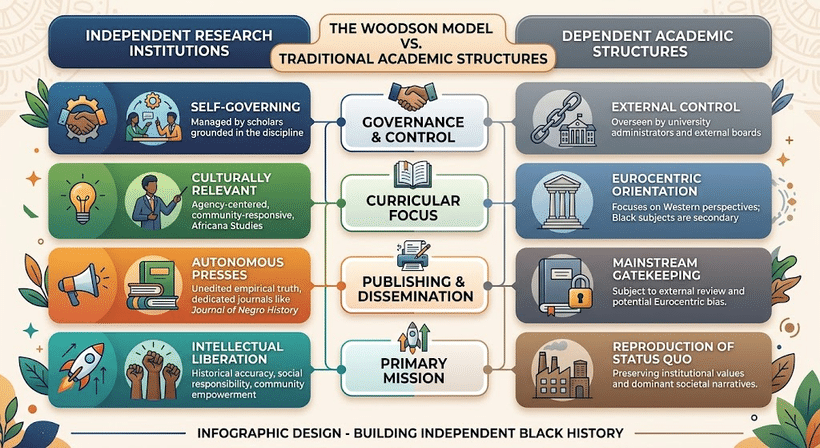
Institutional independence remains vital today. Without autonomous departments, dedicated funding, and self-governing degree programs, Black historical research and Africana Studies remain vulnerable to administrative budget cuts, curricular dilution, and ideological co-optation by host institutions (Williamson, 1999, p. 97; Record, 1973, p. 204). Woodson’s legacy demonstrates that institutional self-determination is the non-negotiable foundation of intellectual freedom.
Preserving Intellectual Autonomy in the Modern Era
Dr. Carter G. Woodson’s lifelong narrative arc—from deep frustration with Eurocentric historical omissions to the deliberate creation of enduring, self-sustaining institutions—offers a masterclass in intellectual self-determination. Rather than seeking assimilation within an academic establishment designed to diminish Black agency, Woodson built a self-governing infrastructure encompassing research, publishing, and public engagement. His legacy proved that independent institutions are essential for recovering historical truth and sustaining cultural integrity.
As modern educators, scholars, and institutions navigate contemporary challenges to ethnic studies and historical curricula, Woodson’s model remains profoundly instructive. In an era of shifting educational policies and renewed institutional pressures, how can contemporary scholars and organizations construct and defend autonomous intellectual spaces to ensure that Black history remains rigorous, self-determined, and uncompromisingly authentic?
About the Author
Darius Spearman is a professor of Black Studies at San Diego City College, where he has been teaching for over 20 years. He is the founder of African Elements, a media platform dedicated to providing educational resources on the history and culture of the African diaspora. Through his work, Spearman aims to empower and educate by bringing historical context to contemporary issues affecting the Black community.
References
- Karenga, M. (2018) ‘Founding the First PhD in Black Studies: A Sankofa Remembrance and Critical Assessment of Its Significance’, Journal of Black Studies, 49(6), pp. 576–603.
- Record, W. (1973) ‘Some Implications of the Black Studies Movement for Higher Education in the 1970s’, The Journal of Higher Education, 44(3), pp. 191–216.
- Williamson, J.A. (1999) ‘In Defense of Themselves: The Black Student Struggle for Success and Recognition at Predominantly White Colleges and Universities’, The Journal of Negro Education, 68(1), pp. 92–105.
