


Horn of Africa Migration Route: Why Thousands Risk Active War
By Darius Spearman (africanelements)
Support African Elements at patreon.com/africanelements and hear recent news in a single playlist. Additionally, you can gain early access to ad-free video content.
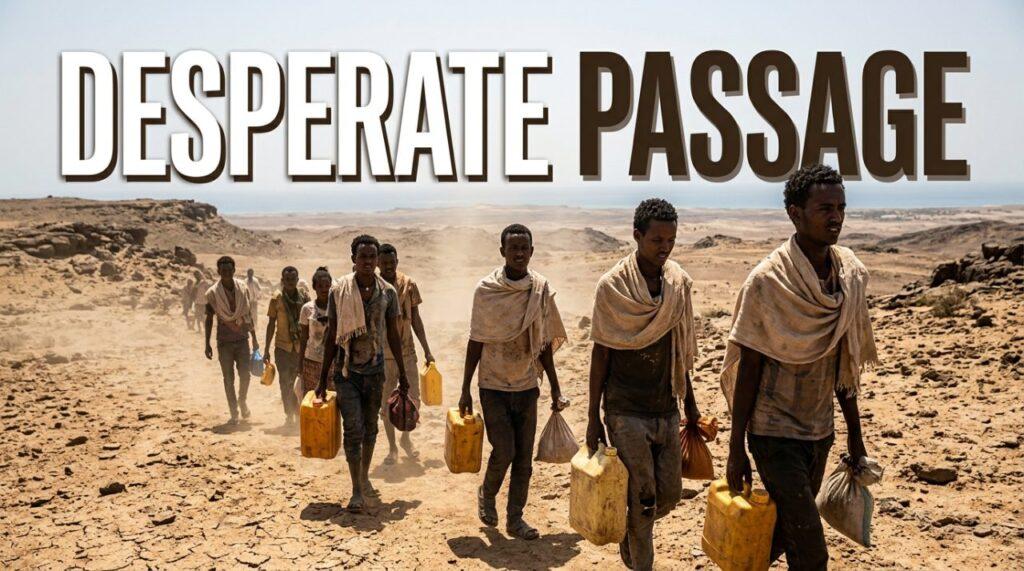
The desert sands of Djibouti burn beneath an unrelenting sun. Across this unforgiving landscape, thousands of exhausted travelers move on foot toward the sea. The United Nations and the International Organization for Migration recently issued an urgent alarm regarding this crossing (africanews.com). More than 20,000 migrants crossed from Ethiopia into Djibouti in a brief three-week span (un.org).
These travelers seek work in the Gulf Cooperation Council nations. Yet, their path requires walking through active war zones in Yemen (africanews.com). Many people outside the continent view this movement as an isolated modern emergency. In reality, this journey represents a historic corridor shaped by centuries of trade, colonial division, and political conflict.
Recent Surge Dynamics in Djibouti Corridor
The Perilous Realities of the Eastern Route
Humanitarian monitors call this passage the Eastern Route. It stretches from rural Ethiopian villages through Djibouti, across the Bab-el-Mandeb strait, and into Yemen (iom.int). Between September 20 and September 30, observers found more than 3,000 migrants stranded in the Djiboutian wilderness (africanews.com, aa.com.tr). Temperatures in this desert regularly climb above dangerous thresholds.
Smuggling syndicates often divert groups away from established roads to avoid border police. As a consequence, travelers find themselves abandoned without food, water, or medical assistance (un.org). Relief teams have documented multiple deaths caused by acute dehydration and severe heat exhaustion along the frontier (aa.com.tr). Many travelers walk for days carrying nothing but empty plastic jugs.
Meanwhile, an unusual multi-directional crisis has unfolded along the coast. While over 20,000 Ethiopians pushed forward toward Yemen, more than 3,700 refugees fled the opposite direction (africanews.com). These refugees crossed the sea from Yemen into Djibouti to escape renewed fighting (un.org). At the exact same time, 539 disillusioned Ethiopian migrants returned on small boats after experiencing horrific abuse abroad (aa.com.tr). These parallel flows highlight a deep breakdown in regional stability.
Ancient Crossroads Across the Red Sea
Movement between Northeast Africa and the Arabian Peninsula is not a modern development. For thousands of years, merchants and pastoral communities traveled freely across the Red Sea basin. A close look at pre-colonial African history reveals how ancient kingdoms maintained dynamic commercial hubs along these maritime corridors. The Bab-el-Mandeb strait functioned as a natural bridge rather than a barrier.
Ancient empires like Aksum controlled territory on both sides of the water. Maritime caravans transported frankincense, spices, textiles, and livestock between Africa and the Arabian Peninsula. Families maintained kinship ties across the narrow channel. Pastoralists followed grazing seasons without strict border controls. The entire Red Sea littoral operated as an interconnected cultural system.
European colonization in the late nineteenth century disrupted these traditional relationships. Imperial powers drew artificial borders across the Horn of Africa, creating rigid territorial states. These borders divided historic communities and restricted customary seasonal migration. Following decolonization, regional governments preserved these fixed boundaries, establishing the legal foundations for modern irregular migration.
From the Derg to Ethnic Federalism
Contemporary migration patterns have deep roots in twentieth-century state violence. In 1974, a Marxist-Leninist military committee known as the Derg seized power in Ethiopia (soas.ac.uk). Led by Mengistu Haile Mariam, the junta launched a brutal campaign called the Red Terror. The regime carried out mass executions, forced resettlement programs, and agricultural collectivization, causing severe devastation across the countryside (soas.ac.uk).
The overthrow of the Derg in 1991 altered the governance structure of the country. A victorious coalition led by the Tigray People’s Liberation Front took control. In 1995, the government adopted a constitution based on ethnic federalism (soas.ac.uk). This system restructured the country into regional states defined by ethnolinguistic identity. Similar to debates over state versus national authority, dividing political power along identity lines created profound institutional friction.
Ethnic federalism tied land ownership and local administrative power directly to ethnic origin (soas.ac.uk). Consequently, border disagreements between regional states turned violent. Disputed zones like Welkait between Amhara and Tigray became epicenters of armed conflict (soas.ac.uk). Although the Tigrayan minority comprised only six percent of the population, its leaders held outsized federal authority for decades (soas.ac.uk). This dominance fueled widespread protests in Oromia and Amhara, culminating in the devastating Tigray War from 2020 to 2022 and ongoing insurgencies today (soas.ac.uk, addisstandard.com).
The Structural Push of Economic Despair
War produces instability, but economic ruin drives rural youth onto the road. Surveys show that roughly 95 percent of migrants cite extreme poverty as their primary motivation for leaving (iom.int, iom.int). Young men and women in Oromia, Amhara, and Tigray face soaring inflation and severe land shortages. Many rural families can no longer survive on subsistence farming alone.
Compounding these challenges, the Horn of Africa suffers from catastrophic climate disasters. Successive multi-year droughts have dried up water wells and wiped out agricultural herds (iom.int). When rains finally arrive, torrential downpours trigger catastrophic flash floods. These recurring climate disasters destroy local trade and push families into insurmountable financial holes. Understanding modern debt burdens helps clarify why rural households view migration as their only path to survival.
Families regularly borrow substantial funds from local lenders to finance a child’s journey. Relatives assume that the traveler will quickly send money home from the Gulf. Instead, many migrants become trapped in brutal trafficking cycles along the way. Because families back home carry heavy debts, migrants feel intense pressure to keep moving forward despite lethal danger.
Annual Outbound Eastern Route Movements
The Yemen War Paradox and Armed Exploitation
When civil war erupted in Yemen in late 2014, observers predicted that migration through the country would cease. Instead, the route expanded. Human smugglers took advantage of the total breakdown of central governance. The ongoing conflict between the internationally recognized government and the Houthi movement created an unregulated security vacuum (un.org).
Migrants land on southern Yemeni beaches in flimsy, overcrowded skiffs. From coastal provinces like Lahj and Shabwah, criminal syndicates transport travelers northward across front lines toward the Saudi border (hrw.org). Along the route, armed groups intercept travelers and confine them in clandestine detention camps. Captors subject migrants to physical abuse and water deprivation while calling their families to extort ransom payments (hrw.org).
Conditions grow even more perilous in northern strongholds like Saada governorate. Factions subject captive migrants to forced manual labor and front-line military service. Recent hostilities inside Yemen have displaced over 184,000 Yemeni citizens since August alone (un.org). Migrants must navigate this active battlefield while completely unarmed, unaware of shifting front lines.
The Kafala System and Forced Labor
Migrants take extraordinary risks because they hope to secure employment across the border. However, those who reach the Gulf Cooperation Council states encounter the *kafala* sponsorship system (freetheslaves.net, ilo.org). This legal framework governs foreign labor by tying a worker’s legal residency directly to an individual employer, known as a *kafeel* (freetheslaves.net). The arrangement creates an extreme power imbalance that strips laborers of basic mobility.
Under standard *kafala* regulations, employees cannot change jobs, resign, or leave the country without written permission from their sponsor (freetheslaves.net, ilo.org). If an abused worker flees, the employer can report them as “absconding” to state authorities (ilo.org). This designation immediately cancels the worker’s legal status, leading to arrest and deportation. The legal structure mirrors long-standing histories of exploitative labor systems that strip workers of autonomy.
Black African laborers face severe forms of this exploitation. Employers routinely confiscate passports, alter wage terms, and deny compensation for months (freetheslaves.net, ilo.org). Domestic workers often endure physical abuse, continuous surveillance, and extreme isolation inside private households (freetheslaves.net). Because workers borrow heavily to pay recruitment fees, they cannot leave without facing financial disaster. This cycle fits the internationally recognized definition of modern debt bondage.
Key Demographic and Policy Metrics
The Revolving Door of Mass Deportation
Rather than reforming labor laws, host nations rely on harsh border enforcement. In 2017, the Kingdom of Saudi Arabia initiated a sweeping crackdown titled “A Nation Without Violations” (orionpolicy.org). Security personnel began conducting widespread sweeps of undocumented foreign workers across urban centers. Between 2017 and the end of 2025, authorities deported more than 750,400 Ethiopian citizens back to Addis Ababa (iom.int).
Border enforcement along the northern frontier has also turned lethal. Human rights investigators documented the systematic use of military-grade force by border guards against migrants crossing from Yemen (hrw.org). Security forces fired heavy artillery and small arms at unarmed groups of men, women, and children. Hundreds of people died attempting to cross mountain passes into the kingdom (hrw.org).
Despite mass expulsions, circular migration continues unabated. When deportees arrive at Addis Ababa Bole International Airport, they return to the exact same poverty that drove them away. Many returnees carry physical injuries, psychological trauma, and heavy debts. Lacking economic opportunities, thousands reconnect with local smugglers and begin the dangerous journey a second time.
Dismantling the Architecture of Exploitation
Halting this ongoing crisis requires concrete structural reforms across the region. Humanitarian groups emphasize that border walls and deportations cannot extinguish human desperation. First, relief agencies need flexible resources to expand mobile rescue patrols in Djibouti. Placing permanent hydration posts and medical stations along isolated desert corridors will save lives immediately (aa.com.tr, un.org).
Second, international partners must support sustainable economic development within high-outflow regions of Ethiopia. Programs that provide vocational training, small-business capital, and land access can offer rural youth realistic alternatives to departure. Comprehensive reintegration support must also reach returning deportees to prevent them from falling back into the hands of criminal smugglers.
Finally, Horn of Africa governments and Gulf states must dismantle the abusive *kafala* framework. Replacing informal smuggling networks with transparent, regulated labor agreements is essential. Until migrant workers receive legal protections, fair contracts, and basic human dignity, the treacherous sands of Djibouti will continue to claim innocent lives.
About the Author
Darius Spearman is a professor of Black Studies at San Diego City College, where he has been teaching for over 20 years. He is the founder of African Elements, a media platform dedicated to providing educational resources on the history and culture of the African diaspora. Through his work, Spearman aims to empower and educate by bringing historical context to contemporary issues affecting the Black community.
