


How Gambian Women Are Saving Their Coastline
By Darius Spearman (africanelements)
Support African Elements at patreon.com/africanelements and hear recent news in a single playlist. Additionally, you can gain early access to ad-free video content.
The Invisible Crisis Along the Gambia River
The Gambia River estuary holds one of the most vital coastal wetland systems in West Africa (mapcarta.com). However, for decades, these essential mangrove forests suffered severe destruction. The country lost between 20 percent and 30 percent of its total mangrove cover over a twenty-five-year period (fao.org, whitegreenblue.com). Prolonged climate droughts, urban sprawl around Banjul, and rising saltwater intrusion destroyed vast stretches of coastal trees (whitegreenblue.com). This environmental loss placed immense pressure on local communities that depended on the river for survival.
Traditional economic practices accelerated this ecological decline. Collecting mangrove wood for domestic cooking fuel and commercial fish smoking accounted for roughly 40 percent of localized forest loss (equatorinitiative.org, equatorinitiative.org). Furthermore, historical shellfish harvesting techniques damaged the fragile root structures. Female harvesters routinely used axes and machetes to chop down root branches to gather attached oysters (equatorinitiative.org, equatorinitiative.org). These destructive methods caused shorelines to collapse and sediment to wash away into the ocean (globalnaturewatch.org).
Female oyster pickers bore the heavy burden of this environmental decline. Working long hours in deep mud without protective gear, these women faced frequent injuries and low financial returns (equatorinitiative.org, equatorinitiative.org). Most harvesters operated within an unregulated informal economy with zero financial security (equatorinitiative.org). The steady degradation of coastal roots left their communities vulnerable to ocean surges while forcing them into surviving harsh economic conditions through backbreaking daily labor (equatorinitiative.org, globalnaturewatch.org).
Historical Drivers of Mangrove Ecosystem Loss
Primary factors contributing to coastal wetland degradation prior to organized community restoration.
The Birth of a Grassroots Environmental Movement
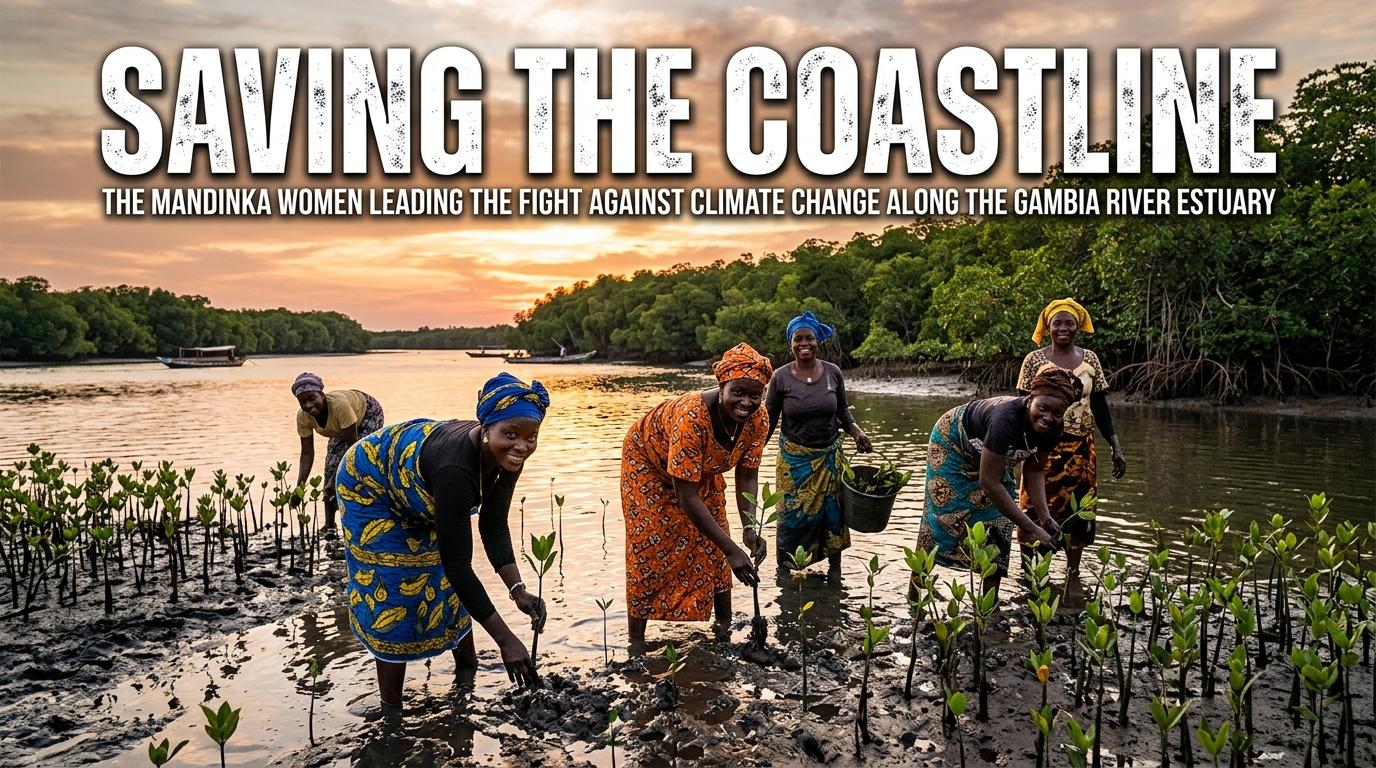
In 2007, a dedicated Gambian social worker named Fatou Janha Mboob recognized the painful struggles of local oyster harvesters (equatorinitiative.org, equatorinitiative.org). She realized that individual pickers lacked collective bargaining power and market access (equatorinitiative.org). To address this issue, she organized an initial group of forty women into the TRY Oyster Women’s Association (equatorinitiative.org, equatorinitiative.org). The cooperative aimed to pool resources, standardize selling prices, and improve sanitary standards (equatorinitiative.org). This effort stands as a powerful example of women leading grassroots movements to protect their communities.
The women quickly discovered that their economic survival linked directly to the health of the surrounding trees (equatorinitiative.org). Destroying mangrove roots removed the breeding grounds for oysters and fish (equatorinitiative.org, uri.edu). In response, the association adopted strict conservation rules (equatorinitiative.org). Members enacted a mandatory eight-month closed harvesting season every year (equatorinitiative.org, uri.edu). This annual pause gave shellfish populations time to grow larger and allowed damaged trees to recover naturally (equatorinitiative.org, uri.edu).
The association introduced strict technical rules to stop forest destruction (equatorinitiative.org, uri.edu). Harvesters agreed to minimum size limits for collected shellfish (equatorinitiative.org, uri.edu). They abolished the practice of chopping root branches with axes (equatorinitiative.org, equatorinitiative.org). Instead, harvesters learned to pick mature oysters by hand or use small knives without injuring the underlying tree (equatorinitiative.org). During closed seasons, association members began planting young mangrove seedlings along eroded banks (equatorinitiative.org, gambiamangrove.com).
Historic Governance and Exclusive Fisheries Rights
The success of the movement culminated in a landmark policy shift in 2012 (equatorinitiative.org). The Gambian government formally approved the Cockle and Oyster Co-Management Plan (equatorinitiative.org). This historic decree granted the TRY Oyster Women’s Association exclusive fishery management rights over 6,300 hectares within the Tanbi Wetland National Park (equatorinitiative.org, internationalparks.org). It represented the first time an African government granted exclusive fishery tenure to a community organization led by women (equatorinitiative.org).
This co-management agreement altered resource management in the region (equatorinitiative.org, uri.edu). The formal policy granted local women legal authority to set seasonal harvesting schedules, enforce equipment standards, and penalize illegal cutting (equatorinitiative.org, uri.edu). State agencies, such as the Department of Fisheries and the Department of Parks and Wildlife Management, maintained regulatory oversight while honoring the user rights of the women (equatorinitiative.org, uri.edu).
Granting exclusive control to female harvesters did not generate social conflict with local men (equatorinitiative.org). Community elders and male leaders supported the legal change because higher shellfish prices increased overall family incomes (equatorinitiative.org, equatorinitiative.org). The initiative transformed marginalized female workers into recognized legal custodians of the coastal environment (equatorinitiative.org, equatorinitiative.org). In 2012, the United Nations Development Programme recognized this success by awarding the organization the Equator Prize (equatorinitiative.org, equatorinitiative.org). This milestone demonstrated how localized leadership can help address broader economic challenges in Africa.
Socio-Economic & Ecological Impact Metrics
Understanding Blue Carbon and Coastal Defense
The restoration of coastal wetlands provides significant environmental benefits that extend far beyond local fisheries (financebiodiversity.org, financebiodiversity.org). Environmental scientists use the term blue carbon to describe carbon captured and stored by coastal ecosystems (financebiodiversity.org, financebiodiversity.org). Mangrove forests excel at capturing atmospheric carbon dioxide through photosynthesis (financebiodiversity.org, financebiodiversity.org). In fact, healthy mangroves store carbon at rates four to ten times higher per hectare than mature land-based tropical forests (financebiodiversity.org, financebiodiversity.org).
The primary difference between blue carbon and terrestrial forest carbon lies in soil storage dynamics (financebiodiversity.org). Terrestrial forests store most carbon above ground in living tree trunks and leaves (financebiodiversity.org). Conversely, mangroves store between 70 percent and 90 percent of their carbon below ground in waterlogged, anaerobic soils (financebiodiversity.org). The absence of oxygen in saturated wetland mud prevents dead organic matter from decomposing quickly (financebiodiversity.org). Consequently, carbon remains locked beneath the soil surface for hundreds or even thousands of years (financebiodiversity.org).
Beyond carbon storage, mangrove restoration provides physical protection for low-lying communities (globalnaturewatch.org). The capital city of Banjul sits on an exposed peninsula vulnerable to coastal erosion and storm surges (globalnaturewatch.org, mapcarta.com). Dense roots act as natural wave breakers that absorb incoming ocean energy (globalnaturewatch.org). These root systems trap sediment flowing down the Gambia River, stabilizing shoreline mudflats and preventing sea-level rise from washing away vulnerable urban infrastructure (globalnaturewatch.org, mapcarta.com).
International Carbon Markets and Ground Facilitators
The success of grassroots planting campaigns attracted major international conservation partnerships (orsted.com). The Department of Parks and Wildlife Management teamed up with energy firm Ørsted and regional non-profit organizations (orsted.com). Together, they initiated large-scale mangrove rehabilitation under the Verified Carbon Standard framework (orsted.com). Under this international market system, one verified carbon credit equals one metric ton of carbon dioxide removed from the atmosphere (orsted.com).
On-the-ground operational success relies heavily on indigenous civil society organizations (orsted.com). The West African Bird Study Association brings expertise in avian ecology and community environmental education (orsted.com). The Kombo Foni Forestry Association coordinates village committees and local labor across more than seventy-five participating communities (orsted.com). Sahel Wetlands Concern provides operational oversight to clear invasive grasses and restore natural tidal waterways (orsted.com).
This organized network expanded mangrove restoration from 200 hectares in 2022 to over 6,000 hectares by 2025 (orsted.com). Project leaders aim to restore 10,000 hectares of degraded wetlands (orsted.com). Long-term carbon purchase agreements guarantee that starting in 2027, 100 percent of carbon credit revenues will belong directly to local Gambian communities (orsted.com). These revenues will directly fund local microcredit systems, primary education, and marine protection programs (orsted.com).
Community Mangrove Restoration Trajectory
Hectares restored through community labor scaling toward long-term goals.
Economic Substitution and Future Outlook
Long-term environmental protection requires reliable economic alternatives so residents do not need to cut trees for survival (fao.org, fao.org). International agencies and local groups have funded sustainable livelihood programs in participating villages (fao.org, fao.org). Over 3,000 modern beehives were placed in mangrove zones, enabling women to produce honey and beeswax for sale (fao.org, fao.org). Microfinance funds provide low-interest business loans to female pickers (equatorinitiative.org, orsted.com). These loans help harvesters run small trade enterprises during non-harvesting months (equatorinitiative.org).
Safety outcomes and technical skills have improved significantly for female harvesters (fao.org, africacommons.net). Through the FISH4ACP program, the Gambia Navy provided swimming and water safety lessons to association members (africacommons.net). Harvesters also received heavy gloves, protective boots, and modern life jackets (africacommons.net). These safety tools eliminated deep-water drowning risks and drastically reduced physical injuries caused by sharp shells (africacommons.net).
Major global initiatives continue to expand these restoration strategies (fao.org, fao.org). The Green Climate Fund partnered with the Food and Agriculture Organization to implement the 25 million dollar PROREFISH project (fao.org, fao.org). This initiative mobilizes coastal youth and women to plant 1.7 million mangrove seedlings across degraded estuaries by 2028 (fao.org, fao.org). This achievement highlights the deep resilience of community structures when local leaders guide conservation. By uniting local ecological knowledge with legal rights and carbon finance, Gambian women have established a global blueprint for coastal climate adaptation (equatorinitiative.org, orsted.com).
About the Author
Darius Spearman is a professor of Black Studies at San Diego City College, where he has been teaching for over 20 years. He is the founder of African Elements, a media platform dedicated to providing educational resources on the history and culture of the African diaspora. Through his work, Spearman aims to empower and educate by bringing historical context to contemporary issues affecting the Black community.
