


Why Thousands Risk Death at the Deadly Ceuta Border Crisis
By Darius Spearman (africanelements)
Support African Elements at patreon.com/africanelements and hear recent news in a single playlist. Additionally, you can gain early access to ad-free video content.
A Deadly Crossing on the African Coast
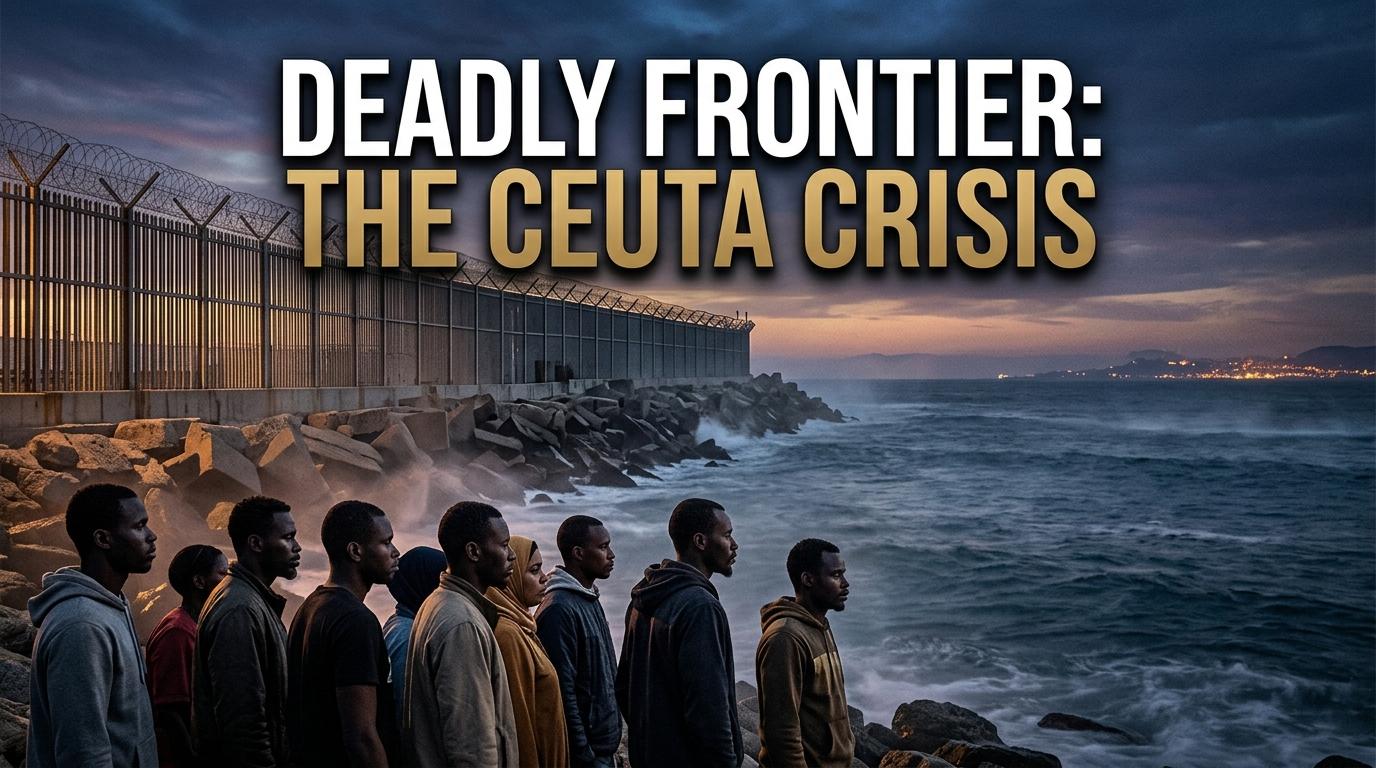
Sub-Saharan and North African migrants face deadly hazards along the Mediterranean coast (migrationdataportal.org). Recently, thousands of individuals attempted to swim around military breakwaters into Spanish territory (north-africa.com). The peninsula of Ceuta forms a tiny Spanish exclave in North Africa (wikipedia.org). An exclave is a piece of sovereign territory geographically separated from its main landmass by foreign lands or waters (wikipedia.org). Ceuta covers less than twenty square kilometers on the North African coastline (britannica.com). The city shares a short land boundary with the Kingdom of Morocco (wikipedia.org).
Consequently, this tiny territory serves as an external frontier of the European Union (euperspectives.eu). Hundreds of swimmers battled violent coastal currents near the Tarajal border breakwater (north-africa.com). Emergency response teams recovered dozens of drowned victims along the shore (middle-east-online.com). Meanwhile, human rights organizations reported over one hundred fatalities across both sides of the border (hespress.com). Local mortuaries rapidly reached full capacity during the crisis (surinenglish.com). This catastrophe sparked renewed global demands for urgent European border policy reform (euperspectives.eu).
Colonial Footprints and European Exclaves
To understand this modern border emergency, observers must analyze centuries of colonial history (africasacountry.com). Portuguese forces captured Ceuta in 1415 during early European imperial expansion (britannica.com). Later, the Spanish Crown took formal possession of the territory in 1580 (wikipedia.org). Spain solidified its claims through the Treaty of Lisbon in 1688 (wikipedia.org). During this era, Spanish colonial expansion redefined global trade and territorial boundaries.
Morocco gained independence from French and Spanish protectorates in 1956 (wikipedia.org). Since that time, the Moroccan government has challenged Spanish sovereignty over Ceuta and Melilla (wikipedia.org). Rabat views these coastal enclaves as colonial remnants occupied by a foreign power (wikipedia.org). Conversely, Madrid insists that Ceuta has formed an integral part of Spain for centuries (wikipedia.org). This historical sovereignty dispute creates permanent diplomatic tension between both nations (orsam.org.tr).
The Fortress Europe Strategy and Schengen Control
The geopolitical role of Ceuta changed dramatically when Spain joined the Schengen Area in 1991 (euperspectives.eu). The Schengen Area includes twenty-nine European countries that eliminated internal passport controls (europa.eu). Consequently, Ceuta transformed into a fortified external gateway to continental Europe (euperspectives.eu). Spain began constructing high perimeter wire fences in 1993 to stop movement (wikipedia.org).
In 2005, hundreds of sub-Saharan migrants mounted coordinated fence scaling attempts using makeshift ladders (wikipedia.org). Border guards deployed force, resulting in thirteen fatalities (wikipedia.org). Afterward, authorities raised fence heights to six meters and installed advanced infrared surveillance (wikipedia.org). Spain established a state-run primary reception facility called a CETI (administracion.gob.es). A CETI provides basic housing, meals, and medical evaluations for incoming migrants (administracion.gob.es). However, recurring arrival waves repeatedly push this reception facility past its official capacity of five hundred beds (globaldetentionproject.org).
Weaponized Migration and Diplomatic Warfare
Border security at Ceuta remains deeply connected to broader geopolitical disputes in North Africa (carnegieendowment.org). Specifically, the contested status of Western Sahara generates constant diplomatic conflicts (cfr.org). The Polisario Front has fought for Sahrawi independence since the 1970s (wikipedia.org). In April 2021, Spain admitted Polisario leader Brahim Ghali for medical treatment (chathamhouse.org). Morocco viewed this act as a severe breach of sovereign trust (carnegieendowment.org).
In retaliation, Moroccan border guards relaxed security barriers near Fnideq in May 2021 (carnegieendowment.org). Over ten thousand migrants entered Ceuta within forty-eight hours (carnegieendowment.org). Spanish military forces deployed armored vehicles to secure the perimeter (theguardian.com). This event demonstrated how governments can use human movement as diplomatic leverage (carnegieendowment.org). To end the standoff, Spain recognized Morocco’s autonomy plan for Western Sahara in 2022 (chathamhouse.org). Modern migration policies directly reflect rising sovereign debt and geopolitical pressures across the global south.
Social Media Rumors and the Mass Border Surge
A massive humanitarian emergency unfolded between July 30 and August 1, 2026 (north-africa.com). Over sixty thousand individuals attempted to breach the border within forty-eight hours (north-africa.com). This sudden movement represented roughly seventy percent of Ceuta’s entire resident population (britannica.com, democrata.es). The primary catalyst was viral social media misinformation across hundreds of online platforms (democrata.es). These posts misinterpreted a July 8, 2026 Spanish Supreme Court ruling (democrata.es).
Online rumors falsely claimed that Spanish law prohibited returning migrants who arrived by sea (democrata.es). Consequently, tens of thousands of young people rushed toward the coastal border (north-africa.com). Swimmers flooded into strong sea currents around the Tarajal breakwater (north-africa.com). Spanish security forces collaborated with Moroccan police to execute rapid returns under a 1992 treaty (north-africa.com, democrata.es). Authorities returned over seventy thousand crossers within days (democrata.es). Meanwhile, officials established a temporary holding center to process remaining asylum applicants (moncloa.com).
Anti-Black Racism and Profiling at the Border
Black sub-Saharan migrants face severe systemic barriers along North African border zones (africasacountry.com). While local Moroccan residents historically possessed limited border transit permissions, sub-Saharan Africans encounter complete exclusion (africasacountry.com). Security forces routinely use racial profiling to prevent Black individuals from approaching official checkpoints (africasacountry.com, hrw.org). Therefore, sub-Saharan refugees are forced to attempt dangerous sea swims or fence climbs (africasacountry.com).
Furthermore, North African transit countries conduct aggressive pre-border containment operations (picum.org). Security forces carry out violent raids on informal woodland camps near the border (hrw.org). Black migrants face arbitrary arrests, forced internal displacement, and destruction of personal possessions (hrw.org, picum.org). Many of these individuals are fleeing active armed conflicts in Mali, Sudan, and Somalia (rescue.org). These harsh practices align with broader patterns of militarized law enforcement targeting vulnerable populations.
Hot Returns and Legal Protection Disputes
The practice of summary expulsions remains a central point of legal conflict (eumigrationlawblog.eu). In Spain, immediate border pushbacks are known as “devoluciones en caliente” (courthousenews.com). Authorities codified border rejections into domestic law through a 2015 legal reform (eumigrationlawblog.eu). Officials argue that migrants climbing fences have not legally entered Spanish territory (eumigrationlawblog.eu). However, human rights scholars argue this practice violates international refugee law (thehuman-rights.com).
Specifically, international law strictly prohibits refoulement under Article 33 of the 1951 Refugee Convention (un.org). Non-refoulement forbids returning individuals to places where they face torture or death (unhcr.org). The European Court of Human Rights issued a controversial ruling in 2020 (coe.int). The court decided that summary pushbacks did not violate rights if migrants bypassed legal channels (coe.int). Nevertheless, rights organizations insist that mass returns prevent refugees from requesting international protection (amnesty.org). Solidarity movements continue to organize around principles of pan-African solidarity to demand accountability.
Diplomatic Strain and European Union Fractures
The border emergency in Ceuta generated intense political friction across the European Union (euperspectives.eu). In response to the crisis, Italy temporarily suspended Schengen passport-free travel rules for Spanish arrivals (euperspectives.eu). Rome cited border security concerns to justify reinstated passport inspections (euperspectives.eu). Spain retaliated by implementing counter border checks on Italian travelers (euperspectives.eu). This diplomatic spat exposed growing internal instability within the Schengen framework (euperspectives.eu).
At the same time, twenty-two EU member states demanded stricter external border enforcement (euperspectives.eu). Spanish authorities announced plans to construct a five hundred meter maritime barrier along the coast (euperspectives.eu). Critics argue that fortified walls fail to address the root drivers of human mobility (euperspectives.eu). Without legal migration channels, migrants will continue to risk their lives at the border (migrationdataportal.org). Policymakers must balance border management with fundamental human rights guarantees (thehuman-rights.com).
About the Author
Darius Spearman is a professor of Black Studies at San Diego City College, where he has been teaching for over 20 years. He is the founder of African Elements, a media platform dedicated to providing educational resources on the history and culture of the African diaspora. Through his work, Spearman aims to empower and educate by bringing historical context to contemporary issues affecting the Black community.
