


Why Did Shelby County Black Voter Turnout Surge in 2026?
By Darius Spearman (africanelements)
Support African Elements at patreon.com/africanelements and hear recent news in a single playlist. Additionally, you can gain early access to ad-free video content.
The Catalyst: Dissolving Memphis’s Majority-Black District
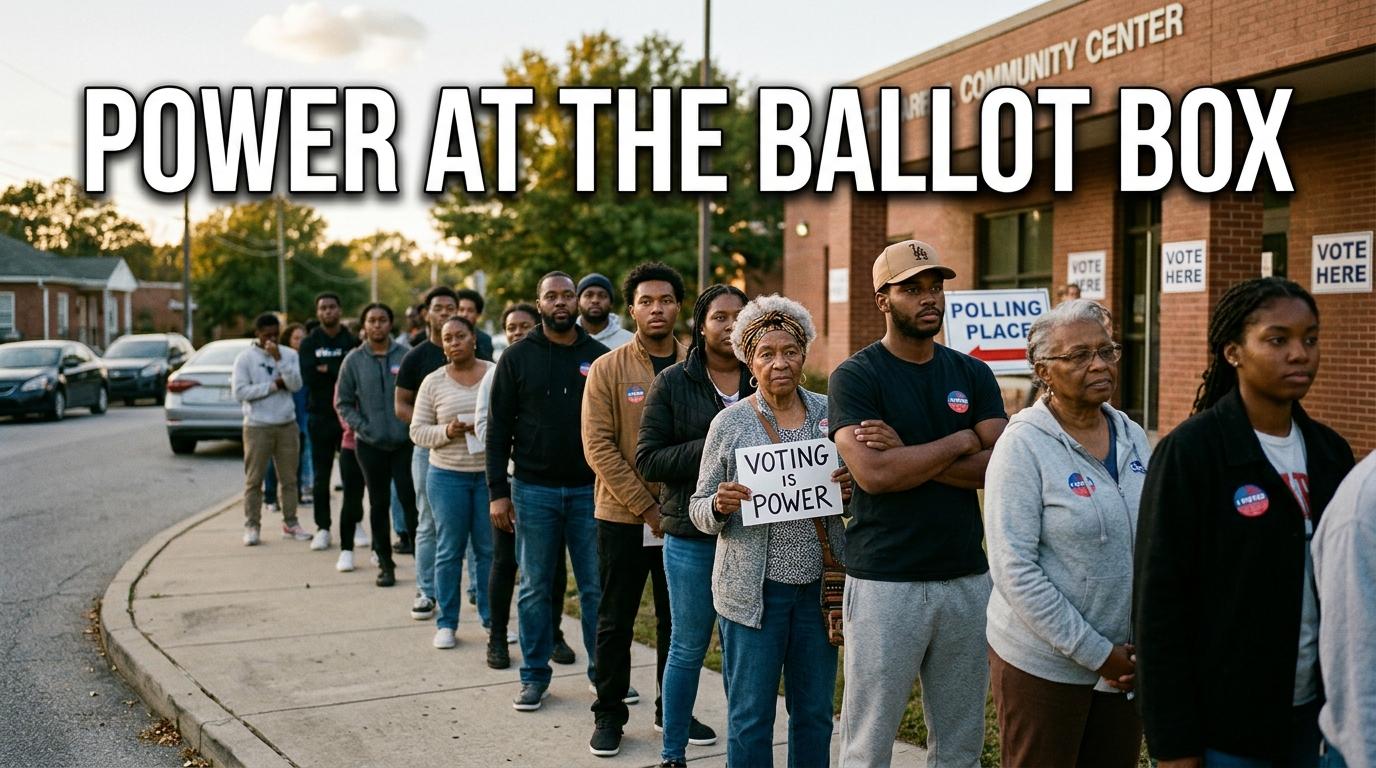
In August 2026, voter participation in Shelby County, Tennessee reached historic levels (washingtonpost.com). A fifth of active registered voters cast ballots in the Democratic primary election (washingtonpost.com). Total ballots exceeded 133,000 voters across the county (washingtonpost.com, localmemphis.com). This surge marked a decade-high participation rate for primary contests in West Tennessee (washingtonpost.com, localmemphis.com). This massive turnout was a direct reaction to state redistricting decisions (washingtonpost.com).
In May 2026, the Republican-controlled General Assembly convened an extraordinary special session (washingtonpost.com). State lawmakers dismantled Tennessee’s 9th Congressional District (washingtonpost.com, pbs.org). The 9th District had long stood as the state’s sole majority-Black congressional seat (washingtonpost.com, pbs.org). Lawmakers partitioned Shelby County into three sprawling districts that extend into distant rural counties (washingtonpost.com).
This strategy is known as mid-decade redistricting (ballotpedia.org). Mid-decade redistricting occurs outside the standard ten-year census cycle (ballotpedia.org). Controlling parties use mid-decade redraws to gain sudden political advantages (ballotpedia.org). The newly redrawn map forced ten-term Representative Steve Cohen to announce his retirement (washingtonpost.com, washingtonpost.com). Cohen, a white Jewish Democrat, had represented the majority-Black district since 2007 (ballotpedia.org, washingtonpost.com). His decision left local leadership options open for a new generation of Black political leaders (washingtonpost.com).
Historical Roots: From Baker v. Carr to Harold Ford Sr.
Shelby County has a long history at the center of national voting rights battles (constitutioncenter.org, wikipedia.org). In 1959, Shelby County resident Charles Baker sued the state over unequal legislative lines (constitutioncenter.org, wikipedia.org). Tennessee had not redrawn its electoral boundaries since 1901 (constitutioncenter.org). Over nearly sixty years, population shifts diluted urban voting power in Memphis (constitutioncenter.org). Rural votes held up to ten times the weight of urban votes in Shelby County (constitutioncenter.org).
The legal challenge reached the U.S. Supreme Court in Baker v. Carr in 1962 (constitutioncenter.org, wikipedia.org). The High Court ruled that federal courts could intervene in legislative reapportionment disputes (constitutioncenter.org, supremecourthistory.org). This landmark decision established the constitutional principle of “One Person, One Vote” (constitutioncenter.org, supremecourthistory.org). It fundamentally reshaped American political representation across the nation (constitutioncenter.org).
Memphis also served as a critical battleground during the Civil Rights Movement (blackfacts.com). The 1968 Sanitation Workers Strike and the assassination of Dr. Martin Luther King Jr. forged powerful local organizing networks (blackfacts.com). These events activated local voter registration drives within Black churches and labor groups (blackfacts.com).
In 1974, Harold Ford Sr. won election to the U.S. House of Representatives (wikipedia.org). He became Tennessee’s first Black member of Congress in the twentieth century (wikipedia.org). Following the 1980 census, state lawmakers formally designated the 9th District as a majority-Black seat under the Voting Rights Act (washingtonpost.com). For over four decades, it served as a primary anchor for Black political power in West Tennessee.
Voting Rights Protections and Legal Thresholds
Section 2 of the Voting Rights Act of 1965 is a permanent federal protection against racial discrimination in voting (justice.gov, justice.gov). It guarantees that minority voters have an equal opportunity to elect chosen candidates (justice.gov). Section 2 specifically bans practices that lead to racial vote dilution (justice.gov, justice.gov). These practices include cracking minority voters across multiple districts or packing them into one (justice.gov, justice.gov).
However, recent federal court rulings have shifted voting rights jurisprudence (pbs.org, pbs.org). In Shelby County v. Holder (2013), the Supreme Court eliminated federal preclearance requirements (pbs.org). States no longer needed federal approval before changing local election rules or maps (pbs.org).
In cases like Louisiana v. Callais, the Supreme Court altered legal thresholds under Section 2 (oyez.org, pbs.org). The Court ruled that complying with Section 2 did not automatically justify race-conscious mapmaking (oyez.org). Republican lawmakers utilized these revised standards to justify dismantling existing majority-minority seats (washingtonpost.com, pbs.org).
State lawmakers frequently defend race-conscious maps by claiming partisan motivations (democracydocket.com). In Rucho v. Common Cause (2019), the Supreme Court ruled that partisan gerrymandering cannot be reviewed by federal courts (constitutioncenter.org). Consequently, state officials assert that their maps target rival political parties rather than minority voters (washingtonpost.com, democracydocket.com). This distinction creates a major challenge for civil rights litigants in federal court (democracydocket.com).
Preemption and the Power Struggle Over Local Control
To Memphis voters, the mid-decade redistricting reflects an ongoing pattern of state intervention (washingtonpost.com, wpln.org). State-level preemption occurs when a state legislature passes laws that override local municipal ordinances (tn.gov). Conservative state majorities frequently use preemption to restrict progressive policies in urban centers (wpln.org, tn.gov).
This legal mechanism limits local control in majority-Black cities like Memphis and Nashville (washingtonpost.com, wpln.org). In 2022, state lawmakers divided Democratic-leaning Nashville into three separate rural districts (washingtonpost.com, wpln.org). That action successfully eliminated the seat held by long-time Democratic Congressman Jim Cooper (wpln.org).
In 2026, the state legislature targeted Memphis municipal governance alongside congressional maps (washingtonpost.com, tn.gov). State lawmakers passed measures restructuring the Memphis-Shelby County School Board and local airport authorities (washingtonpost.com, tn.gov). State Democratic leaders characterized these combined actions as an intentional power grab (washingtonpost.com, wpln.org).
State preemption restricts local self-determination and forces city officials to yield to state mandates (tn.gov). Municipalities find themselves unable to enforce localized policies backed by their constituents (tn.gov). As a result, Black voters increasingly view state preemption as a direct challenge to meaningful political representation.
Grassroots Rising: Justin Pearson and Local Organizing
The mid-decade map sparked immediate grassroots mobilization across Shelby County (washingtonpost.com, aclu-tn.org). High-profile local leaders stepped forward to organize the electorate (washingtonpost.com). State Representative Justin J. Pearson emerged as a key figure during the August 2026 primary campaign (washingtonpost.com).
Pearson gained national prominence in April 2023 following his expulsion from the Tennessee House (wikipedia.org). He and Representative Justin Jones led floor demonstrations demanding gun reform following a Nashville school shooting (wikipedia.org). The Republican supermajority expelled both Black lawmakers for decorum violations, triggering national scrutiny (wikipedia.org). Within days, the Shelby County Commission unanimously voted to reinstate Pearson to his seat (wikipedia.org).
In 2026, Pearson framed the U.S. House primary election as a direct referendum on civil rights (washingtonpost.com). He ran in the Democratic primary alongside State Senator London Lamar (washingtonpost.com). Their competitive campaigns energized local voters and drove primary interest (washingtonpost.com).
Grassroots organizations executed comprehensive voter mobilization drives across Memphis (washingtonpost.com, aclu-tn.org). Groups such as Organize Tennessee, The Equity Alliance, and the Black Clergy Collaborative organized door-to-door outreach (aclu-tn.org). They focused on voter education and canvassing in historically underrepresented neighborhoods (washingtonpost.com, aclu-tn.org). These efforts demonstrated how communities navigate the complex system of federalism to defend political access.
Legal Challenges and the General Election Math
Civil rights organizations responded to the redrawn map by filing federal lawsuits (aclu-tn.org, aclu.org, democracydocket.com). Groups including the NAACP and the ACLU of Tennessee filed challenges such as Sherman v. Hargett (aclu-tn.org, aclu.org). Plaintiffs argued the map intentionally diluted Black voting strength in violation of the Fourteenth Amendment (aclu-tn.org, democracydocket.com).
The litigation also introduced First Amendment claims regarding freedom of political association (aclu.org, democracydocket.com). Civil rights attorneys requested an emergency preliminary injunction to block the map for 2026 (aclu-tn.org, democracydocket.com). However, a federal court panel denied the preliminary injunction request (democracydocket.com). The ruling allowed the redrawn map to govern the 2026 elections while full litigation continues (democracydocket.com).
Despite record primary turnout, Democrats face steep mathematical hurdles in the general election (washingtonpost.com). The redrawn 9th District now incorporates rural, heavily conservative counties (washingtonpost.com). Approximately 71 percent of voters in the redrawn district reside outside its historic Memphis base (washingtonpost.com).
High voter turnout in urban Memphis cannot easily offset conservative rural voting blocs (washingtonpost.com). Civil rights advocates stress that cracking urban communities fundamentally alters election math (washingtonpost.com, naacp.org). Organizing boosts local participation, but structural gerrymandering heavily influences general election outcomes (washingtonpost.com). Campaign strategists continue evaluating these strategic implications as midterm elections approach.
The Future of Mobilization in the American South
The events in Shelby County highlight the enduring resilience of Black voters in the American South (washingtonpost.com). Mid-decade redistricting plans designed to divide urban communities often trigger countervailing voter activation (washingtonpost.com, aclu-tn.org). Memphis voters transformed frustration over lost representation into historic primary participation (washingtonpost.com).
This mobilization offers key lessons for voting rights advocacy nationwide (washingtonpost.com, naacp.org). When federal court protections shift, community-based organizing becomes crucial (aclu-tn.org, naacp.org). Local faith leaders, civil rights organizations, and elected officials created a unified response to legislative changes (washingtonpost.com, aclu-tn.org).
The legal fight over Tennessee’s congressional boundaries remains ongoing in federal court (aclu-tn.org, democracydocket.com). Judges will evaluate the long-term constitutional arguments presented by civil rights plaintiffs (democracydocket.com). Meanwhile, Shelby County voters have demonstrated their resolve through the ballot box (washingtonpost.com). Their response shows that efforts to dilute minority voting power can spark historic levels of civic action (washingtonpost.com, aclu-tn.org).
About the Author
Darius Spearman is a professor of Black Studies at San Diego City College, where he has been teaching for over 20 years. He is the founder of African Elements, a media platform dedicated to providing educational resources on the history and culture of the African diaspora. Through his work, Spearman aims to empower and educate by bringing historical context to contemporary issues affecting the Black community.
