



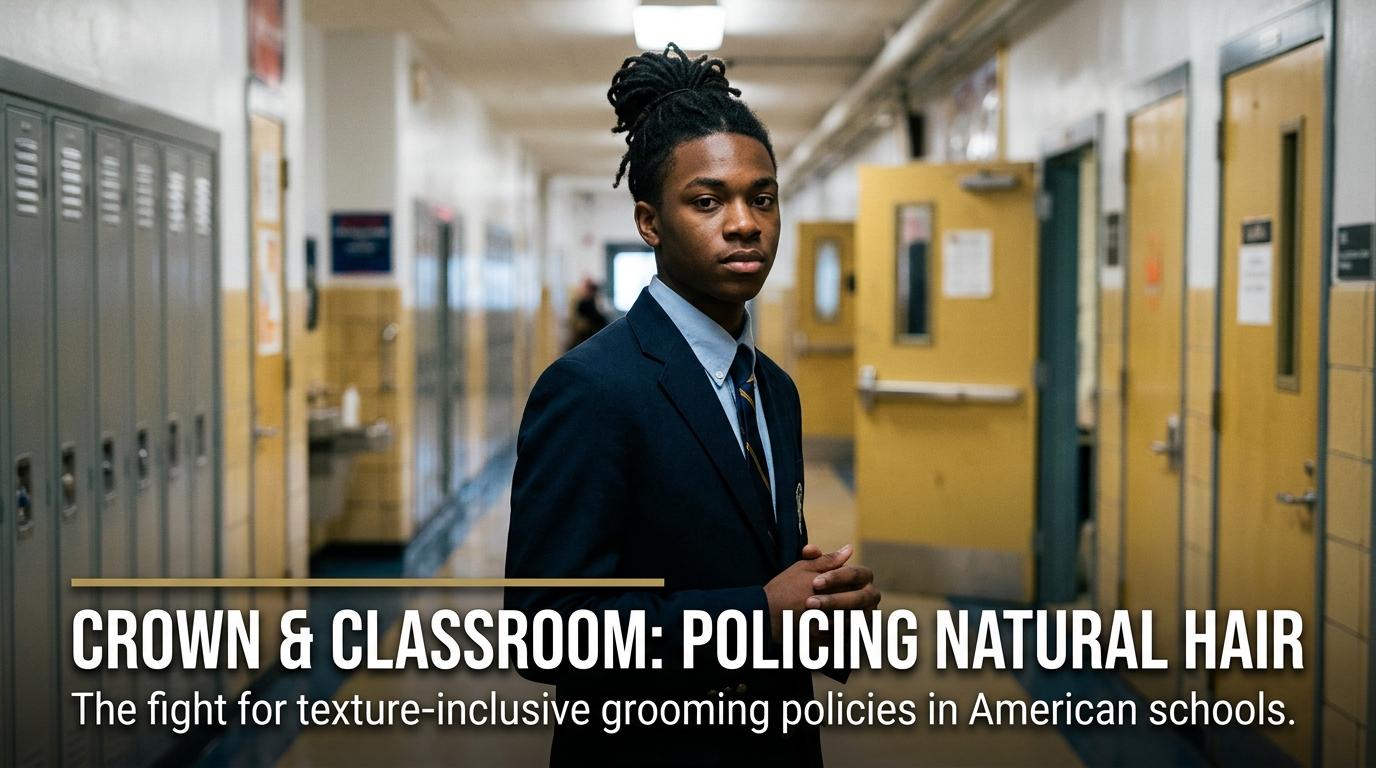
Why Is Texas Still Policing Black Hair in Schools?
By Darius Spearman (africanelements)
Support African Elements at patreon.com/africanelements and hear recent news in a single playlist. Additionally, you can gain early access to ad-free video content.
The Darryl George Standoff in Mont Belvieu
The classroom door closed on Darryl George in the autumn of 2023. School administrators in Mont Belvieu, Texas, removed the Black high school junior from his regular studies (texastribune.org, texastribune.org). His supposed infraction was not violence, truancy, or academic failure. Instead, the school punished him because he refused to cut his natural locs (texastribune.org, texastribune.org).
George neatly pinned his locs atop his head to keep them above his collar, ears, and eyes (courthousenews.com, texastribune.org). Nevertheless, Barbers Hill Independent School District claimed his hair broke the dress code (bhisd.net, texastribune.org). Officials asserted that his hair would fall past his collar if let down (texastribune.org, texastribune.org). Consequently, the district placed him in disciplinary isolation for most of his junior year (click2houston.com, click2houston.com). The prolonged punishment sparked national outrage and reignited fierce debate over the limits of student expression and systemic bias in education (texastribune.org, 19thnews.org).
From West Africa to the Louisiana Tignon Laws
The regulation of Afro-textured hair did not begin in modern Texas classrooms. In pre-colonial West African societies, hair carried profound spiritual, social, and familial significance. Intricate braids, twists, and locs signaled tribal origin, marital status, wealth, and community standing. Hair was considered a sacred conduit to the divine, demanding careful grooming and artistic respect.
The transatlantic slave trade systematically attacked these cultural expressions. Enslaving captors shaved the heads of captured Africans to strip away individual identity and ancestral heritage. Later, colonial governments enacted strict legislation to suppress Black self-expression. In 1786, Louisiana Governor Esteban Rodríguez Miró enacted the Tignon Laws (medium.com). This edict legally mandated that women of African descent cover their hair with a cloth wrap in public. Colonial authorities designed the rule to mark Black women as second-class citizens. Even so, Black women resisted by decorating their wraps with vibrant fabrics and jewels, turning an instrument of oppression into a display of dignity.
The Mutable Hair Doctrine in American Courts
Modern legal barriers against protective hairstyles solidified during the late twentieth century. For decades, federal courts refused to recognize natural hairstyle bans as racial discrimination (epi.org, umn.edu). Judges routinely divided human physical traits into two strict categories: immutable characteristics and mutable choices (epi.org, umn.edu). Skin color was deemed immutable, while hairstyle was classified as a personal preference (epi.org, umn.edu).
This judicial doctrine emerged clearly in the 1981 federal case Rogers v. American Airlines (epi.org, umn.edu). The court ruled that an employer could legally prohibit braided hairstyles in the workplace (epi.org, umn.edu). The judge claimed braids were an easily changeable cultural choice rather than an unchangeable racial trait (epi.org, umn.edu). Decades later, in EEOC v. Catastrophe Management Solutions, the Eleventh Circuit upheld the revocation of a Black woman’s job offer because of her locs (epi.org, umn.edu). These rulings created deep legal loopholes that allowed institutions to police Black bodies while claiming racial neutrality (epi.org, umn.edu).
Chronology: The Legal Policing of Black Hairstyles
The Rise of the CROWN Act and State Protections
Frustrated by judicial inaction, grassroots activists, civil rights leaders, and the CROWN Coalition organized to change state laws (dove.com, thecrownact.com). The coalition formed in 2019 through a partnership between Dove, the National Urban League, Color Of Change, and the Western Center on Law and Poverty (dove.com, thecrownact.com). They drafted legislation known as the CROWN Act, which stands for Creating a Respectful and Open World for Natural Hair (thecrownact.com).
The model bill directly targeted the old judicial doctrines. It expanded the legal definition of race in state civil rights laws to include hair texture and protective hairstyles (thecrownact.com, umn.edu). California became the first state to pass the measure in 2019 (thecrownact.com). Over two dozen states and scores of municipalities soon followed suit (thecrownact.com, adamsandreese.com). These statutory protections provided crucial shields against arbitrary dress codes. In many regions, the legislation enabled students to express cultural pride and self-determination without fear of educational penalties.
Anatomy of the Length Loophole
Texas enacted its own version of the CROWN Act, known as House Bill 567, on September 1, 2023 (texastribune.org, texastribune.org). State lawmakers passed the measure following earlier controversies in the very same school district (texastribune.org, texastribune.org). In 2020, Barbers Hill ISD barred Black students De’Andre Arnold and Kaden Bradford from their graduation ceremonies over their uncut locs (texastribune.org, texastribune.org). Despite this clear legislative intent, the school board maintained strict grooming standards (texastribune.org, bhisd.net). They prohibited male students from wearing hair that extended past the earlobes, eyebrows, or collar when down (bhisd.net, texastribune.org).
The district argued that the state law protected hairstyle and texture, but not hair length (texastribune.org, texastribune.org). In February 2024, Chambers County District Judge Chap B. Cain III sided with the school board (texastribune.org, texastribune.org). The state court ruled that the literal text of House Bill 567 did not specifically mention length (texastribune.org, texastribune.org). This narrow statutory interpretation created a glaring loophole (texastribune.org, texastribune.org). Consequently, schools could penalize male students for wearing mature protective styles simply by measuring their hair length (texastribune.org, texastribune.org).
Documented Impact of Hair Bias in Education and Employment
Data Sources: Dove CROWN Research Study for Girls & Workplace Reports
The Biology and Cultural Sanctity of Locs
Protective hairstyles are not arbitrary aesthetic choices. Tight, coily Afro-textured hair is naturally prone to moisture loss, structural dryness, and mechanical breakage. Protective styles such as locs, twists, cornrows, and braids shield delicate strands from environmental damage. They tuck away fragile ends, eliminate the need for damaging heat treatments, and reduce daily combing manipulation. This styling tradition promotes scalp health and supports sustainable hair growth over many years.
Locs develop through an organic locking process in which individual hair strands naturally mesh together. Once mature, a loc forms a continuous structural matrix from the scalp to the tip. Trimming or cutting locs permanently destroys this structural integrity. Severing a loc causes unraveling, thinning, fraying, and severe shedding at the raw edge. Furthermore, forced alteration inflicts profound emotional pain. Locs represent years of dedicated growth, ancestral tradition, and personal identity. Demanding that a student cut their locs asks them to destroy their personal heritage to conform to Eurocentric appearance standards.
Discipline, DAEP, and the Civil Rights Fallout
The punitive measures used against Darryl George highlight broader systemic inequalities in school disciplinary practices (click2houston.com, click2houston.com). Barbers Hill ISD placed George in in-school suspension before banishing him to an alternative education facility (click2houston.com, fox26houston.com). In Texas, a Disciplinary Alternative Education Program, or DAEP, is a segregated disciplinary environment (click2houston.com, fox26houston.com). Under Chapter 37 of the Texas Education Code, schools generally reserve DAEP assignments for severe safety infractions like drug possession, weapons violations, or violent assaults.
Subjecting a student to DAEP isolation over a dress code dispute mirrors broader punitive disciplinary practices that disproportionately harm Black children (click2houston.com, fox26houston.com). According to data from the U.S. Department of Education, Black boys represent approximately eight percent of all public school students. Yet, they receive over twenty-five percent of out-of-school suspensions. Vague grooming policies remove vulnerable pupils from direct instruction, creating severe obstacles for the educational success of Black youth. George eventually transferred out of the school district to complete his high school studies in an environment free from constant punishment.
Federal Civil Rights Legal Framework
Federal Gridlock and the Unfinished Freedom Struggle
The legal fight over Darryl George’s locs soon moved into the federal court system (courthousenews.com, courthousenews.com). In federal proceedings, civil rights attorneys argued that policing male hair length violates both Title IX and the Fourteenth Amendment (aclutx.org, courthousenews.com). Under heightened constitutional scrutiny, government entities must prove that gender-specific rules serve important educational objectives (aclutx.org, courthousenews.com). While U.S. District Judge Jeffrey Brown initially dismissed George’s primary claims against the district, appeals continue to test the boundaries of federal protections (courthousenews.com, courthousenews.com).
This ongoing judicial deadlock demonstrates the urgent need for comprehensive national reform. The federal CROWN Act has passed the U.S. House of Representatives in multiple legislative sessions (house.gov). However, the bill remains stalled in the U.S. Senate due to procedural filibusters and partisan opposition (house.gov). Opponents argue that existing federal statutes are sufficient and that federal laws infringe upon local school board authority. This congressional stalemate underscores recurring struggles with federalism across American history. Until lawmakers pass explicit federal protections, Black students will remain vulnerable to exclusionary dress codes that target their cultural identity.
About the Author
Darius Spearman is a professor of Black Studies at San Diego City College, where he has been teaching for over 20 years. He is the founder of African Elements, a media platform dedicated to providing educational resources on the history and culture of the African diaspora. Through his work, Spearman aims to empower and educate by bringing historical context to contemporary issues affecting the Black community.
