



Why Special Needs School Bus Safety Keeps Failing
By Darius Spearman (africanelements)
Support African Elements at patreon.com/africanelements and hear recent news in a single playlist. Additionally, you can gain early access to ad-free video content.
A Mother Seeks Answers in Fort Bend County
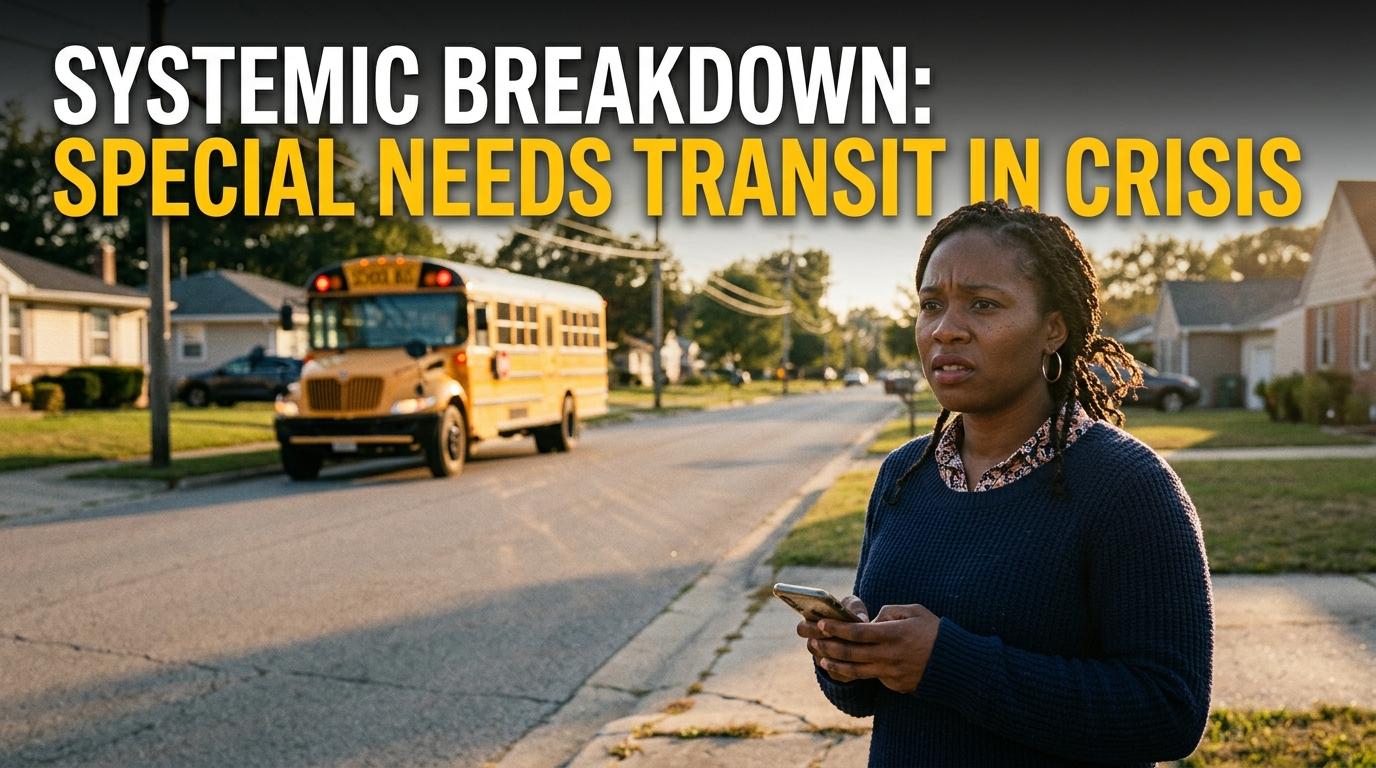
In late August, a mother in Fort Bend County faced every parent’s worst nightmare. Michelle Lemon waited for her ninth-grade daughter, Bryne, to arrive home from Hightower High School. Bryne is a non-verbal student with special needs who relies on dedicated support. Her scheduled drop-off time was 2:50 in the afternoon. However, the yellow bus did not stop at her curb (blacknews.com, hoodline.com).
Thirty minutes passed without any sign of the bus. Lemon immediately called the Fort Bend Independent School District transportation office. The dispatcher did not check real-time GPS tracking data. Instead, the employee asked Lemon to describe her daughter. This casual response shocked the family. It revealed that dispatchers had no immediate record of who was aboard that vehicle (hoodline.com, click2houston.com).
Bryne remained on the active school bus for nearly two hours. The driver continued driving secondary routes while trying to determine the teenager’s identity. The district later confirmed that the student remained in the presence of the driver. Still, Bryne did not arrive home until approximately 4:30 in the afternoon. The prolonged disappearance left her mother demanding systemic accountability (blacknews.com, click2houston.com).
When Modern Tracking Systems Collapse
School districts often promise safety through advanced technology. Fort Bend ISD uses the SMART Tag system to monitor ridership. Students scan an automated card when entering and exiting the bus. In theory, this hardware logs passenger counts instantly for campus leaders and parents (hoodline.com, bytecurve.com).
On that afternoon, the digital safeguards collapsed entirely. Bryne did not have her physical badge when boarding the bus. Because she is non-verbal, she could not speak her name to the driver. The driver carried a paper roster that failed to include Bryne’s name. As a result, no electronic check-in occurred (hoodline.com, click2houston.com).
Human error made the technological breakdown even worse. The regular bus monitor was absent on that day. Bus monitors serve as the primary human safeguard for special needs students. Without an attendant or an accurate manifest, the substitute driver departed campus with an unidentified student aboard. The district failed to catch the error before leaving school grounds (blacknews.com, click2houston.com).
The Labor Shortage and Private Contractors
Public school districts across the country face an acute transit staffing crisis. More than 80 percent of school districts report severe shortages of licensed bus drivers (napt.org). Furthermore, overall public pupil transportation employment remains 9.5 percent below pre-pandemic numbers. Private contracting companies have suffered an even steeper employment decline of 28.8 percent (epi.org).
To keep routes moving, Fort Bend ISD contracts services through Goldstar Transit. School systems use private vendors when internal recruitment cannot meet local demand (hoodline.com). However, reliance on outside contractors often weakens institutional communication. High employee turnover causes replacement staff to operate unfamiliar routes without adequate training (bytecurve.com, epi.org).
Substitute drivers rarely know the individual medical and communication needs of their riders. When staffing shortages eliminate route attendants, the margin for error disappears. A missing attendant removes the human safety net that protects non-verbal children. This shortage exposes vulnerable students to severe logistical dangers (bytecurve.com, stnonline.com).
The Legal Right to Specialized Transportation
Special education transit is not an optional courtesy provided by school districts. It is an enforceable civil right under federal law. Congress passed the Education for All Handicapped Children Act in 1975. That law is known today as the Individuals with Disabilities Education Act (autismsocietymd.org, aalrr.com).
Federal regulations explicitly define transportation as a mandatory related service under 34 CFR § 300.34(c)(16). The law requires school districts to provide door-to-door transit, adapted buses, and trained personnel (autismsocietymd.org, schoolinjuryattorneys.com). These services ensure that every child receives a Free Appropriate Public Education. The historic Civil Rights era established the legal groundwork for such protections.
Every accommodation must appear in the student’s Individualized Education Program. An IEP is a legally binding document created by parents, educators, and administrators (autismsocietymd.org, kimberly.edu). Nevertheless, school teams often treat transportation as an administrative afterthought. When transportation planning is neglected, the district violates the federal mandate for safe educational access (aalrr.com).
The Lasting Impact of the Texas Special Education Cap
The transit crisis in Texas connects directly to years of state administrative suppression. In 2004, the Texas Education Agency created an arbitrary benchmark. The agency penalized school districts if special education enrollment exceeded 8.5 percent. The national average was roughly 13 percent (arcpublishing.com).
To avoid state sanctions, school districts delayed evaluations and denied services to thousands of students (arcpublishing.com). An investigative report in 2016 exposed this unlawful practice across the state. In 2018, the federal government found Texas in direct violation of the law (arcpublishing.com). The state legislature subsequently outlawed the cap.
The state remains under a federal corrective action plan to address huge service backlogs (arcpublishing.com). Districts had to expand services rapidly without sufficient funding or staff. This sudden strain damaged local infrastructure, including student transportation fleets. Districts continue to struggle with the consequences of that legacy (arcpublishing.com, katymagazineonline.com).
Lessons From Past Tragedies
Administrative failures on school buses can carry deadly consequences. In 2015, a 19-year-old non-verbal autistic student named Hun Joon “Paul” Lee died in California. A driver left him inside a locked bus during extreme heat for seven hours (panish.law). The driver had failed to conduct a routine end-of-trip sweep.
In response, California enacted the Paul Lee School Bus Safety Law in 2016 (panish.law, stnonline.com). The statute requires child safety alarm systems on all school buses. Drivers must walk to the rear of the bus to deactivate the alarm before shutting down the engine. This mechanical rule forces a physical check of every seat (panish.law, stnonline.com).
Unfortunately, many states do not require these interior alarm systems. School districts frequently substitute software applications and electronic badges for manual sweeps (bytecurve.com, schoolbusfleet.com). However, digital tags do not protect a child who loses an ID card. True safety requires continuous human verification alongside technical tools (schoolbusfleet.com, rightspotsol.com).
Race, Advocacy, and Equity in Fort Bend County
The incident in Fort Bend County highlights broader issues of racial equity in suburban public education. Fort Bend County is recognized as one of the most ethnically diverse counties in the nation. Systemic breakdowns in school services frequently affect Black and Latino families (hoodline.com, arcpublishing.com).
Studies within Black Studies show that families of color face unique hurdles when advocating for special education services. Parents often encounter administrative skepticism and bureaucratic delays (arcpublishing.com). When Michelle Lemon called for help, dispatchers responded with indifference instead of urgency (hoodline.com, click2houston.com). The enduring resilience of African American families remains vital when demanding accountability from public institutions.
This was not the first special education controversy in Fort Bend ISD. In May, multiple staff members at Walter Moses Burton Elementary School were relieved of duty during student abuse investigations (hoodline.com, hoodline.com). These recurring issues erode community trust. Parents need reassurance that school systems will protect their children from harm (blacknews.com, hoodline.com).
Establishing True Transit Accountability
Following the incident, Fort Bend ISD Executive Director of Special Education Dahria Driskell met with the family (hoodline.com, click2houston.com). The district initiated an administrative review of its bus operations. Administrators examined substitute driver preparation and manifest confirmation procedures (hoodline.com, click2houston.com). However, internal reviews alone cannot fix deep structural weaknesses.
Districts must establish fail-closed transit protocols. If an unverified child boards a bus, that bus must remain parked until identity confirmation occurs. Drivers should never leave a campus with an unidentified passenger on board (schoolbusfleet.com, rightspotsol.com). The balance between (stnonline.com). Staffing shortages must not excuse compromised safety standards. Families deserve reliable safeguards every single day (bytecurve.com, aalrr.com).
Protecting Vulnerable Students Moving Forward
The story of Bryne in Fort Bend County is a clear warning for school districts nationwide. Relying on digital cards without personal oversight leaves children vulnerable. Technology should assist human workers, not replace basic safety procedures (bytecurve.com, schoolbusfleet.com).
Federal law guarantees every child safe access to public education (autismsocietymd.org, aalrr.com). When school systems fail in their transit duties, vulnerable children bear the highest cost. Parents will continue to organize and demand structural accountability from school boards (blacknews.com, hoodline.com).
Protecting non-verbal students requires continuous diligence, trained staff, and strict safety rules. School districts must match their legal promises with real protection on every route. Our public schools must ensure that no child gets left behind on a school bus (blacknews.com, panish.law).
About the Author
Darius Spearman is a professor of Black Studies at San Diego City College, where he has been teaching for over 20 years. He is the founder of African Elements, a media platform dedicated to providing educational resources on the history and culture of the African diaspora. Through his work, Spearman aims to empower and educate by bringing historical context to contemporary issues affecting the Black community.
