

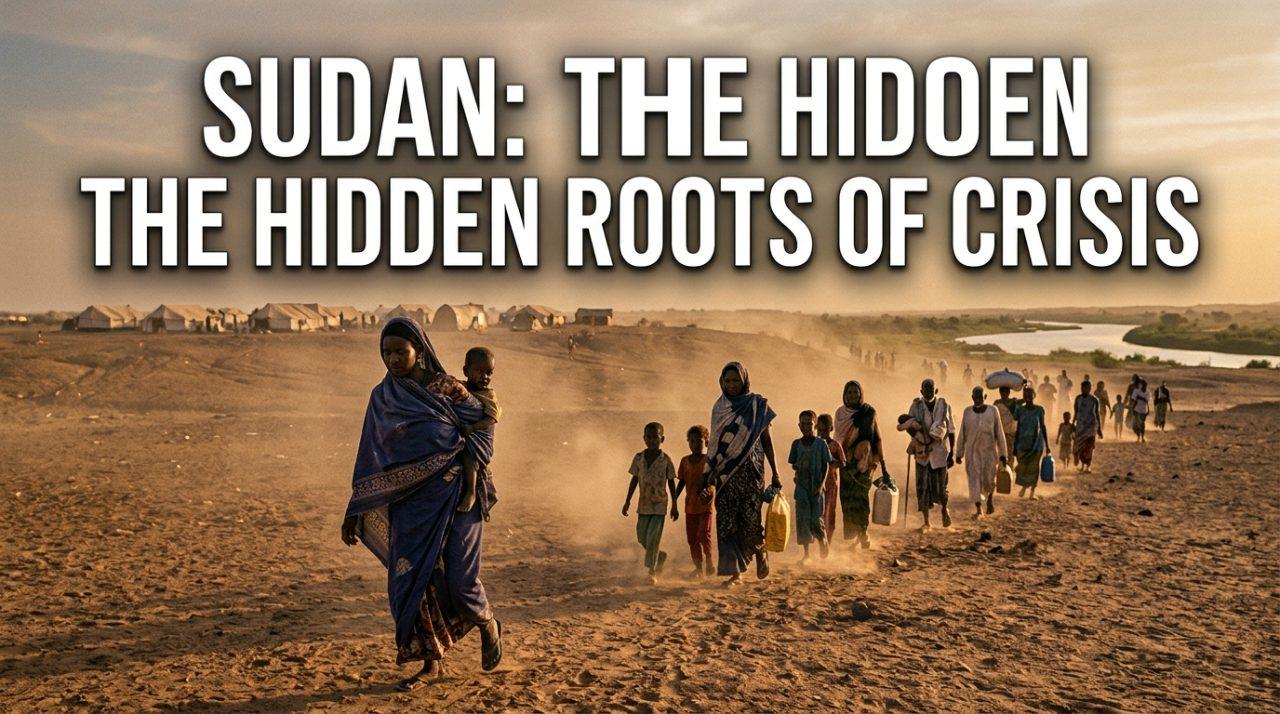
Sudan Humanitarian Crisis: The Hidden Roots of War
By Darius Spearman (africanelements)
Support African Elements at patreon.com/africanelements and hear recent news in a single playlist. Additionally, you can gain early access to ad-free video content.
The Warning from Geneva
United Nations High Commissioner for Human Rights Volker Türk issued a severe warning in Geneva. He stated that innocent civilians across Sudan face imminent peril and catastrophic violence (un.org). Bitter clashes between the Sudanese Armed Forces and the paramilitary Rapid Support Forces continue to spread. Aerial bombardments, heavy artillery, and targeted ethnic killings have expanded deep into the strategic Blue Nile corridor (ungeneva.org).
International observers often describe the conflict as a simple personal rivalry between two opposing generals. That simplistic narrative conceals the deeper historical drivers that have destabilized the nation for generations. Türk stressed that foreign arms shipments and proxy networks are actively fueling this human destruction (un.org). To understand this modern devastation, one must examine the lasting scars of colonialism and state-sponsored oppression.
Colonial Foundations and the Riverine Divide
The structural inequalities haunting Sudan originated under imperial rule. Between 1899 and 1956, the British and Egyptian colonial condominium governed the vast territory (countrystudies.us). British officials established deliberate divide-and-rule administrative policies that favored a tiny riverine elite. Power and wealth were concentrated along the Nile river valley near the capital of Khartoum (wikipedia.org).
Under colonial rule, peripheral borderlands were treated as mere labor reserves and military recruitment zones. British authorities enacted the Closed District Ordinances of 1922 to restrict domestic travel and commerce (countrystudies.us). That policy isolated southern and western provinces from national economic development. This unequal system of centralized state power laid the groundwork for decades of violent regional rebellion.
Invented Castes and the Legacy of Slavery
All indigenous populations living within Sudan are Black Africans. Despite this reality, centuries of cultural Arabization created rigid social divisions across society (hrw.org). Riverine groups adopted the Arabic language and claimed genealogical lineages linking them to the Arabian Peninsula. These elites constructed a racialized hierarchy that treated non-Arab indigenous African groups as inferior subjects (hrw.org).
This social division carries painful echoes of the historic trans-Saharan slave trade. Modern paramilitary fighters frequently shout racial slurs while attacking indigenous communities (hrw.org). Non-Arab ethnic groups like the Masalit, Fur, and Zaghawa have faced targeted violence for decades. Paramilitary leaders exploit these deep-seated cultural divisions to justify land theft, sexual violence, and ethnic cleansing (hrw.org).
Scale of Human Displacement in Sudan
Represents the largest internal and cross-border displacement crisis in the world today.
Children endure severe acute malnutrition, trauma, and complete loss of educational schooling.
Center-Periphery Marginalization as Economic Redlining
The political structure of post-independence Sudan mirrors the mechanics of institutional redlining and geographic disinvestment. For decades, the central regime extracted valuable agricultural crops, cattle, and raw minerals from peripheral territories. Yet the state returned virtually no tax revenues or public services to those outer regions. Rural farmers and pastoralists generated national wealth while enduring severe structural poverty (columbia.edu).
Peripheral provinces routinely lacked functional clinics, paved road networks, clean municipal water systems, and accredited secondary schools (paxvoorvrede.nl). Meanwhile, ruling elites in Khartoum used state budgets to construct modern neighborhoods and military academies. This calculated abandonment reflects centuries of economic exploitation designed to keep marginalized populations vulnerable and dependent. When peripheral citizens protested this extraction, the central government answered with military force.
The Janjaweed Reborn as the Rapid Support Forces
When Darfuri rebel groups demanded political representation and civil rights in 2003, the government responded with brutality. Former dictator Omar al-Bashir mobilized nomadic Arab pastoralist fighters known as the Janjaweed (wikipedia.org). The regime provided those militias with heavy weaponry, military vehicles, and absolute legal immunity. They unleashed scorched-earth campaigns, burned hundreds of farming villages, and systematically murdered innocent civilians (wikipedia.org).
In 2013, the regime institutionalized these horseback militias into an official paramilitary unit named the Rapid Support Forces (wikipedia.org). Commander Mohamed Hamdan Dagalo, known widely as Hemedti, rose rapidly through the military hierarchy. Bashir deployed the paramilitary force as an armed guard against domestic uprisings. Hemedti built a massive financial empire by seizing industrial gold mines and deploying mercenary fighters abroad (lowyinstitute.org, globalinitiative.net).
Sudan Acute Humanitarian Breakdown
Corroborated by UN OCHA, World Food Programme, and Integrated Food Security Phase Classification.
The Strategic Choke Point of the Blue Nile
The conflict has expanded far beyond the streets of Khartoum and the plains of Darfur. Fighting now threatens the Blue Nile state, an essential transit hub bordering Ethiopia and South Sudan (ungeneva.org). Historically designated as one of the Two Areas alongside South Kordofan, the region possesses long-standing political grievances (ethz.ch). Indigenous populations like the Berta and Gumuz aligned with southern liberation movements during the second Sudanese civil war (crisisgroup.org).
When South Sudan achieved independence in 2011, the Two Areas were denied a secession referendum. Instead, residents received a vague promise of popular consultations that the central government soon cancelled (ethz.ch). Today, control of the Blue Nile determines national food distribution and cross-border transport routes. The region sits adjacent to the Grand Ethiopian Renaissance Dam, raising geopolitical stakes for Egypt and Ethiopia (gisreportsonline.com).
Weaponized Hunger and Modern Drone Warfare
Starvation is being deployed intentionally as a military tactic throughout this protracted conflict. Paramilitary units have placed major population centers like El Fasher under severe military sieges (acjps.org). These forces systematically cut off municipal water lines, food trucks, and life-saving medical supplies. The Integrated Food Security Phase Classification confirmed full famine conditions in North Darfur displacement camps (ipcinfo.org, fews.net).
Simultaneously, both warring parties have escalated their reliance on foreign-manufactured aerial drones (un.org). Independent investigators found that remote drone strikes repeatedly strike civilian markets, crowded bus terminals, and functional hospitals (ungeneva.org). The widespread destruction of tertiary healthcare has crippled emergency responses across the country. Over seventy percent of medical clinics in conflict states are completely closed or severely damaged (reliefweb.int).
Global Humanitarian Funding Gap (Sudan Appeals)
International donors have provided less than half of requested emergency aid, forcing critical aid kitchens and clinics to close.
Proxy Wars and Illicit Gold Networks
The Sudanese war is sustained by lucrative foreign commercial partnerships and illegal mineral extraction. Commander Hemedti and his family oversee vast gold mining concessions, including the Jebel Amer mines in Darfur (wikipedia.org). Investigative records reveal that up to seventy percent of national gold is smuggled abroad through foreign networks (globalinitiative.net). Front companies launder these resource windfalls through Gulf markets to finance mercenary recruitment and heavy weaponry (lowyinstitute.org).
Foreign actors maintain military pipelines through eastern Libya, Chad, and porous border crossings. These covert transit lines supply the paramilitary forces with high-caliber weapons, surface-to-air missiles, and combat drones (ungeneva.org). Meanwhile, the Sudanese Armed Forces receive air support, diplomatic backing, and military supplies from regional partners (arabcenterdc.org). This foreign meddling enriches international weapons brokers while ordinary Sudanese families lose their homes and lives.
Global Indifference and the Path Forward
Despite causing the largest displacement crisis on earth, Sudan receives remarkably little attention from Western news networks. The international community demonstrates an alarming double standard when responding to Black suffering across Africa. Financial pledges for humanitarian relief in Sudan fall drastically short of appeals for European emergencies (unocha.org). Diplomatic peace negotiations spearheaded by regional organizations like the African Union have repeatedly stalled (sudantribune.com).
Despite state collapse and foreign indifference, ordinary citizens display generational resilience through community mutual aid networks. Grassroots volunteers in neighborhood Emergency Response Rooms risk sniper fire to operate communal kitchens, organize medical deliveries, and bury the dead (reliefweb.int). High Commissioner Volker Türk emphasized that outside nations must enforce a strict arms embargo immediately (un.org). Dismantling illicit proxy financing and supporting civilian-led democratic governance represent the only viable path toward genuine peace.
About the Author
Darius Spearman is a professor of Black Studies at San Diego City College, where he has been teaching for over 20 years. He is the founder of African Elements, a media platform dedicated to providing educational resources on the history and culture of the African diaspora. Through his work, Spearman aims to empower and educate by bringing historical context to contemporary issues affecting the Black community.
