


Why Is Black Unemployment Rising So Fast Today?
By Darius Spearman (africanelements)
Support African Elements at patreon.com/africanelements and hear recent news in a single playlist. Additionally, you can gain early access to ad-free video content.
A Sudden Reversal in Economic Security
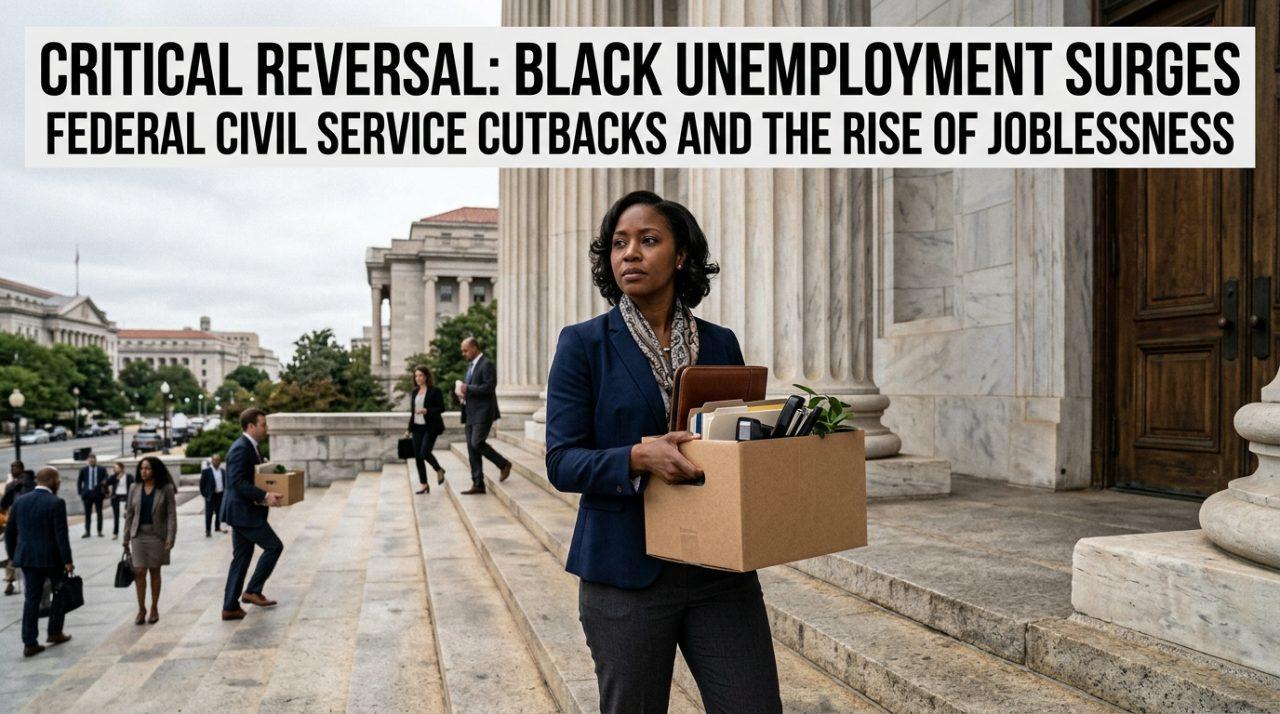
National economic data often conceals deep fractures behind broad national averages. Recent economic reports from the Economic Policy Institute and the Brookings Institution revealed that the national Black unemployment rate jumped to 7.6 percent (epi.org). This increase marks a steep departure from recent historic lows of roughly 5.5 percent recorded between 2023 and 2024. Consequently, thousands of families across the country now face unexpected financial strain.
Labor analysts emphasize that this surge does not stem from an influx of new job seekers entering the market. Instead, the numbers reflect absolute job losses concentrated in specific industries (epi.org). In particular, rapid reductions within the federal civil service have destabilized a primary foundation of African American economic stability. To understand why these cutbacks strike Black households so severely, one must look at the long historical connection between Black labor and public employment.
Unemployment Rate Disparities (2026)
The Civil Service as an Early Safe Harbor
Following the era of emancipation after the Civil War, African American workers encountered pervasive barriers in the private economy. Sharecropping, tenant farming, and predatory labor contracts trapped millions in economic servitude. In response, early Black leaders identified the federal government as a rare arena where written laws might offer protection from local racial terror.
The passage of the Pendleton Civil Service Act of 1883 introduced competitive examinations for federal positions. These objective tests gave African Americans an entry point into stable employment based on merit rather than patronage. During the late nineteenth century, the United States Post Office Department emerged as a leading employer of Black clerks, sorters, and letter carriers. By providing reliable compensation, postal work offered an essential stepping stone toward early property ownership and family stability.
However, this forward progress faced aggressive resistance. In 1913, the administration of President Woodrow Wilson institutionalized segregation across federal facilities. Black supervisors were demoted, physical partitions were erected in federal workspaces, and applicants were required to submit photographs to expose their racial identity. Civil rights leaders organized pushback against these policies, solidifying the fight for fair civil service employment as a central priority for racial equality.
Executive Action and Civil Rights in the Public Payroll
During the Great Depression and World War II, the civil service became an active battleground for fair economic treatment. Labor leader A. Philip Randolph leveraged the political strength of generations of Black workers in 1941 to challenge discriminatory defense industries. He threatened a massive demonstration in the nation’s capital, which pressured President Franklin D. Roosevelt to issue Executive Order 8802. This directive banned discrimination in defense industries and government service, creating the Fair Employment Practice Committee.
Subsequent presidents added further administrative protections to open federal offices to minority professionals. President Harry Truman issued executive orders desegregating the armed forces and the federal civilian workforce. Decades later, President John F. Kennedy signed Executive Order 10925, mandating affirmative action in government hiring, followed by Executive Order 10988, which protected collective bargaining rights for federal unions.
The legal foundation reached full strength with the Equal Employment Opportunity Act of 1972. This legislation brought public employees under the statutory protections of Title VII of the Civil Rights Act of 1964. For the first time, Black public employees had legal recourse against systemic discrimination in government promotions. As a result, the federal government evolved into the most secure pathway into the middle class for Black households.
Black Labor Force Participation
Total U.S. Labor Force
Federal Civil Service
The Persistent Two-to-One Unemployment Dynamic
Even with protections in place, the broader labor market has maintained structural inequality. Since the Bureau of Labor Statistics began tracking racially separated employment data in 1954, the Black unemployment rate has remained approximately twice that of white workers through almost every economic cycle. Economists routinely describe this enduring condition as the “last hired, first fired” reality.
When the national economy encounters downturns, Black workers regularly endure layoffs earliest and struggle the longest to recover. During times of national growth, the jobless rate for Black workers falls only toward the end of an expansion. The recent climb to a 7.6 percent unemployment rate demonstrates that this historical two-to-one ratio continues today (epi.org). In urban centers such as Washington, D.C., the local disparity has reached an alarming 2.6-to-1 ratio (brookings.edu).
Because the public sector provided an institutional buffer against these broad private-sector biases, any reduction in government employment destabilizes the primary safeguard Black workers rely on. The federal civil service employs Black workers at a rate of 19 percent, while Black workers make up just 13 percent of the overall national civilian workforce (brookings.edu). Consequently, when government headcount drops, minority communities experience the fallout most acutely.
Mechanisms of the 2025–2026 Workforce Reductions
The swiftness of the recent job cuts has led many observers to ask how civil service rules permitted such reductions. Historic civil service protections, established under the Civil Service Reform Act of 1978, were designed to prevent arbitrary terminations. However, government planners have relied on structural mechanisms to bypass conventional disciplinary hurdles.
Agencies have implemented statutory Reductions in Force under Title 5 of the United States Code. A Reduction in Force allows an agency to eliminate positions entirely due to reorganization, budget reductions, or a curtailment of work. Because these actions are classified as institutional management decisions rather than disciplinary dismissals, displaced workers cannot challenge the policy decisions before the Merit Systems Protection Board. Employees may only contest whether basic administrative procedures regarding veteran status or seniority were applied correctly.
In addition, administrative strategies have accelerated attrition without formal dismissal proceedings. Agencies implemented mandatory office returns, unexpected office relocations outside the national capital area, and strict hiring freezes. Proposals to reclassify policy-related positions into excepted categories also reduced statutory civil service protections. Over 300,000 civil service roles disappeared through these administrative restructuring actions during 2025.
The Concentrated Impact on Black Women
The burden of these layoffs has fallen with particular severity on college-educated Black women (epi.org). Historically, civil rights gains and the mid-1960s expansion of the Great Society opened career avenues in human services and social-welfare administration. Federal agencies created during that period provided the initial white-collar entry points for African American women who held advanced professional credentials.
Consequently, Black female professionals clustered in agencies such as the Department of Veterans Affairs, the Department of Housing and Urban Development, and the Department of Health and Human Services. These departments align with career paths where Black women earn significant shares of postsecondary degrees, including nursing, social work, public health, and educational administration. Today, across the American South, Black women represent 9.7 percent of the overall labor force, yet they account for 13.2 percent of federal personnel and 15.5 percent of state workers (epi.org).
When restructuring initiatives target social-welfare agencies, Black women lose stable professional roles at elevated rates. Studies by the Economic Policy Institute show that college-educated Black women experienced the sharpest initial spikes in unemployment during the 2025 contraction (epi.org). The educational attainment that typically insulates workers during recessions has offered little defense against direct agency cuts.
Regional Shock: Capital Metropolitan Area
The Regional Epicenter in the Capital Corridor
The geographic concentration of federal work has intensified the economic damage within the District of Columbia, Maryland, and Virginia metropolitan region. For decades, the stability of federal salaries helped make suburban jurisdictions like Prince George’s County and Charles County in Maryland two of the most affluent majority-Black counties in the United States. Federal salaries, transparent pay schedules, and structured retirement pensions enabled rapid homeownership and wealth building.
The Brookings Institution documented that job loss in the capital area has outpaced the rest of the nation (brookings.edu). Between late 2024 and late 2025, regional unemployment increases among Black workers were more than double the increases seen among white workers (brookings.edu). In the District of Columbia, Black unemployment climbed past 10 percent (brookings.edu). These regional numbers reveal how national policy shifts reshape local communities.
The ripple effects reach far beyond individual households. As civil servants lose their incomes, local consumer spending drops throughout neighboring business districts. County governments face reduced property and income tax revenues, which threatens funding for municipal services and public schools. The erosion of civil service positions directly undermines the institutional wealth built up across the region over multiple generations.
Barriers to Private-Sector Absorption
Displaced public servants often discover that their skills do not translate easily into private-sector employment. The federal General Schedule system utilizes standardized qualification standards and transparent pay bands. Decades of economic research demonstrate that this rigid structure significantly narrows racial wage disparities by removing subjective manager discretion.
In contrast, the private sector relies heavily on informal hiring networks, discretionary salary negotiations, and subjective cultural assessments. Labor market audit studies continue to reveal that corporate applicants with distinctively Black names receive substantially fewer interview callbacks than white applicants with identical resumes. Furthermore, many corporate hiring managers attach an unfair stigma to public-sector service, discounting federal program experience as bureaucratic rather than commercial.
This absorption barrier is intensified by corporate rollbacks of internal diversity initiatives. Recent court challenges and corporate cost-cutting measures led numerous private companies to scale back minority recruitment and compliance teams. These corporate departments historically offered logical landing spots for former public administrators. Consequently, displaced federal workers encounter a private labor market that remains hesitant to welcome their expertise.
The Road Ahead for Economic Equity
The ongoing increase in Black unemployment reveals that educational attainment and civil service loyalty cannot permanently insulate workers from structural labor shocks. The civil service once functioned as an equalizer against historic racial bias. However, broad contractions on the public payroll have transformed that protective shield into a distinct vulnerability. The struggle for steady employment remains intimately tied to the broader struggle for political power and economic self-determination.
Addressing these setbacks requires coordinated policy action. Workforce development programs must provide dedicated retraining pathways for displaced civil servants. State and local economic agencies need targeted investments to attract new commercial employers to hard-hit metropolitan corridors. Without intentional measures to support displaced workers, the historical racial wealth gap will expand, undoing decades of middle-class achievement.
About the Author
Darius Spearman is a professor of Black Studies at San Diego City College, where he has been teaching for over 20 years. He is the founder of African Elements, a media platform dedicated to providing educational resources on the history and culture of the African diaspora. Through his work, Spearman aims to empower and educate by bringing historical context to contemporary issues affecting the Black community.
