


Why African Leaders Skipped the UN Assembly
By Darius Spearman (africanelements)
Support African Elements at patreon.com/africanelements and hear recent news in a single playlist. Additionally, you can gain early access to ad-free video content.
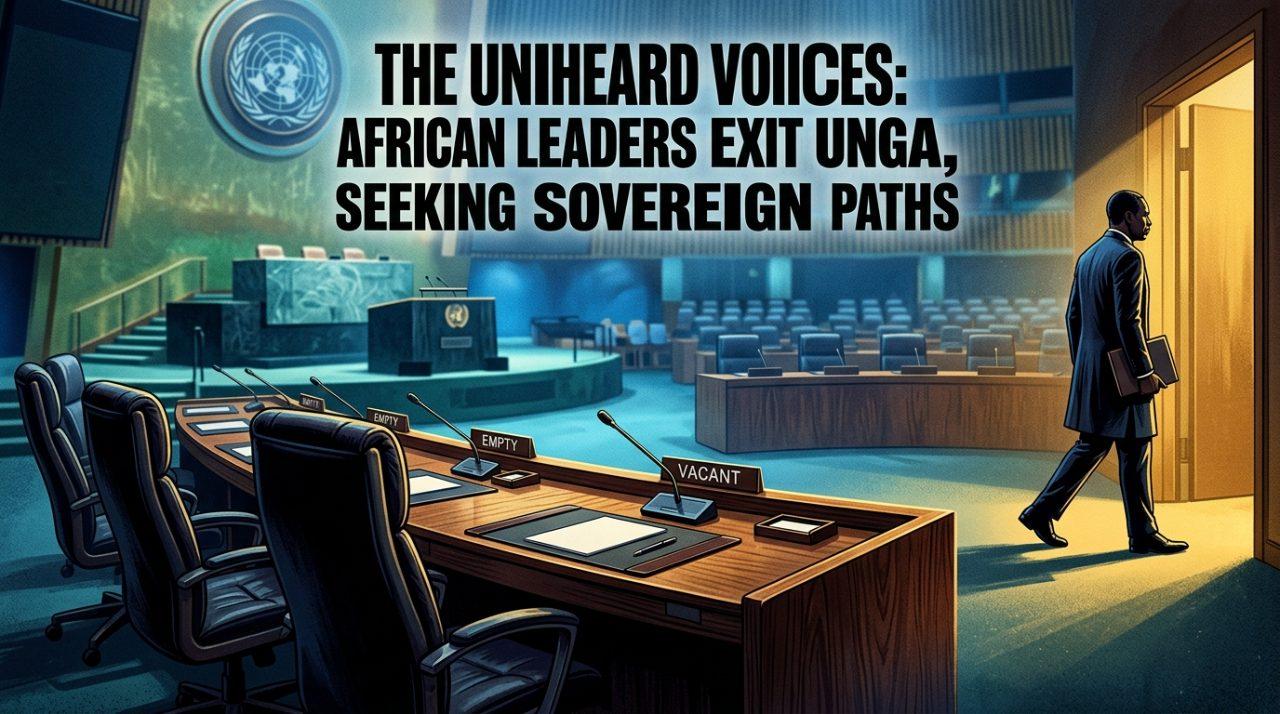
Empty Chairs at the Global Gathering
The annual gathering of the United Nations General Assembly in New York is traditionally a showcase of global statecraft. World leaders step to the famous green marble podium to outline their visions for peace and cooperation. Yet, during the 81st session, a powerful statement came from those who decided not to attend. The heads of state representing Africa’s three largest economies—Nigeria, South Africa, and Egypt—chose to stay home (ground.news, eurasiareview.com, africanews.com).
Official statements cited urgent domestic security issues, difficult economic headwinds, and regional conflicts. However, diplomatic observers recognize that these empty chairs signal something far deeper. A quiet diplomatic boycott is underway. Decades of frustration have reached a breaking point. African nations contribute troops, resources, and substantial diplomatic energy to international institutions, yet they remain systematically locked out of real decision-making power (securitycouncilreport.org, aa.com.tr).
Multilateral Roots Built on Colonial Exclusion
To understand why African leaders are turning away from the United Nations podium, one must return to 1945. When the Allied powers created the United Nations in San Francisco, almost the entire African continent was under direct European colonial rule. Only four African nations were among the original fifty-one signatories: Egypt, Ethiopia, Liberia, and South Africa (wikipedia.org).
Even those four nations operated under severe limitations. Egypt was still occupied by British troops. Ethiopia was recovering from fascist occupation. Liberia maintained close economic dependence on the United States. Meanwhile, South Africa was governed by a white-minority regime that was already building the legal framework of apartheid. Field Marshal Jan Smuts helped draft the preamble to the UN Charter while denying basic human rights to Black South Africans at home (wikipedia.org).
The victorious powers gave themselves permanent seats on the Security Council with unilateral veto power. More than one billion colonized people had zero voice in shaping the rules of global sovereignty. The 1960 decolonization wave brought seventeen newly independent African states into the international organization (wikipedia.org). Although the General Assembly expanded non-permanent Security Council seats in 1965, the core power structure remained completely locked (securitycouncilreport.org, parliament.uk).
The Broken Promise of the Ezulwini Consensus
African leaders have not remained silent about this structural exclusion. In 2005, the African Union gathered in Ezulwini, Eswatini, to establish a unified position on international reform. The resulting document, known as the Ezulwini Consensus, was formally adopted through the Sirte Declaration (securitycouncilreport.org, au.int).
The position was straightforward. Africa demanded no fewer than two permanent seats on the UN Security Council, complete with full veto privileges. In addition, the continent called for five non-permanent seats chosen by the African Union itself (au.int). African diplomats argued that it was unjust for foreign powers to deliberate on continental conflicts while denying the affected nations equal authority (securitycouncilreport.org).
Two decades later, the permanent five members continue to protect their monopoly. Western and Asian powers often offer polite diplomatic statements during public debates. Yet, concrete constitutional reform never moves forward. African leaders now see these discussions as endless procedural delays designed to preserve post-colonial advantages (aa.com.tr, eurasiareview.com).
Global Veto Power Mirrors Domestic Disenfranchisement
For observers within the African Diaspora, this diplomatic disenfranchisement looks strikingly familiar. The refusal to grant African nations voting power on the world stage parallels the mechanisms used to silence Black communities within Western democracies. In American history, when post-Civil War Reconstruction failed, white political elites erected Jim Crow laws, gerrymandering, and poll taxes to neutralize the Black vote.
The veto power wielded by the permanent members functions as a global version of this political suppression. Five nations preserve minority rule over an international body of nearly two hundred member states. Civil rights leaders long understood that global policy and domestic oppression share the same historical roots. In 1947, W.E.B. Du Bois and the NAACP presented “An Appeal to the World” directly to the United Nations, charging that racial segregation in America mirrored European imperial domination overseas (wikipedia.org).
Similarly, Malcolm X traveled to Cairo in 1964 to address the Organization of African Unity (youtube.com, transcend.org). He urged African heads of state to bring the human rights violations of the United States government before the United Nations (transcend.org). Malcolm X argued that Black freedom struggles across the globe were inseparable. When modern African leaders refuse to participate in symbolic assemblies, they continue this long tradition of rejecting second-class citizenship on the world stage.
The Crippling Weight of the African Risk Premium
The institutional bias against African sovereignty extends beyond military security into international finance. The Bretton Woods institutions, established in 1944, laid the foundation for global financial governance. Today, forty-six nations in Sub-Saharan Africa hold only about 5.3 percent of the voting power within the International Monetary Fund (brettonwoods.org). In contrast, the United States holds more than 16 percent, which grants it an effective unilateral veto over institutional decisions (brettonwoods.org).
This power imbalance enables what economists call the “African risk premium.” Private credit rating agencies based in Western financial centers frequently downgrade African debt based on subjective political perceptions (undp.org). Consequently, African governments must pay interest rates four to eight times higher than peer nations in other parts of the world. This financial penalty deepens the rising debt crisis across the continent, draining national budgets of money needed for hospitals, schools, and roads.
A landmark 2023 study by the United Nations Development Programme revealed that these rating biases cost African nations up to $74.5 billion each year in excess interest and lost loans (undp.org, undp.org). To counter this financial extraction, the African Union has initiated steps to launch the Africa Credit Rating Agency (africanleadershipmagazine.co.uk). African policymakers seek to break the monopoly of foreign financial institutions and establish equitable terms for continental development (africanleadershipmagazine.co.uk).
Building New Roads: The Rise of BRICS and the NDB
Tired of waiting for Western concessions, major African nations are investing their energy into alternative institutions. The expansion of the BRICS economic group has provided an important platform for this realignment. Both South Africa and Egypt are active members of this coalition, which offers practical alternatives to Western financial structures (socialistchina.org, ndb.int).
Through the New Development Bank, headquartered in Shanghai, emerging economies can secure funding without accepting severe public spending cuts (socialistchina.org, ndb.int). Unlike traditional lenders, the New Development Bank was designed with equal founding voting rights and prohibits political conditionalities on development loans (socialistchina.org). The bank also aims to supply up to thirty percent of its financing in local currencies to protect borrowing nations from US dollar volatility (socialistchina.org).
These alternatives do not resolve every challenge. For example, popular economic battles in South Africa highlight internal struggles over resource management, while reliance on Chinese capital presents new diplomatic questions (socialistchina.org). Even so, these new formations give African heads of state meaningful leverage that did not exist during the twentieth century (swp-berlin.org).
Nigeria, South Africa, and Egypt Turn Inward
The empty seats at the 81st General Assembly also reflect serious domestic priorities at home. In Nigeria, President Bola Ahmed Tinubu delegated attendance to his vice president while confronting major domestic challenges (brookings.edu, eurasiareview.com). Sweeping economic reforms, including fuel subsidy removals and currency realignments, have fueled record inflation (brookings.edu, facebook.com). In addition, massive climate-driven floods devastated Borno State, requiring immediate executive attention on the ground (eurasiareview.com).
In South Africa, President Cyril Ramaphosa faced his own pressing domestic landscape. After contentious elections, Ramaphosa oversees an unprecedented Government of National Unity that requires continuous political negotiation (facebook.com). Concurrently, Pretoria faces international diplomatic pressure from Western capitals over its non-aligned foreign policy and its historic legal challenge against Israel at the International Court of Justice (africanews.com). Speaking in ceremonial debates thousands of miles away offered little benefit compared to stabilizing domestic affairs (facebook.com).
Similarly, Egyptian President Abdel Fattah el-Sisi skipped the gathering as regional wars erupted along his nation’s borders (ground.news, facebook.com). Cairo must manage the devastating war in neighboring Gaza, ongoing civil strife in Sudan, and shipping disruptions in the Red Sea that have halved revenue from the Suez Canal (ground.news). For all three leaders, managing real crises at home took clear precedence over listening to unfulfilled promises in New York (ground.news, eurasiareview.com, facebook.com).
Beyond the Talk Shop: A New Era of Black Geopolitics
Even leadership within the United Nations acknowledges the justice of these grievances. Speaking on the sidelines of the assembly, UN Secretary-General António Guterres described the continent as a “double victim of colonialism” (modernghana.com, aa.com.tr). Guterres noted that African societies were excluded when international institutions were designed and continue to be mistreated by those same systems today (modernghana.com, aa.com.tr).
The empty presidential seats signal that African nations are done begging for an invitation to the table. Across the Diaspora, working communities have carried out an enduring fight for economic justice, learning that power concedes nothing without demand. African diplomacy is embracing that very reality.
Instead of relying on speeches in New York, African states are directing their focus toward regional integration under the African Continental Free Trade Area (AfCFTA) and strategic bilateral partnerships (brookings.edu, swp-berlin.org). The message delivered by Nigeria, South Africa, and Egypt is unmistakable. Global governance must either reform to reflect the modern world, or prepare to watch the continent chart its own course forward.
About the Author
Darius Spearman is a professor of Black Studies at San Diego City College, where he has been teaching for over 20 years. He is the founder of African Elements, a media platform dedicated to providing educational resources on the history and culture of the African diaspora. Through his work, Spearman aims to empower and educate by bringing historical context to contemporary issues affecting the Black community.
