


Why Pharmacy Deserts in Black Neighborhoods Are Spreading
By Darius Spearman (africanelements)
Support African Elements at patreon.com/africanelements and hear recent news in a single playlist. Additionally, you can gain early access to ad-free video content.
The Unfolding Crisis in Urban Medication Access
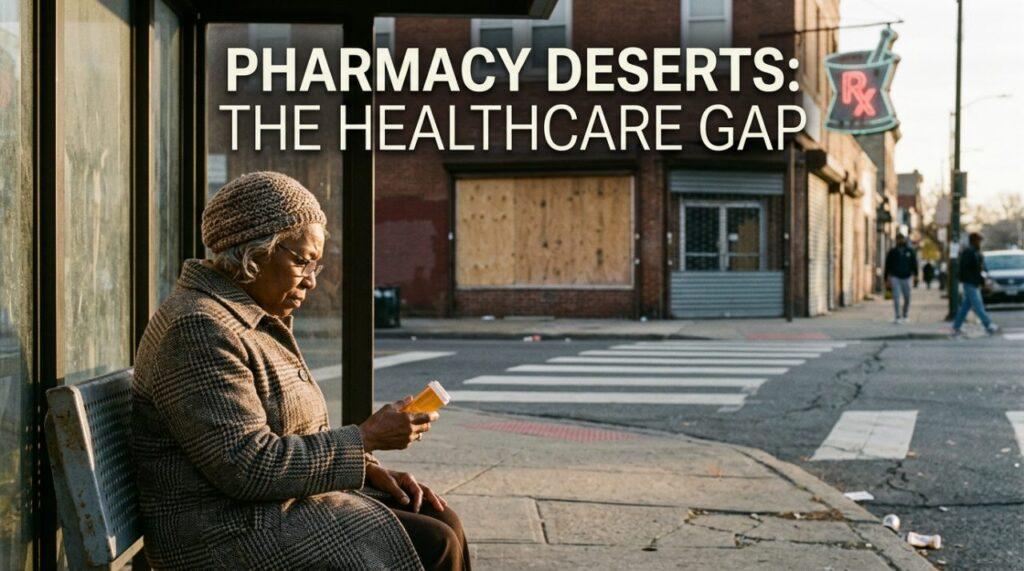
A quiet healthcare disaster is spreading across American cities today. Millions of Black residents wake up in neighborhoods where getting a simple prescription filled has become an uphill battle. While corporate headlines frequently mention store closures, public health researchers point out a far more alarming reality. Predominantly Black communities are losing their neighborhood pharmacies at an alarming rate, leaving residents stranded without basic medical resources (healthaffairs.org, bu.edu).
Public health experts call these areas pharmacy deserts. In cities like Chicago, New York, and Philadelphia, a pharmacy desert is defined as any urban neighborhood where residents live more than one mile away from a pharmacy if they own a car, or more than half a mile away if they walk (healthaffairs.org). In many segregated Black neighborhoods, access is far worse. Elderly individuals and parents managing chronic illnesses must travel miles on public buses just to purchase basic medications. This geographic isolation worsens health inequality and deepens historic racial divides (northwestern.edu, usc.edu).
The Architecture of Spatial Segregation and Redlining
The contemporary loss of urban drugstores is not an unforeseen market accident. Rather, it is the direct consequence of federal and commercial housing policies established nearly a century ago. During the 1930s, the Home Owners’ Loan Corporation and the Federal Housing Administration drew color-coded residential security maps of major American metropolises. Neighborhoods inhabited by Black residents were systematically shaded in red ink, branding them as hazardous investments (spotlightonpoverty.org, ncrc.org).
This institutional practice of redlining locked Black communities out of conventional mortgages and small business capital. Commercial disinvestment followed residential segregation. Following World War II, white middle-class flight drew private capital outward toward newly built suburbs. Supermarkets, department stores, and major drug chains bypassed urban centers, laying the groundwork for retail redlining. The geographic borders created by New Deal segregation maps still determine which communities receive healthcare resources today (bu.edu, ncrc.org). Much like the systemic economic barriers after emancipation, these discriminatory financial boundaries kept Black communities artificially underfunded for decades.
The Systematic Starvation of Black Independent Pharmacies
Decades ago, independent dispensaries owned by African Americans served as essential anchors throughout urban neighborhoods. These community stores provided far more than prescription drugs. Black pharmacists provided informal health counseling, monitored blood pressure, and extended store credit to neighbors waiting on social security checks (centerforhealthjournalism.org, uwpress.org). These independent stores preserved neighborhood self-reliance during the height of the Jim Crow era and the Civil Rights movement.
Yet, Black independent pharmacy owners confronted severe financial barriers that prevented them from expanding. Commercial lending institutions systematically denied loans and lines of credit to Black professionals. The Small Business Administration frequently approved smaller loan amounts with punitive interest rates for Black entrepreneurs compared to white applicants. Without commercial mortgages, Black pharmacists could not purchase the real estate housing their stores. Lacking property equity and operating capital, these essential community institutions could not survive when predatory corporate competitors entered their neighborhoods (uwpress.org, uwpress.org).
Pharmacy Desert Share in Chicago Neighborhoods
Corporate Monopolization and Chain Divestment
During the 1980s and 1990s, corporate pharmacy giants such as Walgreens, CVS, and Rite Aid reshaped the retail market. Backed by institutional Wall Street capital and national credit facilities, corporate retailers opened massive storefronts across American cities. They used predatory pricing models to drive local independent pharmacies out of business. Independent stores could not match the wholesale prices or massive retail selections of national chains (healthaffairs.org, ilsr.org).
Once local competitors disappeared, national corporations bought up neighborhood prescription files and established near-total monopolies across urban Black centers. However, this corporate presence was fragile. When corporate leadership decided to adjust profit margins decades later, chains closed these stores without hesitation. Approximately thirty percent of all retail drugstores in the United States closed between 2010 and 2021 (healthaffairs.org). Black communities that had lost their local drugstores were abandoned by corporate chains, leaving behind deep healthcare vacuums (usc.edu, healthaffairs.org).
The Landmark Discoveries of Dr. Dima Qato
Public awareness of this crisis shifted dramatically through the groundbreaking scholarship of Dr. Dima M. Qato. Conducting research at the University of Illinois Chicago, Dr. Qato published a landmark 2014 study in the journal Health Affairs. Her team tracked the spatial distribution of pharmacies across Chicago from 2000 through 2012. Her findings exposed deep, systemic inequalities throughout the city (healthaffairs.org).
The study proved that race, rather than family income, served as the primary indicator of pharmacy access. White neighborhoods experienced a consistent surplus of drugstores, while segregated Black census tracts faced widespread pharmacy deserts. Over forty percent of predominantly Black census tracts were designated as pharmacy deserts, compared to just two percent of white tracts (healthaffairs.org, usc.edu). Dr. Qato documented that independent pharmacies were twice as likely to close as chains, illustrating how market forces systematically remove healthcare access from vulnerable urban centers (healthaffairs.org).
The Predatory Squeeze of Pharmacy Benefit Managers
The recent surge in urban pharmacy closures is driven by opaque middlemen called Pharmacy Benefit Managers, or PBMs. These corporations manage prescription benefits for insurance conglomerates. PBMs dictate reimbursement rates, determine approved drug lists, and control how community pharmacies get paid (house.gov, ftc.gov). Over time, PBMs have squeezed retail pharmacies into operating at severe financial deficits (ftc.gov).
Central to this financial damage are Direct and Indirect Remuneration fees, commonly called DIR clawbacks. PBMs assess these arbitrary fees months after a patient picks up medication at the counter. The intermediary claws back payments based on unilateral performance metrics, forcing pharmacies to lose money on routine generic prescriptions (manesnarahari.com, ohiopharmacists.org). These clawbacks reflect broader patterns of debt extraction that drain capital from vulnerable communities. Independent dispensaries in urban centers cannot withstand these unpredictable penalties, speeding up community closures (drugtopics.com, ftc.gov).
National Retail Pharmacy Losses (2010–2021)
Payer Mix Realities and Inner-City Store Abandonment
Urban dispensaries in Black neighborhoods face specific revenue challenges that suburban stores avoid. Due to wage gaps and employment barriers, many residents rely on Medicaid or dual-eligible Medicare plans. Government programs reimburse pharmacies at significantly lower rates than private commercial insurance plans (bu.edu, manesnarahari.com). Consequently, inner-city locations generate less income per prescription filled than stores in affluent suburbs.
Suburban pharmacies offset low prescription margins through front-of-store sales. They sell cosmetics, groceries, seasonal decor, and health products to affluent consumers. In contrast, urban neighborhood stores often operate inside smaller retail footprints with lower consumer spending. When retail giants look to downsize operations, corporate spreadsheets prioritize profits over community health. They shutter inner-city stores first, leaving Black neighborhoods without essential medications (spotlightonpoverty.org, healthaffairs.org).
Cascading Clinical Fallout Across Segregated Communities
The sudden loss of a community pharmacy causes severe public health problems. When an urban drugstore closes, patients frequently stop taking maintenance therapies for chronic illnesses. Clinical studies show significant declines in medication adherence for conditions like hypertension, cardiovascular disease, and diabetes (usc.edu, nih.gov). Vulnerable seniors face long, exhausting commutes on public transit just to obtain life-saving insulin or heart medications.
Furthermore, neighborhood pharmacies serve as essential community public health centers. Pharmacists deliver the majority of seasonal adult vaccines and offer confidential tests for viral infections. They distribute naloxone kits to prevent fatal overdoses and provide preventive treatments like PrEP to slow HIV transmission (nih.gov, nih.gov). When a neighborhood loses its pharmacy, these clinical interventions vanish. Preventable chronic illnesses escalate rapidly, sending residents to overwhelmed hospital emergency rooms (northwestern.edu, nih.gov).
Urban Populations Living in Pharmacy Deserts
The Hidden Impact on Food and Household Security
In many urban areas, corporate pharmacies also serve as neighborhood corner stores. Because residential segregation systematically produced grocery store deserts, residents often rely on pharmacies for everyday essentials. Families purchase milk, baby formula, diapers, over-the-counter children’s medicines, and basic toiletries from these corporate retail outlets (bu.edu, centerforhealthjournalism.org).
When these commercial stores shutter their doors, they create immediate food and retail shortages. Residents lose access to fresh dairy and pantry goods alongside life-saving medications. Working parents and elderly relatives are forced to travel miles on public transportation for basic infant formula or fever medicines. Relying on enduring family resilience, neighbors share rides and coordinate deliveries. However, personal networks cannot fully replace missing community infrastructure.
Reclaiming Care Through the Federal 340B Program
Relying on corporate chains to solve this crisis has repeatedly failed urban Black communities. Health equity advocates argue for community-anchored models built to withstand corporate market swings. The federal 340B Drug Pricing Program offers a sustainable path forward. Created by Congress in 1992, the statute requires drug manufacturers to offer discounted prices to safety-net healthcare clinics, including Federally Qualified Health Centers (gaprx340b.com, nachc.org).
Embedding in-house, non-profit dispensaries into community clinics offers an alternative to retail corporations. Community health centers reinvest 340B savings into clinical programs, providing free or low-cost medications to uninsured patients (nachc.org, aha.org). These clinics are protected from Wall Street demands and cannot abandon neighborhoods during economic downturns. These centers provide culturally competent care, bilingual staff, and door-to-door transit services, placing community wellness above corporate revenue (commonwealthfund.org, nachc.org).
Policy Paths Toward Equitable Health Infrastructure
Ending pharmacy deserts requires bold policy changes at state and federal levels. Lawmakers must confront corporate PBM practices by passing transparency legislation, banning retroactive DIR clawback fees, and setting minimum reimbursement floors (house.gov, ftc.gov). Ensuring dispensing fees cover the actual cost of medications allows safety-net pharmacies to keep their doors open in low-income neighborhoods.
State Medicaid agencies must also raise dispensing fees in Medically Underserved Areas to support urban dispensaries. Community members are turning to Black political organizing to demand state-backed telepharmacy sites and subsidized local courier programs. Pharmacy deserts are not natural market outcomes. They are the visible result of decades of commercial redlining and policy choices. Rebuilding healthcare access in Black neighborhoods requires bold public investment to ensure medical equity for all (bu.edu, spotlightonpoverty.org).
About the Author
Darius Spearman is a professor of Black Studies at San Diego City College, where he has been teaching for over 20 years. He is the founder of African Elements, a media platform dedicated to providing educational resources on the history and culture of the African diaspora. Through his work, Spearman aims to empower and educate by bringing historical context to contemporary issues affecting the Black community.
