


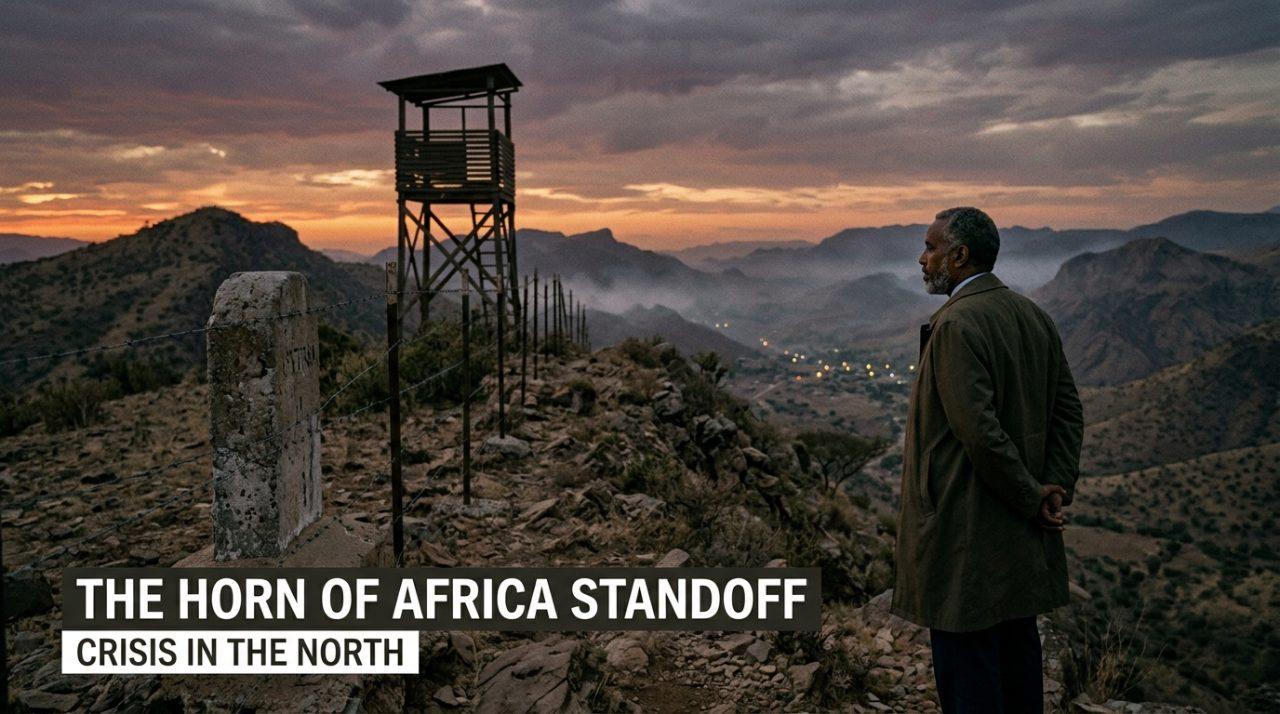
Ethiopia-Eritrea Border Crisis: Can War Be Averted?
By Darius Spearman (africanelements)
Support African Elements at patreon.com/africanelements and hear recent news in a single playlist. Additionally, you can gain early access to ad-free video content.
Diplomatic alarms are ringing across the Horn of Africa as military units assemble along the rugged northern frontier of Ethiopia (securitycouncilreport.org, thereporterethiopia.com). Observers across the global Black diaspora watch with deep concern as old battlegrounds threaten to ignite once again. The African Union Commission and the United Nations Security Council have launched urgent diplomatic interventions to stop direct warfare between Ethiopia and Eritrea (securitycouncilreport.org, africanews.com).
Trouble escalated rapidly following skirmishes along the border towns of Tigray, including Zalambessa, Adigrat, and Adi Hageray (garoweonline.com, borkena.com). Both nations severed formal diplomatic channels, recalled diplomatic missions, and exchanged harsh words in international forums (thereporterethiopia.com, newarab.com). Ethiopian federal forces launched drone strikes against military hardware moving near the frontier (borkena.com). In response, Asmara accused Addis Ababa of plotting an invasion to seize Red Sea coastline (ahram.org.eg, arabnews.com). To make sense of these dangerous developments, one must examine the deep historical grievances that continue to haunt both sister nations.
Lines Drawn in Dust: The Colonial Roots of Conflict
The current standoff along the northern frontier cannot be separated from the legacy of European imperialism. During the late nineteenth century, European powers carved up the African continent with little regard for indigenous populations. Italy established its colony of Eritrea along the Red Sea coast in 1890 (wikipedia.org, wikipedia.org). Imperial authorities then negotiated borders with Emperor Menelik II of Ethiopia through treaties signed in 1900, 1902, and 1908 (wikipedia.org).
These colonial agreements relied on vague topographical descriptions, seasonal riverbeds, and imprecise mountain peaks (wikipedia.org, wikipedia.org). The resulting ambiguity created contested pockets such as Badme, Zalambessa, and Bure. Many African historians emphasize that addressing modern territorial disputes requires examining this colonial legacy to dismantle inherited geopolitical traps. When European empires withdrew, their arbitrary borders remained behind like unexploded landmines across the African landscape.
Eritrea fought a bitter thirty-year war of independence against Ethiopian rule that concluded in 1991 (wikipedia.org). When Eritrean citizens voted overwhelmingly for sovereign independence in 1993, Ethiopia officially became landlocked (cfr.org, wikipedia.org). Although relations between the two capitals appeared fraternal at first, the lack of formal border demarcation left unresolved tensions beneath the surface (wikipedia.org, wikipedia.org). The shared frontier spanned roughly one thousand kilometers, yet neither state completed physical boundary demarcation on the ground (wikipedia.org).
Human Toll of Northern Ethiopian Conflicts
From Brothers in Arms to Enemies: The Badme Legacy
The shared struggle against the Derg military dictatorship originally united the Tigray People’s Liberation Front and the Eritrean People’s Liberation Front (wikipedia.org). However, mutual suspicion steadily grew over currency policies, trade duties, and disputed farmland (wikipedia.org, wikipedia.org). In May 1998, a localized clash near the remote border village of Badme triggered an immense conventional war (wikipedia.org). The conflict quickly devolved into trench warfare reminiscent of the First World War (wikipedia.org, wikipedia.org).
Between 1998 and 2000, artillery duels and human wave assaults claimed an estimated seventy thousand to one hundred thousand lives (wikipedia.org). Hundreds of thousands of civilians were forced to flee their homes along the battle lines (wikipedia.org, wikipedia.org). In December 2000, both nations signed the Algiers Agreement under the mediation of the Organization of African Unity and the United Nations (wikipedia.org). An independent Eritrea-Ethiopia Boundary Commission was established in The Hague to deliver a final ruling on the frontier (wikipedia.org, wikipedia.org).
The commission announced its verdict in April 2002, formally awarding the disputed town of Badme to Eritrea (wikipedia.org). The Ethiopian government, then dominated by the Tigray People’s Liberation Front, refused to surrender the territory without further preconditions (wikipedia.org). This refusal produced a paralyzing sixteen-year standoff known as the “No War, No Peace” era (wikipedia.org, crisisgroup.org). Families remained separated, trade stopped entirely, and heavily armed infantries stared down each other across barbed-wire trenches (wikipedia.org, wikipedia.org).
The 2018 Peace Deal and the Tigray War Paradox
The regional political landscape shifted dramatically in 2018 when Abiy Ahmed assumed office as Prime Minister of Ethiopia (cfr.org, wikipedia.org). In a surprise diplomatic breakthrough, Prime Minister Abiy accepted the 2002 boundary ruling without reservations (wikipedia.org). He traveled to Asmara in July 2018 to embrace Eritrean President Isaias Afwerki (wikipedia.org). The historic peace declaration restored commercial aviation, telephone links, and diplomatic embassies, earning Abiy the 2019 Nobel Peace Prize (cfr.org, wikipedia.org).
However, this bilateral rapprochement carried a hidden friction. The leadership of the Tigray People’s Liberation Front, operating from their regional stronghold in Mekelle, felt sidelined by the direct pact between Addis Ababa and Asmara (cfr.org, crisisgroup.org). Historical rivalries between President Isaias and the Tigrayan leadership had festered for decades (crisisgroup.org, crisisgroup.org). The alliance between Addis Ababa and Asmara isolated the regional government of Tigray, setting the stage for domestic upheaval (cfr.org, crisisgroup.org).
When civil war erupted in northern Ethiopia in November 2020, President Isaias deployed the Eritrean Defense Forces alongside Ethiopian federal troops (cfr.org, crisisgroup.org). The intervention aimed to neutralize their shared Tigrayan adversary once and for all (crisisgroup.org, crisisgroup.org). The brutal two-year internal conflict exacted a staggering humanitarian price, resulting in approximately six hundred thousand war-related deaths and mass starvation (crisisgroup.org, crisisgroup.org). Yet the conclusion of the war did not bring lasting stability to the frontier.
Why Eritrea Was Shut Out of the Pretoria Accord
In November 2022, the African Union mediated a historic Cessation of Hostilities Agreement in Pretoria, South Africa (securitycouncilreport.org, crisisgroup.org). The accord halted direct combat between the Ethiopian federal military and Tigrayan regional forces (crisisgroup.org, crisisgroup.org). However, Eritrea was completely absent from the negotiating table (crisisgroup.org). African Union mediators treated the conflict strictly as an internal Ethiopian political crisis rather than an international confrontation (crisisgroup.org).
International human rights bodies had accused Eritrean forces of severe atrocities during the fighting, making their presence at the peace table diplomatically sensitive (crisisgroup.org, hrc-eritrea.org). Furthermore, Tigrayan negotiators refused to participate if Asmara was recognized as an official party to the peace talks (crisisgroup.org, crisisgroup.org). As a result, the Pretoria Agreement included a mandate requiring the withdrawal of all foreign forces from Tigrayan soil, but Eritrea never signed the document (crisisgroup.org, crisisgroup.org).
This exclusion created profound resentment in Asmara. President Isaias viewed the peace settlement as an unexpected betrayal by Prime Minister Abiy (crisisgroup.org). The agreement spared their mutual adversary and allowed Tigrayan authorities to retain political influence (crisisgroup.org, crisisgroup.org). Consequently, Eritrean regiments refused to vacate strategic border communities in northern Tigray, including portions of Irob and the Zalambessa transit corridor (garoweonline.com, crisisgroup.org). The seeds for renewed confrontation were sown the very day the peace accord was signed.
Frontier Territorial Scale and Deployments
The New Alliances: Fano, TPLF, and the Red Sea Rush
The post-war peace architecture began to crack wide open in early 2023 when the Ethiopian government moved to disarm regional paramilitary organizations (thenewhumanitarian.org, cfr.org). Amhara volunteer militias known as the Fano had fought alongside federal troops during the war against Tigrayan forces (cfr.org). However, Fano fighters perceived federal disarmament orders as a direct threat to their regional security (thenewhumanitarian.org, cfr.org). They feared that federal authorities would return contested lands like Welkait to Tigray under political compromises (thenewhumanitarian.org).
These grievances transformed former allies into determined insurgents. Fano commanders initiated an armed rebellion against federal authority across the Amhara region (thenewhumanitarian.org, cfr.org). In an astonishing reversal of allegiances, rebel elements coordinated to create the “Alliance for Survival” (garoweonline.com, borkena.com). This loose opposition coalition brought together historical adversaries, uniting factions of the Fano with Tigrayan elements and regional insurgent groups (garoweonline.com, borkena.com). These shifts resemble earlier political struggles where disparate groups aligned against a common adversary to survive state pressure.
Addis Ababa quickly accused Asmara of arming and sheltering these insurgent elements across the northern border (garoweonline.com, borkena.com). Skirmishes erupted along transportation corridors connecting Zalambessa to Adigrat (garoweonline.com, borkena.com). Ethiopian military units responded with high-altitude drone operations aimed at neutralising logistics networks (borkena.com). Tensions exploded into full view when both nations expelled diplomats, bringing bilateral relations to a complete standstill (borkena.com, thereporterethiopia.com).
Regional Chessboard: Somaliland, Egypt, and Encirclement
The frontier friction is further fueled by high-stakes maritime ambitions across the Red Sea basin. Prime Minister Abiy declared that sovereign sea access is an existential requirement for Ethiopia and its one hundred twenty million citizens (cfr.org, arabnews.com). On January 1, 2024, Ethiopia signed a controversial Memorandum of Understanding with the self-declared Republic of Somaliland (cfr.org, adf-magazine.com). The proposed agreement offered naval base access along the Gulf of Aden in exchange for formal recognition of Somaliland’s sovereignty (cfr.org, adf-magazine.com).
The deal triggered intense outrage in Mogadishu, which considers Somaliland an inalienable component of sovereign Somalia (cfr.org, adf-magazine.com). Somalia immediately reached out to traditional regional powers to construct a counter-balancing coalition (cfr.org, ahram.org.eg). Egypt quickly formed an alliance with Somalia, delivering military shipments to Mogadishu and offering thousands of peacekeeping soldiers (cfr.org, ahram.org.eg). Cairo has long opposed Ethiopia over the construction of the Grand Ethiopian Renaissance Dam along the Blue Nile (cfr.org, ahram.org.eg).
Eritrea seized this diplomatic opening to safeguard its coastal territory. President Isaias forged closer security arrangements with Egypt, Somalia, and the military government of Sudan (ahram.org.eg, theeastafrican.co.ke). Leaders in Addis Ababa now fear complete diplomatic and military encirclement by hostile neighbors (cfr.org, theeastafrican.co.ke). At the same time, Asmara fears Ethiopian military leaders might launch an offensive toward the Eritrean port of Assab (ahram.org.eg, arabnews.com). Much like broken promises in other historical eras, unresolved agreements have renewed insecurity across the entire region.
Diplomatic and Humanitarian Metrics
The African Union Steps In: Can Diplomacy Prevail?
Faced with the prospect of an interstate war that could engulf the Horn of Africa, the African Union Peace and Security Council has mobilized emergency diplomatic channels (securitycouncilreport.org, theeastafrican.co.ke). AU Commission Chairperson Moussa Faki Mahamat urged both capitals to step back from military confrontation (thereporterethiopia.com, africanews.com). Mediators emphasize that boundary disputes cannot be settled through mechanized armor and air strikes (securitycouncilreport.org, thereporterethiopia.com).
Former Nigerian President Olusegun Obasanjo, who led the 2022 Pretoria peace negotiations, has been called upon to revive high-level mediation (thereporterethiopia.com, theeastafrican.co.ke). His primary task is re-establishing direct communication between Addis Ababa and Asmara before localized skirmishes spiral out of control (thereporterethiopia.com, theeastafrican.co.ke). At the United Nations Security Council, regional representatives held closed-door briefings to coordinate international mediation efforts alongside the African Union (securitycouncilreport.org).
The humanitarian stakes could not possibly be higher. Northern Ethiopia is still struggling to recover from the devastation of the 2020–2022 civil conflict (thenewhumanitarian.org, crisisgroup.org). Approximately one million internally displaced persons remain in makeshift camps across Tigray without permanent shelter (thenewhumanitarian.org). Over four million people depend on emergency food shipments to survive severe drought and broken agricultural systems (thenewhumanitarian.org). A renewed war along the border would sever vital supply corridors, plunging vulnerable communities back into catastrophic famine (thenewhumanitarian.org).
Looking Ahead: Breaking the Cycle of Horn Conflict
The escalating friction along the Ethiopia-Eritrea border demonstrates that military victories cannot substitute for genuine political reconciliation (crisisgroup.org, crisisgroup.org). For over a century, the people of the northern frontier have endured the consequences of European colonial mapping, autocratic rivalry, and broken peace accords (wikipedia.org, wikipedia.org). Sustainable regional stability requires comprehensive solutions that address the underlying grievances of all communities involved.
First, both nations must complete physical boundary demarcation in accordance with international legal rulings (securitycouncilreport.org, wikipedia.org). Second, regional security frameworks must respect national borders while offering reasonable, negotiated commercial access to maritime shipping lanes (cfr.org, adf-magazine.com). The African Union must demonstrate that African institutions possess the diplomatic resolve to resolve continental crises peacefully (securitycouncilreport.org, theeastafrican.co.ke). Only by dismantling the militarized legacies of the past can the Horn of Africa build a shared future rooted in dignity, peace, and mutual prosperity.
About the Author
Darius Spearman is a professor of Black Studies at San Diego City College, where he has been teaching for over 20 years. He is the founder of African Elements, a media platform dedicated to providing educational resources on the history and culture of the African diaspora. Through his work, Spearman aims to empower and educate by bringing historical context to contemporary issues affecting the Black community.
