


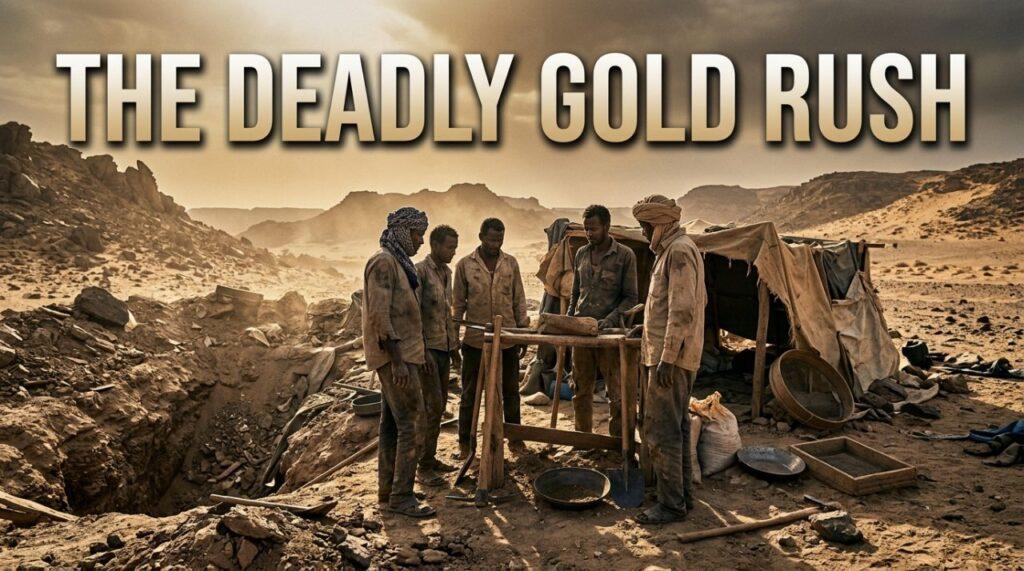
Sudanese Border Miners Strike: The Deadly Gold Rush
By Darius Spearman (africanelements)
Support African Elements at patreon.com/africanelements and hear recent news in a single playlist. Additionally, you can gain early access to ad-free video content.
The dawn over the Nubian Desert brought sudden devastation rather than warmth. On a quiet morning in the borderlands of Red Sea State, heavy military aircraft appeared above the artisanal mining encampments of Jabal al-Uqaydat. Five separate aerial strikes pounded the dry terrain. The bombardments tore through makeshift tents and primitive excavation tunnels where civilian laborers slept. When the smoke cleared, human rights monitors discovered a catastrophic scene. Over seventy artisanal prospectors lay dead, and dozens more suffered grievous wounds (arabnews.com, newarab.com).
The tragedy immediately sparked regional fury. Legal collectives such as Emergency Lawyers and the Sudan Doctors Network quickly condemned the aerial assault as a massacre of civilians (sudantribune.com). Survivors described frantic efforts to dig out comrades trapped beneath collapsed hillsides. Most victims were not soldiers or armed insurgents. Instead, they were ordinary Sudanese laborers seeking survival amid an economic collapse. The story echoes the long history of resource plunder across the African diaspora. Black labor continues to be sacrificed in remote borderlands while military cartels claim the riches buried beneath the earth.
To view this airstrike as a random border skirmish is to ignore history. The violence along the northern border is the modern chapter of an imperial struggle. Colonial cartography, state fragmentation, and the global scramble for gold have converged in northern Sudan. Understanding the tragedy requires exploring the deep historical roots behind these bloody headlines.
The Carnage at Jabal al-Uqaydat
The strikes struck deep inside the Shamal al-Wadi corridor near the Egyptian frontier. Eyewitness accounts gathered by legal groups revealed that the aircraft dropped heavy ordnance directly on civilian processing huts (sudantribune.com). Scores of prospectors perished instantly. Others suffocated under tons of dislodged rock inside narrow shafts. Terrified survivors fled into the desert towards the al-Ansary markets, leaving behind tools and personal belongings (newarab.com).
This incident was not an unprecedented event. Only months earlier, a similar aerial sweep along the border killed twenty-three artisanal workers (sudanhorizon.com). Foreign security forces seized dozens of tons of mineral ore during those earlier operations. Cairo framed these sweeping maneuvers as border defense against smugglers and criminal gangs. Yet, rights advocates emphasize that the overwhelming majority of victims were unarmed citizens trying to feed their families.
General Abdel Fattah al-Burhan, head of the Sudanese Armed Forces, ordered an internal committee to investigate the strike (sudantribune.com). Still, the official response remained cautious. The Sudanese military relies heavily on regional alliances in its war against paramilitary rivals. That reliance has made accountability difficult to secure for victims living on the geographic periphery. Modern authorities often maintain silence, paralleling ongoing fights over justice that have defined liberation movements throughout modern African and diaspora history.
Documented Casualties: Jabal al-Uqaydat Border Strikes
Imperial Lines and Contested Ground: The 1899 and 1902 Borders
The desert sands around Jabal al-Uqaydat are marked by imperial pencil lines. In 1899, British colonial officials created the Anglo-Egyptian Condominium. They drew a straight line across the map along the 22nd parallel north. This border ignored local grazing routes and native populations. The imperial authorities believed straight lines made military governance simple and efficient.
Three years later, British administrators recognized their mistake. In 1902, the colonial government established an administrative boundary that differed from the original line. This adjustment placed the Halayeb Triangle under Sudanese administration because the local Beja tribes were culturally tied to Khartoum. At the same time, Egypt received administrative authority over Bir Tawil south of the parallel. These conflicting borders laid the foundation for decades of diplomatic friction.
Following independence in 1956, both nations claimed the contested territory. Sudan defended the 1902 administrative border, while Egypt insisted on the 1899 treaty line. Tensions peaked in 1995 after an assassination attempt on Egyptian President Hosni Mubarak in Ethiopia. Cairo accused elements in Khartoum of complicity and moved troops into the Halayeb Triangle to cement de facto control (worldpeacefoundation.org). The indigenous populations found their customary lands militarized. Today, modern prospectors follow mineral veins through these colonial zones, entering crosshairs created by British cartographers over a century ago.
The 2011 Oil Shock and the Rush for Gold
Civilian prospectors did not migrate to the arid mountains by choice. Their presence is the direct result of economic devastation. For decades, Sudan relied almost entirely on crude oil. Petroleum made up over ninety percent of the country’s export earnings and financed the state apparatus. That economic foundation vanished in July 2011 when South Sudan voted for independence (chathamhouse.org).
The partition stripped Khartoum of three-quarters of its oil reserves overnight. Facing high inflation and a currency crisis, the regime of Omar al-Bashir needed revenue immediately. The government actively promoted gold prospecting to replace the lost oil. Officials encouraged citizens to purchase cheap metal detectors and head into the deserts of Northern and Red Sea states. The state treated artisanal mining as a quick fix for national insolvency.
This state-sponsored rush turned millions of impoverished citizens into miners. Displaced farmers and unemployed graduates migrated into harsh desert environments. Much like the forced labor systems that trapped Black workers after emancipatory promises were broken in the Americas, economic desperation compelled Sudanese miners to accept dangerous working conditions. Artisanal operations quickly accounted for more than eighty percent of Sudan’s gold output (dailymaverick.co.za, chathamhouse.org). The government relied on these miners for foreign currency, yet offered them no safety protections or legal security.
Sudan Gold Extraction Profile
From Janjaweed to Corporate Cartels: The Rise of the RSF
As gold production expanded across Sudan, armed factions moved to control the revenue. The most dramatic shift occurred in Darfur around the rich deposits of Jebel Amer. In 2013, President al-Bashir formally institutionalized the Janjaweed militias into the Rapid Support Forces, placing commander Mohamed Hamdan Dagalo, known as Hemedti, in charge (worldpeacefoundation.org, chathamhouse.org). The regime created this praetorian guard to shield itself from internal coups.
By 2017, the RSF seized full control of Jebel Amer through force and tribal displacement. Hemedti consolidated the mines under family-run companies like Al-Junaid (worldpeacefoundation.org). The paramilitary group evolved from a counter-insurgency militia into a transnational economic empire. Raw bullion was flown directly from remote landing strips to regional refineries, bypassing official treasuries. Gold became the primary currency of violence in the region.
Meanwhile, the Sudanese Armed Forces constructed their own corporate networks. The military ran mineral trading companies and collected fees on processing plants. When popular protests ousted al-Bashir in 2019, the generals and the paramilitaries formed an uneasy ruling coalition. That partnership collapsed completely in April 2023 over security sector reforms. The dispute centered on how quickly the RSF would integrate into the regular army (aljazeera.com). When negotiations broke down, the battle for national power began, funded largely by the gold deposits both factions controlled.
Sovereign Collusion: Why Regional Powers Patrol the Desert
The conflict between the SAF and the RSF quickly spilled beyond Sudan’s borders. The warfare transformed the gold fields of northern Sudan into vital lifelines. For the SAF-led government operating from Port Sudan, northern gold represents the last major source of official revenue. For the RSF, illicit gold corridors stretching through the desert fund arms purchases and mercenary payrolls. Control over extraction sites became a matter of military survival.
Regional powers entered the fray to protect their own strategic interests. Egypt has consistently supported General al-Burhan and the regular army. Cairo views the institutional stability of Sudan as essential for its southern border security and Nile water rights, particularly concerning the Grand Ethiopian Renaissance Dam (rawabetcenter.com). Consequently, the Egyptian military watches the northern desert closely to intercept smuggling networks that finance the RSF.
Artisanal prospectors operate directly within these militarized trade corridors. Because the Central Bank pays below-market rates in depreciated currency, many miners sell gold to cross-border dealers for stable cash. Regional air forces treat these remote desert operations as hostile targets. When foreign air power strikes these camps, Khartoum rarely lodges formal protests. The state depends heavily on allied military hardware and diplomatic backing, leaving civilian miners without state protection.
Humanitarian and Labor Landscape
The Human Cost: Artisanal Miners Trapped Between Empires
The tragedy at Jabal al-Uqaydat underscores the dangerous reality faced by artisanal workers. Over two million Sudanese rely on small-scale mining to survive (chathamhouse.org). They operate in unforgiving conditions with basic hand tools. Workers inhale toxic dust, handle mercury without protective equipment, and risk shaft collapses daily. When foreign jets drop bombs on their encampments, these vulnerable workers bear the cost of regional conflicts.
Labels like “illicit miners” or “smuggling networks” obscure the human reality. The miners are citizens displaced by war, searching for an honest wage in a collapsed economy. The practice of criminalizing vulnerable communities mirrors historical patterns where economic refugees are branded as outlaws. Labeling these miners as illicit actors allows military forces to treat civilian gathering points as legitimate free-fire zones.
International legal groups insist that international humanitarian law applies in these border regions. The Geneva Conventions protect civilians who are not participating in active combat. Using heavy aerial munitions against informal mining camps violates core international standards. Yet, without independent international investigations, justice remains elusive for families mourning their dead along the border.
Redefining Sovereignty in the Shadow of Extractive Violence
The airstrikes at Jabal al-Uqaydat reflect the systemic violence of resource extraction across the African continent. When national institutions crumble, mineral wealth rarely enriches the local population. Instead, valuable resources attract armed cartels, foreign interference, and state-sanctioned violence. The artisanal miners of northern Sudan are trapped between domestic warlords and regional security forces.
This reality demonstrates the failures of broken post-conflict reconstruction efforts that prioritize elite power agreements over civilian safety. The miners dig into historical sands shaped by colonial cartographers and modern warlords. Their labor produces the gold that lines foreign vaults, while their lives are cut short by aerial bombardment. True justice for the dead requires more than military investigations. It demands an end to the militarization of African resources and accountability for those who bomb civilian workers.
About the Author
Darius Spearman is a professor of Black Studies at San Diego City College, where he has been teaching for over 20 years. He is the founder of African Elements, a media platform dedicated to providing educational resources on the history and culture of the African diaspora. Through his work, Spearman aims to empower and educate by bringing historical context to contemporary issues affecting the Black community.
