

Why Federal Voter Intimidation Tactics Are Returning
By Darius Spearman (africanelements)
Support African Elements at patreon.com/africanelements and hear recent news in a single playlist. Additionally, you can gain early access to ad-free video content.
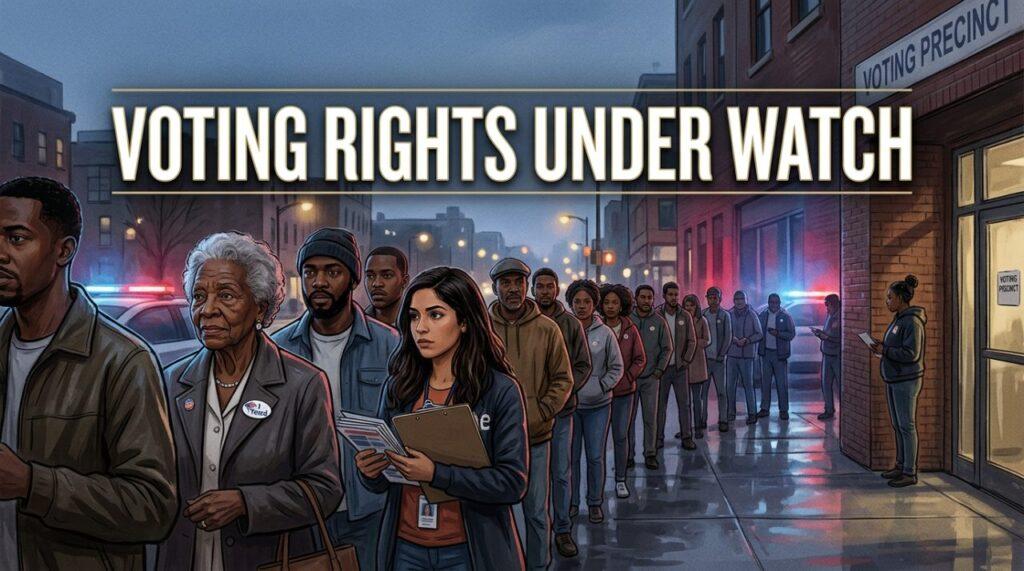
When headlines announce sudden federal probes and state police raids in Black and Brown neighborhoods, communities feel an immediate chill. Sirens flash, officers knock on doors, and local organizers face felony charges. Many observers view these operations as shocking, modern disruptions to American democracy. In truth, these high-profile sweeps are part of a very old playbook. For generations, partisan authorities have used the language of election integrity to frighten targeted communities away from the ballot box.
In response, civil rights groups refuse to stand down. Organizations such as Common Cause, the Lawyers’ Committee for Civil Rights Under Law, and the NAACP Legal Defense Fund have built powerful defense networks (commoncause.org, lawyerscommittee.org). They deploy poll monitors, run multilingual hotlines, and file emergency lawsuits to protect everyday people. To understand why this protection network is necessary today, one must examine the deep historical cycle behind the breaking news.
Relative Polling Place Wait Time Disparity
The Reconstruction Roots of Ballot Policing
The habit of criminalizing Black political engagement began immediately after emancipation. Following the Civil War, the ratification of the Fifteenth Amendment in 1870 granted Black men the constitutional right to vote (cambridge.org). Congress passed the Enforcement Acts to protect these newly freed citizens from white vigilantes (cambridge.org). Federal marshals stood guard at polling places across the South. For a brief moment, Black political power flourished. Black men won seats in southern statehouses, city councils, and the United States Congress.
That progress triggered a swift and violent white backlash. After post-Civil War Reconstruction fell short and federal troops withdrew in 1877, southern states rewritten their constitutions (cambridge.org). White leaders claimed that Black enfranchisement brought rampant corruption and fraud. Under the pretext of cleaning up elections, lawmakers established literacy tests, poll taxes, and grandfather clauses. Sheriffs arrested Black organizers on manufactured charges. Law enforcement became the primary weapon to enforce white supremacy at the ballot box.
This history shows that the concept of ballot integrity was used as a weapon from the start. Whenever Black communities built political power, local officials claimed the vote was tainted. They insisted that only strict policing could protect public trust. That historical pattern continues to shape voting battles across the nation today.
Operation Eagle Eye and Partisan Caging
As the civil rights movement gained national momentum in the 1960s, ballot policing found a modern home within organized political campaigns. In 1962, conservative political operatives in Arizona created a program called Operation Eagle Eye (wikipedia.org). Partisan workers targeted precincts in South Phoenix with large Black, Mexican American, and Native American populations (wikipedia.org, wikipedia.org). Challengers hovered over voters in line, demanding that they read passages from the United States Constitution before receiving a ballot (wikipedia.org).
By 1964, national party officials expanded Operation Eagle Eye across multiple states (wikipedia.org, wikipedia.org). They introduced a technique known as voter caging (wikipedia.org). Operatives sent mass mailings marked do not forward into minority neighborhoods (wikipedia.org). Whenever letters were returned as undelivered because of a typo or postal error, operatives compiled challenge lists. Challengers used those lists on Election Day to demand that poll workers reject minority voters.
These organized challenges were designed to slow down voting lines and frighten new voters away (wikipedia.org, wikipedia.org). Organizers calculated that voters who faced aggressive questioning would simply walk away rather than risk humiliation or police intervention. The strategy transformed the voting booth from a civic center into an interrogation room.
Armed Guards and the Landmark 1982 Consent Decree
The aggressive policing of Black and Brown polling sites reached a national crisis in New Jersey in 1981. During the state gubernatorial contest, partisan officials formed the National Ballot Security Task Force (njspotlightnews.org, wikipedia.org). They hired approximately two hundred armed, off-duty police officers and private security guards (njspotlightnews.org). These guards wore official-looking armbands and openly patrolled Black and Latino neighborhoods in Newark and Trenton (njspotlightnews.org, justia.com).
The guards stood near precinct entrances and posted threatening signs warning that falsifying a ballot was a felony (njspotlightnews.org, justia.com). They physically challenged Black and Latino voters who waited in line (njspotlightnews.org). Civil rights attorneys and the Democratic National Committee immediately filed a federal civil rights lawsuit (wikipedia.org). The legal fight centered on the ongoing struggle over state versus national power and federal voting protections.
In 1982, a federal district court entered a historic consent decree in the case of DNC v. RNC (wikipedia.org, justia.com). The court order strictly barred the national party from conducting ballot security operations in minority-heavy precincts without advance approval from a federal judge (wikipedia.org). For thirty-six years, that federal decree served as a vital shield against racial voter intimidation at the polls (wikipedia.org). In January 2018, however, a federal judge allowed the consent decree to expire, leaving minority precincts vulnerable once again (wikipedia.org).
The 1985 Marion Three Federal Prosecution
The Marion Three and the Federal Precedent
Federal law enforcement has also been used directly against civil rights leaders who organize voters. In 1985, the United States Department of Justice targeted the Black Belt of Alabama (eji.org). After the passage of the Voting Rights Act of 1965, Black voters in Perry County built an effective political organization called the Perry County Civic League (eji.org, washingtonpost.com). They began electing Black candidates to school boards and county commissions (eji.org). That growing political independence alarmed the white political establishment.
Then-United States Attorney Jeff Sessions obtained federal indictments against three veteran civil rights activists: Albert Turner, his wife Evelyn Turner, and Spencer Hogue (eji.org, washingtonpost.com). Albert Turner had marched with Dr. Martin Luther King Jr. and survived Bloody Sunday in Selma (eji.org). Prosecutors brought twenty-nine felony counts of mail fraud against the three organizers (eji.org). Their supposed crime was helping elderly, illiterate Black voters complete absentee ballots (eji.org, washingtonpost.com).
This prosecution reflected a broader political shift toward mass criminalization in American policy. Federal investigators took elderly Black residents away on buses to question them before a grand jury (eji.org). Despite that intimidation, a diverse local jury acquitted the defendants on every single charge after only a few hours of deliberation (eji.org). The case demonstrated that federal power could easily be misdirected to suppress legitimate community organizing.
The 2006 Prosecutor Scandals and Manufactured Crises
Two decades after the Marion Three trial, the federal government attempted another nationwide fraud crackdown. In 2002, the Department of Justice launched its Voting Access and Integrity Initiative under Attorney General John Ashcroft (talkingpointsmemo.com, senate.gov). Federal prosecutors received orders to prioritize election fraud cases across the country (talkingpointsmemo.com). Career attorneys investigated hundreds of leads over five full years (talkingpointsmemo.com). Despite intense scrutiny, investigators found virtually no organized voter fraud (talkingpointsmemo.com, brennancenter.org).
Out of hundreds of millions of ballots cast nationwide, federal prosecutors charged only about one hundred twenty individuals (talkingpointsmemo.com, brennancenter.org). Most of those cases involved administrative confusion rather than illegal conspiracies (talkingpointsmemo.com, brennancenter.org). Political appointees grew frustrated by the lack of indictments. In late 2006, the administration dismissed seven United States Attorneys (talkingpointsmemo.com, senate.gov). Independent investigations revealed that prosecutors like David Iglesias of New Mexico were fired because they refused to file groundless election fraud indictments right before critical elections (talkingpointsmemo.com, senate.gov).
Comprehensive studies from the Brennan Center for Justice reveal that in-person voter impersonation is statistically microscopic (brennancenter.org). The overall incidence rate falls between 0.0003 percent and 0.0025 percent (brennancenter.org). An individual is more likely to be struck by lightning than commit in-person voter fraud (brennancenter.org). Yet the myth of widespread fraud remains a convenient pretext for state and federal interventions.
The Fall of Preclearance and State Police Raids
The elimination of Section 5 preclearance in the landmark 2013 Supreme Court ruling Shelby County v. Holder removed the federal government’s ability to halt discriminatory voting laws before enactment (brennancenter.org). Under the original Voting Rights Act, covered jurisdictions had to prove to the Department of Justice or a federal court that election changes would not harm minority communities (brennancenter.org, campaignlegal.org). Once the Supreme Court eliminated the preclearance coverage formula, states gained the power to pass aggressive election laws that took effect immediately (brennancenter.org).
Without preclearance, civil rights organizations must bear the full evidentiary burden and multi-year expense of challenging statutes under Section 2 of the Voting Rights Act (brennancenter.org, campaignlegal.org). That legal vacuum enabled covered states to establish aggressive election enforcement agencies and conduct voter sweeps without prior federal scrutiny. States no longer had to ask permission before establishing armed election police units. Governors and attorneys general could deploy state investigators to raid grassroots offices long before a federal court could intervene.
In 2022, Florida created the Office of Election Crimes and Security (brennancenter.org). Armed state officers soon staged high-profile morning arrests of twenty formerly incarcerated residents (brennancenter.org, washingtonpost.com). These returning citizens were left vulnerable because Florida’s administrative system issued official voter registration cards without upfront eligibility verification (brennancenter.org, brennancenter.org). This administrative disconnect created a legal trap when the state subsequently criminalized voters for unpaid legal financial obligations (brennancenter.org, brennancenter.org).
Following the passage of Florida’s Amendment 4 in 2018, the state legislature passed Senate Bill 7066 (brennancenter.org, brennancenter.org). That law conditioned voting restoration on the full payment of all court fines, fees, and restitution (brennancenter.org). Yet the state maintained no centralized database to calculate or verify these debts (brennancenter.org, brennancenter.org). County election supervisors mailed out official voter cards without screening for outstanding debt (brennancenter.org). Citizens reasonably believed that the state had verified their eligibility, only to find police officers at their doors years later (brennancenter.org, washingtonpost.com).
Drawing the Line on Community Assistance
The campaign to criminalize election participation extends to grassroots volunteers. In 2024, Texas Attorney General Ken Paxton executed search-warrant raids against Latino leaders and volunteers of the League of United Latin American Citizens (latintimes.com). Armed agents entered the homes of elderly community volunteers, confiscating cell phones and personal records under the claim of investigating illegal ballot harvesting (latintimes.com). These aggressive actions blurred the legal boundary between mutual aid and unlawful conduct.
The legal boundary historically separated legitimate, consensual community assistance from unlawful fraud, coercion, or ballot tampering. Federal law under Section 208 of the Voting Rights Act guarantees that any voter needing assistance due to blindness, disability, or inability to read or write may receive help from a person of their choice (projectvote.org, lawyerscommittee.org). Helping homebound or non-English-speaking voters deliver sealed absentee ballots has long been protected civil rights work (projectvote.org).
Recent state statutes, however, have redefined routine community assistance as a felony offense. State measures like Texas Senate Bill 1 narrowed federal protections by expanding the criminal definition of ballot harvesting (aclu.org, latintimes.com). The statute made it a crime for organizers to receive compensation while helping voters with mail ballots outside immediate family members (aclu.org, latintimes.com). State officials used that vague standard to justify armed raids on long-standing civic groups (latintimes.com). These laws deliberately target civic networks that register working-class minority voters.
Election Protection Hotline Infrastructure
Building the Modern Defense Network
Faced with aggressive policing, civil rights groups built a permanent defense infrastructure. The National Election Protection Coalition now coordinates more than three hundred national, state, and local partner organizations (lawyerscommittee.org, 866ourvote.org). Co-anchored by the Lawyers’ Committee for Civil Rights Under Law and Common Cause, this coalition provides nonpartisan protection across every major election cycle (commoncause.org, lawyerscommittee.org).
At the center of this defense is the 866-OUR-VOTE hotline suite (866ourvote.org). The network operates dedicated phone lines in English, Spanish, Asian languages, and Arabic (866ourvote.org). When voters experience unexpected police presence, broken voting machines, or improper challenges, trained legal volunteers take the calls in real time (866ourvote.org). The coalition routinely processes between seventy-five thousand and one hundred thousand incident reports during national elections (lawyerscommittee.org, 866ourvote.org).
On the ground, Common Cause and local partners deploy thousands of volunteer poll monitors to priority precincts (commoncause.org, commoncause.org). These monitors stand outside voting locations to document misconduct, de-escalate tensions, and report illegal challenges (commoncause.org, commoncause.org). Pro bono attorneys stand ready in federal court to file emergency injunctions when polling places close prematurely or lines stall (lawyerscommittee.org, lawyerscommittee.org). This organized legal defense turns voter intimidation into actionable court evidence.
The Continuing Struggle for the Ballot Box
The headlines documenting voter fraud task forces and armed raids are not sudden anomalies. They represent the modern evolution of century-old disenfranchisement tactics. From the collapse of Reconstruction to Operation Eagle Eye, the 1981 New Jersey security patrols, and the Marion Three prosecution, authority figures have repeatedly weaponized state power against minority voters. The ongoing debates over the power of the ballot show that democracy requires constant vigilance.
Today, grassroots mobilization serves as an essential counterweight to state overreach. Through hotlines, trained poll monitors, and rapid-response legal teams, civil rights coalitions protect communities against fear and suppression. As state and federal agencies continue to police minority precincts, the civil rights movement continues to mobilize. The right to vote was earned through relentless struggle, and collective defense ensures that the ballot remains in the hands of the people.
About the Author
Darius Spearman is a professor of Black Studies at San Diego City College, where he has been teaching for over 20 years. He is the founder of African Elements, a media platform dedicated to providing educational resources on the history and culture of the African diaspora. Through his work, Spearman aims to empower and educate by bringing historical context to contemporary issues affecting the Black community.
