

Why Maryland Built a Malcolm X Monument in Annapolis
By Darius Spearman (africanelements)
Support African Elements at patreon.com/africanelements and hear recent news in a single playlist. Additionally, you can gain early access to ad-free video content.
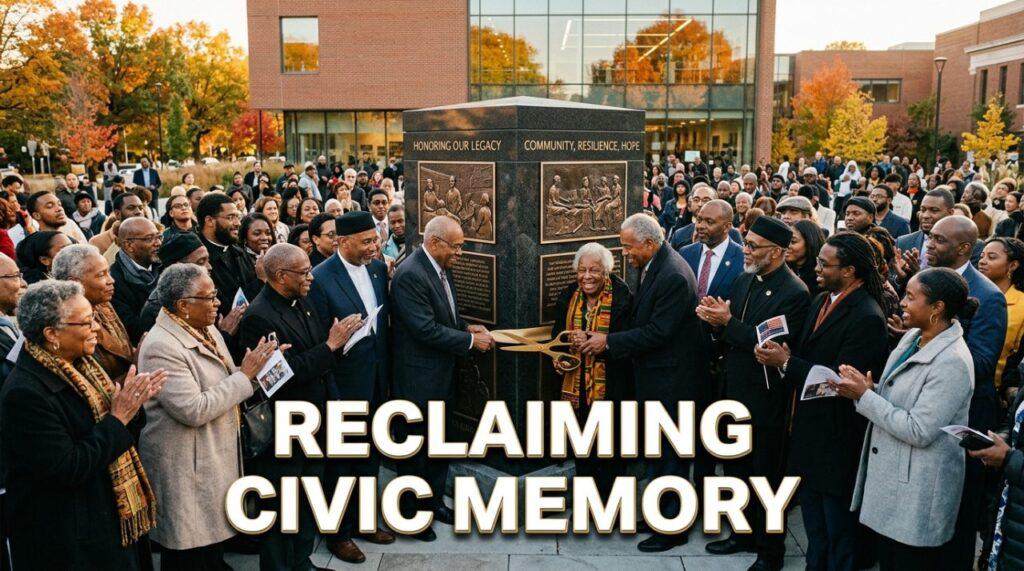
In October 2026, civil rights leaders, community organizers, and public officials assembled outside the Michael E. Busch Annapolis Library. They gathered to dedicate Maryland’s first official public monument honoring El-Hajj Malik El-Shabazz, widely known as Malcolm X (reportannapolis.com, eyeonannapolis.net). The permanent installation features historical panels, archival photographs, and a sealed fifty-year time capsule (reportannapolis.com). This landmark ceremony established the first state-supported monument honoring a Muslim American leader in Maryland history (cair.com).
The dedication marks a major milestone in public memory. For generations, traditional memorials celebrated military conquests and political elites while ignoring radical voices for racial justice (monumentlab.com). Placing a memorial for Malcolm X in Maryland’s state capital represents an important shift in historical storytelling. Understanding this moment requires examining the deep historical currents that connect the Atlantic slave trade, Black radical thought, and contemporary struggles over civic space (monumentlab.com).
Annapolis and the Long Shadow of Racial Subjugation
The presence of a Malcolm X memorial in Annapolis carries immense historical weight because of the city’s origins. During the eighteenth century, Annapolis functioned as a major slave port in the Chesapeake region (smithsonianmag.com). Thousands of captured Africans arrived chained in cargo holds at the Annapolis City Dock. Among them was Kunta Kinte, who arrived aboard the slave ship Lord Ligonier in 1767. The city built its early wealth directly upon the exploitation of enslaved Black labor (smithsonianmag.com).
Maryland maintained a contradictory position throughout the nineteenth century as a slaveholding border state. Even after the Civil War, systems of racial control adapted quickly as legal patterns failed to end involuntary servitude across the South and Mid-Atlantic. For decades, the public square in Annapolis reflected this racial hierarchy. The Maryland State House grounds long featured a prominent bronze statue of United States Supreme Court Chief Justice Roger B. Taney (smithsonianmag.com). Taney authored the infamous 1857 Dred Scott decision, ruling that Black people possessed no rights that white citizens had to respect (smithsonianmag.com).
The state removed Taney’s statue from the capitol grounds in August 2017 following nationwide protests against white supremacist symbols (smithsonianmag.com). That removal created an ideological opening in the historic capital. Honoring Malcolm X near the seat of state power directly challenges generations of Confederate and segregationist memorialization (cair.com, eyeonannapolis.net). It replaces monuments dedicated to legal disenfranchisement with a tribute to Black liberation.
Demographics of U.S. Public Monuments
Garveyite Foundations: The Youth of Malcolm Little
The philosophical convictions that defined Malcolm X did not emerge in isolation. They originated in his childhood home through the teachings of Marcus Mosiah Garvey (nps.gov). Malcolm was born Malcolm Little in Omaha, Nebraska, in 1925. His parents, Earl and Louise Little, served as dedicated local leaders in Garvey’s Universal Negro Improvement Association (UNIA) during the 1920s (nps.gov). Earl Little worked as a traveling organizer, while Louise Little managed administrative reports and wrote for the national publication The Negro World (nps.gov).
UNIA meetings introduced young Malcolm to early concepts of Pan-African solidarity, Black self-reliance, and racial pride. The Garvey movement rejected racial integration into white capitalist frameworks. Instead, it demanded that Black people build independent economic institutions and assert psychological freedom. These fundamental principles of Black nationalism remained central to Malcolm’s worldview throughout his life (nps.gov).
This activism brought swift white supremacist violence down upon the Little family. The Ku Klux Klan terrorized their home in Omaha, smashing windows and threatening their lives (nps.gov). After the family moved to Michigan, the Black Legion, a violent white supremacist militia, burned their home to the ground (nps.gov). In 1931, Earl Little was discovered brutally murdered across streetcar tracks in Lansing, Michigan (nps.gov). This racial terror fractured the household and institutionalized his mother, exposing young Malcolm to the brutal realities of American racism (nps.gov).
Prison Walls and Literacy as Liberation
Following years of poverty and street life in Boston and New York, Malcolm received an eight-to-ten-year prison sentence for burglary in 1946 (nps.gov). He entered the Charlestown State Prison at just twenty years old. He later transferred to the Norfolk Prison Colony in Massachusetts, an experimental facility with an extensive lending library (nps.gov). Behind bars, Malcolm encountered a transformative intellectual awakening through books.
Frustrated by his inability to express himself in letters, Malcolm obtained a dictionary. He meticulously copied every single entry, word for word, from the letter A to Z (nps.gov). This rigorous exercise expanded his vocabulary and sparked a hunger for deeper knowledge. He devoured classic literature, global history, linguistics, and philosophy from prison bookshelves (nps.gov). He later observed that reading opened doors that physical prison bars could not close. This intellectual transformation within the system of mass incarceration provides direct historical context for placing his monument outside a public library.
During this incarceration, his siblings introduced him to Elijah Muhammad and the Nation of Islam (nps.gov). Malcolm embraced the teachings, which provided an explanation for systemic oppression and offered strict moral discipline. Upon his release in 1952, he dropped his ancestral slave surname Little. He adopted the letter “X” to symbolize the true African family name stolen through centuries of chattel bondage (nps.gov).
Annapolis Malcolm X Memorial Budget
The Split with the Nation of Islam and Mecca
Between 1952 and 1963, Malcolm X served as the most prominent national spokesperson for the Nation of Islam (nps.gov). His fiery oratory expanded the organization from a few hundred followers to tens of thousands across urban centers. He criticized systemic white supremacy, challenged police violence, and urged Black self-determination (nps.gov). However, ideological tensions and moral disagreements with Elijah Muhammad began to strain the relationship by the early 1960s (nps.gov).
In March 1964, Malcolm formally broke with the Nation of Islam (nps.gov). This departure represented a dangerous rupture in both spiritual theology and political direction. Under the NOI, members could not vote or join broader civil rights coalitions (nps.gov). Malcolm sought active political engagement. Shortly after the split, he traveled to Mecca to complete the Hajj pilgrimage in April 1964 (nps.gov, harvard.edu). Praying alongside Muslims across Africa, Asia, and Europe shifted his perspective toward universal brotherhood under orthodox Sunni Islam (harvard.edu).
He adopted the name El-Hajj Malik El-Shabazz and established two new organizations: Muslim Mosque, Inc., and the secular Organization of Afro-American Unity (nps.gov). Shabazz expanded the struggle beyond domestic civil rights, framing Black liberation as an international human rights cause (nps.gov). He traveled across Africa, conferring with heads of state and urging the United Nations to investigate human rights abuses against African Americans (nps.gov). This independence provoked fierce hostility from his former associates, culminating in his tragic assassination in Manhattan on February 21, 1965 (nps.gov).
Beyond the False Binary: Malcolm X and Martin Luther King Jr.
Mainstream media accounts during the 1960s frequently reduced the Black freedom struggle to a simplistic contest between two leaders (nps.gov). Journalists contrasted Malcolm X and the Rev. Dr. Martin Luther King Jr. as bitter rivals, casting one as an apostle of violence and the other as a harmless moderate (nps.gov). This caricatured framing ignored how both thinkers engaged each other and evolved over time.
The two leaders actually met on March 26, 1964, at the United States Capitol during Senate debates over the Civil Rights Act (nps.gov). They greeted each other warmly and exchanged perspectives on federal legislative tactics. In early 1965, Shabazz traveled directly to Selma, Alabama, while King was imprisoned there (nps.gov). Shabazz spoke with Coretta Scott King, explaining that his presence offered an alternative that might compel authorities to negotiate with King more seriously (nps.gov).
Toward the end of their lives, their political analyses converged significantly. King grew increasingly outspoken against economic exploitation, imperialist wars, and systemic urban poverty (nps.gov). Meanwhile, Shabazz built broad tactical alliances across diverse civil rights groups (nps.gov). The Annapolis monument honors this connection by placing images of Malcolm X alongside Dr. King and boxing champion Muhammad Ali on its permanent display panels (reportannapolis.com, eyeonannapolis.net).
Public Memorial Presence of Movement Figures
Coalition Politics and the Fight for Civic Space
The realization of Maryland’s Malcolm X monument resulted from tireless community organizing led by the Caucus of African American Leaders (reportannapolis.com, eyeonannapolis.net). Civil rights activist Carl O. Snowden organized the campaign in partnership with the Dr. Martin Luther King, Jr. Committee, the Council on American-Islamic Relations (CAIR), and the Anne Arundel County Public Library system (cair.com, reportannapolis.com). The project gained unanimous approval from the Library Board of Trustees, securing broad bipartisan and institutional backing (reportannapolis.com).
The total project cost reached approximately $350,000 (reportannapolis.com). Anne Arundel County contributed $70,000 in public funding, while private donations and grassroots contributions covered the remainder (reportannapolis.com). During the unveiling, Maryland House Speaker Joseline Peña-Melnyk noted that progress does not follow a straight line and urged citizens to confront uncomfortable historical truths (reportannapolis.com, eyeonannapolis.net). Anne Arundel County Executive Steuart Pittman emphasized that Malcolm X restored dignity to communities that systemic oppression sought to demean (reportannapolis.com, eyeonannapolis.net).
State Senator Shaneka Henson directly addressed skeptics who questioned why Maryland should honor a leader who did not live in the state (reportannapolis.com, eyeonannapolis.net). Henson asserted that telling the complete story of America requires honoring every figure who shaped the struggle for national justice (reportannapolis.com). CAIR Maryland Director Zainab Chaudry affirmed that public memorials show which historical contributions society truly values (cair.com, eyeonannapolis.net). Honoring El-Hajj Malik El-Shabazz validates Black dignity and Muslim American identity in the public realm (cair.com).
The 2076 Time Capsule and the Future of Black Memory
A central feature of the Annapolis monument is a heavy bronze time capsule sealed beneath the installation (reportannapolis.com, eyeonannapolis.net). Organizers scheduled the capsule to open in 2076, coinciding with the United States Tercentennial (reportannapolis.com). The container holds essays, letters, and multimedia recordings created by Maryland high school students, grassroots organizers, faith leaders, and local residents (reportannapolis.com, eyeonannapolis.net). These materials record modern community assessments of American race relations, civil rights, and political justice (reportannapolis.com).
The time capsule creates a direct dialogue between the present generation and descendants who will inhabit the nation fifty years from now. Just as historians study the unresolved challenges after the era of Reconstruction collapsed, future generations will study contemporary efforts to achieve racial equity. The monument ensures that Malcolm X will remain an active participant in that ongoing conversation.
By transforming the grounds of a public library into sacred civic space, Maryland has challenged traditional historical exclusion. The memorial demonstrates that Black radical thought belongs at the center of American history. El-Hajj Malik El-Shabazz taught that education, self-respect, and unyielding resistance to injustice are essential components of freedom. That enduring message now stands cast in bronze, welcoming every reader who walks through the library doors.
About the Author
Darius Spearman is a professor of Black Studies at San Diego City College, where he has been teaching for over 20 years. He is the founder of African Elements, a media platform dedicated to providing educational resources on the history and culture of the African diaspora. Through his work, Spearman aims to empower and educate by bringing historical context to contemporary issues affecting the Black community.
