

Why the Student Photo ID Voting Ban Sparks Midterm Alarm
By Darius Spearman (africanelements)
Support African Elements at patreon.com/africanelements and hear recent news in a single playlist. Additionally, you can gain early access to ad-free video content.
In late October 2026, less than two weeks before midterm balloting, the United States Supreme Court intervened in New Hampshire election procedures (pbs.org, democracydocket.com). The high court granted an emergency application that cleared the way for state officials to exclude student identification cards at polling places (newsfromthestates.com, cnn.com). This unsigned order suspended a preliminary injunction issued by a federal district judge that had preserved alternative identification pathways for college students (democracydocket.com, courthousenews.com).
The decision provoked immediate dissent from civil rights litigators, youth voting organizations, and democracy advocates nationwide (commondreams.org, theguardian.com). Critics argue that eliminating collegiate identification disproportionately excludes first-time voters, low-income students, and young Black citizens (brennancenter.org, insidehighered.com). The dispute highlights recurring questions regarding ballot access and procedural fairness during decisive election cycles (pbs.org, theguardian.com).
The Twenty-Sixth Amendment and Campus Resistance
The contemporary legal battle over student voting credentials has deep roots in the Vietnam War era. During that conflict, young men faced compulsory military conscription at eighteen years of age while remaining ineligible to vote until age twenty-one (belmont.edu, findlaw.com). Public pressure coalesced around the principle that citizens eligible for military service deserved a voice in national governance (belmont.edu). In 1971, the states rapidly ratified the Twenty-Sixth Amendment, which lowered the national voting age to eighteen and enfranchised approximately eleven million young citizens (belmont.edu, findlaw.com).
This rapid demographic expansion generated immediate pushback from municipal governments across the country (belmont.edu). Local officials in college towns expressed concern that incoming student populations would outvote permanent residents and alter local property tax rates (belmont.edu). In response, registrar offices instituted administrative barriers, including specialized questionnaires, onerous residency requirements, and demands that students prove an intention to remain in the municipality indefinitely after graduation (belmont.edu, findlaw.com).
This administrative friction culminated in the landmark 1979 Supreme Court ruling in Symm v. United States (belmont.edu, findlaw.com). In Waller County, Texas, the local tax assessor-collector, LeRoy Symm, systematically barred students at Prairie View A&M University—a historically Black institution—from voter registration lists unless they met special residency criteria (belmont.edu, findlaw.com). The Supreme Court affirmed that imposing unique evidentiary burdens on collegiate voters violated the Twenty-Sixth Amendment (belmont.edu, findlaw.com). The ruling established that students possess the constitutional right to register and vote in their college communities (belmont.edu).
Adults Lacking Government Photo ID
From Crawford to Shelby County: The Rise of Modern Photo-ID Rules
Modern voter identification statutes developed following the contested 2000 presidential election and the federal passage of the 2002 Help America Vote Act (findlaw.com). In 2005, Indiana approved the first strict state-issued photo-ID mandate in the nation (findlaw.com). Civil rights plaintiffs challenged the law, arguing that it imposed unequal burdens on low-income and minority citizens (findlaw.com). In the 2008 ruling Crawford v. Marion County Election Board, the Supreme Court upheld the statute, finding that states possess an interest in deterring in-person impersonation even in the absence of documented fraud (findlaw.com).
The regulatory framework altered substantially five years later with the decision in Shelby County v. Holder in 2013 (findlaw.com). Under Section 5 of the Voting Rights Act of 1965, jurisdictions with histories of racial discrimination were required to obtain federal preclearance before altering election rules (findlaw.com). This mechanism placed the legal burden on states to prove that new laws would not dilute minority voting strength (findlaw.com). The removal of the preclearance coverage formula in Shelby County eliminated that advance check, enabling states to enact strict ID laws without prior administrative review (findlaw.com).
Following that decision, several state legislatures adopted narrow definitions of acceptable credentials (findlaw.com, theguardian.com). In Texas, lawmakers permitted state-issued concealed handgun licenses for voting while excluding photo identification issued by public universities (findlaw.com, theguardian.com). States including North Carolina and Wisconsin enacted statutes mandating that university cards contain specific technical elements, such as expiration dates and official signatures, which many campus cards do not possess (brennancenter.org, theguardian.com). These measures reflect broader, historic patterns of black voter disenfranchisement across the American electoral landscape.
Systemic Economic Barriers to State Identification
The disqualification of student identification cards exposes voters to broader systemic economic hurdles (brennancenter.org, insidehighered.com). Obtaining an official state driver’s license or non-driver ID card requires supporting foundational paperwork (brennancenter.org, brennancenter.org). Citizens must present certified birth certificates, marriage certificates, or federal passports to satisfy state motor vehicle agency requirements (brennancenter.org, brennancenter.org). These records carry direct fees, administrative processing times, and transit expenses (brennancenter.org, brennancenter.org).
Because the persistent racial wealth gap impacts household savings, these administrative outlays function as regressive financial hurdles for young Black citizens (brennancenter.org, brennancenter.org). Furthermore, millions of American motorists experience debt-based driver’s license suspensions (brennancenter.org). These suspensions stem frequently from unpaid traffic tickets, court fees, or missed appearances rather than dangerous driving behavior (brennancenter.org). Disproportionate traffic stops in minority neighborhoods intensify this process, causing thousands of young drivers to lose their credentials (brennancenter.org, nyu.edu).
Transportation infrastructure also shapes access to acceptable documentation (brennancenter.org, brennancenter.org). Black households are more than twice as likely as white households to lack access to a personal vehicle, reducing their need for a driver’s license (brennancenter.org, brennancenter.org). Concurrently, state governments have consolidated rural and urban Department of Motor Vehicles offices, restricting operating hours and moving branches away from public transit routes (brennancenter.org, brennancenter.org). These compounding obstacles mirror historical systems of involuntary servitude after emancipation where legal mandates restricted physical and political mobility.
Youth Turnout by State ID Policy
The Battle Over New Hampshire House Bill 323
The immediate conflict before the Supreme Court originated from changes to New Hampshire voting legislation (newsfromthestates.com, indepthnh.org). In April 2026, Governor Kelly Ayotte signed House Bill 323, which formally removed student IDs from the statutory list of acceptable photo cards (newsfromthestates.com, indepthnh.org). New Hampshire statute maintains a historical safety-valve provision under RSA 654:12 (nh.gov, nh.gov). That provision allows individuals lacking standard photo identification to establish identity by submitting other reasonable documentation to local supervisors of the checklist (nh.gov, nh.gov).
Following the enactment of HB 323, New Hampshire Secretary of State David Scanlan issued administrative guidance to local election officials (newsfromthestates.com, indepthnh.org). The guidance instructed supervisors that student IDs could not be considered for any purpose, including verification under the statutory safety-valve exception (newsfromthestates.com, indepthnh.org). The Coalition for Open Democracy and affiliated youth organizations initiated federal litigation, alleging that the directive violated the First, Fourteenth, and Twenty-Sixth Amendments (democracydocket.com, courthousenews.com).
In October 2026, United States District Judge Joseph Laplante declined to invalidate the primary statute but issued a preliminary injunction against the administrative directive (democracydocket.com, courthousenews.com). The court determined that the Secretary of State had exceeded the statutory language by preventing local supervisors from reviewing student IDs alongside other corroborating evidence (democracydocket.com, courthousenews.com). After the United States Court of Appeals for the First Circuit refused to stay that injunction, New Hampshire Attorney General John Formella sought emergency relief from the Supreme Court (newsfromthestates.com, democracydocket.com).
At the Precinct: What Happens Without a Safety Valve?
Statutory safety valves serve as essential safeguards for registered voters who arrive at precincts without standard documentation (nhmunicipal.org, nh.gov). Under traditional New Hampshire practice, a voter who lacks qualifying photo identification can execute a challenged voter affidavit (nhmunicipal.org, nh.gov). This document requires the voter to swear to their identity, citizenship, and qualifications under penalty of criminal perjury (nhmunicipal.org, nh.gov). Alternatively, local checklist supervisors can confirm the voter’s identity based on personal knowledge or supporting corroboration, allowing the voter to cast a regular ballot (nhmunicipal.org, nh.gov).
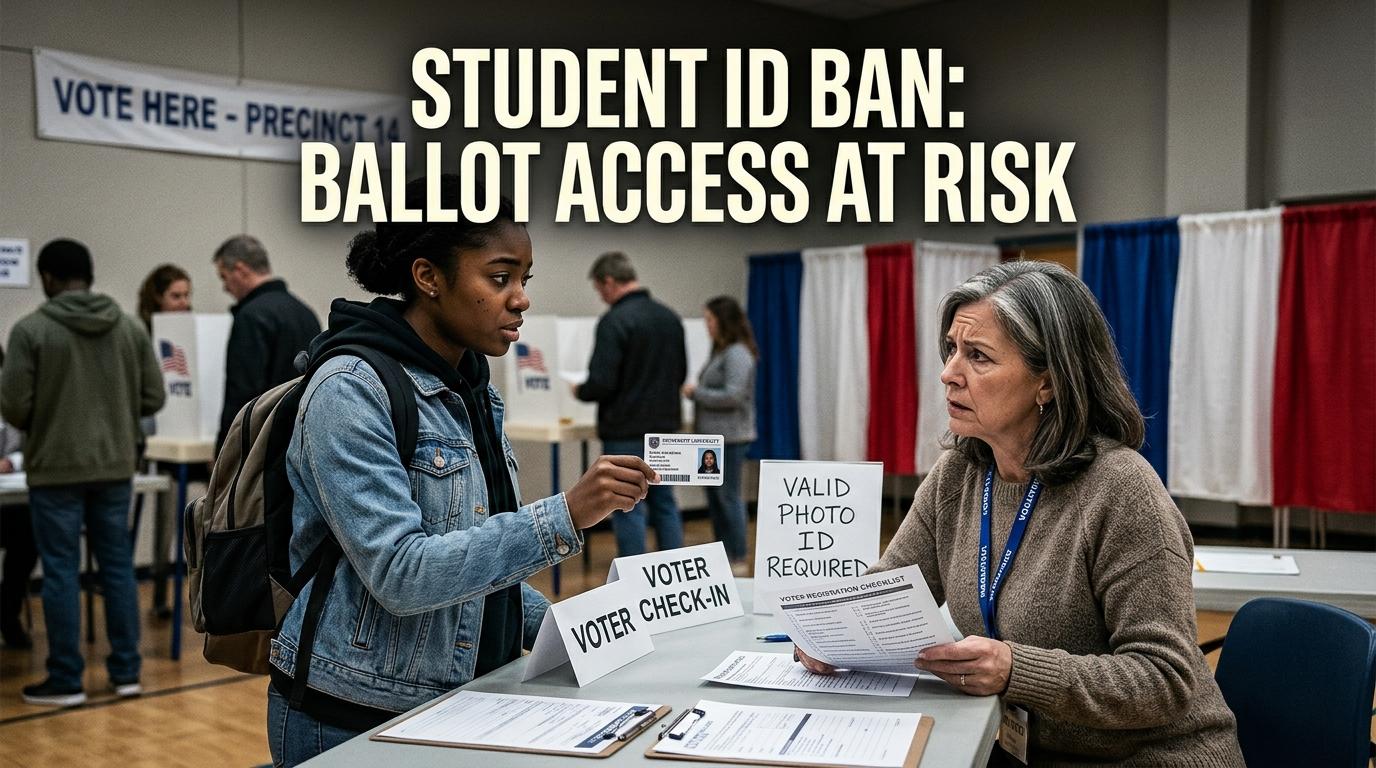
When election administrators prohibit poll workers from reviewing unlisted identification cards or eliminate alternative affidavits, practical disenfranchisement occurs on site (newsfromthestates.com, heartlandernews.com). A voter presenting a college card is turned away without recourse at the polling table (newsfromthestates.com, heartlandernews.com). The citizen must leave the location to retrieve alternative paperwork before voting locations close (newsfromthestates.com, heartlandernews.com). Alternatively, the voter must file an immediate petition before a state superior court judge on Election Day to obtain an order permitting them to vote (newsfromthestates.com, heartlandernews.com).
These procedural obstacles fall heavily on young voters navigating collegiate schedules, work obligations, and limited personal transportation (insidehighered.com, tufts.edu). The reality of on-site exclusion at the ballot box parallels unresolved debates over racial inequality in education, where institutional policies limit participation across civic spaces.
Youth Ballot Verification Hurdles
The Purcell Principle and the Shadow Docket
The legal mechanism permitting New Hampshire to enforce its administrative prohibition is rooted in the Purcell principle (pbs.org, cnn.com). Established in the 2006 case Purcell v. Gonzalez, the doctrine counsels federal courts against altering state election rules in the period immediately preceding an election (democracydocket.com, findlaw.com). The original purpose of the principle was to protect voter clarity and prevent administrative disruption among local poll workers (democracydocket.com, findlaw.com).
Over the past decade, legal scholars note that the Supreme Court has frequently invoked the doctrine via its emergency docket (democracydocket.com, theguardian.com). These unsigned orders occur without oral arguments or full written decisions (democracydocket.com, theguardian.com). In the New Hampshire proceeding, the emergency stay halted the district court order, allowing the Secretary of State’s directive to take full effect for the November midterms (pbs.org, cnn.com).
Justice Ketanji Brown Jackson issued the sole public dissent from the emergency stay (pbs.org, cnn.com). Jackson argued that the majority misapplied the Purcell principle to shield executive overreach (pbs.org, democracydocket.com). She noted that Judge Laplante had not altered state statutory law; instead, the district court required state officials to follow the enacted text of the statute by invalidating an inaccurate administrative directive (pbs.org, democracydocket.com). Jackson observed that by intervening on an emergency basis two weeks prior to the election, the Supreme Court created confusion for voters and election workers alike (pbs.org, cnn.com).
Disparate Demographic Burdens and Midterm Stakes
Demographic research documents the unequal impact that technical ID exclusions create across the electorate (brennancenter.org, tufts.edu). According to data compiled by the Brennan Center for Justice, approximately eleven percent of voting-age American citizens lack current government photo identification (brennancenter.org, brennancenter.org). Among young Black adults aged eighteen to twenty-nine, thirty percent lack a standard driver’s license, compared to only five percent of white peers in the same age demographic (brennancenter.org, brennancenter.org).
Furthermore, residential mobility introduces significant complications for collegiate voters (tufts.edu, tufts.edu). Research from the Center for Information & Research on Civic Learning and Engagement indicates that over twenty-five percent of young adults change residences annually (tufts.edu). Consequently, forty-seven percent of young adults possess identification cards that list an address different from their current residence (brennancenter.org, brennancenter.org). Because fewer than half of young Americans possess a valid passport, disqualifying collegiate credentials eliminates the primary photo ID held by students (brennancenter.org, tufts.edu).
These barriers affect participation outcomes during midterm elections (tufts.edu, tufts.edu). In states with expansive identification policies, youth voter turnout averages forty-nine percent (tufts.edu). In states that enforce strict photo-ID laws without student ID options, average youth turnout drops to forty-four percent (tufts.edu). In competitive swing states like New Hampshire, where collegiate communities house thousands of voting-age citizens, these percentage variations can influence congressional and legislative races (pbs.org, newsfromthestates.com).
The Enduring Struggle for Equal Democratic Participation
The controversy surrounding collegiate identification represents the latest chapter in a long struggle over democratic access (belmont.edu, findlaw.com). While early twentieth-century disenfranchisement relied upon literacy tests, poll taxes, and white primaries, modern restrictions operate through administrative categories and documentation mandates (findlaw.com). These measures achieve similar outcomes by exploiting existing wealth disparities, mobility patterns, and bureaucratic hurdles (brennancenter.org, brennancenter.org).
From the registrar offices of Waller County in the 1970s to the emergency appellate dockets of 2026, the campus voting precinct remains an active battleground for political representation (democracydocket.com, belmont.edu). The Supreme Court’s emergency stay reinforces the reality that access to the ballot remains contingent upon ongoing legal oversight (pbs.org, cnn.com). As election laws continue to evolve, the historical mandate of the Twenty-Sixth Amendment faces enduring procedural challenges in American courtrooms and polling places alike (belmont.edu, findlaw.com).
About the Author
Darius Spearman is a professor of Black Studies at San Diego City College, where he has been teaching for over 20 years. He is the founder of African Elements, a media platform dedicated to providing educational resources on the history and culture of the African diaspora. Through his work, Spearman aims to empower and educate by bringing historical context to contemporary issues affecting the Black community.
