


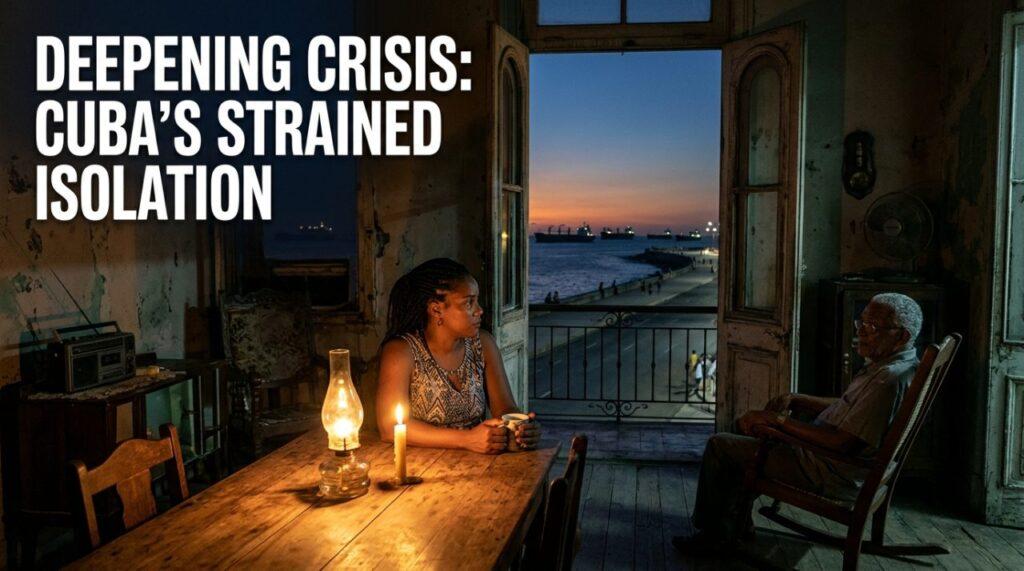
US Embargo on Cuba: UN Debate Exposes Deepening Crisis
By Darius Spearman (africanelements)
Support African Elements at patreon.com/africanelements and hear recent news in a single playlist. Additionally, you can gain early access to ad-free video content.
Every autumn, diplomats gather in New York to address an enduring Cold War standoff. The United Nations General Assembly opens its annual session on the decades-long trade restrictions against Havana, bringing the historic US Embargo on Cuba into sharp focus (un.org, un.org). For more than thirty years, this gathering has functioned as an international assessment of unilateral economic measures (wikipedia.org, europeansting.com). Member states from the Caribbean and Africa consistently lead appeals to lift these restrictions (un.org, dailytrust.com). They argue that external economic pressures severely restrict civilian access to electrical power, food supplies, and essential medicines (un.org, ohchr.org).
Behind the recurring diplomatic speeches lies an acute domestic emergency. Power grids across the island have suffered catastrophic failures, leaving millions of residents in darkness for days (elpais.com). Disruptions to electrical distribution halt municipal water pumping systems and cause scarce refrigerated groceries to spoil rapidly (elpais.com, cubaminrex.cu). Washington maintains that internal government mismanagement and state monopolies explain these domestic shortages (usembassy.gov). In contrast, developing nations argue that international sanctions deliberately undermine the civilian economy (un.org, diplomatictimes.net). Understanding this diplomatic clash requires examining the historical evolution of sanctions policy over the past six decades (gwu.edu, gwu.edu).
UN General Assembly Cuba debate Highlights Island Hardship
The annual UN General Assembly Cuba debate regularly exposes deep fractures between American foreign policy and global sentiment (un.org, europeansting.com). Cuban Foreign Minister Bruno Rodríguez Parrilla directly addressed the assembly floor, declaring that sanctions inflict severe damage on ordinary households (un.org, elpais.com). The minister noted that cumulative economic damages exceed 164 billion dollars over six decades (cubaminrex.cu, cubaminrex.cu). Between March 2023 and February 2024 alone, direct damages reached over 5 billion dollars, averaging approximately 421 million dollars every single month (cubaminrex.cu, cubaminrex.cu). These economic pressures coincide with a severe Cuba economic crisis characterized by steep currency depreciation and persistent fuel deficits (elpais.com, unctad.org).
United States representatives responded by asserting that domestic economic failures stem from the political choices of Havana (usembassy.gov). American diplomats emphasized that trade regulations contain humanitarian exemptions for agricultural goods and medical donations (usembassy.gov). However, third-party trading partners note that financial transfer mechanisms remain effectively blocked by secondary regulations (ohchr.org, unctad.org). The UN Cuba embargo vote consistently reveals overwhelming international consensus, with the resolution condemning the embargo passing year after year with nearly unanimous global support (un.org, wikipedia.org).
UN General Assembly Cuba Resolution Votes (In Favor)
Lester Mallory memorandum Laid Groundwork for Deprivation
The origins of modern trade interdictions date back to the immediate aftermath of the 1959 Cuban Revolution (wikipedia.org, gwu.edu). Following the overthrow of Fulgencio Batista, the revolutionary administration instituted agrarian reform policies (wikipedia.org). The state nationalized vast commercial estates, including American-owned sugar plantations, utility companies, and oil refineries (wikipedia.org, gwu.edu). The Eisenhower administration retaliated by eliminating Cuba sugar import quotas in 1960, severing the primary commercial export revenue of the island nation (wikipedia.org, gwu.edu).
The strategic blueprint for this economic containment appeared in a declassified internal document known as the Lester Mallory memorandum (gwu.edu, gwu.edu). Written on April 6, 1960, by Deputy Assistant Secretary of State Lester D. Mallory, the text explicitly acknowledged that the broad public supported Fidel Castro (gwu.edu). Mallory concluded that direct political opposition could not succeed from within (gwu.edu). He therefore proposed an intentional strategy of widespread economic pressure:
“The only foreseeable means of alienating internal support is through disenchantment and disaffection based on economic dissatisfaction and hardship… Every possible means should be undertaken promptly to weaken the economic life of Cuba… to decrease monetary and real wages, to bring about hunger, desperation and overthrow of government.”
This doctrine became formal executive policy in February 1962 (wikipedia.org, gwu.edu). President John F. Kennedy issued Proclamation 3447, declaring an all-encompassing trade ban under the Trading with the Enemy Act of 1917 (wikipedia.org). One year later, the United States Department of the Treasury implemented the Cuban Assets Control Regulations (wikipedia.org). These regulations froze all Cuban government assets within American borders and prohibited unlicensed commercial transactions (wikipedia.org). The institutional foundation created in the early 1960s established structural mechanisms that remain operational six decades later (gwu.edu, unctad.org).
Helms-Burton Act sanctions Turned Measures into Permanent Law
When the Soviet Union collapsed in 1991, the Cuban economy lost approximately 80 percent of its foreign trade (wikipedia.org). Subsidized petroleum, industrial machinery, and agricultural fertilizers disappeared almost overnight (wikipedia.org). Rather than relaxing commercial restrictions during this crisis, American lawmakers moved to codify executive orders into federal statute (wikipedia.org, gwu.edu). The Cuban Democracy Act of 1992, commonly known as the Torricelli Act, barred overseas subsidiaries of American corporations from doing business with Havana (wikipedia.org, unctad.org).
The Torricelli Act introduced the Torricelli Act 180-day rule, a maritime shipping provision with lasting consequences (wikipedia.org, unctad.org). Under this mandate, any commercial vessel entering a Cuban harbor cannot dock at an American port to load or unload freight for 180 days (wikipedia.org, unctad.org). This restriction drastically inflates cargo insurance rates and freight charges, as international shipping carriers demand substantial premiums before docking in Cuban waters (unctad.org, unctad.org). Just four years later, the United States Congress codified the sanctions permanently through the Cuban Liberty and Democratic Solidarity Act of 1996 (wikipedia.org, gwu.edu).
These Helms-Burton Act sanctions systematically removed the constitutional authority of the American president to end the embargo by executive decree (wikipedia.org). Authority was transferred entirely to Congress, locking trade prohibitions into federal law (wikipedia.org). Title III of the legislation authorized American nationals to file lawsuits against international companies that manage property nationalized after 1959 (wikipedia.org, gwu.edu). Meanwhile, Title IV denied American entry visas to executives of foreign firms investing in those enterprises (wikipedia.org). Although the Trade Sanctions Reform and Export Enhancement Act of 2000 authorized limited food sales, it mandated advance cash payments without commercial credit, placing strict barriers on trade (wikipedia.org, unctad.org).
Direct Monthly Economic Cost to Cuba (2023-2024)
Cuba State Sponsor of Terrorism Label Drives Bank De-risking
Bilateral relations experienced a brief thaw during the second presidential administration of Barack Obama (wikipedia.org, responsiblestatecraft.org). Diplomatic embassies reopened in 2015, travel categories expanded, and Washington abstained during the 2016 UN General Assembly resolution vote (un.org, wikipedia.org). However, the administration of Donald Trump reversed this policy, implementing more than 240 new executive restrictions (cubaminrex.cu, responsiblestatecraft.org). In January 2021, days before leaving office, the Trump administration redesignated Cuba as a State Sponsor of Terrorism (responsiblestatecraft.org).
The legal justification for the Cuba State Sponsor of Terrorism designation connects directly to historical political exiles and domestic civil rights figures (responsiblestatecraft.org). The United States Department of State regularly cites the presence of Black liberation activist Assata Shakur, also known as Joanne Chesimard, who received political asylum in Cuba in 1984 following her escape from prison (responsiblestatecraft.org). American authorities also cite the presence of Puerto Rican nationalist William Morales (responsiblestatecraft.org). Washington demands their extradition, classifying their sanctuary as evidence of state support for criminal activity (responsiblestatecraft.org).
This terror list classification carries severe financial ramifications across the globe (responsiblestatecraft.org, unctad.org). International commercial banks systematically sever relationships with Cuban trading firms to avoid heavy American fines, an institutional practice termed Cuba sanctions bank de-risking (ohchr.org, unctad.org). This financial freeze disrupts ordinary currency conversions, cancels commercial credit arrangements, and prevents the timely purchase of emergency fuel (elpais.com, unctad.org). Foreign suppliers frequently cancel shipments of medical components, hospital diagnostic equipment, and surgical supplies due to secondary banking liabilities (ohchr.org, cubaminrex.cu).
Afro-Cubans and remittance inequalities Shape Economic Survival
Economic sanctions do not fall equally across the Cuban population (ohchr.org, elpais.com). Demographic realities within the overseas diaspora play a major role in shaping domestic survival strategies (elpais.com). The historic migration patterns from the island created an emigrant community in the United States that is predominantly white (elpais.com). Consequently, private family money transfers flow primarily to white households on the island (elpais.com). Sociological and economic surveys demonstrate that white citizens receive more than 70 percent of foreign cash transfers, creating deep Afro-Cubans and remittance inequalities (elpais.com).
These financial flows directly determine who can participate in the emerging domestic private sector (elpais.com). Small private companies, known locally as mipymes, require foreign currency to purchase inventory and capital equipment from abroad (elpais.com). Citizens without access to family funds abroad encounter severe obstacles when seeking startup financing (elpais.com). Just as Black communities have historically fought for economic justice through collective labor organization, marginalized groups in the Caribbean must constantly adapt to structural economic exclusion under severe resource scarcity.
Real estate dynamics further magnify these historic disparities (elpais.com). Under early post-revolutionary urban housing distributions, prime architectural properties in tourist centers were largely retained by older resident lineages (elpais.com). Afro-Cuban citizens predominantly reside in high-density urban areas or peripheral neighborhoods (elpais.com). They possess fewer commercial properties suitable for conversion into private restaurants, boutique lodging, or retail shops (elpais.com). When sanctions limit state employment salaries, families must rely on domestic family survival strategies to counter severe currency inflation.
Estimated Foreign Remittance Distribution in Cuba
CARICOM Cuba diplomatic solidarity Grounded in Anti-Apartheid Action
The strong stance taken by the Caribbean Community and the African Group during UN proceedings reflects long-standing historical partnerships (un.org, dailytrust.com). The CARICOM Cuba diplomatic solidarity observed at the assembly podium is rooted in shared colonial histories and post-independence mutual defense (un.org, cubaminrex.cu). African member states emphasize that Cuba provided decisive direct assistance during national liberation struggles against colonial rule and racial segregation regimes throughout southern Africa (dailytrust.com, cubaminrex.cu).
Between 1975 and 1991, Cuba deployed over 400,000 soldiers, engineers, and medical staff to Angola during Operation Carlota (dailytrust.com, cubaminrex.cu). This military deployment culminated in the 1988 Battle of Cuito Cuanavale (cubaminrex.cu). Cuban forces, fighting alongside Angolan units and SWAPO liberation fighters, repelled the South African apartheid army (cubaminrex.cu). This military victory preserved Angolan independence, secured the sovereign liberation of Namibia, and accelerated the collapse of the apartheid state in Pretoria (dailytrust.com, cubaminrex.cu). Nelson Mandela frequently acknowledged this military commitment upon his release from prison (dailytrust.com, cubaminrex.cu).
Beyond military conflicts, decades of civilian medical cooperation solidified these diplomatic alliances across the Global South (un.org, dailytrust.com). Through the Henry Reeve Medical Contingent, thousands of Cuban doctors deployed across Africa and the Caribbean to treat infectious epidemics and natural disaster casualties (un.org, dailytrust.com). Furthermore, the Latin American School of Medicine in Havana has trained thousands of medical doctors from developing nations tuition-free (un.org). Caribbean and African delegates view current American trade restrictions as direct impediments to these collective public health systems (un.org, dailytrust.com).
| Sanctions Policy Dimension | United States Government Position | United Nations Majority Position |
|---|---|---|
| Sanctions Objective | Promote democratic transition and protect basic human rights (usembassy.gov). | Unilateral coercive measures that violate the sovereign equality of states (un.org, ohchr.org). |
| Domestic Shortages | Caused by centralized state planning and internal economic corruption (usembassy.gov). | Exacerbated by fuel blockades and secondary banking interdictions (un.org, unctad.org). |
| Humanitarian Channels | Exemptions allow sales of agricultural goods and medical donations (usembassy.gov). | Prohibitive maritime rules and cash requirements render trade unworkable (ohchr.org, unctad.org). |
| Terror Designation | Justified by harboring American fugitives and foreign militants (responsiblestatecraft.org). | Politically motivated listing causing systemic financial de-risking (ohchr.org, responsiblestatecraft.org). |
The annual assembly debate represents more than a symbolic diplomatic exercise (un.org). It highlights deep disagreements over international law, economic sovereignty, and the humanitarian consequences of secondary sanctions (europeansting.com, ohchr.org). While Washington maintains that financial pressure provides necessary leverage for democratic governance, the international community views these restrictions as collective punishment against a civilian populace (un.org, usembassy.gov). As domestic power outages and supply shortages continue across the island, the historical decisions made in 1960 continue to shape everyday life in modern Cuba (gwu.edu, elpais.com).
About the Author
Darius Spearman is a professor of Black Studies at San Diego City College, where he has been teaching for over 20 years. He is the founder of African Elements, a media platform dedicated to providing educational resources on the history and culture of the African diaspora. Through his work, Spearman aims to empower and educate by bringing historical context to contemporary issues affecting the Black community.
