


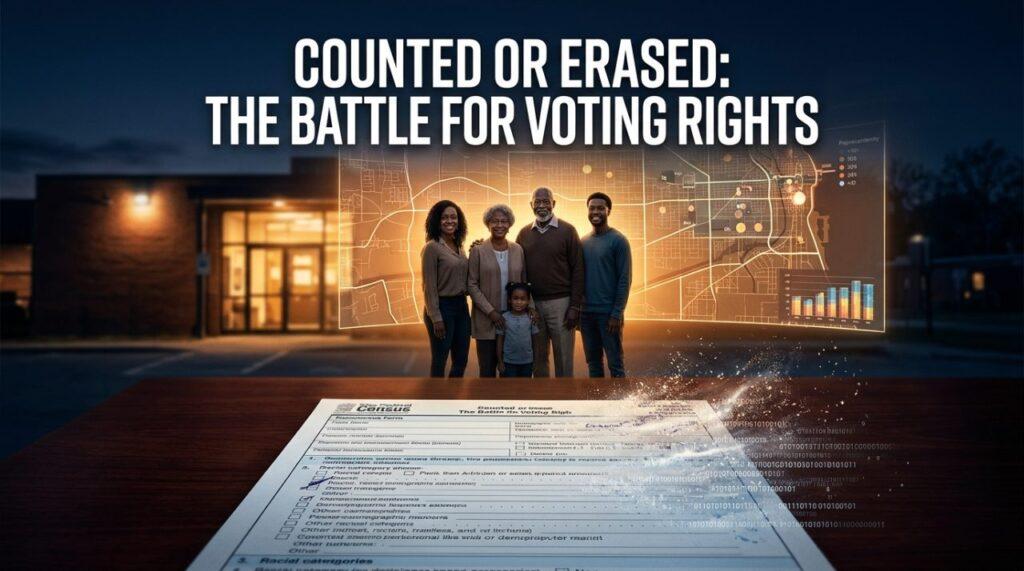
Census Race Data: What Erasing It Means for Voting Rights
By Darius Spearman (africanelements)
Support African Elements at patreon.com/africanelements and hear recent news in a single playlist. Additionally, you can gain early access to ad-free video content.
Mobilizing Around the Census Bureau Public Comment Deadline
November 2 marks the close of the extended federal comment window for Docket USBC-2026-0628 (regulations.gov). The proposal, published in the Federal Register under the title “Decennial Census of the Population of Americans; Proposed Residence Criteria and Proposed Regulations for Demographic Questions,” would prohibit inquiries about race, ethnicity, and sexual orientation on the decennial census short form (federalregister.gov). This proposed change to Title 15 of the Code of Federal Regulations seeks to restrict enumeration questions exclusively to age, biological sex, and household relationships (regulations.gov).
Civil rights legal organizations, municipal leaders, and social science institutions have organized an urgent national response (smartcitiesdive.com). The formal Census Bureau public comment period has accumulated more than 83,900 public submissions (regulations.gov). Federal officials justify the removal of demographic questions by citing race neutrality and administrative efficiency (federalregister.gov). Opponents counter that removing demographic tracking will compromise civil rights monitoring, legislative apportionment, and community resource delivery (forbes.com, redistrictingfoundation.org). The regulatory docket has consequently become a major flashpoint over federal demographic transparency.
Public Comments: Census Docket vs Standard Federal Rulemaking
The 236-Year History of Census Race Data in America
The collection of demographic data dates back to the initial formation of the American republic (archives.gov). Article I, Section 2 of the United States Constitution established the decennial enumeration primarily to apportion congressional seats and levy direct taxes (wikipedia.org). The constitutional text incorporated the Three-Fifths Compromise, which counted an enslaved individual as three-fifths of a free person while excluding un-taxed Indigenous populations (racism.org). The inaugural 1790 census institutionalized racial distinctions by classifying heads of households as Free White males, Free White females, All other free persons, and Slaves (archives.gov).
During the antebellum era, federal marshals assigned racial categories through personal inspection rather than self-reporting (yale.edu). Government officials frequently manipulated demographic statistics to defend chattel slavery. The 1840 census erroneously recorded high rates of lunacy among Northern free African Americans, an anomaly pro-slavery theorists cited to defend forced labor regimes (uchicago.edu). Following the Civil War, the Fourteenth Amendment mandated the counting of the whole number of persons in each state (wikipedia.org). Despite the end of involuntary servitude after emancipation, federal census officials expanded racial taxonomies to reflect nineteenth-century scientific racism, introducing fractional classifications like “Mulatto,” “Quadroon,” and “Octoroon” (archives.gov, yale.edu).
The history of census race data underwent a fundamental shift during the mid-twentieth century (racism.org). Beginning in 1960, the Census Bureau replaced enumerator visual appraisal with self-identification forms mailed directly to households (archives.gov). Passage of the Civil Rights Act of 1964 and the Voting Rights Act of 1965 converted demographic counts from instruments of exclusion into statutory mechanisms for civil rights enforcement (ldfrecollection.org). In 1977, the Office of Management and Budget standardized racial classifications through Statistical Policy Directive No. 15 (bls.gov). That standard underwent revisions in 1997 to accommodate multiracial identification and was updated in March 2024 to establish a Middle Eastern or North African category while combining race and ethnicity into a unified question (spd15revision.gov). Docket USBC-2026-0628 seeks to dismantle this 236-year trajectory by ending racial inquiry altogether (federalregister.gov).
Why Voting Rights Act Redistricting Relies on the Decennial Count
Eliminating census race data poses an immediate threat to the legal foundations of minority legislative representation (redistrictingfoundation.org). When the Supreme Court neutralized Section 5 preclearance in Shelby County v. Holder in 2013, Section 2 of the Voting Rights Act became the primary remaining safeguard against discriminatory redistricting (brennancenter.org). Section 2 prohibits any electoral practice or boundary line that results in the denial or abridgment of the right to vote on account of race (ldfrecollection.org). Enforcing this statutory protection requires rigorous mathematical modeling that depends entirely on comprehensive population counts (redistrictingdatahub.org).
In Thornburg v. Gingles (1986), the Supreme Court established a three-prong evidentiary test required to prove illegal minority vote dilution in Voting Rights Act redistricting cases (lls.edu, redistrictingonline.org):
- The minority community must demonstrate that it is sufficiently large and geographically compact to constitute a majority in a single-member district (lls.edu).
- The minority community must prove that its members are politically cohesive in their voting patterns (redistrictingonline.org).
- The minority community must show that the white majority votes sufficiently as a bloc to defeat candidates preferred by minority voters (lls.edu).
Meeting the first Gingles condition requires actual headcount figures of voting-age minority residents across small geographic areas (redistrictingfoundation.org). If the decennial short form excludes race, plaintiffs cannot establish geographical compactness under federal judicial standards (redistrictingdatahub.org). Without reliable demographic records, state mapmakers can implement racial gerrymandering through cracking and packing without statutory accountability (redistrictingdatahub.org). Contiguous Black neighborhoods can be split among multiple districts to submerge their voting power, or compressed into a single district to dilute surrounding areas (redistrictingfoundation.org, brennancenter.org). This absence of verifiable data directly threatens the preservation and creation of Black-held legislative and congressional seats.
The Critical Role of Census Block Level Data in Civil Rights Law
Federal rulemakers propose relying on the American Community Survey (ACS) to capture race metrics after removing them from the decennial census (federalregister.gov). Legal scholars and redistricting analysts reject this alternative as statistically unworkable for civil rights litigation (redistrictingfoundation.org, redistrictingdatahub.org). In 1975, Congress enacted Public Law 94-171, establishing the Census Redistricting Data Program (census.gov). This statute mandates that the Census Bureau supply state legislatures with small-area population statistics—broken down by race and ethnicity—within one year of Census Day (census.gov, redistrictingdatahub.org).
The standard decennial census conducts a 100 percent headcount covering all 8.1 million census blocks across the nation (redistrictingdatahub.org). In contrast, the ACS is an inferential sample survey sent to roughly 3.5 million households per year (mit.edu). While the ACS provides informative estimates for large metropolitan counties, it carries severe margins of error when applied to small geographic units like precincts and neighborhoods (mit.edu, redistrictingdatahub.org). Decennial census block level data provides the only baseline with the precision required to evaluate voting-age populations and satisfy the first prong of the Gingles test (redistrictingfoundation.org).
Geographic Precision: Decennial Census vs Annual ACS
Furthermore, social scientists pair block-level demographics with voting precinct tallies to conduct ecological inference modeling (redistrictingdatahub.org). This statistical technique demonstrates racially polarized voting by determining whether non-minority electors consistently vote as a bloc against candidates backed by Black voters (redistrictingonline.org). When racial counts are removed from individual blocks, ecological regression becomes impossible to execute (redistrictingfoundation.org). Litigators lose the empirical evidence required to prove vote dilution in federal court, undermining decades of legal battles regarding the balance of federal and state power over fair representation.
How the Decennial Census Undercount Distorts Black Representation
The decennial census has historically struggled with differential coverage errors, systematically undercounting Black Americans while overcounting White Americans (census.gov). Following each decennial census, the Bureau conducts the Post-Enumeration Survey (PES) to evaluate operational accuracy (census.gov, census.gov). The 2020 PES demonstrated that the Census Bureau undercounted the African American population by an estimated net rate of 3.30 percent (census.gov). In contrast, the non-Hispanic White population experienced a statistically significant net overcount of 1.64 percent (census.gov).
Differential undercounts fall heavily on vulnerable segments of the population. The 2020 PES revealed acute exclusion rates among Black children under the age of five (census.gov, georgetownpoverty.org). Tracking race on the decennial enumeration provides the only reliable baseline for identifying these gaps (georgetownpoverty.org). When an administration ceases tracking demographic categories on the decennial headcount, it removes the empirical mechanism needed to verify these errors (brennancenter.org). The official record instead presents an unverified count that masks persistent omissions.
2020 Census Net Undercount and Overcount Rates
An unresolved decennial census undercount compounds over time. Because the decennial enumeration establishes the population controls for all subsequent federal surveys over the next decade, an undercounted community remains underrepresented in intercensal population estimates (georgetownpoverty.org). This discrepancy reduces the number of congressional representatives assigned to diverse regions, penalizing areas with large minority populations while artificially amplifying political power in overcounted areas (redistrictingfoundation.org, brennancenter.org).
The Threat to Federal Funding Census Data Allocation
Beyond legislative mapmaking, decennial population data determines the distribution of public resources (forbes.com, familiesusa.org). The federal government directs between $1.5 trillion and $2.8 trillion annually to states, localities, and tribal governments based on census-derived formulas (familiesusa.org, georgetownpoverty.org). Major statutory programs rely on these counts to allocate resources, including Medicaid, Title I grants for local educational agencies, Section 8 Housing Choice Vouchers, the Supplemental Nutrition Assistance Program (SNAP), Head Start, and the Children’s Health Insurance Program (familiesusa.org, nea.org, georgetownpoverty.org).
| Federal Program | Primary Target Beneficiaries | Census Demographic Application |
|---|---|---|
| Medicaid & CHIP | Low-income families, children, and elderly persons | Calculates Federal Medical Assistance Percentages (FMAP) |
| Title I Education Grants | High-poverty public school districts | Allocates funds based on local child poverty counts |
| Section 8 Housing Vouchers | Low-income renters facing housing cost burdens | Determines Fair Market Rents and housing subsidy formulas |
| Head Start Programs | Preschool children from low-income families | Guides early childhood education expansion grants |
When decennial counts omit race and ethnicity data, federal grant allocations cannot accurately reflect community needs (familiesusa.org). Historically redlined urban centers and underserved rural towns experience lower funding allocations for schools, transit systems, and clinical infrastructure (forbes.com, georgetownpoverty.org). Public health researchers note that stripping racial demographic data also impairs epidemiological research (kff.org, nih.gov). Without detailed block-group data, public health agencies cannot track racial disparities in maternal mortality, diabetes prevalence, or industrial pollution exposure (kff.org, cahealthadvocates.org, nih.gov). This limitation directly undermines ongoing claims for racial justice and health equity.
The proposed rule also impacts other racial and ethnic communities (nativenewsonline.net, hispanicresearchcenter.org). Hispanic advocacy organizations point out that the changes would remove ethnic identifiers for 65 million Latinos, leaving the political status and counts of 3.2 million Puerto Rican island residents unaddressed (grupocne.org, pasquines.us, hispanicresearchcenter.org). Tribal leaders note that omitting Indigenous enumerations threatens sovereign treaty trust responsibilities and Indian Health Service financing (nativenewsonline.net). Furthermore, removing race data eliminates the Middle Eastern or North African category before it can appear on a decennial questionnaire (spd15revision.gov). The proposal weakens the statistical visibility that marginalized communities have sought for decades (nativenewsonline.net, spd15revision.gov).
The end of the public comment period for Docket USBC-2026-0628 brings this debate to the forefront of administrative law (regulations.gov). While supporters defend the rule as a move toward race neutrality, historical precedent demonstrates that unrecorded disparities do not disappear (racism.org, ldfrecollection.org). Instead, eliminating demographic counts removes the empirical tools used to enforce constitutional equal protection, safeguard voting power, and allocate vital community resources (redistrictingfoundation.org, brennancenter.org).
About the Author
Darius Spearman is a professor of Black Studies at San Diego City College, where he has been teaching for over 20 years. He is the founder of African Elements, a media platform dedicated to providing educational resources on the history and culture of the African diaspora. Through his work, Spearman aims to empower and educate by bringing historical context to contemporary issues affecting the Black community.
