

King Charles Slavery Speech: Why Reparations Remain at an Impasse
By Darius Spearman (africanelements)
Support African Elements at patreon.com/africanelements and hear recent news in a single playlist. Additionally, you can gain early access to ad-free video content.
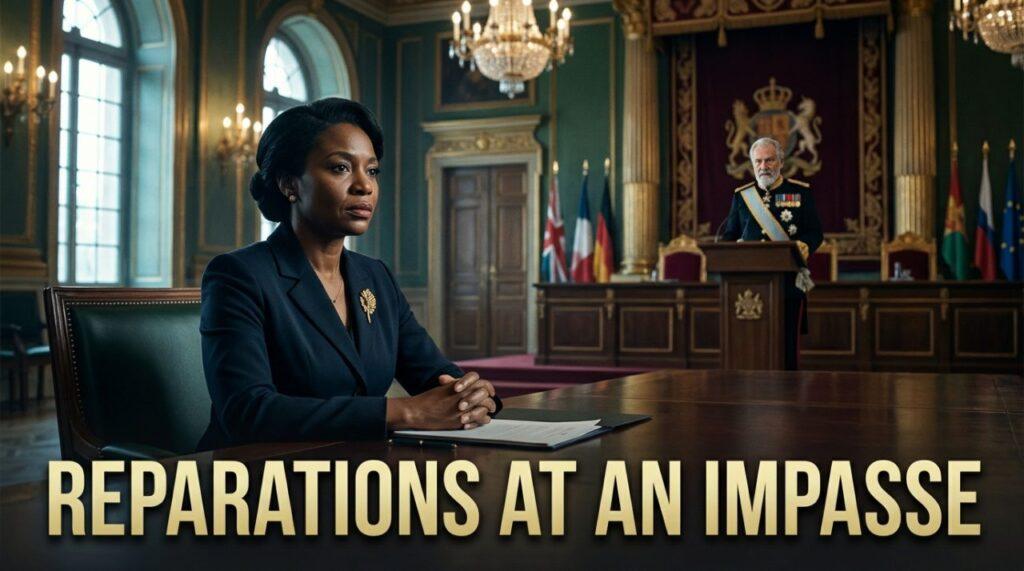
Speaking before leaders from 56 nations at the Commonwealth summit in Antigua and Barbuda, King Charles III addressed the transatlantic trade in human beings. The monarch described chattel slavery as a monstrous injustice that casts a continuing shadow across former British colonies. His address marked one of the strongest verbal acknowledgments of historic harm ever delivered by a reigning sovereign. The King Charles slavery speech expressed personal sorrow over the suffering caused by British colonial exploitation (enca.com, theguardian.com).
The royal rhetoric stopped noticeably short of an official state apology or any pledge of financial restitution. Caribbean leaders have intensified diplomatic pressure on London to address reparatory justice Caribbean claims. Downing Street continues to insist that modern taxpayers cannot assume legal liability for historic atrocities. Understanding this persistent deadlock requires looking beyond summit diplomacy to examine how royal power created British slave systems (1news.co.nz, theguardian.com).
Transatlantic Trafficking Volume by Empire
Royal African Company History and Crown Wealth Extraction
The English Crown was an executive sponsor of chattel slavery rather than a detached bystander. Direct royal involvement started during the sixteenth century under Queen Elizabeth I. Elizabeth commissioned a royal naval vessel named the Jesus of Lubeck for Captain John Hawkins. Hawkins utilized the ship to complete early English voyages trafficking captive Africans directly to Spanish settlements (history.com).
Sovereign investment expanded dramatically following the Stuart Restoration of 1660. King Charles II granted exclusive charters to the Company of Royal Adventurers and subsequently established the Royal African Company in 1672. Royal African Company history demonstrates that the enterprise operated under royal monopoly. James, Duke of York, who later ruled as King James II, managed the business as corporate governor. Company agents branded captive men, women, and children on their chests with the initials RAC or DY to mark them as sovereign property (pvamu.edu, encyclopediavirginia.org).
The Royal African Company transported between 100,000 and 212,000 enslaved Africans across the Atlantic. Profits from this extraction enriched royalty, aristocrats, and early founders of the Bank of England. Royal family slave trade ties laid the fiscal foundations for British industrial development and global naval supremacy. Caribbean colonies such as Barbados and Jamaica became brutal manufacturing centers for raw sugar. These lucrative colonial holdings generated enormous revenue streams that sustained the domestic British treasury for generations (londonmuseum.org.uk, bankofengland.co.uk).
In his King Charles Commonwealth speech, the sovereign praised the Royal Navy for suppressing the maritime slave trade after 1807. Historical records show a dual legacy. For more than a century prior to abolition, the Royal Navy primarily secured slave merchant routes and protected slave ships. The navy defended violent plantation colonies against competing European rivals. The armed forces protected the economic assets that accumulated immense sovereign wealth for London (cbsnews.com, historyreclaimed.co.uk).
How the Slavery Abolition Act 1833 Enriched Enslavers
When Parliament passed the Slavery Abolition Act 1833, it codified an extraordinary transfer of public wealth into private accounts. Wealthy plantation owners and their political allies in the West India Committee demanded direct indemnification before surrendering their claimed human property. Parliament authorized a payment of £20 million to roughly 46,000 slave owners. That sum constituted approximately 40 percent of the annual budget of the British government at the time (historyofparliament.com, nationalarchives.gov.uk).
Enslaved people received nothing in terms of money, land, or initial capital. British authorities instead instituted a compulsory apprenticeship system that compelled formerly enslaved laborers to provide unpaid agricultural work for four additional years. This coercive arrangement resembled other forms of involuntary servitude after emancipation seen across the Americas. Slave owner compensation UK policies transferred massive resources to enslavers while trapping freed workers in extreme poverty (wikipedia.org, tandfonline.com).
The 1833 Abolition Financial Distribution
To fund the bailout, the British government secured massive sovereign loans from private banking syndicates, including Nathan Mayer Rothschild. That sovereign debt was refinanced across decades and was not completely liquidated until 2015. Modern British citizens, including members of the Caribbean diaspora residing in the United Kingdom, paid taxes to retire government loans issued to compensate the enslavers of their ancestors (taxjustice.net, thejournal.ie).
Following legal emancipation in 1838, colonial governors enacted strict land regulations to preserve the plantation labor pool. Authorities set high minimum purchase sizes for public acreage and imposed poll taxes on agricultural workers. These structural policies suppressed independent Black farming across the region. Former colonies entered self-governance with depleted public coffers, no developmental capital, and severe infrastructure deficits (royalgazette.com, bankofsaintlucia.com).
CARICOM Reparations Demand and Modern Debt Realities
Modern economic challenges across the Caribbean are directly linked to these historic extraction frameworks. The CARICOM reparations demand reflects an organized diplomatic movement seeking structural remedy rather than simple financial hand-outs. The Caribbean Community established a detailed Ten-Point Plan for Reparatory Justice. The proposal demands formal state apologies, public health investments, educational technology transfers, and sovereign debt cancellation (caricom.org, reparationscomm.org).
Caribbean leaders emphasize that political independence did not erase colonial debt burdens. Prime Minister Mia Mottley of Barbados points out that newly sovereign islands inherited massive infrastructural deficits without financial assistance. Prime Minister Philip J. Pierre of Saint Lucia reiterated that an apology without repair is fundamentally incomplete. Caribbean states spend large percentages of national revenue servicing external debt, leaving few domestic resources for climate resilience or public health (bankofsaintlucia.com, eclac.org).
Brattle Group Slavery Liability Valuations
Recent economic research has quantified the financial scope of these claims. A comprehensive 2023 analysis by the Brattle Group, co-authored with International Court of Justice Judge Patrick Robinson, evaluated historical damages. The study calculated total uncompensated labor, physical injury, and generational wealth loss. Brattle Group slavery reparations figures assessed a financial obligation of roughly $24 trillion against the United Kingdom (brattle.com, un.org).
These calculations counter assertions that historic slavery damages cannot be reliably measured. Similar rigorous models inform modern debates over state-level reparatory justice initiatives in North America. Caribbean governments utilize these economic assessments as objective benchmarks in multilateral forums. The objective is to secure developmental financing, debt write-offs, and environmental infrastructure investments through diplomatic negotiations (youtube.com, brattle.com).
Why a British Monarchy Slavery Apology Faces Deadlock
Constitutional law explains why King Charles cannot issue an independent apology. Under the unwritten British constitution, the monarch reigns as a politically neutral head of state. The sovereign acts strictly on the advice of elected ministers. King Charles cannot unilaterally formulate foreign policy or accept state responsibility. An official British monarchy slavery apology delivered by the crown requires authorization and consent from Downing Street (theweek.com, cnn.com).
Whitehall legal advisors have cautioned successive governments against issuing an unqualified sovereign apology. An official state apology could be interpreted in international courts as a formal admission of legal liability. That admission could expose the British Treasury to enforceable financial claims. Downing Street has resisted direct monetary payments. British officials prefer informal dialogues, multilateral green funds, and trade partnerships that avoid legal exposure (1news.co.nz, commonspace.eu).
This persistent deadlock accelerates constitutional realignments across the Commonwealth. Caribbean nations are moving to sever formal ties with the British Crown. Following the transition of Barbados to a republic in 2021, Jamaica, the Bahamas, and Antigua and Barbuda launched steps toward constitutional independence. These political shifts reflect broader decolonization efforts that reject hereditary imperial leadership (caribbeanandco.com, mirror.co.uk).
The divide between London and the Caribbean remains wide. The British government seeks to isolate historic slavery within past centuries. Caribbean leaders argue that modern poverty, chronic non-communicable diseases, and fiscal vulnerabilities are the ongoing consequences of imperial policy. King Charles recognized the slave trade as a monstrous injustice. For the Caribbean diaspora, moral rhetoric without financial restitution leaves the historical ledger unbalanced (enca.com, voice-online.co.uk).
About the Author
Darius Spearman is a professor of Black Studies at San Diego City College, where he has been teaching for over 20 years. He is the founder of African Elements, a media platform dedicated to providing educational resources on the history and culture of the African diaspora. Through his work, Spearman aims to empower and educate by bringing historical context to contemporary issues affecting the Black community.
