

Uganda Somalia Withdrawal: Inside the Historic 20-Year Exit
By Darius Spearman (africanelements)
Support African Elements at patreon.com/africanelements and hear recent news in a single playlist. Additionally, you can gain early access to ad-free video content.
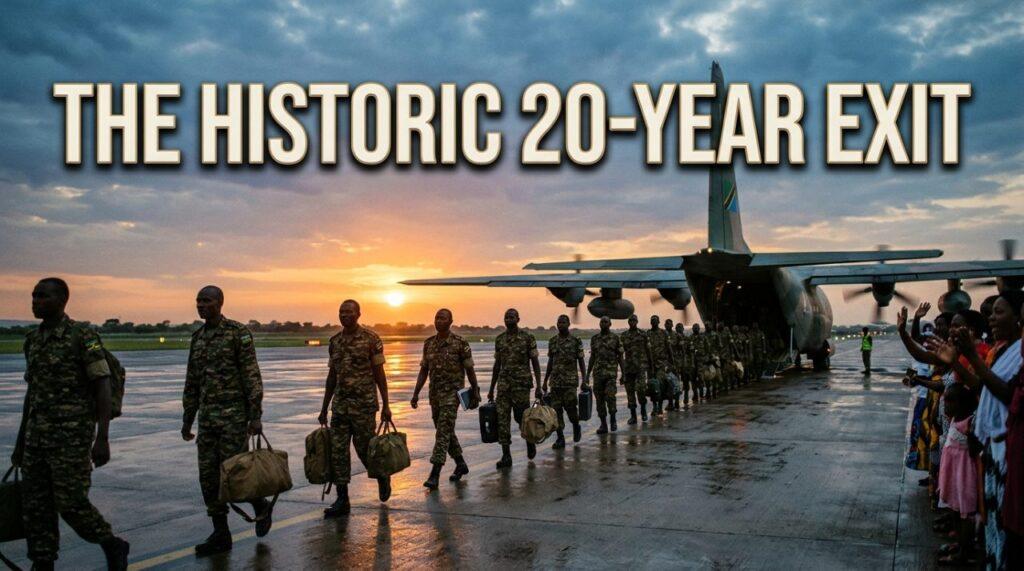
The return of 109 soldiers to Entebbe marked the quiet beginning of a historic military departure (punchng.com, hiiraan.com). For nearly two decades, the Uganda People’s Defence Forces served as the backbone of African Union peacekeeping in the Horn of Africa (researchgate.net). Now, an official Ugandan military drawdown has formally commenced (theinvestigatornews.com). Chief of Defence Forces General Muhoozi Kainerugaba confirmed that this first cohort represents an immediate, phased departure (hiiraan.com, eagle.co.ug). All remaining Ugandan forces are scheduled to vacate Somalia by late 2027 (ranenetwork.com, newscord.org).
This exit signals the twilight of the most protracted military deployment in modern African history (researchgate.net). Ugandan troops first entered Mogadishu in March 2007, stepping into a ruined coastal capital that global powers had abandoned (wikipedia.org, wikipedia.org). Behind today’s headlines lies a complex history of urban combat, foreign policy calculations, and domestic political repressions. Understanding the Uganda Somalia withdrawal requires examining two decades of intense conflict, institutional evolution, and regional sacrifice.
The 1993 Fallout and the AMISOM Mogadishu Intervention
To grasp why Uganda deployed troops to Somalia, one must return to the geopolitical vacuum of the 1990s (researchgate.net). Following the 1991 collapse of the government of President Mohamed Siad Barre, Somalia entered protracted factional warfare (wikipedia.org). In October 1993, the disastrous Battle of Mogadishu resulted in the deaths of 18 American soldiers and hundreds of Somalis (wikipedia.org). That battle prompted an immediate withdrawal of United States forces and United Nations peacekeepers (uu.se, wikipedia.org). The trauma of that loss led Washington to issue Presidential Decision Directive 25, which sharply curtailed direct American ground combat in foreign conflicts (responsiblestatecraft.org).
For more than a decade, Western nations refused to deploy ground personnel to Somalia (uu.se). When the Islamic Courts Union established civic order across Mogadishu in 2006, regional alarm bells sounded (researchgate.net, wikipedia.org). Ethiopian forces crossed the border with covert American support to oust the courts (uu.se). That invasion ignited a fiery nationalist insurgency that gave rise to Harakat al-Shabaab al-Mujahideen (researchgate.net, wikipedia.org). As Ethiopian forces faced unsustainable resistance, the African Union authorized a new security mission under United Nations Resolution 1744 (wikipedia.org, wikipedia.org). Most nations hesitated, but Ugandan President Yoweri Museveni stepped forward (researchgate.net).
On March 6, 2007, Battle Group I of the Ugandan military landed at Aden Adde International Airport under direct mortar fire (wikipedia.org, eagle.co.ug). For months, Ugandan peacekeepers stood virtually alone amid violent urban ruins before Burundian forces arrived (researchgate.net, wikipedia.org). Western powers eagerly financed the operation, providing heavy weapons, drone surveillance, and troop allowances (ranenetwork.com, europa.eu). This transactional framework outsourced physical danger to African infantry, allowing foreign capitals to project power remotely without domestic casualty exposure (responsiblestatecraft.org). The AMISOM Mogadishu intervention had officially begun, establishing an operational precedent that defined regional security for two decades (researchgate.net, wikipedia.org).
African Union Somalia Mission Personnel Casualties
Urban Crucible and Al-Shabaab Counterinsurgency Operations
The mission in Mogadishu quickly diverged from traditional peacekeeping (researchgate.net, uu.se). There was no peace to keep in southern Somalia (researchgate.net). Instead, Ugandan forces became embroiled in high-intensity urban combat (wikipedia.org, wikipedia.org). Soldiers operated within a fortified perimeter protecting three vital nodes: the seaport, the international airport, and the presidential palace at Villa Somalia (researchgate.net). Insurgent fighters attacked these positions daily using suicide car bombs, sniper fire, and concealed mortar pits (wikipedia.org, wikipedia.org).
Between 2009 and 2011, the conflict evolved into close-quarters urban warfare (wikipedia.org). Ugandan and Burundian soldiers fought through ruined neighborhoods room by room (wikipedia.org, wikipedia.org). They cleared sniper nests and breached concrete compounds under relentless fire (wikipedia.org). In August 2011, allied forces launched Operation Free Mogadishu, successfully clearing militant strongholds across the sprawling Bakara Market (wikipedia.org). This hard-fought push forced the insurgents to abandon territorial defense of the city (wikipedia.org, wikipedia.org).
The expulsion of militant fighters allowed the Somali central authority to administer its capital for the first time in twenty years (wikipedia.org). However, the counterinsurgency campaign demanded enormous tactical evolution (researchgate.net). Ugandan units adopted armored urban tactics, relying on sandbagged fighting positions and mine-resistant transport (researchgate.net). Insurgents responded by refining their improvised explosive devices, shifting tactics from conventional defense to hit-and-run ambushes (ranenetwork.com, researchgate.net). Sustained Al-Shabaab counterinsurgency operations demanded continuous vigilance from peacekeepers operating far from home (researchgate.net, wikipedia.org).
The Bloodiest Frontlines and UPDF Lower Shabelle Casualties
Following the liberation of Mogadishu, the African Union expanded its theater of operations (wikipedia.org). Planners partitioned central and southern Somalia into distinct territorial sectors as Kenya, Ethiopia, and Djibouti contributed battalions (wikipedia.org, wikipedia.org). The Ugandan contingent assumed responsibility for Sector 1, which comprised the Benadir administrative district and the fertile Lower Shabelle river basin (researchgate.net). This assignment proved to be the most grueling deployment in the entire theater (researchgate.net, voanews.com).
Lower Shabelle functioned as the economic core and staging ground for the insurgency (researchgate.net). The region provided agricultural revenue through extortionist agricultural taxes, known as zakat, and direct road links into Mogadishu (ranenetwork.com). In pushing across this rural basin, Ugandan troops transitioned from compact urban centers to remote forward operating bases (researchgate.net). These rural outposts sat surrounded by dense brush and hostile lines of communication (researchgate.net, voanews.com). Militants adapted their strategy by deploying suicide vehicle bombs to breach base perimeters before sending coordinated infantry waves (voanews.com, hiiraan.com).
The physical costs mounted rapidly across the rural outposts (voanews.com). In September 2015, fighters stormed a Ugandan base in Janaale, overrunning defensive earthworks and inflicting heavy fatalities (wikipedia.org, wikipedia.org). Then, in May 2023, militants carried out a devastating dawn attack against an outpost in Buulo Mareer (voanews.com, hiiraan.com). Over 800 insurgents assaulted the compound using multiple explosive-laden trucks, killing 54 Ugandan soldiers in a single engagement (voanews.com). These continuous losses contributed to the staggering UPDF Lower Shabelle casualties that gradually diminished domestic enthusiasm for an open-ended foreign deployment (voanews.com, hiiraan.com).
Ugandan Troop Presence in Somalia Over Time
Kampala’s Geopolitical Bargain in the Museveni Western Security Alliance
Military interventions are rarely driven solely by humanitarian altruism (researchgate.net). For President Yoweri Museveni, committing the Ugandan military to Somalia served distinct strategic purposes (researchgate.net, kas.de). On the global stage, Museveni championed the ideal of African solutions for African security challenges (researchgate.net). Regionally, he positioned Uganda as the central pillar of East African stability (researchgate.net). Just as scholars critique the need for decolonizing institutional frameworks across the continent, security analysts point out how international peacekeeping often perpetuated external dependencies (responsiblestatecraft.org).
By providing the bulk of the infantry to fight Al-Shabaab, Kampala constructed an indispensable security shield with Washington and Brussels (researchgate.net, responsiblestatecraft.org). Western policymakers relied on Ugandan boots to avoid deploying their own forces (responsiblestatecraft.org). In return, Western capitals muted their criticism of Kampala’s internal domestic repression (responsiblestatecraft.org). When Ugandan security forces suppressed political protests, Western responses remained restricted to mild diplomatic statements (responsiblestatecraft.org). Similar dynamics have historically mirrored the broader political shifts where institutional convenience routinely supersedes genuine civil rights protections.
Throughout contentious election cycles, state security forces crushed domestic opposition movements (responsiblestatecraft.org). In November 2020, security personnel killed more than 50 protesters during demonstrations against the arrest of opposition leader Robert Kyagulanyi (responsiblestatecraft.org). State agents routinely abducted activists in unmarked vans, held detainees incommunicado, and shut down national internet access (responsiblestatecraft.org). Yet, defense assistance, foreign equipment, and operational stipends continued to flow (responsiblestatecraft.org, europa.eu). The Museveni Western security alliance created a transactional dynamic where domestic authoritarianism was tolerated to sustain external counterterrorism priorities (responsiblestatecraft.org).
However, the intervention brought direct violence back to Ugandan soil (wikipedia.org, wikipedia.org). On July 11, 2010, Al-Shabaab suicide bombers detonated explosives among crowds watching the World Cup final in Kampala (wikipedia.org, wikipedia.org). The blasts killed 76 people, shattering the assumption that Uganda could wage a foreign war without domestic consequences (wikipedia.org, wikipedia.org). Still, the military commitment endured, sustained by international allowances and regional prestige (researchgate.net, europa.eu).
From Liberation to Drawdown: The ATMIS to AUSSOM Transition
By the late 2010s, donor fatigue had set in across European capitals (ranenetwork.com, europa.eu). The European Union, which funded operational soldier allowances through its African Peace Facility, reduced its direct subsidies (europa.eu). International donors argued that external peacekeeping forces could not maintain an open-ended defensive umbrella forever (ranenetwork.com, responsiblestatecraft.org). Somalia required a phased handover mechanism to transfer security responsibilities to its own institutions (ranenetwork.com, atmis-au.org).
In April 2022, the African Union ended AMISOM and established the African Union Transition Mission in Somalia (atmis-au.org, newscord.org). The new mission mandated a structured, multi-phase withdrawal (atmis-au.org). Its operational guidelines required the progressive transfer of forward operating bases to the national military (atmis-au.org, newscord.org). Although repeated insurgent offensives caused operational pauses, thousands of peacekeepers vacated peripheral outposts between 2022 and 2024 (atmis-au.org, newscord.org).
In January 2025, the peacekeeping architecture shifted again under United Nations Security Council Resolution 2767 (ranenetwork.com, newscord.org). The council authorized the African Union Support and Stabilisation Mission in Somalia, a downsized force designed to protect major infrastructure through late 2027 (ranenetwork.com, newscord.org). Uganda agreed to participate in this streamlined mission while concurrently executing the return of its separate bilateral brigade (hiiraan.com, theinvestigatornews.com). This ongoing ATMIS to AUSSOM transition formally set the timeline for Kampala’s comprehensive operational exit (ranenetwork.com, hiiraan.com).
Evolution of African Union Force Mandates
Structural Fragility and Somalia Security Vacuum Concerns
As peacekeepers pack their gear, the central question centers on local military readiness (ranenetwork.com, responsiblestatecraft.org). The historical record reveals that post-war reconstruction efforts frequently unravel when national institutions lack the internal capacity to enforce the rule of law. Independent observers warn that the national forces are not fully prepared to hold liberated areas independently (ranenetwork.com, responsiblestatecraft.org). Specialized, foreign-trained formations like the Danab Brigade demonstrate impressive tactical skill in offensive raids (responsiblestatecraft.org). However, conventional army divisions face deep systemic hurdles (ranenetwork.com, responsiblestatecraft.org).
The national military struggles with compromised logistics, erratic salary distributions, and an acute lack of air evacuation support (ranenetwork.com, responsiblestatecraft.org). To recapture lost territory, the federal administration has relied on local clan militias known as the Macawisley (ranenetwork.com, responsiblestatecraft.org). While these fighters possess deep local knowledge, their participation elevates inter-clan frictions (ranenetwork.com). When federal forces capture an outpost, regular units frequently lack the heavy artillery and defensive supplies needed to resist counterattacks (ranenetwork.com, responsiblestatecraft.org). These institutional weaknesses exacerbate widespread Somalia security vacuum concerns across vulnerable rural districts (ranenetwork.com).
A premature withdrawal without robust logistical remedies risks catastrophic consequences for rural civilians (ranenetwork.com, responsiblestatecraft.org). Whenever federal units retreat from contested bases, insurgent columns return to exact revenge against local leaders who assisted the government (ranenetwork.com). Militants reimpose illegal extortion checkpoints and sever humanitarian transit corridors (ranenetwork.com, newscord.org). The departure of seasoned Ugandan infantry presents a profound challenge to regional stability, testing whether Somali statehood can withstand the relentless pressure of an entrenched rural insurgency (ranenetwork.com, researchgate.net).
The return of the first 109 soldiers represents far more than routine troop movements (punchng.com, hiiraan.com). It closes an era defined by immense sacrifice, where thousands of African soldiers gave their lives to rebuild a fractured state (researchgate.net, voanews.com). Uganda’s departure forces both regional leaders and foreign donors to confront the limits of armed intervention (researchgate.net, responsiblestatecraft.org). As the military drawdown advances toward its 2027 completion date, the burden of defense shifts entirely onto the Somali soldiers standing guard on the front lines (ranenetwork.com, newscord.org).
About the Author
Darius Spearman is a professor of Black Studies at San Diego City College, where he has been teaching for over 20 years. He is the founder of African Elements, a media platform dedicated to providing educational resources on the history and culture of the African diaspora. Through his work, Spearman aims to empower and educate by bringing historical context to contemporary issues affecting the Black community.
