

UK Slavery Reparations: Why Caribbean Leaders Reject an Apology
By Darius Spearman (africanelements)
Support African Elements at patreon.com/africanelements and hear recent news in a single playlist. Additionally, you can gain early access to ad-free video content.
A major diplomatic confrontation over UK slavery reparations has emerged between Great Britain and the Caribbean Community. Ahead of the Commonwealth Heads of Government Meeting in St. John’s, Antigua and Barbuda, British Prime Minister Andy Burnham offered an unprecedented concession. In an article published by The Guardian, Burnham signaled that the British government is willing to consider a formal state apology for its role in transatlantic chattel slavery (theguardian.com, theguardian.com). He also offered structured talks on economic support and sovereign debt restructuring (aljazeera.com, theguardian.com).
At the same time, Burnham drew an uncompromising line against financial restitution. The British prime minister stated that modern British citizens cannot be held financially liable for events that took place centuries ago under different legal systems (thenational.scot, huffingtonpost.co.uk). Caribbean leaders immediately rejected this distinction. Led by Antigua and Barbuda Prime Minister Gaston Browne, regional heads of government reaffirmed that full restitution remains non-negotiable (aljazeera.com, aa.com.tr). For the Caribbean, words of remorse without economic repair cannot settle a catastrophic colonial legacy (thejournal.ie, jpost.com).
Commonwealth Summit Reparations: St. John’s Diplomatic Clash
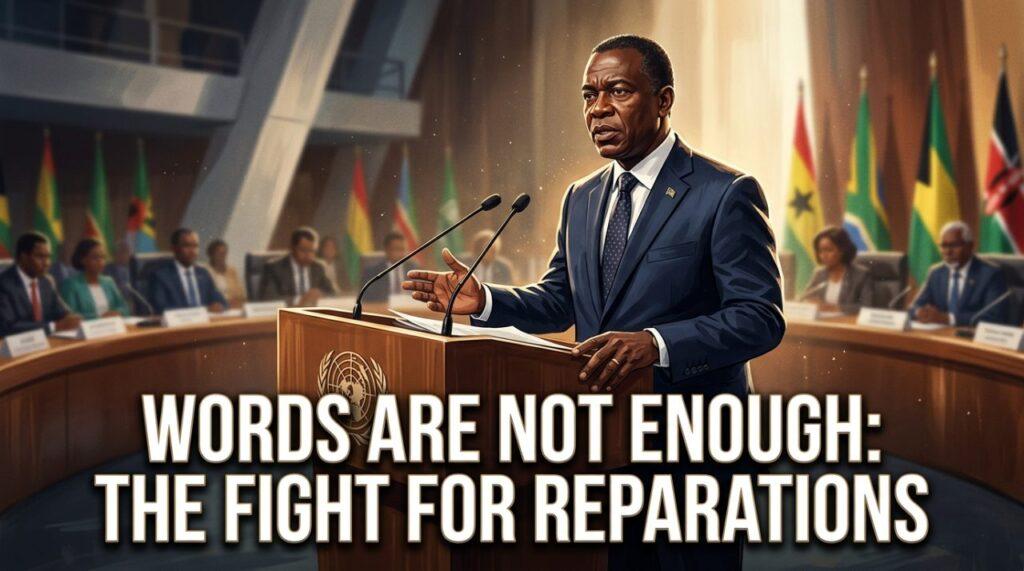
The 2026 Commonwealth Heads of Government Meeting brought these long-simmering tensions directly to the forefront. Prime Minister Gaston Browne hosted the summit alongside Britain’s King Charles III (aljazeera.com). Browne delivered a direct counter to Westminster’s position. He explained that offering an apology while ruling out material redress sets a dangerous international precedent (aljazeera.com, thenational.scot). If atrocious state actions carry no financial consequence, Browne argued, there is little deterrence against similar state crimes in the future (aljazeera.com).
Other Caribbean leaders quickly supported this unified regional stance. Saint Lucia Prime Minister Philip J. Pierre, serving as Chairman of CARICOM, stated that any discussion excluding financial restitution is incomplete from the outset (aljazeera.com, thejournal.ie). Pierre emphasized that sovereign debt restructuring cannot serve as a substitute for reparatory justice (aljazeera.com). Barbados Prime Minister Mia Mottley underscored that the Caribbean demand is not an appeal for foreign charity (theguardian.com, americasquarterly.org). Instead, it represents a formal developmental claim based on international law (caricom.org, caricom.org).
The Commonwealth Heads of Government Meeting has evolved into the central diplomatic arena for this dispute. The Commonwealth is a voluntary association of 56 independent member nations that grew out of the British Empire (aljazeera.com, dennisignatius.com). It operates on sovereign equality and multilateral consensus. African and Caribbean nations hold a combined voting majority within the body. This voting power allows formerly colonized nations to shape official communiqués and hold Downing Street diplomatically accountable (aljazeera.com, dennisignatius.com).
However, the Commonwealth possesses no binding statutory or judicial authority to enforce financial settlements. Its resolutions reflect collective political and moral pressure rather than executive force (dennisignatius.com). Caribbean leaders recognize this institutional limitation. Still, they use the summit platform to dismantle British attempts to treat colonial history as a closed domestic matter (aljazeera.com, theguardian.com).
1833 Emancipation Financial Allocations
UK Slavery Apology: Moral Words Versus Material Harm
The British government attempts to isolate the past by creating a legal boundary around modern citizens. Prime Minister Burnham argued that living generations bear no personal responsibility for policies enacted by ancestors long dead (theguardian.com, theguardian.com). This framing misinterprets how public international law evaluates state liability. Sovereign states possess continuous legal identity (dennisignatius.com). Governments inherit treaties, financial obligations, and institutional liabilities that do not expire when individual leaders pass away (dennisignatius.com, americasquarterly.org).
International legal scholars ground the Caribbean case in the doctrine of continuous delict, or a continuing wrongful act (dennisignatius.com). Under this standard, when an initial state crime produces ongoing harms that remain unaddressed, the legal infraction persists into the present day. Caribbean legal commissions also rely on the principle of unjust enrichment (caricom.org, americasquarterly.org). This common-law doctrine holds that one party cannot retain assets gained through systemic theft and forced labor without providing restitution (dennisignatius.com). Similar principles have emerged in domestic initiatives, such as the first-in-a-nation task force to study reparations in the United States.
Clear precedents demonstrate that modern sovereign states can compensate victims for historical violations (dennisignatius.com). In the 1952 Luxembourg Agreement, West Germany agreed to pay billions of marks in reparations to the State of Israel and the Claims Conference for the Holocaust (dennisignatius.com). In 1988, the United States government issued financial restitution and formal apologies to Japanese Americans interned during World War II. In 2013, the British government paid nearly twenty million pounds to thousands of Kenyan survivors who suffered torture during the colonial Mau Mau rebellion (dennisignatius.com). These precedents refute the claim that state responsibility dissolves over time.
British Slave Trade History: Building an Imperial Empire
To understand why words alone fail to satisfy Caribbean nations, one must study the historical foundation of British maritime wealth. European powers forcibly captured and transported more than twelve million African people across three centuries (wikipedia.org). Great Britain was the dominant driver of this forced human migration (aljazeera.com, wikipedia.org). In 1672, King Charles II granted a royal charter to the Royal African Company (nationalarchives.gov.uk, wikipedia.org). The monarch placed his brother James, Duke of York, at its head (wikipedia.org). The company shipped more enslaved human beings to the Americas than any other single institution in world history (nationalarchives.gov.uk, wikipedia.org).
British merchants transported between 3.1 and 3.4 million enslaved African men, women, and children across the Atlantic (aljazeera.com, wikipedia.org). Most survivors ended up on sugarcane and agricultural plantations across Jamaica, Barbados, the Leeward Islands, Trinidad, and Guyana (aljazeera.com, wikipedia.org). The plantation economy generated massive capital through raw commodities, including sugar, rum, and cotton (wikipedia.org, taxjustice.net). Enslaved workers faced horrific mortality rates, routine violence, and generational bondage (aljazeera.com, wikipedia.org). This systemic extraction shaped geopolitical policies throughout the hemisphere, influencing early state systems analyzed in studies on the historical intricacies of the U.S. Constitution and slavery.
The profits generated from chattel slavery built modern British commercial institutions. Major banking and insurance enterprises, including the precursors to Barclays, Lloyds, and the Bank of England, originated from colonial mortgage systems and slave-ship finance (taxjustice.net, bankofengland.co.uk). Capital extracted from the West Indies funded domestic canals, railway networks, and industrial factories across London, Liverpool, Bristol, and Glasgow (aljazeera.com, taxjustice.net). While Great Britain developed world-class industrial infrastructure, Caribbean colonies suffered structural underdevelopment, monocultural dependence, and economic deprivation that persist today (aljazeera.com, caricom.org).
Enslaved Africans Shipped by British Fleets
1833 Slavery Abolition Act: The Bailout That Cost Millions
When the British Parliament passed the Slavery Abolition Act in August 1833, it did not construct the legislation as human rights redress (nationalarchives.gov.uk, wikipedia.org). The act took effect on August 1, 1834, treating human emancipation as an expropriation of private capital (nationalarchives.gov.uk). The British government decided that slaveholders deserved financial compensation for losing their human property (nationalarchives.gov.uk, fullfact.org). Parliament authorized a massive payout of twenty million pounds directly to forty-six thousand enslavers across the empire (nationalarchives.gov.uk, fullfact.org).
The scale of this imperial bailout was staggering. The twenty million pounds represented forty percent of the entire annual budget of the British government in 1833 (nationalarchives.gov.uk, fullfact.org). It amounted to roughly five percent of Great Britain’s total gross domestic product (nationalarchives.gov.uk, taxresearch.org.uk). To raise the money, HM Treasury took out substantial private loans from financiers Nathan Mayer Rothschild and Moses Montefiore (nationalarchives.gov.uk, theguardian.com). That capital reinforced the private wealth of British elites, merchant dynasties, and royal family members for generations (nationalarchives.gov.uk, theguardian.com).
In contrast, the more than eight hundred thousand formerly enslaved people in the British West Indies received nothing (aljazeera.com, nationalarchives.gov.uk). Instead, Parliament imposed an exploitative apprenticeship system (nationalarchives.gov.uk). Formerly enslaved workers over the age of six were legally mandated to provide forty-five hours of uncompensated labor each week to their former enslavers (nationalarchives.gov.uk, wikipedia.org). This forced labor period lasted four to six years until widespread protests secured full emancipation in 1838 (nationalarchives.gov.uk). Similar forms of coercion appeared after American emancipation, where newly emancipated Blacks continued to face involuntary servitude through institutional sharecropping and convict leasing.
British Slave Owner Compensation: The 182-Year National Debt
The British government’s handling of the 1833 compensation loan contradicts contemporary arguments against reparatory justice. After paying the enslavers, the British Treasury rolled the borrowed debt into long-term government gilts and consolidated annuities (fullfact.org, taxresearch.org.uk). The British public serviced the interest on these slaveholder loans across nineteenth-century and twentieth-century administrations (fullfact.org, theguardian.com). The debt remained active on the national balance sheet for 182 years (fullfact.org).
HM Treasury did not redeem and finalize the remaining bonds until 2015 (fullfact.org, taxresearch.org.uk). Because the government serviced the debt through general tax revenue, generations of British taxpayers financed the slaveholder compensation fund (fullfact.org). This financial reality created a painful historical irony for the Windrush generation (theguardian.com). Between 1948 and 1973, hundreds of thousands of Caribbean citizens migrated to Great Britain under the British Nationality Act 1948 (theguardian.com). They arrived to rebuild public transit, the National Health Service, and heavy manufacturing following World War II (theguardian.com).
These Caribbean immigrants and their children paid regular income and sales taxes into the British Treasury for decades (theguardian.com, taxresearch.org.uk). As a result, direct descendants of enslaved Africans were forced to finance the financial payout awarded to the enslavers of their ancestors (theguardian.com). This documented fiscal timeline undermines the claim that modern citizens have no connection to the institution of slavery (fullfact.org, theguardian.com). The British state maintained the financial mechanism of enslavement well into the twenty-first century.
1833 British Annual Budget Allocation
CARICOM Reparatory Justice: The 10-Point Development Plan
The Caribbean Community does not define reparations as simple cash payouts or charity. In 2013, regional leaders formed the CARICOM Reparations Commission under the leadership of Barbadian historian Professor Sir Hilary Beckles (caricom.org, caricom.org). The commission crafted a Ten-Point Plan for Reparatory Justice (caricom.org). This policy framework focuses on systemic community restoration, regional public infrastructure, and developmental repair (caricom.org, caricom.org). The demands reflect the pursuit of systemic equity seen in other state movements, such as the pursuit of reparations following racial violence in the United States.
| Number | Pillar of Justice | Developmental Objective |
|---|---|---|
| 1 | Formal State Apology | Official recognition of state liability, moving beyond non-committal regret. |
| 2 | Repatriation Program | Legal and logistical aid for citizens wishing to resettle in Africa. |
| 3 | Indigenous Development | Targeted investment for Kalinago and Taíno communities. |
| 4 | Cultural Institutions | Endowment for historical museums, cultural research centers, and archives. |
| 5 | Public Health Strategy | Addressing chronic hypertension and type 2 diabetes linked to colonial diets. |
| 6 | Illiteracy Eradication | Financing schools to counter long-standing imperial educational neglect. |
| 7 | African Knowledge Programs | Institutional exchanges and language initiatives across the diaspora. |
| 8 | Psychological Repair | Programs healing the intergenerational psychosocial trauma of white supremacy. |
| 9 | Technology Transfer | Assisting small island economies in modernizing industrial capacity. |
| 10 | Debt Cancellation | Relieving crippling debts incurred while building post-colonial nations. |
Each pillar targets specific structural injuries left behind by centuries of imperial rule (caricom.org). For example, the focus on public health addresses extreme regional rates of hypertension and type 2 diabetes (caricom.org). Epidemiological studies link these chronic health patterns to the nutritional deprivation and generational stress of plantation servitude (caricom.org). Similarly, sovereign debt cancellation addresses the financial burden placed on newly independent nations that had to build basic infrastructure without initial capital (aljazeera.com, caricom.org).
Caribbean heads of government reject Prime Minister Andy Burnham’s proposal to substitute foreign aid or commercial debt restructuring for full restitution (aljazeera.com, theguardian.com). As Gaston Browne and his regional colleagues made clear in St. John’s, symbolic contrition without structural repair is empty (aljazeera.com). The era of accepting simple apologies is over. For the Caribbean Community, reparatory justice remains an urgent, non-negotiable imperative for long-term regional development (aljazeera.com, caricom.org).
About the Author
Darius Spearman is a professor of Black Studies at San Diego City College, where he has been teaching for over 20 years. He is the founder of African Elements, a media platform dedicated to providing educational resources on the history and culture of the African diaspora. Through his work, Spearman aims to empower and educate by bringing historical context to contemporary issues affecting the Black community.
