

Haiti Security Crisis: Inside the Fight for Port-au-Prince
By Darius Spearman (africanelements)
Support African Elements at patreon.com/africanelements and hear recent news in a single playlist. Additionally, you can gain early access to ad-free video content.
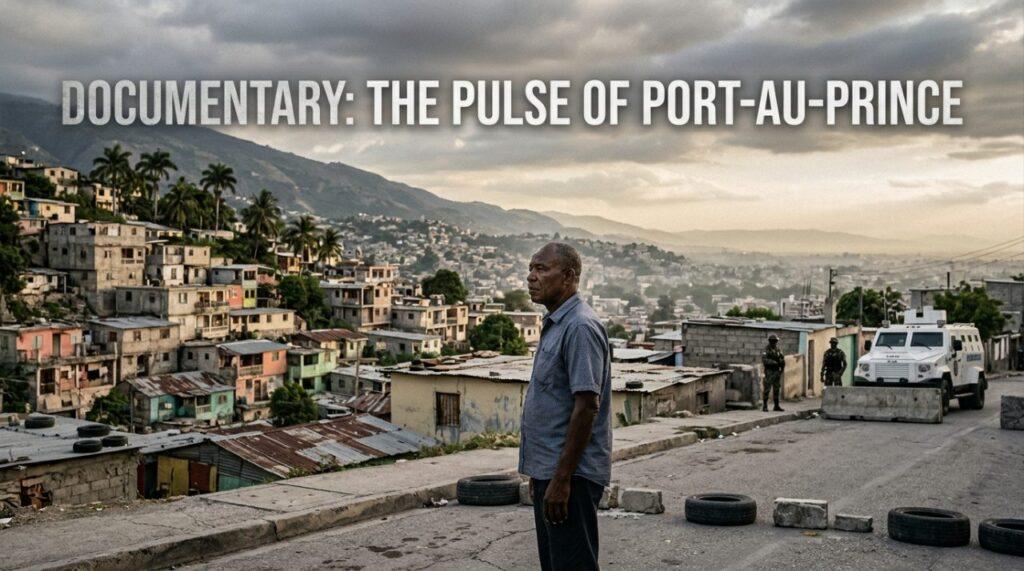
The contemporary headlines emerging from Port-au-Prince paint a grim picture of urban warfare. Armored vehicles navigate barricaded streets while smoke rises above dense neighborhoods. The modern Haiti security crisis is frequently portrayed as an unexpected descent into lawlessness. Yet, the current struggle for the capital is the direct result of centuries of external exploitation, economic strangulation, and elite political manipulation (insightcrime.org, theguardian.com).
International observers often describe the street battles between security forces and armed federations as sudden chaos. In reality, the security vacuum stems from deliberate historical policies that systematically weakened public institutions. To comprehend why joint patrols struggle to maintain control today, one must examine the long historical arc that brought the nation to this perilous crossroad (theglobalobservatory.org, cambridge.org).
Haiti Foreign Debt and Occupation: The Economic Roots of Instability
The structural vulnerability of the modern Haitian state began long before the emergence of twenty-first-century street factions. Following the triumph of the Haitian Revolution in 1804, European powers and the United States imposed diplomatic and financial isolation on the young Black republic. In 1825, King Charles X of France dispatched an armada of fourteen warships to demand payment for lost colonial property, including the enslaved persons who had liberated themselves (cambridge.org).
Under the direct threat of naval bombardment, Haitian leaders agreed to an indemnity of 150 million francs, later renegotiated to 90 million. To fulfill this debt, the country took high-interest loans from French banks, generating a catastrophic cycle of double debt. For more than a century, up to eighty percent of national revenues went straight to debt service instead of schools, hospitals, or domestic infrastructure (cambridge.org).
External extraction accelerated during the twentieth century. In December 1914, United States Marines entered the National Bank of Haiti and seized five hundred thousand dollars in national gold reserves on behalf of National City Bank of New York. Seven months later, the United States launched a military occupation that lasted from 1915 to 1934 (cambridge.org).
During the occupation, foreign administrators controlled national customs houses and redirected revenue to overseas creditors. They rewrote the constitution to permit foreign land ownership and reinstituted the corvée, a brutal system of forced peasant labor. This system built military supply roads while bypassing sovereign civil institutions. Decades of institutional deprivation laid the groundwork for future political instability (cambridge.org).
Territory and Aid Scale in Port-au-Prince
The Roots of Haiti Gang Violence: Paramilitarism and Demobilization
The contemporary armed factions controlling urban districts did not emerge in a vacuum. Their structural lineage traces directly back to the dynastic dictatorship of François Duvalier and his son, Jean-Claude Duvalier. Ruling from 1957 to 1986, the Duvalier regime established a private paramilitary militia known as the Tonton Macoutes to terrorize dissidents and neutralize military rivals (cambridge.org).
The Macoutes operated entirely outside the law, creating a precedent where state leaders relied on informal armed squads. Decades later, democratic breakthroughs met fierce pushback from entrenched elites. When Catholic priest Jean-Bertrand Aristide won the presidency in 1990, the conventional military deposed him in a violent coup led by General Raoul Cédras (wikipedia.org, cambridge.org).
Restored to power in 1994 by United States military forces, Aristide took a radical step to prevent future mutinies. He disbanded the seven-thousand-member Armed Forces of Haiti in 1995. To replace it, international advisers helped create the Haitian National Police. This new civil police force inherited border control, crowd management, and counter-insurgency duties without adequate funding or logistical support (wikipedia.org, cambridge.org).
Lacking an army and confronting fierce opposition from commercial elites, subsequent administrations cultivated ties with neighborhood youth groups in impoverished quarters like Cité Soleil and Bel Air. Known as chimères, these armed groups received political patronage and weapons to protect political leaders and suppress rival protests. Political patronage transformed street groups into armed power brokers across the capital (cambridge.org).
Following the 2004 coup that removed Aristide a second time, these neighborhood factions remained heavily armed. Over the following two decades, political elites from multiple factions continued funding armed groups. They utilized these fighters as private security details and voter-suppression squads, deeply entrenching the roots of Haiti gang violence (insightcrime.org, cambridge.org).
The MINUSTAH Peacekeeping Legacy: Mixed Interventions and Deep Mistrust
Following the 2004 collapse of the civilian administration, the United Nations Security Council dispatched a stabilization mission known as MINUSTAH. Spearheaded largely by Brazilian military units, the international force launched heavy pacification operations between 2006 and 2007. Their armored incursions into dense slums dislodged several powerful faction leaders (theglobalobservatory.org, cambridge.org).
However, the tactical raids caused substantial civilian casualties, sparking intense criticism from neighborhood residents and local human rights groups. More critically, the mission focused on military pacification while failing to build lasting domestic judicial capacity or an independent police apparatus. The departure of the mission in 2017 left local institutions as vulnerable as before (theglobalobservatory.org, cambridge.org).
The mission also caused profound trauma among the local population. In October 2010, United Nations peacekeepers accidentally discharged untreated sewage into the Artibonite River, introducing a devastating cholera epidemic. The outbreak infected hundreds of thousands of residents and killed roughly ten thousand people. Widespread allegations of sexual exploitation and abuse further eroded public faith in multilateral security missions (theglobalobservatory.org, cambridge.org).
This painful history explains why traditional Western powers avoided deploying their own ground troops during the present crisis. The MINUSTAH peacekeeping legacy made direct foreign intervention politically toxic. When Haitian leaders requested emergency international assistance, Western powers turned to third-party arrangements, funding a mission led by Kenya under UN Security Council Resolution 2699 (theglobalobservatory.org, ethz.ch).
The Kenyan deployment faced immediate domestic pushback in Nairobi, where civil rights organizations questioned the mission. In early 2024, the Kenyan High Court temporarily blocked the deployment due to the lack of a reciprocal bilateral treaty. Civil society groups also raised concerns regarding human rights abuses committed by Kenyan police during domestic protests, fearing similar conduct in Port-au-Prince (ethz.ch, eastleighvoice.co.ke).
Frontline Police Ratio Comparison
Florida Weapons Trafficking to Haiti: Fueling the Firepower Imbalance
A critical question central to the conflict involves weaponry. Haiti manufactures no arms or commercial ammunition, yet local factions possess military-grade arsenals. Investigations by the United Nations Office on Drugs and Crime confirm that Florida weapons trafficking to Haiti serves as the main pipeline supplying urban fighters (insightcrime.org, globalinitiative.net).
Lax retail gun sales in southeastern United States jurisdictions permit straw purchasers to obtain assault rifles and .50-caliber sniper rifles. Traffickers conceal these arms inside shipping containers, passenger vehicles, and freight barrels moving through commercial seaports along the Miami River. The contraband slips past overwhelmed customs checkpoints into unguarded ports across the Haitian coastline (globalinitiative.net).
This illicit trade is financed through systematic extortion, highway tolls, and kidnapping ransoms. Armed factions also derive substantial revenue by controlling national transit corridors. Past multilateral sanctions imposed by Canada and the United States revealed that prominent business leaders and elected officials also financed these weapons pipelines to secure private commercial monopolies (insightcrime.org, globalinitiative.net).
This massive influx of high-caliber firepower creates a stark tactical imbalance. Frontline police officers carry standard sidearms and aging shotguns, while street fighters operate belt-fed machine guns and specialized sniper platforms. This disparity has made direct territorial reclamation exceedingly dangerous for local authorities (insightcrime.org, cbsnews.com).
Haitian National Police Operations and the Push for Regional Stability
The contemporary security crisis escalated dramatically following the July 2021 assassination of President Jovenel Moïse. His death created a total constitutional vacuum, leaving the parliament dissolved and the judiciary incapacitated. By early 2024, rival street factions formed a unified front known as the Viv Ansanm gang coalition, led by figures like former police officer Jimmy Barbecue Cherizier (insightcrime.org, theguardian.com).
In February 2024, Viv Ansanm launched coordinated assaults across Port-au-Prince. They breached the National Penitentiary, freeing over four thousand prisoners, besieged the international airport, and attacked government ministries. The offensive forced the resignation of unelected Prime Minister Ariel Henry. In response, regional partners through CARICOM Haiti security talks brokered a Transitional Presidential Council to restore executive governance (theguardian.com, cbsnews.com).
Recent Haitian National Police operations represent a determined pushback against this territorial encirclement. Supported by Kenyan officers from the Multinational Security Support mission, specialized tactical units have targeted key strongholds. Their joint forces launched armored sweeps through Bas-Delmas, cleared barricades around the main seaport, and secured perimeter checkpoints protecting vital hospitals (cbsnews.com, eastleighvoice.co.ke).
Caribbean nations, including Jamaica and the Bahamas, sent personnel to bolster the mission. Yet, tactical advances alone cannot solve systemic governance deficits. Cleared intersections frequently slip back under gang control once patrols depart, demonstrating that physical presence cannot replace functioning courts, corrections facilities, or basic civic administration (cbsnews.com, reliefweb.int).
Due to chronic funding shortages, the United States and transitional authorities have urged the United Nations to convert the Kenyan-led deployment into a formal peacekeeping mission. A regular UN mission would secure predictable funding and heavier logistics. Without durable civic institutions, military operations merely provide temporary relief in an ongoing humanitarian emergency (theglobalobservatory.org, reliefweb.int).
MSS Mission Force Mobilization
The ongoing unrest in the capital carries profound implications for the wider hemisphere. Over seven hundred thousand civilians have been driven from their homes, creating an immense internal refugee emergency (unocha.org, unocha.org). The displacement has intensified regional migration pressures and disrupted vital maritime supply chains throughout the Caribbean basin.
Historical lessons remain paramount. State security cannot be sustained through foreign security forces alone. Decades of external interventions demonstrate that lasting stability requires rebuilding sovereign institutions, halting illicit arms pipelines, and supporting democratic governance chosen by the Haitian people (theglobalobservatory.org, cambridge.org). Understanding the history behind the headlines proves essential if the international community hopes to support sustainable peace rather than repeating past failures.
About the Author
Darius Spearman is a professor of Black Studies at San Diego City College, where he has been teaching for over 20 years. He is the founder of African Elements, a media platform dedicated to providing educational resources on the history and culture of the African diaspora. Through his work, Spearman aims to empower and educate by bringing historical context to contemporary issues affecting the Black community.
