

Western Sahara UN Mission: Why Peacekeepers Are Leaving
By Darius Spearman (africanelements)
Support African Elements at patreon.com/africanelements and hear recent news in a single playlist. Additionally, you can gain early access to ad-free video content.
On October 31, 2026, the international legal architecture governing Northwest Africa experienced an unprecedented rupture. The United Nations Security Council failed to renew the operational mandate for the United Nations Mission for the Referendum in Western Sahara, commonly known as MINURSO (un.org, securitycouncilreport.org). The lapse occurred after competing resolutions sponsored by the United States and the Russian Federation met reciprocal vetoes and abstentions, resulting in a complete UN Security Council deadlock (africansecurityanalysis.com, securitycouncilreport.org). The expiration officially ended thirty-five years of continuous United Nations military observation on the ground (unmissions.org).
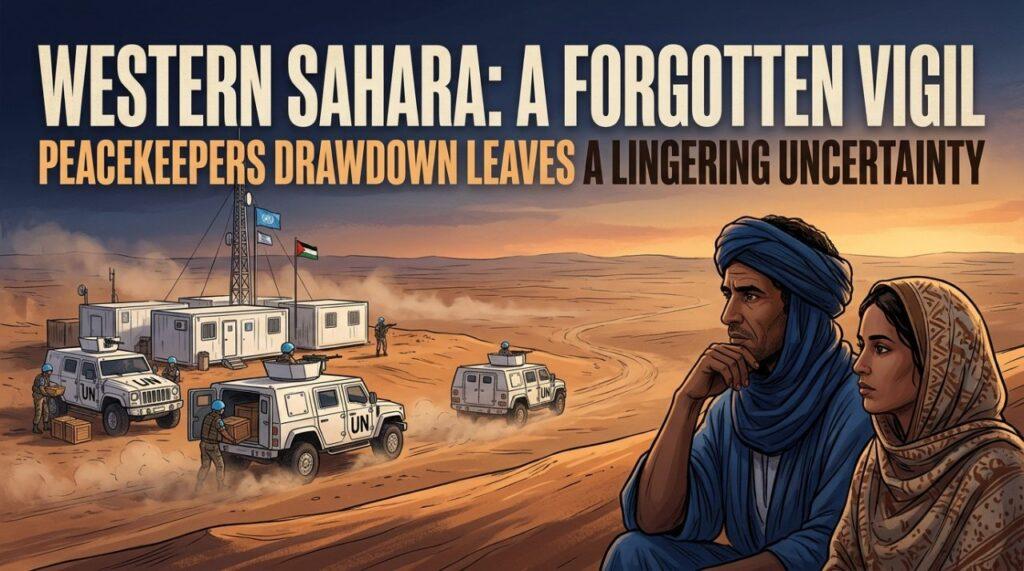
Following the midnight deadline, United Nations Secretary-General António Guterres confirmed that the mission entered its formal liquidation phase (un.org). United Nations logistics divisions immediately began preparations to withdraw 155 deployed uniformed peacekeepers and repatriate personnel to their contributing home nations (un.org, africansecurityanalysis.com). The departure creates a perilous geopolitical void in a territory that the African Union still defines as the last colony on the African continent (africansecurityanalysis.com, mei.edu). Understanding the collapse of the Western Sahara UN mission requires looking beyond modern diplomatic friction to examine decades of colonial partition, armed conflict, and contested self-determination.
Polisario Front History and the Roots of Sahrawi Resistance
The contemporary conflict in Western Sahara originated during the late nineteenth-century European partition of Africa. In 1884, the Spanish Empire claimed authority over the 266,000-square-kilometer coastal territory, creating the administrative colony of Spanish Sahara (wikipedia.org). For almost a century, Spain extracted local mineral wealth while denying indigenous Sahrawi nomadic populations political franchise (mei.edu, wikipedia.org). In 1963, the United Nations added Western Sahara to its formal list of Non-Self-Governing Territories under Chapter XI of the UN Charter, demanding that Madrid initiate an orderly decolonization process (un.org, wikipedia.org).
Frustrated by Spanish delays, Sahrawi university students and desert leaders founded the Frente Popular para la Liberación de Saguia el-Hamra y de Río de Oro in May 1973 (mei.edu, wikipedia.org). Known globally as the Polisario Front, the organization began an anti-colonial insurgency against Spanish military garrisons (mei.edu, wikipedia.org). Like many contemporary nationalist struggles across the African continent, the Polisario Front framed its armed campaign around sovereign independence and democratic self-governance for indigenous residents (mei.edu).
To preempt an independence vote, neighboring Morocco and Mauritania challenged the decolonization process before the International Court of Justice in The Hague (wikipedia.org, mei.edu). Both nations argued that pre-colonial legal ties bound Sahrawi nomadic tribes to their respective historic realms (mei.edu). In an advisory opinion issued in October 1975, the court acknowledged historical ties of allegiance between local chieftains and the Moroccan Sultan, as well as connections to the Mauritanian entity (wikipedia.org, mei.edu). However, the court ruled definitively that those connections did not constitute territorial sovereignty, affirming that the Sahrawi people retained an inherent right to self-determination through a free referendum (wikipedia.org, mei.edu).
Rather than abiding by the international court ruling, King Hassan II of Morocco ordered 350,000 Moroccan civilians and 20,000 troops to march across the border in November 1975, an event known as the Green March (mei.edu, wikipedia.org). Confronting domestic political turmoil following the death of dictator Francisco Franco, Spain capitulated by signing the secret Madrid Tripartite Accords (mei.edu, wikipedia.org). Spain transferred administrative control to Morocco and Mauritania without consulting the indigenous Sahrawi leadership (mei.edu, wikipedia.org). The Polisario Front declared the Sahrawi Arab Democratic Republic in February 1976 and expanded its guerrilla war against both northern occupiers (mei.edu, wikipedia.org).
Territorial Division of Western Sahara
The Western Sahara Sand Wall and Decades of Divided Land
The armed conflict that followed Spain’s retreat displaced thousands of Sahrawis. Facing Moroccan aerial bombardment and ground offenses, Sahrawi families migrated eastward across the desert border into Tindouf, Algeria (mei.edu, wikipedia.org). There, refugees established five semi-permanent settlements that continue to host over 158,000 displaced Sahrawis dependent on international humanitarian assistance (fmreview.org, wikipedia.org). In 1979, Mauritania withdrew from the war, signing a formal peace treaty with Polisario and renouncing all territorial claims (wikipedia.org). Moroccan forces immediately advanced into the southern sector, annexing the entire territory (wikipedia.org).
Between 1980 and 1987, the Royal Moroccan Armed Forces transformed the desert landscape by constructing the Western Sahara Sand Wall, locally known as the Berm (jmu.edu, wikipedia.org). Stretching roughly 2,700 kilometers across the desert, this continuous earthen fortification relies on radar stations, troop bunkers, artillery batteries, and expansive mine installations (jmu.edu, the-monitor.org). International mine-clearance organizations report that the Berm and its perimeter contain between seven and ten million landmines, making it one of the most contaminated military zones on Earth (jmu.edu, the-monitor.org).
The construction of the sand wall effectively divided Western Sahara into two distinct zones. Morocco solidified its administration over the western eighty percent of the territory, which contains populated urban centers, rich mineral mines, and Atlantic coastal ports (jmu.edu, wikipedia.org). The Polisario Front remained confined to the barren eastern twenty percent, along with the isolated refugee population living inside Algerian territory (jmu.edu, fmreview.org). This physical barrier permanently separated families, militarized traditional nomadic migratory routes, and hardened the territorial status quo (jmu.edu, wikipedia.org).
The Western Sahara Sand Wall Dimensions
Western Sahara Natural Resources and Sovereign Rights
The dispute over Western Sahara extends far beyond territorial administration; it centers on economic control over rich natural resources (jadaliyya.com, wikipedia.org). The territory holds some of the world’s largest reserves of high-grade phosphate rock at the Bou Craa mine, operated directly by Morocco’s state-owned Office Chérifien des Phosphates (jadaliyya.com, wikipedia.org). Phosphate minerals represent an indispensable component of commercial agricultural fertilizers worldwide, giving the deposits immense geopolitical and commercial value (jadaliyya.com).
Beyond minerals, Western Sahara possesses one of the most productive marine fisheries along the West African coast (jadaliyya.com, moroccoworldnews.com). For decades, foreign commercial fleets negotiated fishing agreements with Rabat that permitted trawlers to harvest seafood off the Western Saharan shoreline (jadaliyya.com, moroccoworldnews.com). However, international human rights advocates and Sahrawi activists argue that the commercial exploitation of Western Sahara natural resources violates international law because it proceeds without the consent of the indigenous population (hrw.org, jadaliyya.com).
This argument achieved major legal backing inside European courts. In multiple landmark rulings issued between 2016 and 2024, the Court of Justice of the European Union nullified bilateral trade and fisheries agreements between the European Union and Morocco (hespress.com, moroccoworldnews.com). The European judges affirmed that Western Sahara possesses a distinct legal status separate from Morocco (hespress.com, moroccoworldnews.com). Under European jurisprudence, commercial extraction cannot lawfully occur without the direct consent of the Sahrawi people, confirming that economic sovereignty remains tied to political self-determination (hespress.com, moroccoworldnews.com).
Morocco Autonomy Plan Versus Decolonization
In 1991, the United Nations brokered a ceasefire between Morocco and the Polisario Front, establishing the MINURSO mandate through Security Council Resolution 690 (un.org, wikipedia.org). The mission had two explicit tasks: monitor the ceasefire across the sand wall and organize a free, fair referendum allowing Sahrawis to choose between sovereign independence and integration with Morocco (un.org, wikipedia.org). However, the planned vote stalled over voter identification rolls (wikipedia.org, mei.edu). Polisario demanded the use of the 1974 Spanish colonial census, while Morocco insisted on enrolling thousands of individuals from nomadic tribes residing in southern Morocco, raising concerns over demographic manipulation and electoral representation (wikipedia.org, mei.edu).
Former United States Secretary of State James Baker sought to break the deadlock through compromise proposals between 1997 and 2004 (wikipedia.org, mei.edu). His revised plan proposed an autonomous interim authority followed by a self-determination referendum that included Moroccan settlers (wikipedia.org, mei.edu). Although the Polisario Front accepted the compromise, King Mohammed VI of Morocco rejected the initiative in 2004, declaring Moroccan sovereignty non-negotiable (wikipedia.org, mei.edu). In April 2007, Rabat submitted its alternative: the Morocco Autonomy Plan (meforum.org, mei.edu).
The 2007 initiative proposes limited regional administrative autonomy while permanently retaining national defense, foreign affairs, judicial oversight, and natural resources under the Moroccan monarchy (meforum.org, mei.edu). The fundamental legal difference between this plan and United Nations decolonization doctrine remains profound (un.org, mei.edu). Under Chapter XI of the UN Charter and General Assembly Resolution 1514, decolonization requires a democratic ballot offering genuine alternatives, specifically including complete independence (un.org, mei.edu). The Polisario Front rejected the autonomy proposal because it bars an independence ballot, while Morocco rejected any process where independence remains a possible outcome (meforum.org, mei.edu).
MINURSO Peacekeeping Withdrawal and Regional Instability
The diplomatic stalemate turned precarious in November 2020 during the Guerguerat crisis (africansecurityanalysis.com, unmissions.org). Moroccan forces crossed into the United Nations-monitored buffer zone to clear a civilian protest blocking commercial transit between Moroccan-held Western Sahara and Mauritania (africansecurityanalysis.com, unmissions.org). Polisario declared the operation a violation of the 1991 military agreements, formally ending the twenty-nine-year ceasefire and resuming low-intensity artillery strikes against the sand wall (africansecurityanalysis.com, wikipedia.org). International diplomacy experienced a major shift in December 2020 when the United States recognized Moroccan sovereignty over the territory in exchange for Morocco normalizing diplomatic ties with Israel under the Abraham Accords (newarab.com, usmission.gov).
Major European powers followed this geopolitical realignment, as Spain in 2022 and France in 2024 officially endorsed Morocco’s autonomy framework as the only credible political path forward (mei.edu, hespress.com). In October 2025, the Security Council adopted Resolution 2797, elevating the Moroccan proposal as the primary basis for future negotiations (africansecurityanalysis.com, securitycouncilreport.org). However, the policy pivot triggered resistance from other global powers with long histories of Soviet Cold War diplomacy (securitycouncilreport.org, securitycouncilreport.org). When the Security Council convened on October 30, 2026, the United States proposed transitioning MINURSO toward an autonomy monitoring body while cutting personnel (africansecurityanalysis.com, vanguardngr.com). Russia vetoed the draft, insisting on preserving the 1991 settlement referendum mandate (africansecurityanalysis.com, vanguardngr.com).
A counter-resolution sponsored by Moscow failed to secure requisite council votes, leading to an immediate impasse (africansecurityanalysis.com, vanguardngr.com). At midnight on October 31, 2026, the MINURSO mandate officially expired, initiating the formal MINURSO peacekeeping withdrawal and mission liquidation (un.org, africansecurityanalysis.com). Rabat welcomed the end of the mission, calling the referendum concept obsolete (hespress.com, hespress.com). Conversely, Sahrawi authorities and Algerian diplomats warned that removing the only international observation presence increases the likelihood of open war across the Maghreb, leaving the Sahrawi people stranded in political limbo (africansecurityanalysis.com, vanguardngr.com).
UN Security Council Deadlock: Oct 30, 2026
The closure of the Western Sahara UN mission reflects a profound breakdown in multilateral conflict resolution. For thirty-five years, United Nations peacekeepers provided a thin layer of operational stability, holding open the promise that an indigenous African population might eventually cast ballots on their own political future (un.org, unmissions.org). As United Nations teams pack their equipment and leave the desert, the unresolved contest over sovereignty, natural wealth, and human dignity remains as dangerous as it was five decades ago.
About the Author
Darius Spearman is a professor of Black Studies at San Diego City College, where he has been teaching for over 20 years. He is the founder of African Elements, a media platform dedicated to providing educational resources on the history and culture of the African diaspora. Through his work, Spearman aims to empower and educate by bringing historical context to contemporary issues affecting the Black community.
