

Ethiopian Press Freedom Crushed: The Reporter Suspended
By Darius Spearman (africanelements)
Support African Elements at patreon.com/africanelements and hear recent news in a single playlist. Additionally, you can gain early access to ad-free video content.
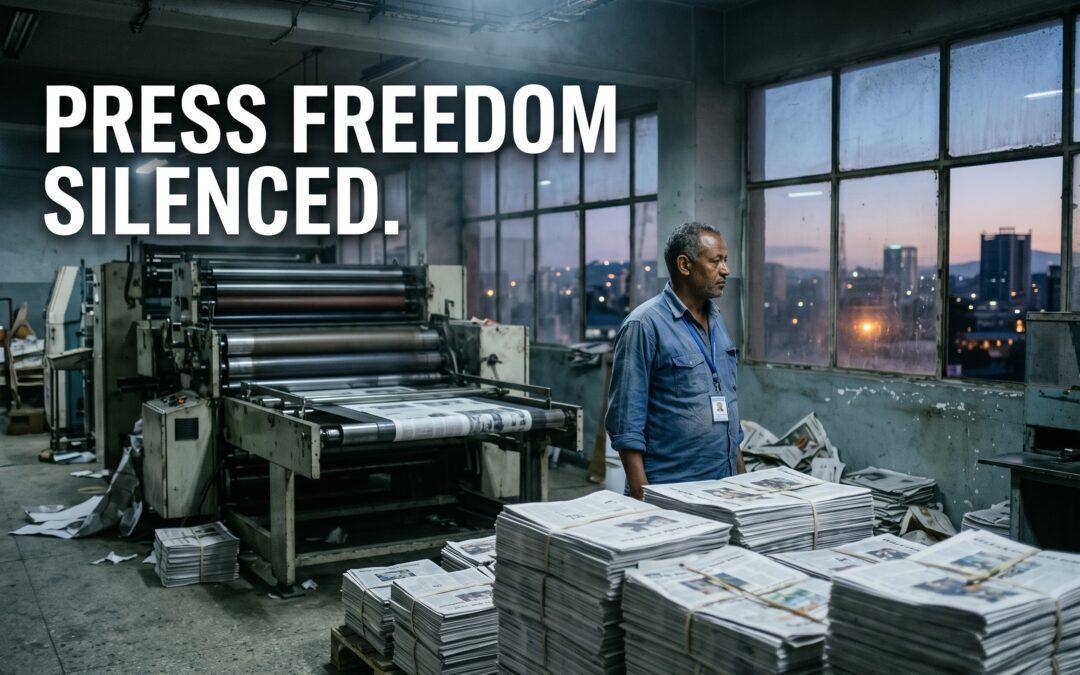
On November 2, 2026, the federal government of Ethiopia silenced the last remaining independent Amharic print newspaper in the country (ground.news, umdmedia.com). Regulators indefinitely suspended the operating licenses of the Media and Communication Center, the parent company of The Reporter (umdmedia.com). The regulatory order halted all print, digital, and broadcast operations of the thirty-year-old news organization (ground.news, umdmedia.com). Ethiopian press freedom advocates immediately warned that the decision completed the elimination of domestic non-state print journalism (allafrica.com, cpj.org).
International observers quickly condemned the action. Emergency alerts from Human Rights Watch Ethiopia and the Committee to Protect Journalists emphasized that the state used vague national security claims to crush legitimate scrutiny (hrw.org, cpj.org). For historians of the African diaspora, this regulatory suppression is familiar. The suppression of independent voices echoes historic state efforts to suppress dissent when centralized authorities face political crises. Understanding this headline requires examining the deep historical cycles that have shaped modern Ethiopia.
The Reporter Ethiopia Suspension and the Loss of Free Speech
The regulatory shutdown occurred following direct pushback against state oversight by the editorial board of The Reporter (umdmedia.com, umdmedia.com). On October 31, 2026, the paper ran a front-page editorial titled “Press Freedom Is Not A Luxury!” (umdmedia.com). The editorial criticized growing executive interference in independent news operations (umdmedia.com, umdmedia.com). It cautioned that private news organizations faced their most dangerous environment in modern history (umdmedia.com). Two days later, state regulators issued an immediate, open-ended shutdown order (ground.news, umdmedia.com).
The regulatory authority asserted that the newspaper repeatedly printed biased, sensationalized, and unverified reports (ground.news, umdmedia.com). Officials claimed these reports damaged national security, harmed foreign investment, and undermined international diplomatic relations (umdmedia.com, umdmedia.com). However, the agency cited no specific articles, factual errors, or legal infractions to substantiate the accusations (umdmedia.com, cpj.org). CPJ press freedom alerts pointed out that the indefinite ban followed coverage detailing the unlawful detention of reporters Samuel Getachew and Amanuel Gebremedhin (hrw.org, cpj.org). The government replaced factual engagement with administrative prohibition.
Independent Amharic Print Newspapers Remaining
History of Ethiopian Private Press
To understand the current crisis, one must review the history of Ethiopian private press development over the past century (wikipedia.org, ju.edu.et). Under Emperor Haile Selassie, an independent commercial press did not exist (wikipedia.org). The imperial state strictly held a monopoly over print media through state organs such as Addis Zemen and The Ethiopian Herald (wikipedia.org). Following the 1974 revolution, the Marxist military junta known as the Derg instituted complete pre-publication censorship (wikipedia.org, ju.edu.et). The regime transformed all publishing into ideological instruments of the state while imprisoning dissidents (wikipedia.org).
The collapse of the Derg in 1991 generated an unprecedented opening (wikipedia.org). The transitional government enacted Press Proclamation No. 34/1992, which banned pre-publication censorship and recognized the right of citizens to start private media companies (wikipedia.org, ju.edu.et). Veteran media figure Amare Aregawi seized this opportunity (umdmedia.com). In 1995, Aregawi founded the Media and Communication Center and launched The Reporter in Amharic, followed by an English edition in 1996 (umdmedia.com, umdmedia.com). The newspaper established a standard for investigative journalism, independent economic data, and civic reporting (umdmedia.com).
This early expansion suffered a devastating blow during the disputed federal elections of 2005 (wikipedia.org). Confronting widespread street protests, the ruling coalition arrested dozens of independent publishers and journalists on charges of treason (cpj.org, wikipedia.org). Authorities then passed the Freedom of the Mass Media and Access to Information Proclamation of 2008 and the Anti-Terrorism Proclamation of 2009 (ethiolex.com, hrw.org). These laws allowed prosecutors to classify critical reports on public unrest as material support for terrorism (hrw.org, hrw.org). Scores of independent newsrooms collapsed, and investigative reporters fled abroad (cpj.org, wikipedia.org).
Abiy Ahmed Media Crackdown
Prime Minister Abiy Ahmed assumed federal power in April 2018 with sweeping promises of democratic transformation (wikipedia.org, freedomhouse.org). During his initial months, the federal government dropped charges against critical publishers, emptied detention facilities of jailed reporters, and unblocked over 260 restricted websites (freedomhouse.org). In 2021, parliament passed Media Proclamation 1238, which eliminated criminal defamation penalties and prohibited pre-trial detention for press-related offenses (ictpolicyafrica.org, ethiolex.com). International observers celebrated the transformation, and global press freedom scores rose noticeably (freedomhouse.org).
However, the outbreak of civil war in the northern Tigray region in late 2020 ended this brief period of tolerance (wikipedia.org, hrw.org). The administration invoked wartime emergency decrees that bypassed statutory legal protections (hrw.org, hrw.org). Plainclothes security agents detained journalists inside military bases without access to counsel (hrw.org, hrw.org). The government shut down telecommunication infrastructure across northern regions and expelled multiple foreign correspondents (hrw.org, safetyofjournalists.org). The Abiy Ahmed media crackdown expanded rapidly from the battlefield into domestic newsrooms across the capital city (hrw.org, cpj.org).
RSF Global Press Freedom Index Score (Out of 100)
Pretoria Agreement Conflict Fallout
The roots of the current media blackout connect directly to the Pretoria Agreement conflict fallout (wikipedia.org). On November 2, 2022, the federal government and the Tigray People’s Liberation Front signed a formal cessation of hostilities in South Africa (wikipedia.org). While the agreement concluded major active warfare in Tigray, it excluded political and paramilitary factions in the neighboring Amhara region (wikipedia.org). Amhara groups had fought alongside federal troops during the war and held deep concerns regarding administrative boundaries and regional self-defense (wikipedia.org, hrw.org).
Instability intensified in April 2023 when federal officials announced the immediate dissolution and integration of all regional paramilitary forces (hrw.org). In response, regional militia fighters resisted disarmament, initiating armed conflict across the Amhara territory (hrw.org). Rather than establishing durable stability, federal policy shifted active armed warfare from Tigray into Amhara and Oromia (hrw.org, hrw.org). When reporters covered these military operations, the state treated independent reporting as a direct national security crisis (hrw.org, hrw.org). The government turned to administrative tools to restrict public information about regional fighting (umdmedia.com, hrw.org).
Fano and OLA Insurgency Coverage
The state treats Fano and OLA insurgency coverage as an unacceptable challenge to sovereign control (hrw.org, hrw.org). Ethiopia operates under a constitution that organizes governance and political power along ethnolinguistic borders (wikipedia.org). The Oromo Liberation Army has fought a protracted armed conflict in the Oromia region, citing historic economic and political marginalization (wikipedia.org, freedomhouse.org). In the north, decentralized Amhara militias known as Fano organized widespread armed resistance against federal forces following the 2023 disarmament decrees (hrw.org). These parallel insurgencies present severe military challenges across large sections of the country (hrw.org, hrw.org).
For independent journalists, reporting on these conflicts carries extreme hazards (hrw.org, cpj.org). Federal prosecutors interpret interviews with insurgent leaders or reports on civilian drone casualties as unlawful support for terrorism (cpj.org, hrw.org). In our historical analyses of the notion of civil liberty, centralized powers often use emergency narratives to eliminate legal oversight. The Ethiopian state relies on national security rhetoric to conceal military casualties and displacement figures (hrw.org, hrw.org). Reporting on battlefield realities contradicts federal assertions of national unity and economic renewal (umdmedia.com, umdmedia.com).
Global Press Freedom Rank Comparison (Out of 180 Countries)
Ethiopian Media Authority Decrees and the Legal Reality
Recent Ethiopian Media Authority decrees demonstrate how statutory administrative regulations can replace direct judicial process (umdmedia.com, umdmedia.com). Media Proclamation 1238 of 2021 was designed to establish an independent regulatory body outside executive ministries (ictpolicyafrica.org, ethiolex.com). Yet the legislation provided broad administrative authority to suspend broadcast and print licenses without prior judicial review (umdmedia.com, ethiolex.com). By invoking economic stability and national prestige, the regulator bypasses regular court hearings entirely (umdmedia.com, cpj.org).
The indefinite closure of The Reporter follows a wider pattern of institutional suppression (umdmedia.com, allafrica.com). Earlier in 2026, the regulatory authority revoked the operating permit of Addis Standard, another prominent independent news agency (allafrica.com). Civil society organizations, including the Ethiopian Human Rights Council and the Center for the Advancement of Rights and Democracy, have similarly faced administrative suspensions and police interference (hrw.org, hrw.org). The regulatory machinery functions as an arm of executive enforcement rather than a neutral arbiter of standards (cpj.org).
This systematic retreat carries profound consequences for the public sphere (allafrica.com, umdmedia.com). When a state eliminates non-aligned print journalism, working-class communities and rural readers lose vital information sources (umdmedia.com). State-owned media enterprises, such as the Ethiopian Broadcasting Corporation and the ruling party platforms, now dominate domestic news (allafrica.com, wikipedia.org). As we observe in studies on the exercise of political power, the monopolization of information undermines civic self-determination. The elimination of Ethiopia’s oldest independent paper silences critical accountability across the Horn of Africa (ground.news, cpj.org).
The indefinite closure of The Reporter highlights the vulnerability of institutional reforms in the absence of constitutional checks (umdmedia.com, cpj.org). When structural conflicts re-emerged, the federal administration reverted to legal instruments and emergency decrees to silence critical observers (hrw.org, hrw.org). The historical pattern resembles the criminalization of public dissent documented across different societies facing internal structural crises. Without legal protections for independent journalists, domestic accountability remains severely compromised (hrw.org, cpj.org).
About the Author
Darius Spearman is a professor of Black Studies at San Diego City College, where he has been teaching for over 20 years. He is the founder of African Elements, a media platform dedicated to providing educational resources on the history and culture of the African diaspora. Through his work, Spearman aims to empower and educate by bringing historical context to contemporary issues affecting the Black community.
