


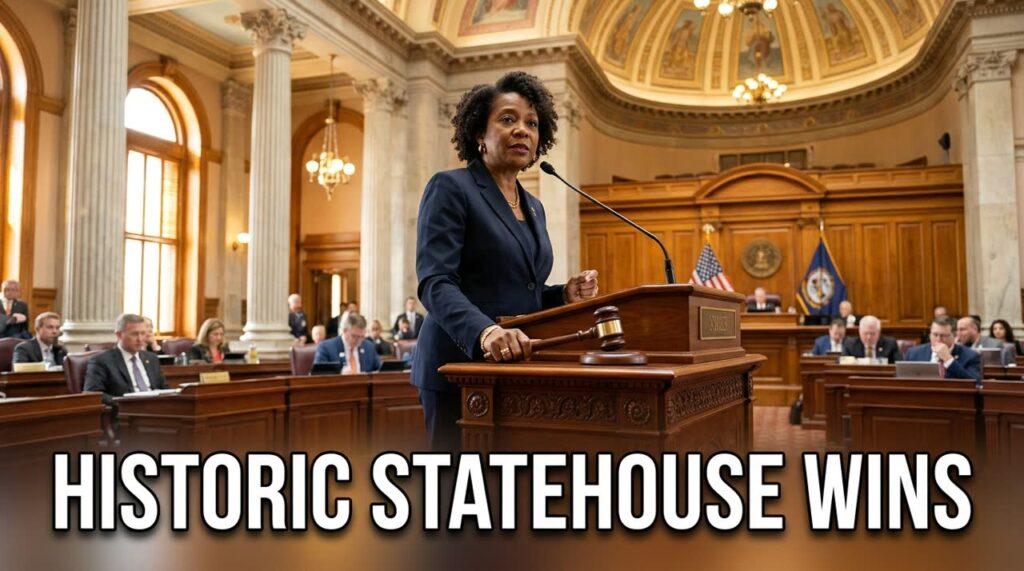
Black Political Representation: Historic Statehouse Wins
By Darius Spearman (africanelements)
Support African Elements at patreon.com/africanelements and hear recent news in a single playlist. Additionally, you can gain early access to ad-free video content.
National political headlines focus heavily on presidential campaigns, congressional majorities, and high-profile governor races (publicwise.org, multistate.us). Yet state legislatures pass laws that directly affect daily community life (ncsl.org). In recent state legislative elections, a profound political transformation has quietly taken hold across the United States (wordinblack.com, multistate.us). African American lawmakers have captured historic state assembly victories, secured milestone re-elections, and assumed top leadership positions in key chambers (wordinblack.com, washingtonpost.com).
This breakthrough in down ballot races reshapes state capitols from the Mid-Atlantic to the Midwest (multistate.us, washingtonpost.com). Black lawmakers now wield legislative gavels and lead committee agendas in chambers where people of color faced deliberate exclusion for generations (pahouse.com, washingtonpost.com). These victories expand Black political power across statehouses nationwide (jointcenter.org, jointcenter.org). Understanding these achievements requires looking beyond the immediate returns to examine the deep historical currents that produced them (blackpast.org, britannica.com).
The Enduring Legacy of Reconstruction Black Politicians
The origins of Black statehouse governance began immediately after the Civil War (blackpast.org). Following the passage of the Reconstruction Acts, newly enfranchised African Americans registered to vote in massive numbers (britannica.com). They organized political conventions and ran for local and state offices across the South (blackpast.org, britannica.com). Between 1865 and 1877, more than 1,500 Reconstruction Black politicians held public offices throughout the former Confederacy (jointcenter.org, blackpast.org).
South Carolina established an unprecedented milestone in 1868 (blackpast.org). The state seated 87 African American lawmakers in its 127-member House of Representatives (blackpast.org). It became the only state legislature in United States history to hold an outright Black legislative majority (blackpast.org). Lawmakers like Robert Smalls in South Carolina and P.B.S. Pinchback in Louisiana reshaped governance (blackpast.org). They drafted progressive state constitutions, funded the first universal public school systems, and protected civil liberties (blackpast.org, britannica.com).
This governing era faced violent white-supremacist resistance from paramilitary groups and conservative politicians (blackpast.org, britannica.com). The Compromise of 1877 removed federal protective troops from the South, initiating the Jim Crow counter-revolution (blackpast.org, britannica.com). Southern states adopted new constitutions between 1890 and 1908 to enforce voter disenfranchisement through poll taxes, literacy tests, and grandfather clauses (britannica.com). By the turn of the century, Black officeholders were systematically purged from southern statehouses (blackpast.org).
Black State Legislators Nationwide
How the Voting Rights Act 1965 Rebuilt Representation
For more than half a century, Black state legislative representation remained almost non-existent (jointcenter.org, blackpast.org). Isolated figures broke barriers in northern cities, such as Crystal Bird Fauset in Pennsylvania in 1938 and Cora Brown in Michigan in 1953 (wikipedia.org, wikipedia.org). However, the systemic disenfranchisement of millions in the South prevented equitable institutional access (britannica.com). The turning point arrived with the passage of the federal Voting Rights Act 1965 (jointcenter.org, britannica.com).
The Voting Rights Act 1965 outlawed discriminatory literacy tests and authorized federal voter registration monitors (britannica.com). Section 5 required jurisdictions with documented histories of discrimination to submit voting changes for federal preclearance (electionlawblog.org, britannica.com). This mechanism ensured that state redistricting plans could not dilute minority voting strength (electionlawblog.org). In 1965, fewer than one hundred Black lawmakers served in state legislatures nationwide (jointcenter.org, jointcenter.org).
Civil rights activists quickly recognized that registering voters was only the first step toward lasting power (jointcenter.org). In 1970, leaders established the Joint Center for Political Studies to train newly elected officials and provide technical policy analysis (jointcenter.org, jointcenter.org). In 1977, state representatives formed the National Black Caucus of State Legislators to coordinate legislative strategy across borders (causeiq.com, housedems.com). That same year, K. Leroy Irvis became the Speaker of the Pennsylvania House of Representatives (wikipedia.org). He was the first Black statehouse speaker in the country since Reconstruction (wikipedia.org).
Historic State Assembly Speakers Shattering Capitols
Recent election cycles produced a historic transformation in legislative leadership (multistate.us, washingtonpost.com). Black lawmakers have secured the highest presiding offices in chambers across the country (wordinblack.com, courthousenews.com). In Pennsylvania, Representative Joanna McClinton made history in 2023 by becoming the first woman and the first Black woman elected Speaker of the House (pahouse.com, pa.gov). Her ascension reflected years of disciplined organizing and coalition building across urban and suburban districts (wordinblack.com, pahouse.com).
A similar breakthrough occurred in the Midwest during the same legislative term (michiganchronicle.com, wemu.org). Representative Joe Tate was elected as the first Black Speaker of the Michigan House of Representatives after his caucus won its first majority in nearly four decades (michiganchronicle.com, wemu.org). In Virginia, Delegate Don Scott Speaker made history in 2024 by taking the gavel of the Virginia House of Delegates (courthousenews.com, washingtonpost.com). He became the first Black speaker in the 405-year history of the oldest continuous lawmaking body in the Western Hemisphere (courthousenews.com, 13newsnow.com).
These victories build on earlier milestones established by Adrienne A. Jones in Maryland in 2019 and Emanuel “Chris” Welch in Illinois in 2021 (wikipedia.org, wikipedia.org). Modern historic state assembly speakers do not govern solely as symbolic figures (michiganchronicle.com, pahouse.com). They set daily legislative calendars, control committee assignments, and lead high-stakes budget negotiations with governors (ncsl.org, washingtonpost.com). Their presence demonstrates how down-ballot contests can alter the distribution of state-centered federal power across entire regions (multistate.us).
Black Women Statehouse Representation
Structural Hurdles and Down Ballot Election Turnout
Winning down-ballot legislative seats remains structurally challenging for minority candidates (publicwise.org, mit.edu). Voters often complete the presidential or gubernatorial selections at the top of a ticket but leave lower contests completely blank (mit.edu). This phenomenon, known as ballot roll-off or ballot fatigue, disproportionately impacts candidates who lack multi-million-dollar advertising budgets (publicwise.org, mit.edu). Depressed down ballot election turnout in off-year cycles further reduces minority voter participation (publicwise.org).
Campaign finance disparities create additional barriers for Black legislative candidates (publicwise.org). State legislative races depend heavily on personal wealth, seed funding, and access to private business networks (publicwise.org). Because of systemic racial wealth gaps, Black candidates historically faced exclusion from elite donor circles and corporate political action committees (publicwise.org). Candidates running in working-class districts frequently must knock on thousands of doors to compensate for serious fundraising deficits (publicwise.org, washingtonpost.com).
Furthermore, district map drawing historically clustered Black residents into a small number of overwhelmingly minority districts (cambridge.org). This packing strategy bleached neighboring suburban districts of diverse voting populations (cambridge.org). It limited Black lawmakers to safe urban enclaves and prevented them from building broader coalitions (cambridge.org, publicwise.org). Overcoming these barriers required candidates to compete in suburban swing districts and appeal directly to multiracial working-class communities (wordinblack.com, washingtonpost.com).
Gerrymandering and the Shelby County v Holder Impact
The legal landscape surrounding legislative districts shifted dramatically over the past decade (electionlawblog.org, britannica.com). In 2013, the United States Supreme Court issued its landmark ruling in *Shelby County v. Holder* (electionlawblog.org, britannica.com). The Court struck down the coverage formula of the Voting Rights Act, effectively dismantling the federal preclearance system (electionlawblog.org, britannica.com). Jurisdictions with documented histories of voting discrimination could immediately implement voting law changes without prior federal approval (electionlawblog.org, britannica.com).
The Shelby County v Holder impact created immediate obstacles for voting rights advocates (electionlawblog.org). Several states quickly closed polling locations, shortened early voting windows, and enacted stricter voter identification mandates (publicwise.org, electionlawblog.org). Partisan mapmakers drew state legislative maps designed to dilute minority voting power before legal challenges could proceed under slower court procedures (electionlawblog.org). Despite these challenges, voting rights coalitions responded by changing their organizing strategies (publicwise.org).
In states like Michigan, citizen-led ballot initiatives established independent redistricting commissions to draw fair and competitive maps (ballotpedia.org). In Pennsylvania and Virginia, judicial reviews struck down unconstitutional gerrymanders and ordered balanced districts drawn by independent experts (palegis.us, virginia.gov). These competitive maps provided the institutional foundation for Black legislative candidates to expand beyond urban centers (wordinblack.com, washingtonpost.com). Candidates mobilized voters across diverse suburban districts and delivered governing majorities (wordinblack.com, michiganchronicle.com).
Michigan Earned Income Tax Credit Expansion
Policy Victories Won by Black Caucus State Legislators
When Black lawmakers assume chamber leadership, they translate electoral victories into tangible public policy (multistate.us, michiganchronicle.com). They advance legislative packages aimed at broad economic justice and civil rights (michiganchronicle.com, pahouse.com). Under Speaker Joe Tate, the Michigan House of Representatives passed the “Lowering MI Costs” plan (michiganchronicle.com). This legislation quintupled the state Working Families Tax Credit match from 6 percent to 30 percent, delivering direct tax relief to 700,000 working households (michiganchronicle.com).
The Michigan legislature also repealed a century-old criminal abortion ban, expanded civil rights protections for LGBTQ+ citizens, and repealed anti-union laws (michiganchronicle.com). In Pennsylvania, Speaker Joanna McClinton led the House to pass the bipartisan CROWN Act to outlaw discrimination based on natural hairstyles (pahouse.com). Her majority also advanced “Clean Slate 3.0” legislation, expanding automatic criminal record-sealing to reduce employment barriers for formerly incarcerated people (clsphila.org).
In Virginia, Speaker Don Scott used his legislative majority to defend essential social programs and expand worker rights (washingtonpost.com, washingtonpost.com). The General Assembly passed legislation to increase the state minimum wage and expand gun violence prevention initiatives (washingtonpost.com). His leadership blocked executive efforts to redirect public funds to private school vouchers and defeated unnecessary corporate stadium subsidies (washingtonpost.com). Black caucus state legislators have proven that holding statehouse power transforms policy agendas into direct protections for working communities (multistate.us, housedems.com).
About the Author
Darius Spearman is a professor of Black Studies at San Diego City College, where he has been teaching for over 20 years. He is the founder of African Elements, a media platform dedicated to providing educational resources on the history and culture of the African diaspora. Through his work, Spearman aims to empower and educate by bringing historical context to contemporary issues affecting the Black community.
