


Georgia Abortion Ban: Bottoms Moves to Repeal HB 481
By Darius Spearman (africanelements)
Support African Elements at patreon.com/africanelements and hear recent news in a single playlist. Additionally, you can gain early access to ad-free video content.
The political ground shifted across the American South following the November 2026 election. Former Atlanta Mayor Keisha Lance Bottoms won the race for governor of Georgia, securing an 8.6-percentage-point victory over Republican opponent Rick Jackson (opb.org, ballotpedia.org). The outcome broke decades of single-party executive rule in the state. Bottoms made national history as the first Black woman elected governor in the United States, as well as the first woman to lead Georgia (opb.org, wikipedia.org).
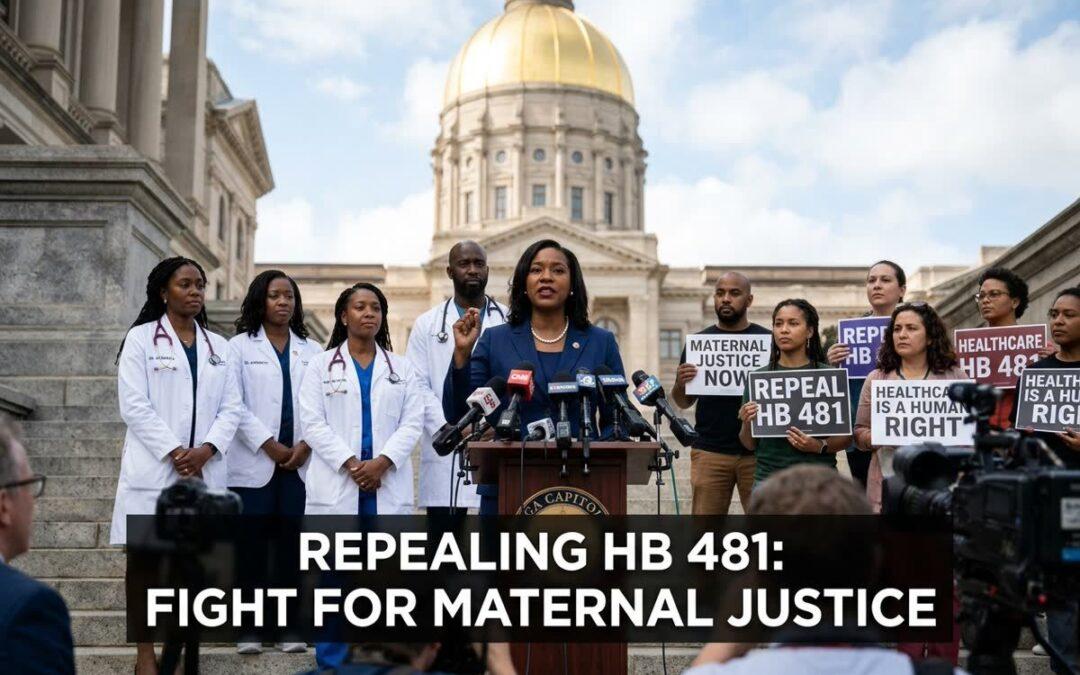
Days after her victory, Governor-elect Bottoms stood outside the Georgia State Capitol to outline the transition agenda for her administration, titled “Georgia’s Promise” (opb.org). Her foremost announcement addressed the state’s controversial reproductive policies. Bottoms confirmed that early discussions had begun to roll back or repeal the six-week Georgia abortion ban ahead of the 2027 legislative session (opb.org). The decision directly responds to a severe public health emergency that disproportionately affects Black mothers across the state.
This political shift connects directly to long-standing struggles over healthcare, bodily autonomy, and voting power. The contemporary fight over reproductive freedom in Georgia does not exist in isolation. It reflects decades of federal jurisprudence, institutional neglect, and grassroots organizing led by Black women. Examining this development requires looking closely at the history behind the headlines.
Keisha Lance Bottoms Transition and the 2026 Realignment
The Keisha Lance Bottoms transition marks a major realignment in Georgia politics. Bottoms captured 2,268,462 votes, representing 54.3 percent of the statewide total, while Jackson received 1,908,261 votes, or 45.7 percent (opb.org, ballotpedia.org). Her electoral victory ended uninterrupted Republican control of the governor’s mansion that began in 2003 (wikipedia.org, ballotpedia.org). It also marked the first time a Democrat won the executive branch in Georgia since Governor Roy Barnes took office in 1998 (wikipedia.org).
Bottoms’ strong performance altered the legislative balance inside the Georgia General Assembly. Democratic candidates flipped 13 seats in the state House of Representatives, capturing the majority for the upcoming legislative term (opb.org). While Republicans maintained a narrow majority in the state Senate, voters unseated prominent conservative figures (opb.org, thecurrentga.org). Notably, voters in suburban Cobb County ousted Republican Senator Ed Setzler, the primary legislative author of the state’s six-week ban (opb.org, thecurrentga.org). This realignment illustrates how freedom defines Black political power when structural organizing alters historic voting patterns.
To lead her transition team, Bottoms appointed a bipartisan steering committee co-chaired by veteran public servants and civic leaders (opb.org). The committee includes retired Dean of the Georgia House Calvin Smyre, former gubernatorial nominee Jason Carter, and Atlanta business executive Arthur Blank (opb.org). During her opening briefings, Bottoms emphasized that addressing the six-week ban is not merely an ideological dispute. Instead, she framed the reform as an urgent maternal health priority that requires immediate bipartisan cooperation before lawmakers convene in January 2027 (opb.org).
2026 Georgia Gubernatorial Vote Share
Doe v Bolton Precedent and Georgia Abortion History
Understanding Georgia’s modern reproductive legal landscape requires examining federal legal history. Georgia played a central role in establishing the constitutional framework for abortion rights half a century ago. On January 22, 1973, the Supreme Court of the United States issued its historic ruling in Roe v. Wade (georgiaencyclopedia.org, britannica.com). On the exact same day, the court decided a direct companion case from Atlanta titled Doe v. Bolton (georgiaencyclopedia.org, wikipedia.org).
The case challenged a 1968 Georgia statute that made abortion a felony under most circumstances (georgiaencyclopedia.org, study.com). The state allowed exceptions only if a woman’s life or health was severely endangered, if the fetus had severe defects, or in cases of forcible rape (georgiaencyclopedia.org, study.com). Even when patients met those strict legal criteria, Georgia required complex administrative hurdles (georgiaencyclopedia.org, wikipedia.org). A woman had to obtain approval from a three-physician hospital committee, undergo independent medical consultations, and prove permanent Georgia residency (georgiaencyclopedia.org, study.com).
In a 7–2 decision authored by Justice Harry Blackmun, the Supreme Court struck down Georgia’s procedural restrictions as unconstitutional infringements on Fourteenth Amendment liberty (georgiaencyclopedia.org, wikipedia.org). The court ruled that requiring committee approvals and residency tests placed severe, unlawful burdens on patients and doctors (wikipedia.org, study.com). The Doe v Bolton precedent established that states could not interpose bureaucratic gatekeeping between patients and their physicians (georgiaencyclopedia.org, wikipedia.org). For nearly five decades, that ruling defined the constitutional baseline of reproductive freedom across the American South.
Georgia HB 481 LIFE Act and the Post-Dobbs Reality
The constitutional landscape changed dramatically in 2019 when conservative lawmakers targeted federal precedent. Governor Brian Kemp signed House Bill 481, known as the Living Infants Fairness and Equality (LIFE) Act (thecurrentga.org, reproductiverights.org). HB 481 prohibited medical providers from performing abortions once ultrasound equipment could identify early cardiac activity (thecurrentga.org, reproductiverights.org). This biological stage typically occurs around six weeks of gestation, well before many women recognize that they are pregnant (thecurrentga.org, reproductivefreedomforall.org).
The statute went beyond typical restrictions by introducing statutory “fetal personhood” (thecurrentga.org, reproductiverights.org). The measure redefined an embryo or fetus at any stage of development as a natural person under Georgia state law (thecurrentga.org, reproductiverights.org). This language extended state income tax deductions and child support obligations to early pregnancies (thecurrentga.org). Crucially, the statute subjected medical professionals to felony prosecution, with prison terms ranging from one to ten years for performing unlawful abortions outside narrow, highly technical legal exceptions (thecurrentga.org, ga.gov).
House Bill 481 prohibited abortion procedures as early as six weeks of gestation and established statutory fetal personhood, carrying felony penalties of one to ten years in prison for medical providers.
Federal courts blocked the enforcement of HB 481 between 2019 and 2022 because it violated the protections guaranteed under Roe v. Wade (thecurrentga.org, reproductiverights.org). However, the legal environment reversed in June 2022 when the Supreme Court overturned federal abortion protections in Dobbs v. Jackson Women’s Health Organization (thecurrentga.org, reproductiverights.org). Weeks later, the 11th U.S. Circuit Court of Appeals vacated the district court injunction, allowing Georgia’s six-week ban to take effect immediately (thecurrentga.org, reproductiverights.org). The sudden criminal liability chilled clinical practice throughout the state’s hospital systems (propublica.org, propublica.org).
Georgia Maternal Mortality Crisis and Public Health Harms
The implementation of HB 481 collided directly with an existing public health emergency. Georgia has long maintained one of the highest maternal death rates in the country (ajc.com, cdc.gov). According to the Georgia Maternal Mortality Review Committee, approximately 85 percent of pregnancy-related deaths across the state are preventable (ajc.com, gpb.org). The risk is not distributed equally. Black mothers in Georgia are between two and three times more likely to die from pregnancy-related causes than white mothers (ajc.com, emory.edu).
Institutional disinvestment created these severe disparities long before 2019. More than half of Georgia’s 159 counties lack an obstetrician or a hospital labor-and-delivery unit (ajc.com, gsu.edu). Expectant mothers in rural communities often must travel more than an hour to reach specialized emergency obstetric care (gsu.edu, emory.edu). This structural lack of infrastructure mirrors broader economic disparities, showing how historical inequities documented in studies of African American labor and economic justice continue to shape access to survival today.
The six-week ban exacerbated these institutional failures with deadly consequences. In 2024, investigative reporting revealed that 28-year-old Amber Nicole Thurman died at Piedmont Henry Hospital after doctors delayed a routine dilation and curettage procedure for 20 hours (propublica.org, propublica.org). Thurman suffered rare medical complications following a medication abortion (propublica.org, propublica.org). Hospital personnel delayed standard surgical treatment out of fear of state prosecution under HB 481 while her condition worsened into fatal sepsis (propublica.org, propublica.org). In another instance, 41-year-old Candi Miller died at home from infection because she feared seeking clinical help under the restrictive law (propublica.org, propublica.org).
Georgia Maternal Mortality Disparity (Deaths per 100k)
Controversy escalated further in late 2024 when the state’s official Maternal Mortality Review Committee found that the deaths of Thurman and Miller were directly preventable and caused by hospital delays under the criminal statute (gpb.org, propublica.org). Following the public disclosure of those findings, state officials abruptly disbanded the committee (gpb.org). Public health researchers condemned the dismissal, pointing out that silencing oversight boards obscured preventable maternal mortality instead of addressing clinical realities (gpb.org).
SisterSong Reproductive Justice Framework and Grassroots Push
The organized resistance to HB 481 has been anchored in the reproductive justice movement. Black women established this intellectual and organizing framework in 1994 to move beyond conventional legal advocacy (reproductiverights.org). Led by organizations such as the Atlanta-based SisterSong Women of Color Reproductive Justice Coalition, the framework defines reproductive autonomy around three core human rights (reproductiverights.org):
- The right to have children on one’s own terms.
- The right not to have children through accessible contraception and safe abortion care.
- The right to parent children in safe, sustainable, and healthy environments.
When SisterSong challenged the 2019 law in state and federal court, their attorneys emphasized systemic survival (reproductiverights.org). The coalition pointed out that the state cannot force women to carry pregnancies to term while simultaneously denying them basic prenatal care, affordable labor facilities, and clean environments (reproductiverights.org). This focus on community protection connects to the broader legacy of Black political organizing and institutional power built to resist state neglect.
Mainstream advocacy groups often focus exclusively on privacy and statutory legality. In contrast, reproductive justice advocates demonstrate how abortion bans intersect with poverty, clinical bias, and the physiological toll of structural racism (reproductiverights.org, blackhealth.org). Researchers document that systemic stress causes chronic health conditions, such as hypertension and gestational diabetes, to manifest at earlier ages among Black women (blackhealth.org, emory.edu). By connecting HB 481 to systemic racism, advocates transformed the fight against the law into a broad movement for healthcare equality.
Georgia Abortion Ban Repeal and Legislative Strategy
Governor-elect Bottoms enters the executive mansion with a detailed plan to reverse the six-week ban. Her administration intends to advance legislation to repeal HB 481 during the 2027 legislative session (opb.org). With Democrats holding a majority in the state House, the primary hurdle rests in the Georgia Senate, where conservative leadership retains a narrow numerical advantage (opb.org). However, the defeat of key conservative architects has forced legislative leadership to reconsider hardline positions (opb.org, thecurrentga.org).
Beyond legislative action, Bottoms has pledged to exercise executive authority to protect medical personnel (opb.org). Her platform includes issuing executive directives to prevent state agencies from assisting in the criminal prosecution of doctors providing emergency pregnancy care (opb.org). She has also committed to restoring the independent Maternal Mortality Review Committee, ensuring that epidemiological investigations proceed without political interference or non-disclosure mandates (opb.org, gpb.org).
Georgia Obstetric Care Access Deficit
Crucially, Bottoms ties the repeal of HB 481 to comprehensive healthcare access. Her legislative package includes a plan for full Medicaid expansion under the Affordable Care Act, replacing the state’s restrictive Georgia Pathways program (opb.org, georgia.gov). Georgia Pathways, introduced under a Section 1115 waiver, required recipients to verify 80 hours per month of qualifying work or education, resulting in very low enrollment while leaving hundreds of thousands without care (georgia.gov). While the state offers 12 months of postpartum Medicaid, lacking continuous coverage before and after this window creates severe risks for mothers with chronic illnesses (emory.edu, georgia.gov). Full expansion aims to stabilize rural hospitals and provide continuous care throughout the state.
The push to repeal the Georgia abortion ban marks the culmination of a half-century of political struggle. From the procedural fights of Doe v. Bolton in 1973 to the historic election of America’s first Black woman governor in 2026, reproductive autonomy remains tied to public health and equal protection under the law. As the 2027 legislative session approaches, Georgia stands once again as the central testing ground for the future of reproductive freedom in the American South.
About the Author
Darius Spearman is a professor of Black Studies at San Diego City College, where he has been teaching for over 20 years. He is the founder of African Elements, a media platform dedicated to providing educational resources on the history and culture of the African diaspora. Through his work, Spearman aims to empower and educate by bringing historical context to contemporary issues affecting the Black community.
