

Canary Islands Migrant Crisis: Why the Atlantic Route Surged
By Darius Spearman (africanelements)
Support African Elements at patreon.com/africanelements and hear recent news in a single playlist. Additionally, you can gain early access to ad-free video content.
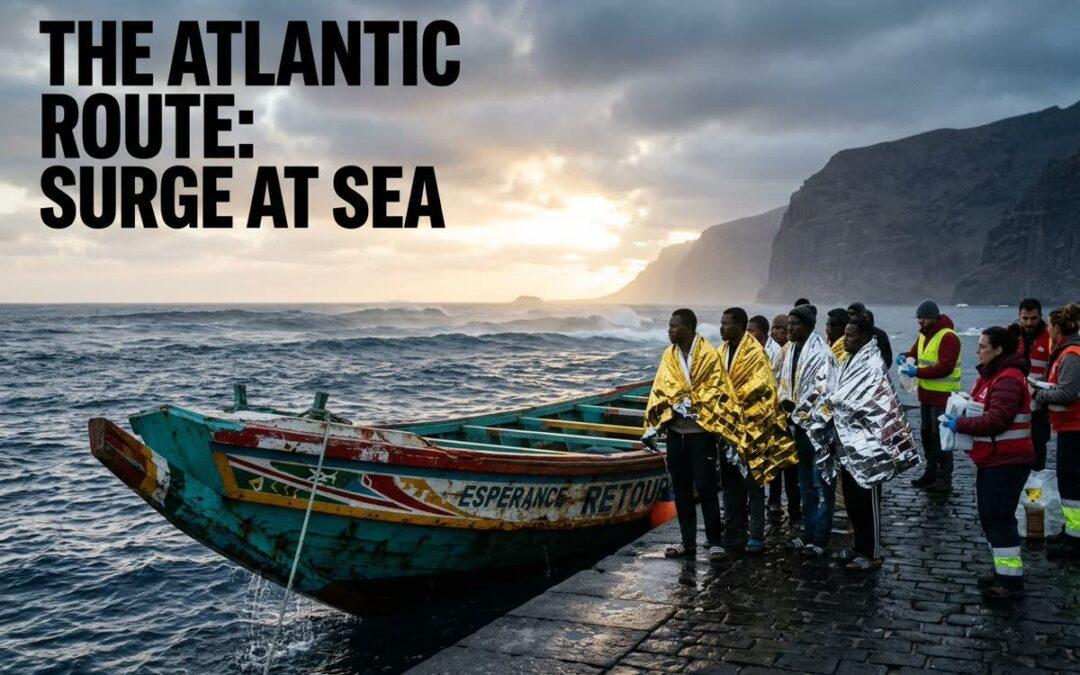
In mid-November, emergency reception facilities across Spain’s Canary Islands collapsed under an unprecedented wave of open-ocean arrivals (democrata.es). Crammed aboard long wooden fishing boats known as cayucos, thousands of West African migrants reached shore after surviving one of the most dangerous oceanic journeys on earth (kvue.com, caminandofronteras.org). On tiny perimeter islands such as El Hierro, the sheer volume of arrivals rapidly equaled or outnumbered local village populations, forcing emergency services to process hundreds of people on open docks (africanews.com, citynews.ca).
While European media accounts frequently frame this unfolding humanitarian emergency as a sudden border shock, the crisis is the direct product of decades of deliberate policy decisions (ecre.org, ox.ac.uk). The current Atlantic boat migration represents the reactivation of a structural migration circuit that has oscillated between the Mediterranean Sea and the open Atlantic Ocean for thirty years (researchgate.net, wikipedia.org). Understanding why thousands of West African youth continue to risk death at sea requires examining the history of border externalization, asymmetric marine resource exploitation, and post-colonial geopolitical ties (greenpeace.org, pulitzercenter.org).
West African Atlantic Route: Geopolitics and Ocean Currents
The maritime corridor connecting West Africa to the Canary Islands is widely recognized by international observers as the deadliest migratory journey in the world (caminandofronteras.org, iom.int). Navigating over a thousand kilometers of open ocean aboard single-engine wooden pirogues exposes passengers to volatile trade winds and relentless swells (bairdmaritime.com, theguardian.com). When engines fail or fuel runs dry, oceanic currents push disabled vessels westward into the vast Atlantic graveyard, creating undocumented shipwrecks that leave no trace behind (aljazeera.com, iom.int).
The people undertaking this passage originate primarily from four nations: Senegal, Mali, The Gambia, and Guinea (democrata.es, unhcr.org). Each nation faces compounding systemic crises that leave young generations with vanishing domestic options. In Mali, the collapse of state security following successive military coups, the withdrawal of United Nations peacekeepers, and spreading insurgencies have displaced hundreds of thousands of people (aljazeera.com, aljazeera.com). In The Gambia and Guinea, currency inflation, youth unemployment, and the repression of political opposition have undermined social stability (africanews.com, aljazeera.com).
These regional pressures unfold against broader systemic imbalances, including historical economic exploitation that strips sovereign states of the fiscal resources necessary to support public infrastructure. Seasonal weather patterns also dictate the timing of these voyages. During late autumn, the fierce trade winds along the Saharan shelf temporarily quiet down during a period known locally as las calmas (democrata.es, teneriffa-news.com). Smuggling networks exploit this brief ocean window, launching scores of crowded boats simultaneously and overwhelming Spanish maritime search and rescue teams (bairdmaritime.com, citynews.ca).
Canary Islands Sea Arrivals by Year
Historical records showing route reactivation across three decades
Ceuta and Melilla Militarization: Closing Land Borders
To grasp why West Africans embark onto open Atlantic waters, one must first look hundreds of miles north to the Mediterranean coast of Morocco. There lie Ceuta and Melilla, two autonomous Spanish cities that have remained under Spanish sovereignty since 1668 and 1497, respectively (wikipedia.org). These enclaves constitute the European Union’s only direct land borders on the African continent (wikipedia.org, ecchr.eu). Following Spain’s integration into the European Union and the Schengen Area, these borders transformed into fortified military installations designed to prevent territorial entry (ecchr.eu, ox.ac.uk).
Throughout the 1990s and early 2000s, asylum seekers and migrants attempted overland transit by crossing enclave boundaries (wikipedia.org). In response, Spanish and European authorities erected massive multi-layered barrier fences reaching six meters in height, complete with razor wire, underground motion sensors, and thermal imaging watchtowers (ecchr.eu, borderviolence.eu). European institutions funneled hundreds of millions of euros into Moroccan border forces to outsource security checkpoints and carry out aggressive enforcement sweeps in the border hinterlands (ecre.org, borderviolence.eu).
Border authorities routinely carried out summary pushbacks (*devoluciones en caliente*) without individual asylum assessments (ecchr.eu, hrw.org). These militarized operations turned deadly, culminating in episodes such as the 2022 Melilla border crossing, in which dozens of Sub-Saharan migrants were killed during violent policing maneuvers (ecchr.eu, borderviolence.eu). By sealing off land crossings, European border policies produced a classic “balloon effect.” Migrants and smuggling networks did not abandon their journey; instead, enforcement pressure redirected them southwest toward the treacherous Atlantic coast (researchgate.net, ox.ac.uk).
2006 Cayuco Crisis History and External Border Patrols
The current emergency is not the first time the Atlantic corridor has seen overwhelming maritime numbers. In 2006, Spain encountered its first major Atlantic migration wave, an event remembered in Spanish administrative history as the *Crisis de los Cayucos* (canariashistoria.com, wikipedia.org). During that single year, 31,678 migrants reached the Canary archipelago aboard wooden vessels departing primarily from Mauritania and northern Senegal (canariashistoria.com, europa.eu). Regional infrastructure fractured under the strain, compelling Madrid to pioneer a sweeping strategy of border externalization (ecre.org, ox.ac.uk).
Rather than reforming European asylum frameworks, Spain constructed a ring of bilateral containment agreements across West Africa (ecre.org, europa.eu). Through high-level diplomacy, Madrid provided development aid, patrol vessels, and police equipment to Senegal, Mauritania, and Cape Verde in direct exchange for migration deterrence and repatriation treaties (ecre.org, ox.ac.uk). Under the auspices of the European Border and Coast Guard Agency (Frontex), the European Union launched *Operation Hera*, placing Spanish Civil Guard boats and aerial surveillance patrols directly inside West African sovereign waters (europa.eu, ox.ac.uk).
These containment treaties effectively froze large-scale departures for nearly a decade (ecre.org, researchgate.net). By 2015, total annual arrivals across the entire archipelago fell below 900 people (ecre.org). However, suppressing the route did not resolve the core social and economic crises that compelled people to migrate (iom.int, pulitzercenter.org). When European agreements with Turkey, Libya, and Morocco later choked off Central and Western Mediterranean routes between 2017 and 2019, smuggling operations promptly reactivated the dormant Atlantic pathway (ecre.org, researchgate.net). By 2020, as the pandemic eroded West African informal economies, maritime departures surged back to life (researchgate.net).
Senegal Overfishing and Migration: Industrial Marine Extraction
The decision to risk one’s life aboard an ocean vessel is deeply rooted in the destruction of local livelihoods. Along the coast of Senegal, the fishing industry historically provided the economic foundation for entire coastal villages, employing hundreds of thousands of workers and supplying essential dietary protein through sardinella stocks (greenpeace.org, pulitzercenter.org). Over the past three decades, however, that resource base has collapsed under the pressure of asymmetric bilateral fishing pacts (greenpeace.org).
The European Union negotiated a series of Sustainable Fisheries Partnership Agreements (SFPAs) granting high-capacity European vessels access to West African maritime zones (greenpeace.org, pulitzercenter.org). While these treaties stipulated that foreign industrial fleets could harvest only surplus populations, European bottom trawlers and tuna vessels regularly overfished fragile marine ecosystems (greenpeace.org). Concurrently, foreign industrial fleets, including heavily subsidized Chinese distant-water trawlers, swept through coastal waters to feed offshore and domestic fishmeal processing plants (greenpeace.org, pulitzercenter.org). These industrial factories ground local fish into animal feed for export, depriving regional markets of affordable food and driving local artisanal fleets into bankruptcy (greenpeace.org, pulitzercenter.org).
Empty oceans broke our generational trade. When artisanal fishermen cannot feed their families from the sea, those same fishing boats become the only vehicle left to seek survival abroad.
Faced with mounting debts and idle vessels, Senegalese fishermen made a calculated economic choice (africanews.com, pulitzercenter.org). Experienced navigators repurposed their ocean-going wooden *cayucos*—originally built to withstand Atlantic swells during multi-day fishing journeys—into passenger carriers (africanews.com, theguardian.com). Young men adopted the Wolof cultural phrase “Barça ou Barzakh”: reach Barcelona or die trying (youtube.com, pulitzercenter.org). The maritime experience that once sustained coastal communities now steers thousands of desperate passengers through oceanic currents toward Spanish territory (africanews.com, theguardian.com).
Primary Nationalities on the Atlantic Route
Estimated share of recent maritime arrivals across Canary reception points
El Hierro Migrant Crisis: A Micro-Island Under Pressure
While the Canary archipelago comprises seven major islands, oceanic geography funnels the brunt of recent landings onto its smallest and most remote outpost (africanews.com, citynews.ca). El Hierro covers less than 270 square kilometers and supports a permanent population of roughly 11,400 inhabitants (africanews.com, kvue.com). Because southern departure points in Senegal and The Gambia force vessels to arc far out into the Atlantic to evade Mauritanian coastal radar, prevailing currents carry incoming *cayucos* past Gran Canaria and Tenerife directly toward El Hierro’s southwestern harbor of La Restinga (africanews.com, kvue.com).
During concentrated arrival windows, the island’s emergency capacity fractures completely (democrata.es, kvue.com). Over individual 48-hour periods, more than 1,200 individuals have disembarked in La Restinga, an influx that temporarily exceeds the municipal population of the entire surrounding district (africanews.com, citynews.ca). The local health center, designed for rural community care, struggles to triage severe hypothermia, acute dehydration, and advanced infections resulting from ten to fifteen days on open water (kvue.com, citynews.ca).
Civil defense workers and Red Cross volunteers operate around the clock on concrete quays, using temporary tents to shelter hundreds of exhausted survivors (africanews.com, kvue.com). Local officials repeatedly voice concerns that the remote island cannot function as an open-air processing facility for continental Europe (democrata.es, kvue.com). The crisis on El Hierro illustrates how international border control regimes shift humanitarian burdens onto isolated municipal communities that lack the physical infrastructure to sustain long-term reception efforts (democrata.es, ecre.org).
Spain Unaccompanied Minor Crisis and Legal Limbo
Surviving the voyage does not guarantee legal safety or economic freedom (asylumineurope.org, globaldetentionproject.org). Under Spain’s Foreigners Act (*Ley de Extranjería*), arriving adults face an administrative apparatus that restricts their civil movement (asylumineurope.org, asylumineurope.org). Upon arrival, national police place migrants in temporary emergency holding facilities known as *Centros de Atención Temporal de Extranjeros* (CATEs) for up to 72 hours to conduct biometric registration, medical evaluations, and background checks (asylumineurope.org, globaldetentionproject.org).
Following initial CATE processing, the legal path diverges into detention or administrative limbo (asylumineurope.org, globaldetentionproject.org). Judges can order adult migrants into closed detention facilities (*Centros de Internamiento de Extranjeros*, or CIEs) for an absolute statutory maximum of 60 days to prepare deportation proceedings (asylumineurope.org, globaldetentionproject.org). If Spain cannot execute removal within that 60-day window—frequently because origin nations reject repatriation flights or refuse citizenship identification—Spanish law mandates their release (asylumineurope.org, asylumineurope.org). Migrants are transferred to the mainland or left on public streets with unenforced deportation orders (*órdenes de expulsión*), legally barring them from formal employment and trapping them in informal labor exploitation for years (asylumineurope.org, refworld.org).
The situation is even more acute for youth. Spain’s legal framework divides responsibility along jurisdictional boundaries: adult migrants fall under national state administration, but unaccompanied children (*menores no acompañados*) are the statutory charge of regional autonomous governments (democrata.es, hrw.org). The Canary Islands regional government has had to house over 5,000 unaccompanied African minors across dozens of overcrowded shelters (democrata.es, hrw.org). Autonomous regional leaders have repeatedly demanded that Spain’s central government mandate compulsory quota transfers to distribute young arrivals among mainland regions (democrata.es).
However, intense political resistance from conservative and far-right regional administrations on the mainland has blocked legislative reform, sparking constitutional gridlock while thousands of young Africans remain confined in underfunded island facilities (democrata.es, hrw.org). In the absence of institutional support, diaspora networks often step forward, drawing on generational family survival strategies to help newcomers locate housing and navigate hostile legal systems. Addressing these human rights challenges requires fundamentally decolonizing political structures and acknowledging that modern migration patterns reflect deep-seated colonial relationships (ecre.org, ox.ac.uk).
Spanish Legal Detention Limits
Statutory detention timelines under Spain’s immigration enforcement framework
The tragedy playing out across Atlantic waters is neither an unexplainable emergency nor a temporary administrative glitch (caminandofronteras.org, iom.int). Rather, it represents the predictable collision of aggressive border militarization and environmental extraction (ecchr.eu, greenpeace.org). As European authorities continue to seal off land borders while industrial fleets extract marine resources from coastal Africa, vulnerable populations will continue to be driven onto wooden boats (ecchr.eu, pulitzercenter.org). Until international policies address the systemic causes fueling forced migration, the Atlantic route will remain an enduring pathway of human displacement (caminandofronteras.org, ecre.org).
About the Author
Darius Spearman is a professor of Black Studies at San Diego City College, where he has been teaching for over 20 years. He is the founder of African Elements, a media platform dedicated to providing educational resources on the history and culture of the African diaspora. Through his work, Spearman aims to empower and educate by bringing historical context to contemporary issues affecting the Black community.
