
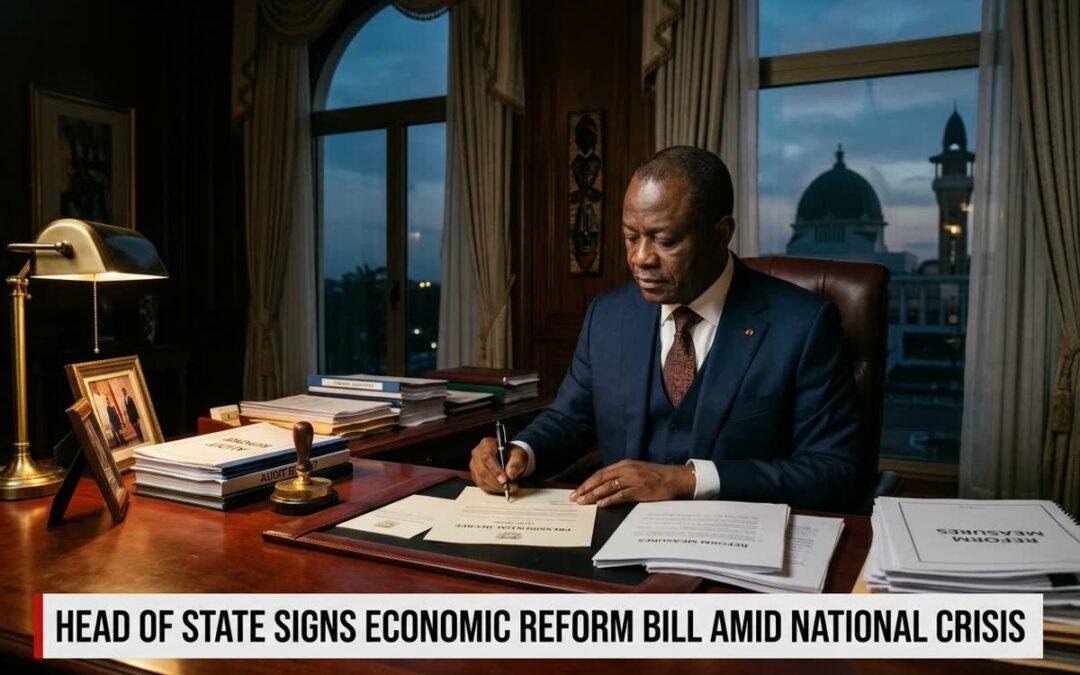


Senegal IMF Bailout: President Faye Bypasses Parliament
By Darius Spearman (africanelements)
Support African Elements at patreon.com/africanelements and hear recent news in a single playlist. Additionally, you can gain early access to ad-free video content.
Senegalese President Bassirou Diomaye Faye made a decisive political move by issuing Decree No. 2026-2416 to push through a revised national budget (intellinews.com). The unilateral decree bypassed the National Assembly after lawmakers firmly rejected the fiscal legislation (apanews.net). The administration took this emergency measure to satisfy preconditions set by the International Monetary Fund for a thirty-six-month, $2.2 billion Extended Credit Facility (intellinews.com).
The legislative standoff exposed a severe constitutional divide in Dakar. The crisis developed after state audits revealed that the previous government concealed billions of dollars in public borrowing (businessfront.com). Confronted with empty state coffers and credit downgrades, the executive branch chose international borrowing over legislative consensus. This confrontation highlights an ongoing historical conflict between African sovereign aspirations and the demands of global financial markets (afronomicslaw.org).
Macky Sall Debt Legacy and the Senegal Sovereign Debt Crisis
The roots of the current economic emergency trace directly to the administration of former President Macky Sall (businessfront.com). Between 2012 and early 2024, Sall championed the Plan Sénégal Émergent, a modernization framework focused on expensive public works (budgit.org). The state invested heavily in major projects, including the Dakar Regional Express Train, the new city of Diamniadio, sports stadiums, and highway networks (businessfront.com). Sall financed these projects through substantial commercial debt offerings.
Senegal issued international Eurobonds and raised capital on regional debt markets to fund this building campaign (tradingview.com). Official macroeconomic reports suggested that public finances were stable, showing annual budget deficits near 5 percent of gross domestic product (businessfront.com). Beneath that visible progress, however, debt obligations multiplied rapidly. When energy and food import costs increased following global disruptions, the government relied on expensive commercial loans to maintain consumer price caps (imf.org). The country accumulated financial obligations that far exceeded its long-term domestic tax revenue (afronomicslaw.org).
Senegal Public Debt Evolution (% of GDP)
Auditing the Books: The Senegal Hidden Debt Scandal
The election of Bassirou Diomaye Faye in March 2024 brought these liabilities to light (wikipedia.org). Faye ran as a proxy candidate for Ousmane Sonko and the left-wing PASTEF party (wikipedia.org). Their campaign focused heavily on anti-corruption and fiscal transparency (carnegieendowment.org). Immediately upon taking office, the new government ordered deep forensic audits of public accounts through the Court of Auditors and international accounting firm Forvis Mazars (businessfront.com).
The investigation uncovered extensive financial misreporting under the previous administration (businessfront.com). Auditors identified more than $6 billion in hidden domestic obligations, unrecorded commercial borrowings, and opaque public contracts (businessfront.com). Actual budget deficits averaged over 10 percent of gross domestic product across recent years, peaking at 12.3 percent rather than the reported 6 percent (businessfront.com). Total public debt climbed to an estimated 132 percent of gross domestic product by late 2024 (intellinews.com). International credit rating agencies responded with severe downgrades (intellinews.com). The downgrade locked Dakar out of commercial bond markets, while the IMF froze an existing $1.8 billion credit program due to inaccurate reporting (businessfront.com).
“The audit findings revealed significant off-budget commitments and debt figures that substantially exceeded historical official declarations.”
Source: (businessfront.com)
Colonial Roots: CFA Franc Monetary Constraints
Senegal’s restricted response to this financial emergency stems directly from its monetary structure (cainz.org). The country uses the West African CFA franc, a currency created on December 26, 1945, by the French colonial administration (wikipedia.org). The currency originally stood for “Franc of the French Colonies of Africa” and was designed to maintain French economic dominance after the Second World War (cainz.org). Although modern reforms replaced the older colonial treaties, the fundamental mechanics remain anchored to Europe through a fixed exchange parity with the euro (wikipedia.org).
Because monetary authority belongs exclusively to the regional Central Bank of West African States (BCEAO), Senegal lacks a sovereign national central bank (bceao.int). The state cannot lower domestic interest rates to stimulate business activity or print local currency during severe liquidity crunches (cainz.org). Furthermore, Dakar cannot devalue its currency to make exports more competitive or lessen the real burden of domestic debts (wikipedia.org). Denied standard monetary mechanisms, the government has only one path to rebalance its accounts: internal budget reductions. This system shifts the entire burden of debt resolution onto public services and domestic taxpayers (afronomicslaw.org).
Social Costs: Resistance to IMF Austerity Spending Cuts
The human cost of internal budget adjustment remains a major flashpoint across West Africa (boell.de). Throughout the 1980s and 1990s, Western financial institutions forced developing nations into Structural Adjustment Programs (afronomicslaw.org). These historical packages dismantled state healthcare networks, reduced education spending, and eliminated agricultural supports (afronomicslaw.org). African social justice organizations and labor unions continue to view loan conditions set by Washington-based institutions as direct threats to self-determination and social welfare (boell.de).
The revised 2026 supplementary budget required by the IMF follows a familiar pattern (intellinews.com). To reduce the fiscal deficit to 7.6 percent of economic output, the government reduced planned public capital projects by 555 billion CFA francs (intellinews.com). The plan also begins phasing out broad energy and fuel subsidies (imf.org). When utility rates and transport fuel costs increase, commercial distributors pass those expenses to shoppers. These measures trigger price increases on staple goods like rice, bread, and cooking oil. Reductions in infrastructure development also reduce local employment opportunities for working-class youth (imf.org).
Fiscal Deficit Realities vs Targets (% of GDP)
Ideological Split: The Ousmane Sonko Parliament Standoff
The fiscal emergency shattered the political partnership between President Faye and his political patron, Ousmane Sonko (africa-confidential.com). After Faye dismissed Sonko as Prime Minister in May 2026, Sonko assumed the role of President of the National Assembly (africa-confidential.com). With PASTEF controlling 130 of the 165 legislative seats, Sonko mounted fierce opposition against executive policies (ranenetwork.com). The conflict centered on how to resolve sovereign liabilities without compromising national independence.
A key source of friction was the administration’s plan to pay down 1.956 trillion CFA francs—approximately $3.5 billion—in domestic debt arrears (intellinews.com). Private civil engineering companies, fuel distributors, and service contractors belonging to industry syndicates held these unpaid invoices (cnes.sn). Sonko and his legislative allies claimed these contractor balances were tainted by irregularities and price inflation under Macky Sall (ranenetwork.com). Lawmakers argued that paying private business owners while freezing social programs betrayed their base. On November 3, 2026, parliament rejected the revised 2026 budget by a vote of 126 to 20 (intellinews.com). Two weeks later, lawmakers also defeated the first section of the 2027 draft budget by 128 votes to 18 (intellinews.com).
Assembly Vote on 2026 Supplementary Budget
Executive Power and Law: The Bassirou Diomaye Faye Decree
Facing rigid loan deadlines from international lenders, President Faye bypassed the assembly on November 19, 2026 (intellinews.com). Decree No. 2026-2416 enacted the rejected supplementary budget into law by presidential authority (intellinews.com). The presidency justified this decision by invoking Article 68 of the Senegalese Constitution (senenews.com). Executive attorneys claimed that the sixty-day constitutional window for legislative consideration had expired without an approved budget, requiring presidential intervention to ensure the continuity of state operations (seneweb.com).
The decree sparked widespread constitutional pushback from legal scholars and opposition deputies (seneweb.com). Critics argued that Article 68 was intended for legislative inaction or prolonged filibustering, not for bills that lawmakers clearly voted down (seneweb.com). Overriding a formal legislative vote weakens parliamentary oversight in a country long celebrated for democratic stability (bti-project.org). Faye secured the necessary framework to unlock the $2.2 billion IMF package, but the decision leaves lingering institutional wounds across Senegal’s governance landscape (intellinews.com).
About the Author
Darius Spearman is a professor of Black Studies at San Diego City College, where he has been teaching for over 20 years. He is the founder of African Elements, a media platform dedicated to providing educational resources on the history and culture of the African diaspora. Through his work, Spearman aims to empower and educate by bringing historical context to contemporary issues affecting the Black community.
