
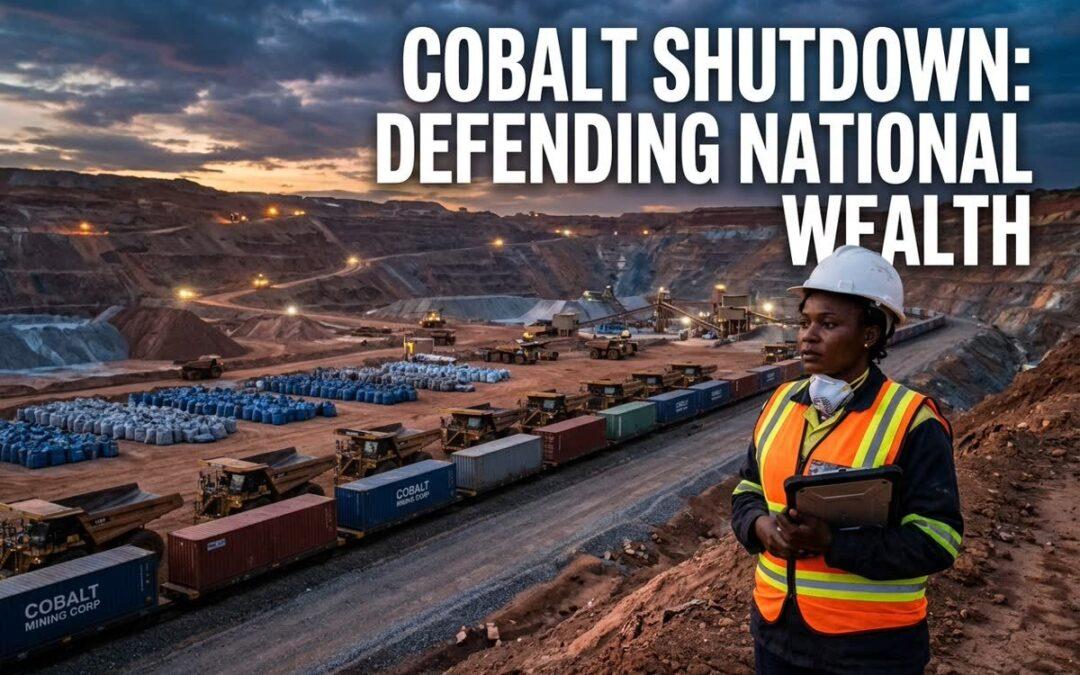


DRC Cobalt Export Ban: Why Kinshasa Halted EV Metal Shipments
By Darius Spearman (africanelements)
Support African Elements at patreon.com/africanelements and hear recent news in a single playlist. Additionally, you can gain early access to ad-free video content.
On November 24, 2026, the government of the Democratic Republic of the Congo took decisive action to defend its primary economic resource. The Ministry of Mines announced a blanket export halt on cobalt, effective November 30 (africasustainabilitymatters.com). President Felix Tshisekedi and regulatory officials acted through the Authority for the Regulation and Control of Strategic Mineral Substances Markets, known as ARECOMS (energynews.pro). This marks the implementation of a second sweeping DRC cobalt export ban within two years to address collapsing global cobalt prices, enforce strict ARECOMS cobalt regulation, and retain local wealth (africasustainabilitymatters.com, energynews.pro).
The DRC supplies more than 70 percent of the world output of cobalt, a critical element required for EV battery minerals and consumer electronics (usgs.gov, iea.org). Yet, intermediate hydroxide values dropped sharply throughout 2026 due to overseas overproduction and corporate inventory buildup (energynews.pro). Kinshasa is refusing to let foreign markets dictate the terms of its wealth. To understand this modern trade dispute, one must examine the deep historical patterns of foreign extraction that have governed Central African minerals for over a century.

African History Series • Volume II • Anti-Colonial Resistance & Sovereignty
Africa Reclaimed: Overcoming the Legacies of the Colonial Machine
By Professor A. Darius Spearman • 353 Pages • ISBN: 979-8-9924836-4-2
Colonialism in Africa was never passively endured—and its extractive machinery did not simply vanish when independence flags were raised. Professor A. Darius Spearman traces the unbroken arc of African political power from 19th-century indigenous statecraft and mid-20th-century liberation wars to contemporary battles against neo-colonial debt and resource imperialism.
Katanga Copperbelt History: Colonial Extraction and Early Monopolies
The roots of modern mineral exploitation trace directly back to the colonial era. Katanga copperbelt history began in earnest under the brutal regime of Belgium’s King Leopold II (britannica.com, historyatlas.com). In October 1906, royal authorities chartered the Union Miniere du Haut-Katanga, widely known as UMHK (wikipedia.org, historyatlas.com). UMHK was granted an immense concession of 20,000 square kilometers, effectively operating as an autonomous private state within the colonized territory (wikipedia.org, historyatlas.com).
The colonial administration designed regional transport lines solely to remove raw riches from the interior. Rail corridors bypassed local communities to haul copper, tin, and cobalt directly to maritime ports for processing in European facilities (lobitocorridor.com, historyatlas.com). During this era, foreign powers extracted unrefined wealth while denying Congolese citizens technical training or fair wages, establishing enduring systems of unfree labor systems. This dynamic left the territory completely stripped of industrial value additions (commodityfrontiers.com, historyatlas.com).
Katanga quickly proved to be a geological miracle. Beyond copper, engineers uncovered massive deposits of pitchblende and heterogenite (wikipedia.org, historyatlas.com). The Shinkolobwe mine in Katanga eventually supplied the uranium utilized by the United States Manhattan Project during World War II (wikipedia.org). Throughout these decades, UMHK secured a near-monopoly over worldwide refined cobalt reserves. The corporate profits enriched Brussels financiers while local populations faced systemic disenfranchisement and forced labor (wikipedia.org, commodityfrontiers.com).
Global Cobalt Mine Production Share
Gecamines Mineral Nationalization and the Post-Colonial Struggle
When the Congo won its independence in June 1960, democratic self-determination clashed immediately with European corporate power (britannica.com). Western mining interests backed the violent secession of Katanga province under Moise Tshombe to protect UMHK holdings (wikipedia.org, britannica.com). This intervention led directly to the assassination of Prime Minister Patrice Lumumba in January 1961, aborting early efforts toward authentic postcolonial sovereignty (britannica.com). After seizing authority in 1965, Mobutu Sese Seko moved to assert direct state authority over the mining sector (wikipedia.org, britannica.com).
In January 1967, the regime dissolved UMHK assets and launched La Generale des Carrieres et des Mines (wikipedia.org, wikipedia.org). This Gecamines mineral nationalization transformed the company into the primary financial lifeblood of Zaire (gecamines.com, wikipedia.org). Throughout the 1970s and 1980s, Gecamines generated up to 70 percent of state revenue and over 60 percent of foreign exchange earnings (gecamines.com, resourcematters.org). However, the Mobutu government treated company accounts as an elite patronage tool rather than reinvesting in technical machinery, sustainable planning, or local processing infrastructure (worldbank.org, resourcematters.org).
The financial and physical collapse of the state monopoly accelerated in 1990 following the structural cave-in of the Kamoto underground mine (wikipedia.org, resourcematters.org). Regional civil conflicts, falling commodity cycles, and hyperinflation brought state production to a halt by the early 2000s (worldbank.org, resourcematters.org). Annual copper output dropped from 500,000 metric tons down to less than 10,000 tons (wikipedia.org, resourcematters.org). The World Bank subsequently advised Kinshasa to pass the liberal 2002 Mining Code, lowering royalties to two percent and privatizing concessions into minority joint ventures with foreign capital (worldbank.org, resourcematters.org).
“It is no longer about exporting tonnes of copper or cobalt; it is about creating value… We are absolutely not selling anything off cheaply.”
— Louis Watum, DRC Minister of Mines, Source: (energynews.pro)
China DRC Cobalt Mining and the Modern Value Chain
During the early 2000s, private Western mining companies dominated concessions across Katanga. However, the international landscape shifted dramatically with the 2008 Sicomines barter agreement under President Joseph Kabila (scmp.com, aiddata.org). This landmark agreement traded mineral concessions for six billion dollars in Chinese-built public infrastructure (scmp.com, aiddata.org). Over the following fifteen years, China DRC cobalt mining ties transformed the Katanga mining region into an industrial engine for Asian manufacturing (scmp.com, iea.org).
Chinese firms acquired flagship properties, including the massive Tenke Fungurume Mining operation and the Kisanfu concession from US-based Freeport-McMoRan (northernminer.com, cruxinvestor.com). By 2024, Chinese entities controlled around 75 percent of commercial Congolese cobalt operations and refined nearly 80 percent of worldwide supplies (theoregongroup.com, iea.org). The African continent retained less than one percent of chemical refining facilities (theoregongroup.com, spglobal.com). Consequently, the DRC remained locked in an extraction model where intermediate hydroxides left the country without yielding finished battery components (africasustainabilitymatters.com, energynews.pro).
The Congolese government responded to this imbalance by enacting the Congo Mining Code 2018 under Loi n° 18/001 (mining.com). This landmark law removed 10-year investor stability guarantees and declared cobalt a strategic substance (miningmx.com, mining.com). The reform raised royalty rates fivefold from two percent to ten percent (miningmx.com, mining.com). President Felix Tshisekedi later successfully forced the renegotiation of the Sicomines pact, securing seven billion dollars in domestic infrastructure funds and demonstrating an assertive model of centralized state authority (scmp.com, aiddata.org).
Global Cobalt Pricing Crash ($/lb)
Artisanal Cobalt Mining DRC: Grassroots Diggers and Environmental Strain
Beyond massive open-pit industrial projects, artisanal cobalt mining DRC operations account for 10 to 12 percent of national extraction (spglobal.com). An estimated 150,000 to 200,000 independent miners, known as creuseurs, manually dig pits using hand tools (spglobal.com). These laborers operate without institutional safety equipment or formal employment contracts. They sell their daily finds to unregulated middlemen for immediate subsistence cash to buy basic food supplies (spglobal.com).
The physical realities of this work remain exceptionally difficult. Runoff from informal mines and industrial operations frequently contaminates regional waterways and farm soil with heavy metals, creating severe respiratory conditions and health hazards for nearby residents (energy-solutions.co). Despite contributing to the green energy transition of wealthy nations, local communities endure polluted soil and hazardous air quality without receiving proportional municipal infrastructure (energy-solutions.co, afdb.org).
A complete trade halt severely disrupts this fragile cash economy. When legal mineral depots close, artisanal miners lose their primary source of daily revenue (africasustainabilitymatters.com, spglobal.com). This dynamic pushes workers to sell their stocks to clandestine networks at deep discounts or trespass into guarded corporate concessions at night (spglobal.com). The resulting conditions elevate the risk of dangerous tunnel collapses, extortion by local rings, and physical confrontations with security details (spglobal.com).
Global Cobalt Prices and Kinshasa’s Strategic Quotas
The November 2026 intervention emerged directly from systemic pressures in international commodity markets. Between 2021 and 2022, rapid projections for battery demand lifted metal prices above $80,000 per metric ton (energynews.pro). In response, industrial producers expanded their mine operations (energynews.pro, cruxinvestor.com). However, the sudden rapid expansion of high-pressure acid leach facilities in Indonesia flooded the world market with low-cost mixed hydroxide precipitate (investingnews.com, iea.org). Indonesia’s share rose to 14 percent of world mined output, breaking Kinshasa’s pricing power (usgs.gov, iea.org).
Furthermore, international automakers accelerated shifts toward Lithium Iron Phosphate battery chemistries, which bypass cobalt completely to lower vehicle costs (theoregongroup.com, iea.org). By early 2025, intermediate hydroxide prices had plummeted to under $10 per pound (energynews.pro). In response, Kinshasa issued a temporary four-month export embargo in February 2025, which initially stimulated a sharp price recovery (energynews.pro). ARECOMS then instituted an annual quota framework on October 16, 2025, capping foreign shipments at 96,600 metric tons per year (energynews.pro).
| Policy Milestone | Effective Date | Key Economic Action |
|---|---|---|
| First Cobalt Moratorium | February 2025 | Four-month blanket halt on foreign export shipments (energynews.pro). |
| ARECOMS Quota Regime | October 2025 | Annual ceiling set at 96,600 metric tons of contained metal (energynews.pro). |
| Second Export Suspension | November 2026 | Complete export halt enacted to curb 87,000-ton domestic stockpiles (africasustainabilitymatters.com, energynews.pro). |
However, an operational dilemma undermined the quota regime. In the DRC, cobalt is extracted as a geological byproduct of copper (energynews.pro, investingnews.com). High copper demand driven by power grids and data centers encouraged miners to maintain elevated processing runs (energynews.pro). While Glencore curtailed cobalt recovery to 13,700 tons, China’s CMOC Group produced 99,694 tons during the first nine months of 2026 (energynews.pro). Because ARECOMS permitted CMOC to export only 12,661 tons, the company accumulated 87,033 tons in local warehouses (energynews.pro). Traders noticed this massive overhang, driving global cobalt prices down 49 percent to $12.70 per pound by late November (energynews.pro).
CMOC Cobalt: Stockpiled vs Exported (2026)
The DRC cobalt export ban announced on November 24 represents an assertive gamble to enforce trade discipline across the battery value chain (africasustainabilitymatters.com, energynews.pro). President Felix Tshisekedi and Mines Minister Louis Watum made clear that the nation will no longer serve merely as a passive quarry for global industry (africasustainabilitymatters.com, energynews.pro). Kinshasa aims to triple state mining revenue by 2040 through domestic chemical refining and precursor manufacturing facilities (energynews.pro).
Yet, Kinshasa faces structural obstacles in this high-stakes confrontation. If supply suspensions remain in place for too long, international battery manufacturers may permanently redesign pack architectures to eliminate cobalt entirely (theoregongroup.com, iea.org). Meanwhile, expanding Indonesian output provides alternative supply lines for foreign chemical refiners (investingnews.com, iea.org). The outcome of this export freeze will determine whether the DRC finally breaks free from colonial extraction models or encounters the hard limits of commodity trade leverage (africasustainabilitymatters.com, energynews.pro).
About the Author
Darius Spearman is a professor of Black Studies at San Diego City College, where he has been teaching for over 20 years. He is the founder of African Elements, a media platform dedicated to providing educational resources on the history and culture of the African diaspora. Through his work, Spearman aims to empower and educate by bringing historical context to contemporary issues affecting the Black community.
