

Inside Haiti General Hospital: What Gangs Left Behind
By Darius Spearman (africanelements)
Support African Elements at patreon.com/africanelements and hear recent news in a single playlist. Additionally, you can gain early access to ad-free video content.
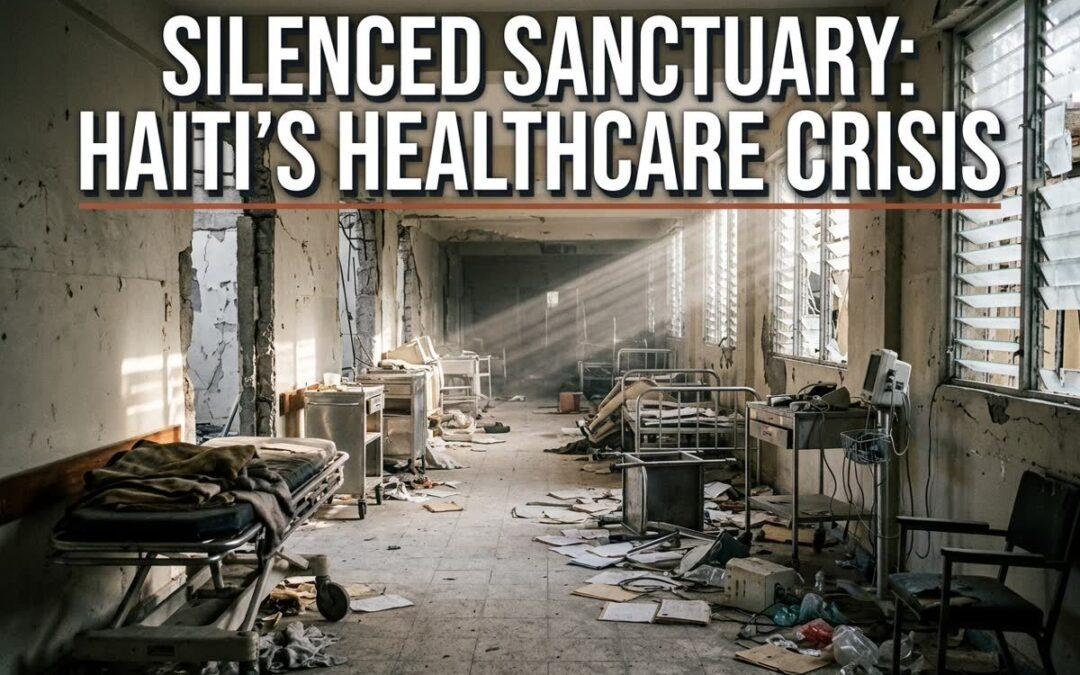
When journalists secured armed escorts to enter the Hospital of the State University of Haiti in late November, they uncovered a scene of structural ruin (miamiherald.com, miamiherald.com). Known historically as the Haiti General Hospital, this civic pillar once delivered medical care to thousands of working-class residents every day (wiredja.com, haitilibre.com). Today, its clinical corridors are silent, abandoned, and filled with physical debris (miamiherald.com, pbs.org). Spent rifle cartridges litter the pediatric wards, while sniper ports remain cut into patient room partitions (miamiherald.com, miamiherald.com).
The facility stands near the National Palace in downtown Port-au-Prince (miamiherald.com, apnews.com). Over the past year, armed federations transformed this center of healing into an urban fortress (miamiherald.com, ap.org). Diagnostic monitors were shattered, backup electrical systems were stripped, and medical records were set on fire (miamiherald.com, miamiherald.com). The fall of this flagship institution did not occur in isolation. It represents the culmination of a century marked by external military intervention, structural disinvestment, and state fragmentation (researchgate.net, afsa.org, cfr.org).
US occupation Haiti public health and Colonial Foundations
The physical footprint of the modern General Hospital originated during the American military occupation of Haiti between 1915 and 1934 (researchgate.net, afsa.org). Following the 1915 military invasion, United States authorities took direct control over Haitian government treasuries, infrastructure, and public works (afsa.org). American administrators organized the Service National d’Hygiène Publique under the command of United States Navy and Marine medical officers (researchgate.net). This occupation force established the hospital in downtown Port-au-Prince to centralize clinical practice and train medical students at the State University (researchgate.net, nih.gov).
This early modernization effort mirrored broader imperial practices throughout the Caribbean (researchgate.net, afsa.org). Colonial administrators prioritized disease eradication to protect commercial shipping ports and military detachments (researchgate.net, nih.gov). Much like earlier Haitian Revolution battles over national sovereignty, external control disrupted organic local governance. Foreign naval authorities centralized administration rather than fostering sustainable domestic institutional leadership (researchgate.net, afsa.org). Medical training mirrored racial hierarchies, reflecting patterns seen in the historical history of medical exploitation across the African diaspora.
When United States forces departed in 1934, they left behind a centralized public healthcare model that relied heavily on foreign capital and external logistics (researchgate.net, afsa.org). The General Hospital remained the sole public safety net for impoverished families who could not afford private fees (wiredja.com, haitilibre.com). For decades, its guiding principle was direct and uncompromising: the institution existed to serve the poor (wiredja.com). At its operational peak, the complex held up to 800 inpatient beds (wiredja.com, haitilibre.com). It handled between 1,000 and 1,500 patient visits each day, delivering specialized surgery, emergency trauma care, and maternity services (wiredja.com, haitilibre.com).
HUEH hospital reconstruction failure After the 2010 Quake
On January 12, 2010, a catastrophic magnitude-7.0 earthquake struck Port-au-Prince, leveling state infrastructure across the capital city (nih.gov, paho.org). The General Hospital suffered immediate and catastrophic structural destruction (wiredja.com, nih.gov). More than half of its historic clinical pavilions collapsed, crushing internal medicine, pediatrics, and surgical suites (wiredja.com, haitilibre.com). In the days following the disaster, medical teams treated thousands of critically injured survivors on the open lawn under plastic tarps (wiredja.com, apnews.com).
In response, international donors pledged an ambitious reconstruction program (wiredja.com, haitilibre.com). The Interim Haiti Recovery Commission approved a tripartite agreement backed by France through the French Development Agency, the United States through USAID, and the Haitian government (wiredja.com, haitilibre.com). Donors committed more than $83 million to construct a state-of-the-art, seismic-resistant, 534-bed teaching hospital (wiredja.com, haitilibre.com). Officials scheduled the complex to reopen by 2017 (wiredja.com, haitilibre.com).
HUEH Operational Capacity Collapse
That ambitious timeline quickly dissolved into bureaucratic paralysis (wiredja.com, haitilibre.com). The project encountered repeated disputes with international contractors, administrative gridlock, and funding lapses for electrical substations and interior fittings (wiredja.com, haitilibre.com). Even before armed fighters entered the grounds, clinical residents mounted regular strikes over unpaid salaries and acute shortages of running water, oxygen, and gauze (wiredja.com, nih.gov). By late 2023, modern concrete buildings stood finished, but they remained empty, uncommissioned, and unprotected (miamiherald.com, wiredja.com).
Viv Ansanm gang coalition and Institutional Collapse
The vacuum that enabled armed groups to seize public facilities developed across decades of political manipulation (humanrightsresearch.org, cfr.org). Political candidates and commercial elites routinely armed neighborhood crews to control voting districts, break commercial strikes, and intimidate rivals (humanrightsresearch.org, cfr.org). This institutional dynamic illustrates the dangers of fragmented state-centered political power when central authority fractures completely. Over time, these local groups extracted independent wealth through extortion networks, kidnappings, and terminal container seizures (humanrightsresearch.org, cfr.org).
The July 2021 assassination of President Jovenel Moïse shattered the remaining constitutional order (humanrightsresearch.org, cfr.org). When legislative mandates expired in January 2023, Haiti was left without a single elected official in public office (humanrightsresearch.org, cfr.org). Armed groups consolidated territory with near total impunity (humanrightsresearch.org, cfr.org). On February 29, 2024, rival downtown factions formed a unified front known as Viv Ansanm, meaning “Living Together” (miamiherald.com, apnews.com).
“The coalition launched synchronized attacks across Port-au-Prince, overrunning central police stations, releasing thousands from the National Penitentiary, and laying siege to ministries around Champ de Mars.”
Source: (apnews.com)
Because the General Hospital occupied a commanding position directly opposite the National Palace, Viv Ansanm targeted the complex as a key military asset (miamiherald.com, apnews.com). Doctors, nurses, and acute care patients evacuated under heavy gunfire (miamiherald.com, pbs.org). Armed fighters breached the compound gates and turned the empty hospital into an operational headquarters (miamiherald.com, miamiherald.com).
Port-au-Prince hospital gang occupation and Tactical Siege
Between March and November 2024, the medical center served as an armed redoubt (miamiherald.com, miamiherald.com). Viv Ansanm fighters exploited the reinforced concrete construction funded by French and American taxpayers (miamiherald.com, wiredja.com). Multi-story patient wards provided commanding fields of fire across commercial corridors, downtown avenues, and government administrative plazas (miamiherald.com, miamiherald.com). Snipers constructed sandbag parapets inside consultation suites, knocking holes through drywall to target approaching law enforcement units (miamiherald.com, miamiherald.com).
Systematic looting accompanied the tactical occupation (miamiherald.com, miamiherald.com). Fighters dismantled newly installed commercial electrical conduits, cut copper plumbing lines, and carried away backup diesel generators (miamiherald.com, miamiherald.com). Operating theaters were broken open, and diagnostic machinery was stripped for scrap or black-market resale (miamiherald.com, miamiherald.com). Similar assaults devastated nearby facilities, including Saint-François de Sales Hospital, eliminating institutional healthcare throughout lower downtown (miamiherald.com, gazettehaiti.com).
Tragedy escalated on Christmas Eve in December 2024 when health officials attempted an unannounced administrative reopening (theguardian.com, cpj.org). An invited press contingent gathered at the facility to document the handover (theguardian.com, cpj.org). Gunmen ambushed the gathering with automatic rifle fire (theguardian.com, cpj.org). The attack claimed the lives of journalists Jimmy Jean and Marckendy Natoux, as well as an accompanying police officer (theguardian.com, cpj.org). Seven other reporters suffered severe gunshot wounds (theguardian.com, cpj.org). Coalition leadership released video statements asserting that the state had no authorization to operate in their security zone (miamiherald.com, youtube.com).
Haiti police MSS mission and Security Limitations
The primary domestic force countering this violence is the Police Nationale d’Haïti (PNH) (pbs.org, arcamax.com). Severely outgunned and depleted by resignations, the national police force struggled to secure government compounds (pbs.org, cfr.org). In October 2023, the United Nations Security Council passed Resolution 2699, authorizing the Multinational Security Support (MSS) mission (arcamax.com, cfr.org). Unlike formal United Nations peacekeeping deployments staffed by blue helmets, the MSS operates as an ad-hoc international coalition led by Kenya (arcamax.com, cfr.org).
Kenyan police officers arrived in Port-au-Prince in June 2024 alongside smaller contingents from Jamaica, Belize, and the Bahamas (arcamax.com, ap.org). The United States government financed and facilitated the mission, contributing over $300 million for armored vehicles, tactical bases, and communications hardware (arcamax.com, cfr.org). Although joint PNH and MSS patrols conducted clearing sweeps around the General Hospital perimeter in July 2024, they lacked the manpower to establish permanent security garrisons (pbs.org, arcamax.com).
| Security Element | Organizational Mandate | Primary Backing & Resources |
|---|---|---|
| PNH (Police Nationale d’Haïti) | Sole domestic civilian law enforcement agency | State budget; severely depleted officer corps (pbs.org) |
| MSS Mission (Multinational Support) | UN-authorized mission to reinforce state police and secure strategic infrastructure | Kenyan leadership; over $300M in US logistics and voluntary trust funds (arcamax.com, cfr.org) |
| Viv Ansanm (Gang Alliance) | Armed coalition commanding urban districts and logistics corridors | Illicit weapons trafficking; territorial extortion and customs control (humanrightsresearch.org, cfr.org) |
Consequently, the downtown core remains a contested combat perimeter (miamiherald.com, pbs.org). Tactical sweeps clear street corners temporarily, but armed units reoccupy buildings as soon as patrol columns withdraw (miamiherald.com, arcamax.com). Because security forces cannot hold fixed defensive positions inside the red zone, engineers cannot assess reconstruction damage, let alone restore municipal power (miamiherald.com, miamiherald.com).
Human Toll of the Haiti healthcare system collapse
The shuttering of HUEH stripped lower-income families of emergency healthcare (miamiherald.com, paho.org). Wealthier residents access private clinics or fly abroad for treatment, but over 80 percent of the metropolitan population relies strictly on public clinics (wiredja.com, paho.org). Currently, between 70 and 80 percent of health centers across Port-au-Prince stand closed or severely impaired by violence (paho.org, paho.org). Nongovernmental facilities operated by Doctors Without Borders remain strained well past emergency limits, frequently dodging stray bullets (miamiherald.com, theguardian.com).
Working-class patients facing vehicular trauma, gunshot wounds, difficult childbirths, or acute infections find closed gates everywhere they turn (miamiherald.com, paho.org). Preventable health complications turn fatal when oxygen and surgical intervention remain unavailable (miamiherald.com, nih.gov). Over 700,000 Haitians have experienced internal displacement, living in makeshift camps across public squares with minimal sanitation (paho.org, cfr.org). The resulting public health crisis has triggered cholera resurgences and widespread chronic malnutrition (paho.org, paho.org).
Daily Consultations at General Hospital
The destruction of the General Hospital also halted medical training across the nation (miamiherald.com, researchgate.net). As the primary teaching hospital for the State University of Haiti, HUEH trained the country’s doctors, surgeons, nurses, and laboratory technicians (researchgate.net, nih.gov). With the complex shuttered, clinical residency programs have been suspended entirely (miamiherald.com, researchgate.net). Medical students in clean white coats have staged street demonstrations, warning that a generation of clinical practitioners is losing its education (miamiherald.com, youtube.com). This collapse accelerates the flight of trained personnel, leaving national medical infrastructure without a future workforce (miamiherald.com, paho.org).
Recognizing that returning to the downtown campus is impossible under current conditions, the Ministry of Public Health and Population has explored relocating emergency units to alternate sites on Avenue Martin Luther King (miamiherald.com, vantbefinfo.com). Yet makeshift clinics cannot replace the diagnostic reach of an 800-bed hospital complex (wiredja.com, haitilibre.com). The physical ruin of the General Hospital stands as a sobering monument to failed state protections and fragmented international development (miamiherald.com, wiredja.com). Until durable public security returns to Port-au-Prince, millions of vulnerable Haitians will remain cut off from basic healthcare (miamiherald.com, paho.org).
About the Author
Darius Spearman is a professor of Black Studies at San Diego City College, where he has been teaching for over 20 years. He is the founder of African Elements, a media platform dedicated to providing educational resources on the history and culture of the African diaspora. Through his work, Spearman aims to empower and educate by bringing historical context to contemporary issues affecting the Black community.
