
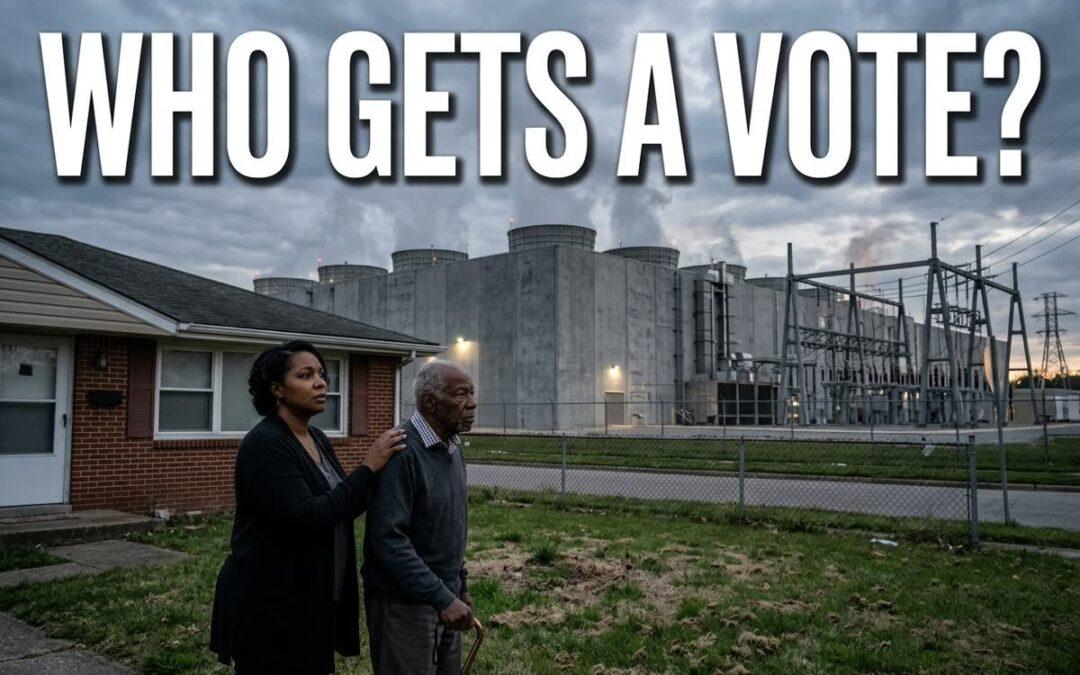


Data Center Environmental Racism: Why Only Some Get a Vote
By Darius Spearman (africanelements)
Support African Elements at patreon.com/africanelements and hear recent news in a single playlist. Additionally, you can gain early access to ad-free video content.
An investigation published in late November reveals a stark racial divide in how the artificial intelligence infrastructure boom expands across the United States. While more than 40 jurisdictions nationwide allowed residents to cast ballots on proposed data center campuses, energy-heavy facilities are routinely directed into lower-income, majority-Black neighborhoods without resident input. Data center environmental racism has emerged as a direct continuation of historical land-use patterns that treat marginalized communities as sacrifice zones for technological advancement (capitalbnews.org, capitalbnews.org).
Technology corporations market hyperscale data centers as clean, quiet developments that power cloud services and machine learning models. The reality on the ground presents an entirely different picture. These computing hubs consume city-sized amounts of electricity, draw millions of gallons of public water daily, and operate massive banks of diesel generators and gas turbines that emit continuous pollution. When communities can vote, they overwhelmingly reject these projects. When corporations enter Black neighborhoods, the ballot box is removed from the equation entirely (capitalbnews.org, capitalbnews.org).
This dynamic illustrates how traditional patterns of racial disenfranchisement adapt to modern economic pressures. The historical record shows that when white municipalities secure political autonomy, Black communities are left to manage the industrial runoff. Understanding this modern reality requires examining the intersection of voting access, industrial zoning, and civil rights law that has shaped American development for a century (americanbar.org, harvard.edu).
Demographics and Democracy: Data Center Ballot Measures
The gap between who decides and who suffers is evident in recent electoral data. In more than 40 jurisdictions across ten states, including Ohio, Wisconsin, Florida, and California, local voters decided on data center ballot measures during municipal elections. These voting jurisdictions had an average population that was over 83 percent white and less than 5 percent Black. When given the power to decide, residents in 40 out of 41 local elections voted to restrict, delay, or ban data center developments (capitalbnews.org, capitalbnews.org).

African Elements Press • Sociology & Black Family Studies
Legacy of Survival: The Dynamics of the Black Family
By Professor A. Darius Spearman • 284 Pages • ISBN: 979-8-9924836-0-4
For decades, mainstream sociology framed the Black family as a crisis to be diagnosed rather than a resilient institution to be understood. Legacy of Survival dismantles those deficit narratives—tracing the extended kinship networks, matriarchal anchors, paternal struggles, and psychological survival strategies that carried Black households from the transatlantic rupture to the modern era.
By contrast, majority-Black towns across Georgia, Mississippi, Tennessee, and the Carolinas rarely see these proposals reach a public ballot. Siting decisions in these areas are handled through appointed industrial boards and municipal development authorities. Local officials frequently sign strict non-disclosure agreements with technology firms before the public is informed. The resulting decisions bypass voter input, allowing facilities to obtain zoning variances and construction permits without town halls or resident votes (capitalbnews.org, capitalbnews.org).
Research from Harvard University underscores how procedural rights alter local outcomes. According to the Harvard Zoned Out study, proposed data center projects are rejected 66 percent of the time when public hearings are mandatory. When public hearings are omitted, local governing bodies approve these developments 80 percent of the time. The ability to access direct democracy remains the primary barrier preventing heavy industrial encroachment into residential neighborhoods (harvard.edu).
Data Center Siting Demographics and Ballot Access
Expulsive Zoning and Redlining as Siting Blueprints
Modern disparities in facility placement did not appear overnight. They are built upon early twentieth-century practices of expulsive zoning and redlining. During the 1930s, the federal Home Owners’ Loan Corporation produced maps that categorized Black and integrated neighborhoods as high-risk, shading them in red. While private banks used these maps to withhold mortgage loans, municipal zoning boards engaged in expulsive zoning to alter the legal character of those same neighborhoods (harvard.edu, umich.edu).
Expulsive zoning operated by changing the designation of residential Black enclaves into industrial or commercial zones. White residential subdivisions were safeguarded by strict single-family covenants, while Black neighborhoods were rezoned to accommodate scrap yards, sewage plants, incinerators, and chemical depots. These historical practices reflect the broader mechanisms of anti-Black politics that have systematically shaped local land value and disenfranchised communities of color for generations (nih.gov, harvard.edu).
In 1979, this institutional practice faced its first major legal test in Houston, Texas. In the landmark case Bean v. Southwestern Waste Management Corp., residents of Northwood Manor challenged the placement of a municipal landfill next to their public high school. Sociologist Dr. Robert D. Bullard conducted research for the lawsuit and documented that more than 80 percent of Houston’s solid waste sites were placed in Black neighborhoods, even though Black residents comprised only 25 percent of the city population (umich.edu).
“The siting of hazardous waste facilities in minority communities is not an accident. It is a systematic process driven by public policies that protect affluent areas while targeting the path of least political resistance.”
— Dr. Robert D. Bullard, Source: (umich.edu)
Although the federal court acknowledged the severe racial disparity in Bean, the plaintiffs lost the case because federal civil rights law required proof of deliberate, intentional discrimination. The legal system shielded administrative boards that cited cheap real estate and pre-existing industrial zoning as neutral business justifications. Those justifications directly mirrored the structural disadvantages codified decades earlier by municipal planning departments (umich.edu).
Warren County Environmental Racism and the Birth of a Movement
The national struggle against discriminatory industrial placement gained widespread attention in 1982 in Warren County, North Carolina. The state government chose the small, rural community of Afton as the dumping ground for 60,000 tons of soil contaminated with toxic polychlorinated biphenyls, commonly known as PCBs. Afton was over 65 percent Black and had one of the lowest median household incomes in the state (capitalbnews.org, umich.edu).
Local residents recognized that their soil and shallow water table were poorly suited for a toxic chemical landfill. Led by local organizers, the United Church of Christ Commission for Racial Justice, and the Southern Christian Leadership Conference, residents staged six weeks of nonviolent direct action. Demonstrators lay down in roadways to block dump trucks from reaching the site, resulting in more than 500 arrests. The Warren County environmental racism protests marked the first time civil rights direct action converged with ecological preservation, giving rise to the modern environmental justice movement (nationalgeographic.com, umich.edu).
During the Warren County demonstrations, civil rights leader Dr. Benjamin Chavis coined the term environmental racism to describe the deliberate targeting of nonwhite neighborhoods for hazardous facilities. The events in North Carolina prompted the United States General Accounting Office to conduct a regional investigation in 1983. The federal study found that in the southeastern states, three out of every four hazardous commercial waste facilities were situated in predominantly Black communities, despite Black residents making up only 20 percent of the regional population (nationalgeographic.com, usccr.gov).
Four years later, the United Church of Christ published its landmark report, Toxic Wastes and Race in the United States. The national study concluded that race was the single most reliable predictor of where commercial toxic waste facilities were sited across the country. Race was a more decisive factor than household income, home values, or local educational attainment. A 1984 consulting report produced by Cerrell Associates for the state of California made the underlying logic explicit: it advised developers to place unwanted facilities in low-income, rural areas with lower education levels because those populations possessed fewer resources to mount sustained legal challenges (umich.edu, uwosh.edu).
Municipal Underbounding Land Use and Excluded Communities
To understand why white suburban towns hold binding ballot measures while neighboring Black communities are shut out of the process, one must examine municipal underbounding land use. Municipal underbounding describes a deliberate annexation tactic where white city leaders draw incorporated town boundaries to include newly developed white subdivisions while intentionally bypassing older, historic Black communities situated just outside city limits (jhu.edu, nih.gov).
This selective drawing of boundaries has produced lasting structural inequities. Incorporated municipalities operate under home-rule charters that grant registered voters the legal power to petition for direct ballot referendums. By contrast, underbounded Black enclaves remain unincorporated county territory. They are denied municipal services, lack direct representation on city councils, and possess no statutory mechanism to initiate citizen-led ballot referendums (jhu.edu, nih.gov).
The historical denial of political agency echoes past structural barriers to elusive constitutional freedoms that Black Americans have navigated since Reconstruction. When tech developers approach a region, county commissioners and appointed development authorities hold exclusive jurisdiction over unincorporated zones. These unelected or countywide boards exercise unilateral authority to grant zoning variances, approve water connections, and sign property tax abatements without direct accountability to the neighborhood residents who bear the physical burdens of the facilities (capitalbnews.org, goodjobsfirst.org).
| Governance Characteristic | Incorporated Suburbs (Majority-White) | Unincorporated Enclaves (Majority-Black) |
|---|---|---|
| Primary Siting Authority | Elected City Councils & Citizen Petitions | Appointed Development Authorities |
| Direct Ballot Mechanisms | Available through Home-Rule Charters | No Statutory Referendum Access |
| Public Notice Mandates | Strict Statutory Public Hearing Laws | Administrative Approvals & NDAs |
| Local Economic Benefits | Community Benefit Agreements & Taxes | Sweeping Multi-Decade Tax Abatements |
The impact of this jurisdictional exclusion is starkly visible in North Carolina. In an affluent, 65 percent white township, organized community resistance gathered thousands of petition signatures, prompting a hyperscale data center developer to abandon its plans. Weeks later, that same developer submitted an application in an adjacent county, targeting an unincorporated, majority-Black community where median household incomes were one-third of the initial site. County commissioners approved the rezoning on a 6-1 vote without open public hearings (capitalbnews.org, capitalbnews.org).
AI Data Center Pollution and Frontline Health Burdens
While industry marketing frames artificial intelligence as weightless software code, hyperscale server campuses are heavy industrial facilities. AI data center pollution imposes substantial air, water, and acoustic burdens on adjacent residential neighborhoods. Because AI computation requires immense electrical loads, data centers place unprecedented demands on local power grids and water supplies (nrdc.org, canarymedia.com).
A prime example of this industrial impact exists in South Memphis, Tennessee. The historic Black community of Boxtown was established in the 1860s by formerly enslaved people who built residences from discarded freight boxcars. Today, Boxtown is bordered by Elon Musk’s artificial intelligence startup, xAI, which established a massive supercomputer cluster known as Colossus. The facility installed at least 27 methane gas turbines without standard pre-construction Clean Air Act permitting to meet its massive electricity demands (apnews.com, wpln.org).
Boxtown residents already face cancer risks four times higher than the national average due to decades of exposure to nearby petrochemical plants, refineries, and interstate freight corridors. The operational turbines add hundreds of tons of nitrogen oxides and fine particulate matter (PM2.5) into the local air basin each year. In Augusta, Georgia, resident Zakiya Mabery discovered that a 200-acre hyperscale campus known as Project Eisenhower was approved a ten-minute walk from her home in Hayne’s Station, a suburban neighborhood where two-thirds of the residents are Black. Commissioners approved the project with zero public hearings (capitalbnews.org, wpln.org).
“They want our power, they want our water, and they leave us with the noise, the air pollution, and the bill.”
Source: (capitalbnews.org)
The health consequences of these facilities extend beyond air emissions. Hyperscale campuses require massive chillers and thousands of high-velocity computer fans that emit constant, low-frequency acoustic vibrations 24 hours a day. Medical research associates chronic sub-bass noise exposure with sleep disruption, elevated stress hormones, and increased risk of cardiovascular disease. The unconsented exposure of Black communities to localized physical harm continues a documented pattern seen across American medical and industrial history (capitalbnews.org, nrdc.org).
The financial burdens are equally severe. A 2025 study from Cornell University revealed that data centers paid approximately 35 percent of the electrical grid upgrade costs required to support their operations. The remaining 65 percent was shifted onto residential utility customers through increased monthly electricity rates. An NAACP survey across seven states revealed that 52 percent of Black households expect significant electricity bill increases directly connected to commercial data center expansion (capitalbnews.org, naacp.org).
Electric Grid Upgrade Cost Distribution (Cornell Study)
Title VI Environmental Discrimination and Legal Resistance
As communities face the physical reality of these projects, legal advocates are developing new strategies to challenge discriminatory industrial approvals. Siting challenges frequently invoke Title VI environmental discrimination protections under the Civil Rights Act of 1964. Section 601 of Title VI prohibits discrimination on the basis of race, color, or national origin in any program receiving federal financial assistance (americanbar.org, usccr.gov).
Mounting a courtroom challenge under Title VI presents significant legal hurdles. In the 2001 Supreme Court decision Alexander v. Sandoval, the court ruled that private individuals cannot bring lawsuits in federal court based on disparate impact regulations alone. Private plaintiffs must prove intentional racial discrimination, an exceptionally high legal standard. To work within these constraints, environmental justice attorneys rely on the Arlington Heights legal framework, pointing to sudden departures from standard administrative procedures, unannounced zoning meetings, and predictable racially disparate outcomes as circumstantial proof of unlawful discrimination (americanbar.org, usccr.gov).
Advocates also utilize administrative complaints under Section 602 of Title VI. Under Section 602, federal agencies like the Environmental Protection Agency maintain the authority to investigate whether recipients of federal grants—such as state departments of environmental quality—utilize policies that cause discriminatory disparate impacts. If a violation is substantiated, the federal government possesses the power to withhold infrastructure funding until corrective actions are taken (americanbar.org, usccr.gov).
Grassroots organizations are concurrently pursuing community-led economic remedies. Coalitions are demanding binding Community Benefit Agreements, which are enforceable private contracts negotiated directly between developers and community coalitions. Unlike state-granted tax abatements that eliminate corporate tax contributions and drain public school funding, these agreements guarantee mandatory local hiring goals, environmental mitigation funds, and transparent air quality monitoring (goodjobsfirst.org, naacp.org).
The national pushback has expanded through initiatives like the NAACP Center for Environmental and Climate Justice “Stop Dirty Data Centers” campaign. Partnering with organizations such as Young, Gifted & Green, civil rights groups developed public dashboards tracking over 2,700 operating, planned, and under-construction computing hubs nationwide. These digital tools document project footprints, local electrical consumption, and municipal zoning transparency. The modern data center boom proves that technological innovation does not automatically yield equitable development. When democratic participation is granted along racial lines, the administrative state continues to mirror twentieth-century patterns of environmental inequality (capitalbnews.org, naacp.org).
About the Author
Darius Spearman is a professor of Black Studies at San Diego City College, where he has been teaching for over 20 years. He is the founder of African Elements, a media platform dedicated to providing educational resources on the history and culture of the African diaspora. Through his work, Spearman aims to empower and educate by bringing historical context to contemporary issues affecting the Black community.
