
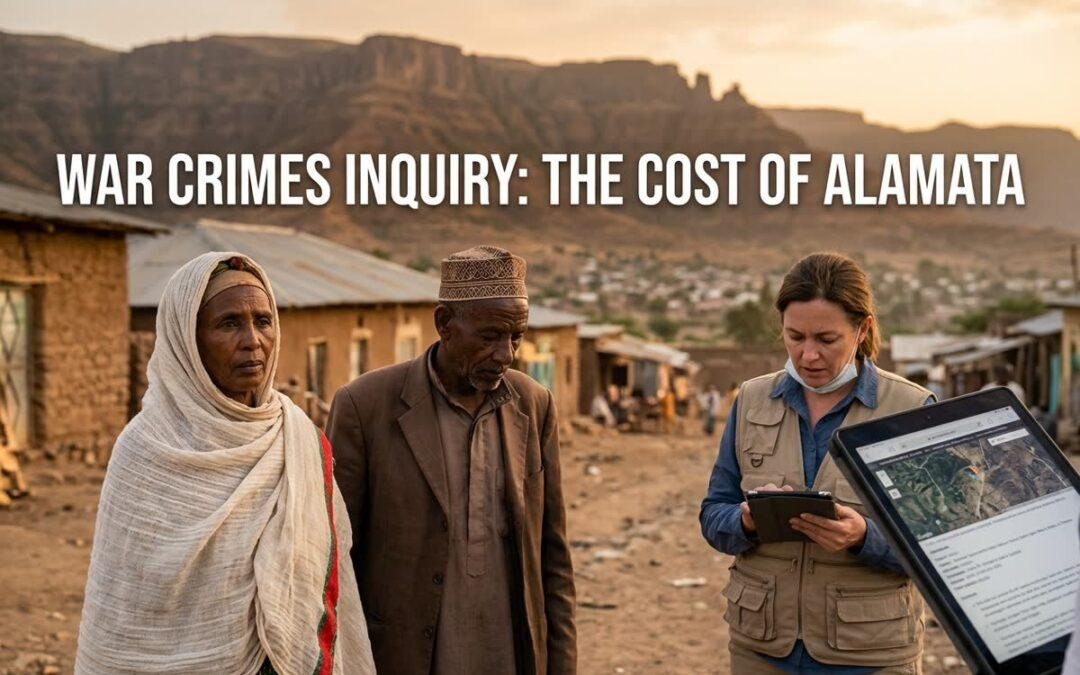

Tigray War Crimes Investigation: Why Alamata Was Shelled
By Darius Spearman (africanelements)
Support African Elements at patreon.com/africanelements and hear recent news in a single playlist. Additionally, you can gain early access to ad-free video content.
On November 24, Amnesty International released a detailed investigative report urging an independent international war crimes inquiry into deadly military assaults in northern Ethiopia (amnesty.org). Between September 26 and September 28, the Ethiopian National Defense Force and an allied militia known as the Tigray Peace Forces bombarded residential neighborhoods in the southern Tigray city of Alamata with heavy artillery (amnesty.org). The barrage struck apartment complexes, private dwellings, and public streets, leaving at least 14 verified civilians dead, including three children, and injuring dozens of others (amnesty.org, amnesty.org).
This assault was not an unexpected outbreak of violence. Instead, it represents the latest chapter in a long history of unresolved borders, broken treaties, and state-sanctioned impunity (amnesty.org, acleddata.com). Understanding why Alamata became a target requires examining the deeper history behind the headlines. When the formal fighting of the 2020 to 2022 northern Ethiopia conflict subsided, the core structural disputes that triggered that devastation remained completely unsettled (acleddata.com, cfr.org). As regional tensions resurfaced, urban civilians once again bore the cost of state power struggles, reflecting patterns of political exclusion explored in studies of anti-Black politics and institutional violence.

African History Series • Volume II • Anti-Colonial Resistance & Sovereignty
Africa Reclaimed: Overcoming the Legacies of the Colonial Machine
By Professor A. Darius Spearman • 353 Pages • ISBN: 979-8-9924836-4-2
Colonialism in Africa was never passively endured—and its extractive machinery did not simply vanish when independence flags were raised. Professor A. Darius Spearman traces the unbroken arc of African political power from 19th-century indigenous statecraft and mid-20th-century liberation wars to contemporary battles against neo-colonial debt and resource imperialism.
Historical Origins: The Raya Alamata Territorial Dispute
The strategic city of Alamata sits on the fertile Raya plain within the Southern Zone of the Tigray Regional State (acleddata.com, wikipedia.org). For decades, this land has stood at the center of fierce political and cultural disagreements (acleddata.com). In 1991, the Ethiopian People’s Revolutionary Democratic Front, a coalition dominated by the Tigray People’s Liberation Front, overthrew the Derg military junta and established a system of ethnic federalism across Ethiopia (wikipedia.org, wikipedia.org). When regional boundaries were redrawn along linguistic lines in the early 1990s, the Raya plain, including Alamata, was formally incorporated into the Tigray Region (wikipedia.org, wikipedia.org).
This administrative reorganization triggered deep resentment among Amhara political organizations and local nationalist movements (acleddata.com, borkena.com). These groups maintained that Raya, alongside Welkait in Western Tigray, was historically part of Amhara territory that had been annexed without democratic consent (acleddata.com, wikipedia.org). For nearly three decades, these grievances were suppressed under the strong central control of the federal government (wikipedia.org, wikipedia.org). However, when Prime Minister Abiy Ahmed assumed office in 2018 and the Tigray People’s Liberation Front lost its dominance over federal institutions, these dormant boundary disputes erupted into armed confrontation (cfr.org, wikipedia.org).
Under Article 48 of the 1995 Ethiopian Constitution, territorial disputes between regional states must follow a specific legal process (wikipedia.org). The law requires opposing regional administrations to resolve disputes by mutual agreement (wikipedia.org). If negotiations fail within two years, the House of Federation is mandated to intervene and organize a local referendum based on demographic settlement patterns (wikipedia.org). However, this constitutional remedy collapsed completely in Southern Tigray (acleddata.com, wikipedia.org). The devastating 2020 to 2022 war triggered mass expulsions and demographic changes that made an impartial vote virtually impossible (acleddata.com, hrw.org). Tigrayan officials demanded the full return of displaced residents before any referendum, while Amhara authorities insisted on maintaining their administrative control, creating a permanent impasse that rival forces routinely attempt to resolve through artillery strikes (addisstandard.com, acleddata.com).
Timeline of Control: Alamata Administrative Shifting
Broken Ceasefires and the Pretoria Agreement Tigray
Between November 2020 and November 2022, northern Ethiopia endured one of the deadliest armed conflicts of the twenty-first century (washingtonpost.com, cfr.org). An estimated 600,000 people died from combat, starvation, and the collapse of essential medical infrastructure (washingtonpost.com). The federal military, reinforced by Amhara regional forces, local Fano militias, and Eritrean troops, captured Alamata during the opening weeks of that war (acleddata.com, wikipedia.org). Thousands of Tigrayan residents were forcibly displaced from the Southern and Western zones, altering communities that had lived together for generations (acleddata.com, hrw.org).
In November 2022, the federal government and the Tigray People’s Liberation Front signed the African Union-brokered Cessation of Hostilities Agreement in Pretoria, South Africa (cfr.org, africanews.com). This pact formally halted nationwide combat operations, restored basic telecommunications, and allowed humanitarian aid convoys into Mekelle (cfr.org). However, like many unresolved post-war settlements seen throughout history, the treaty deferred difficult territorial and political realities rather than solving them (acleddata.com, cfr.org).
Crucially, the Pretoria Agreement failed to resolve the administrative fate of Raya Alamata and Western Tigray (acleddata.com, cfr.org). The document offered vague phrasing, directing that contested territories be settled according to the federal constitution while displaced civilians returned home peacefully (wikipedia.org, cfr.org). Yet federal authorities never established an independent boundary commission or an enforceable timeline for local governance (acleddata.com). Because political promises were never matched by institutional accountability, both sides continued to view military power as their only realistic method for securing land (addisstandard.com, acleddata.com).
Fractured Alliances and the ENDF Tigray Peace Forces Offensive
The years following the Pretoria pact did not produce stable peace; instead, they created political fragmentation across northern Ethiopia (acleddata.com, borkena.com). In early 2023, the federal government attempted to disarm and dismantle regional special forces across all states (acleddata.com). This policy provoked a widespread rebellion across the Amhara Region by Fano militias, who feared that the federal state would return contested borderlands to Tigrayan administration (acleddata.com, borkena.com). As former allies fought each other in the Amhara hills, new political fractures divided the leadership of Tigray (addisstandard.com, borkena.com).
Internal disputes weakened the Tigray Interim Regional Administration and fractured the military leadership of the Tigray Defense Forces (addisstandard.com, borkena.com). Out of this division arose the Tigray Peace Forces, also known locally as Hara Meret (amnesty.org, addisstandard.com). Composed largely of dissident former Tigrayan fighters who opposed the central leadership in Mekelle, this armed faction formed an operational alliance with the Ethiopian National Defense Force (amnesty.org, addisstandard.com). These shifting loyalties mirror the conflicting nationalist ideologies that have historically fractured anti-colonial and liberation movements across Africa and the diaspora.
Prior to late September 2026, the Tigray People’s Liberation Front maintained direct military and civil authority in Alamata (amnesty.org, addisstandard.com). Tigrayan forces had re-entered the city in early 2026 after federal troops withdrew their command outpost from the area (addisstandard.com). The joint offensive launched on September 26 by the Ethiopian military and the Tigray Peace Forces was specifically designed to drive Tigrayan administrators and troops out of Alamata (amnesty.org, addisstandard.com). By September 28, the federal coalition had captured the town, but they achieved that military victory by firing heavy explosive ordnance directly into crowded residential neighborhoods (amnesty.org, amnesty.org).
Alamata Shelling: Verified Civilian Casualties
Urban Devastation: Alamata Artillery Strikes and Kebele 04
The artillery bombardment began on September 26, sending explosive fragmentation through neighborhoods packed with approximately 80,000 residents (amnesty.org, wikipedia.org). Over three days of intense shelling, four separate strikes hit populated civilian areas (amnesty.org). Amnesty International’s Crisis Evidence Lab corroborated these attacks by analyzing satellite imagery, verified video footage, photographs of weapon fragments, and testimony from 28 witnesses and medical personnel (amnesty.org, amnesty.org).
The deadliest single incident took place at dawn on September 27 in the Kebele 04 neighborhood (amnesty.org, amnesty.org). Artillery rounds detonated directly inside residential condominium blocks, killing seven civilians and wounding four others (amnesty.org). The victims included 26-year-old Meron Sewasew, her eight-year-old son Markon Girmahiwot, and her 33-year-old brother Tewekel Sewasew (amnesty.org). A second artillery blast struck a neighboring apartment, killing 40-year-old Kumhis Kahsay and her 14-year-old child alongside two other family members (amnesty.org). Staff at the Alamata General Hospital reported receiving dozens of casualties who were suffering from severe puncture wounds and traumatic amputations caused by jagged metallic shrapnel (amnesty.org).
“Indiscriminate attacks violate the rules of international humanitarian law, and these strikes must be investigated as war crimes.”
— Yasmine Ahmed, Senior Director for Regional Human Rights Impact at Amnesty International, Source: (amnesty.org)
Under international humanitarian law, fighting forces must observe the principles of distinction, precaution, and proportionality (amnesty.org, amnesty.org). Deploying unguided, wide-area explosive weapons into compact residential zones violates these foundational legal standards (amnesty.org). Even when military opponents are active in an urban center, an attacking force is never legally permitted to treat an entire civilian neighborhood as an open target (amnesty.org, hrw.org).
Battlefield Tactics and TPLF Civilian Endangerment Allegations
Amnesty International’s field investigation also examined the military conduct of the Tigray People’s Liberation Front during the three-day battle (amnesty.org). The report established that Tigrayan forces placed armed checkpoints, military vehicles, and troop quarters directly inside residential neighborhoods and near public schools across Alamata (amnesty.org, amnesty.org). By establishing operational hubs within civilian infrastructure, Tigrayan commanders failed to meet their legal duty under the Geneva Conventions to remove non-combatants from the vicinity of military targets (amnesty.org, amnesty.org).
This tactic severely increased the danger to local families, turning residential communities into active war zones (amnesty.org). However, international human rights monitors emphasized that the defensive party’s violations do not cancel the legal duties of the attacker (amnesty.org). Under established legal standards, the presence of opposing soldiers among civilians does not relieve armed forces of their obligation to avoid disproportionate civilian harm (amnesty.org, hrw.org). Both factions disregarded basic safety rules, treating civilian neighborhoods as expendable terrain (amnesty.org).
This recurring disregard for human life reflects long-standing patterns where political leaders use constitutional compromises and legal loopholes to preserve regional authority rather than protect vulnerable populations. When governing authorities subordinate human rights to political survival, civilian communities are forced to endure the consequences without legal protection (amnesty.org, cfr.org).
Impunity by Design: Ethiopian Transitional Justice Accountability
The tragedy in Alamata is the direct result of systematic impunity established during the previous two-year war (amnesty.org, cfr.org). Following the 2022 Pretoria Agreement, the federal government conducted a concerted diplomatic campaign to shield its military officers and regional militias from external legal scrutiny (amnesty.org, cfr.org). Ethiopian diplomats repeatedly asserted national sovereignty and urged the United Nations to adopt an “African solutions to African problems” approach (cfr.org). In response, the European Union chose not to introduce a resolution to renew the mandate of the International Commission of Human Rights Experts on Ethiopia at the United Nations Human Rights Council in late 2023 (amnesty.org, hrw.org).
International observers hoped that dropping multilateral investigations would preserve the fragile peace process and restore diplomatic cooperation with Addis Ababa (cfr.org, hrw.org). In place of international inquiries, the Ethiopian government adopted a domestic Transitional Justice Policy (amnesty.org, addisstandard.com). However, human rights advocates and survivors warn that domestic courts lack institutional independence (amnesty.org, hrw.org). In the years since the 2022 ceasefire, domestic institutions have failed to secure high-ranking convictions for documented massacres, drone strikes on displacement camps, or weaponized starvation (amnesty.org, hrw.org).
This absence of accountability sent a dangerous message to military commanders across the country (amnesty.org). When previous atrocities carry no legal consequences, field commanders operate under the assumption that urban artillery strikes will be ignored by both federal courts and foreign partners (amnesty.org, hrw.org). Consequently, the artillery strikes in Alamata represent the predictable continuation of unpunished state violence (amnesty.org).
Accountability Gap: Atrocity Cases vs Prosecutions
Alamata artillery strikes: The Human Cost of Prolonged Regional Conflict
The human toll of this protracted dispute extends far beyond the physical craters left in Alamata’s streets (amnesty.org, acleddata.com). Across the Raya plain and neighboring districts, repeated rounds of fighting have displaced hundreds of thousands of subsistence farmers and urban workers (acleddata.com, omnatigray.org). Families forced from their homes often spend years in overcrowded temporary shelters without clean water, adequate food rations, or essential health care (omnatigray.org, cfr.org). When combat resurfaced in late 2026, many families who had returned to rebuild their lives were forced to flee for a second or third time (addisstandard.com, acleddata.com).
The economic foundation of Southern Tigray has also been severely damaged (acleddata.com). The Raya valley was historically known as a major agricultural center that supplied teff, sorghum, and vegetables to markets across northern Ethiopia (acleddata.com, wikipedia.org). Continuous militarization, destroyed electrical lines, and unexploded munitions have prevented farmers from cultivating their fields, deepening the regional hunger crisis (acleddata.com, cfr.org). The cycle of violence has effectively transformed a productive agricultural corridor into an unstable military front line (acleddata.com).
| Conflict Phase | Key Armed Actors | Primary Impact on Civilians |
|---|---|---|
| 1991–2018 (EPRDF Rule) | Federal Armed Forces, Regional Police | Simmering territorial resentment; suppressed local protests in Raya and Welkait (wikipedia.org, wikipedia.org). |
| 2020–2022 (Northern War) | ENDF, Amhara Forces, Fano, Eritrean Forces vs. TDF/TPLF | Estimated 600,000 dead; widespread displacement; total communications and aid blockade (washingtonpost.com, hrw.org). |
| 2023–2025 (Post-Pretoria) | ENDF, Fano Militias, Tigray Regional Security | Unresolved borders; new Amhara rebellion; repeated displacement across Raya Alamata (acleddata.com, borkena.com). |
| Late 2026 (Alamata Shelling) | ENDF & Tigray Peace Forces vs. TPLF | At least 14 civilians killed in urban shelling; widespread shrapnel trauma; fresh displacement (amnesty.org, amnesty.org). |
The failure to secure justice for past violations guarantees that ordinary people will continue to suffer the consequences of warfare (amnesty.org). Amnesty International’s urgent call on November 24 demands that the United Nations Human Rights Council establish a credible international investigative mechanism to collect physical evidence, document victim testimonies, and identify commanders responsible for urban shelling (amnesty.org). Without genuine legal accountability, peace agreements will remain superficial political arrangements that fail to protect civilian lives on the ground (amnesty.org, cfr.org).
About the Author
Darius Spearman is a professor of Black Studies at San Diego City College, where he has been teaching for over 20 years. He is the founder of African Elements, a media platform dedicated to providing educational resources on the history and culture of the African diaspora. Through his work, Spearman aims to empower and educate by bringing historical context to contemporary issues affecting the Black community.
