

Are Automated License Plate Readers the New Digital Redlining?
By Darius Spearman (africanelements)
Support African Elements at patreon.com/africanelements and hear recent news in a single playlist. Additionally, you can gain early access to ad-free video content.
The Modern Dragnet: High-Tech Cameras on Every Corner
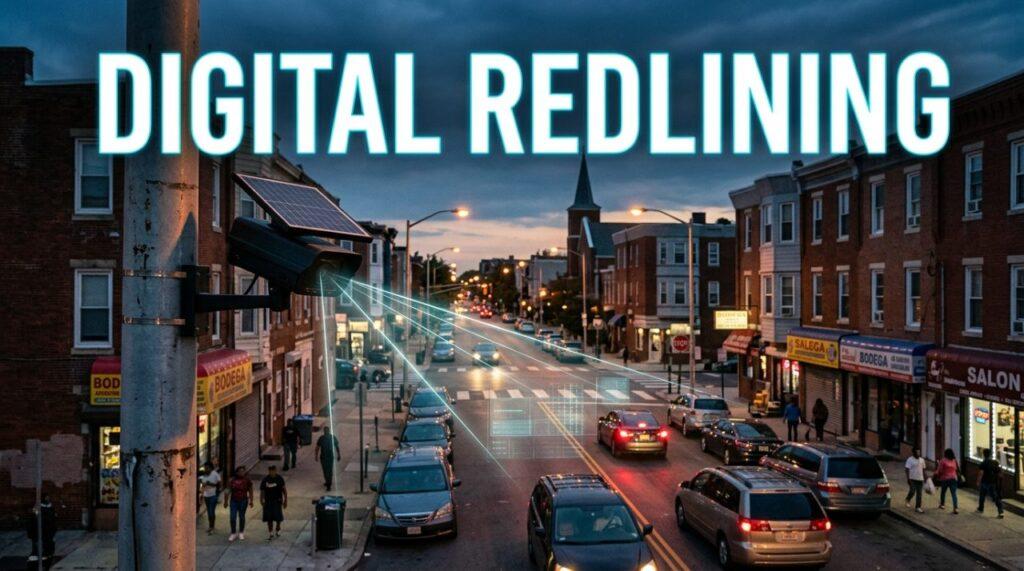
A quiet transformation has taken place on American streets. Small, solar-powered cameras now perch on traffic poles, street lamps, and freeway overpasses across thousands of neighborhoods (techtimes.com). These devices are automated license plate readers, often called ALPRs (eff.org). They do not sleep. Instead, they capture high-resolution images of every passing vehicle, day and night (aclu.org). Commercial vendors maintain private networks that record over twenty billion vehicle scans every single month (techtimes.com).
Civil rights attorneys have now stepped forward to challenge this quiet expansion. The American Civil Liberties Union and the Electronic Frontier Foundation filed an emergency petition with the Wisconsin Supreme Court (aclu-wi.org). The petition demands that law enforcement obtain judicial search warrants before querying mass automated camera networks (aclu-wi.org, eff.org). The litigation represents community groups and congregations who argue that warrantless surveillance tracks innocent drivers and criminalizes Black and Latino motorists across urban centers (aclu-wi.org, eff.org).
Public Sentiment on Neighborhood ALPR Surveillance
From Plantation Passes to COINTELPRO: The Surveillance Tradition
Modern automated surveillance did not appear in a political vacuum. Black Americans have experienced institutional monitoring for centuries. During the antebellum era, white authorities demanded written travel passes from enslaved people who stepped outside designated plantation borders. Patrols stopped and inspected Black travelers without cause. Following emancipation, Black codes and vagrancy statutes continued this legacy. Police officers used movement restrictions to preserve racial control throughout the Jim Crow South.
In the twentieth century, municipal and federal agencies modernized these surveillance practices. J. Edgar Hoover directed the Federal Bureau of Investigation under the Counterintelligence Program, known as COINTELPRO. Federal agents wiretapped, followed, and harassed civil rights leaders, including Dr. Martin Luther King Jr. and Malcolm X (africanelements.org). In 1975, the Church Committee revealed that intelligence services routinely monitored Black churches, funeral services, and civic centers. These historical campaigns laid the groundwork for the political shift from civil rights to mass incarceration that expanded punitive policing across the country.
Digital Redlining: Siting Cameras in Neighborhoods of Color
During the 1930s, the federal Home Owners’ Loan Corporation created colored residential security maps. These maps drew red lines around Black neighborhoods, marking them as hazardous for investment. Decades of intentional disinvestment followed. Today, camera manufacturers and law enforcement agencies mirror those same historic boundaries. Instead of distributing cameras evenly across geographic areas, police departments concentrate surveillance devices within historically segregated minority zip codes (aclu.org, aclu-sdic.org).
Independent audits prove that automated networks are not deployed neutrally. In Tulsa, Oklahoma, municipal audits revealed that camera networks were installed almost entirely in majority-Black and Hispanic sectors, while affluent white communities remained camera-free (acluok.org). Similar patterns emerged in Oakland, California, and Norfolk, Virginia (eff.org). In Virginia, federal court disclosures documented that camera density clustered tightly inside lower-income Black census tracts (eff.org). The historical memory of racial terror, such as the destruction of historic Black communities, deepens community alarm when modern state power builds digital checkpoints outside homes, schools, and churches.
Pretextual Stops and the Ghost of Whren v. United States
The concentration of license plate readers produces a dangerous operational cycle. In 1996, the United States Supreme Court delivered a landmark ruling in Whren v. United States. The justices ruled that officers may pull over any vehicle for a minor technical infraction, even if their true motive is racial profiling or an investigative hunch (harvardlawreview.org). Under this doctrine, subjective police intent is legally irrelevant so long as an officer observes a minor violation of the traffic code (harvardlawreview.org).
Automated license plate readers weaponize this dynamic at machine speed. Cameras constantly scan for administrative lapses such as expired registration tags or missed municipal fees (brennancenter.org). Once an alert rings inside a police cruiser, an officer possesses immediate legal cause to execute a stop under Whren (harvardlawreview.org). Minor administrative discrepancies frequently trigger high-risk felony stop protocols. Officers draw service weapons and extract terrified families onto roadside pavements. Routine driving becomes an armed encounter (eff.org).
Racial Disparities in Modern Traffic Enforcement
The Privatization Loophole: Sidestepping Public Oversight
Local police departments no longer build their own surveillance equipment. Instead, municipalities sign subscription contracts with private surveillance corporations such as Flock Safety and Vigilant Solutions (techtimes.com, eff.org). This dynamic creates a privatization loophole that undermines civic transparency. Private corporations are typically exempt from state Freedom of Information Act statutes. When community watchdogs request camera audit logs or search histories, private vendors refuse by citing corporate trade secrets (eff.org, eff.org).
Municipal oversight ordinances are bypassed by this private framework. Cities often require public hearings before agencies buy new military or surveillance gear. Yet police departments circumvent these rules by signing software subscriptions or receiving feeds directly from private homeowners associations (eff.org, eff.org). Private clouds connect thousands of law enforcement departments across municipal and state boundaries (eff.org, techtimes.com). Understanding this intergovernmental reach requires examining the balance of power inside federalism and the struggle for Black political autonomy.
Constitutional Collision: The Death of the Knotts Precedent
For several decades, government attorneys defended warrantless vehicle surveillance by citing the 1983 Supreme Court case United States v. Knotts. In that case, the Supreme Court ruled that motorists have no reasonable expectation of privacy when traveling along public thoroughfares (supremecourt.gov). Judges reasoned that physical cars travel in plain public view. However, human patrol officers could only tail a single car for a limited distance. Automated digital systems altered that reality completely (aclu.org).
In 2018, the United States Supreme Court reshaped digital privacy law in Carpenter v. United States. The court ruled that accessing historical cell-site location information requires a warrant based on probable cause (aclu.org, supremecourt.gov). Chief Justice John Roberts noted that digital location tracking gives the state tireless surveillance capabilities over physical human movements (supremecourt.gov). Civil rights litigators now assert the mosaic theory (aclu.org). This legal doctrine recognizes that while a single public snapshot is ordinary, aggregating thousands of snapshots creates a detailed, intimate record of an individual’s religious worship, medical care, and political assembly (aclu-wi.org, aclum.org).
The Dragnet Reality: Innocence vs False Hits
Community Coalitions Fight the Surveillance Dragnet
Public pushback against automated mass tracking has expanded from community organizing into major courtroom victories. In October 2026, a federal judge in the Western District of Oklahoma delivered a critical ruling (eff.org). The court held that an officer who queried a nationwide private license plate database without a warrant violated the Fourth Amendment (eff.org). The judge suppressed the recovered evidence, ruling that private license plate camera networks constitute an unconstitutional mass surveillance dragnet (eff.org).
State courts and city halls are also beginning to push back. The Massachusetts Supreme Judicial Court ruled in Commonwealth v. McCarthy that expansive vehicle camera networks create a dragnet that infringes on privacy expectations under state law (aclum.org). Cities across California, Washington, and Massachusetts have ended commercial vendor contracts over data privacy violations and unauthorized sharing with federal agencies (aclunorcal.org, notesfromtheemeraldcity.com). Over generations, the strength and resilience of African American families has endured countless forms of state surveillance. Today, that enduring resilience fuels the fight to reclaim neighborhood privacy in the digital age.
About the Author
Darius Spearman is a professor of Black Studies at San Diego City College, where he has been teaching for over 20 years. He is the founder of African Elements, a media platform dedicated to providing educational resources on the history and culture of the African diaspora. Through his work, Spearman aims to empower and educate by bringing historical context to contemporary issues affecting the Black community.
