

Eatonville Data Center Sparks Outcry on Historic School Land
By Darius Spearman (africanelements)
Support African Elements at patreon.com/africanelements and hear recent news in a single playlist. Additionally, you can gain early access to ad-free video content.
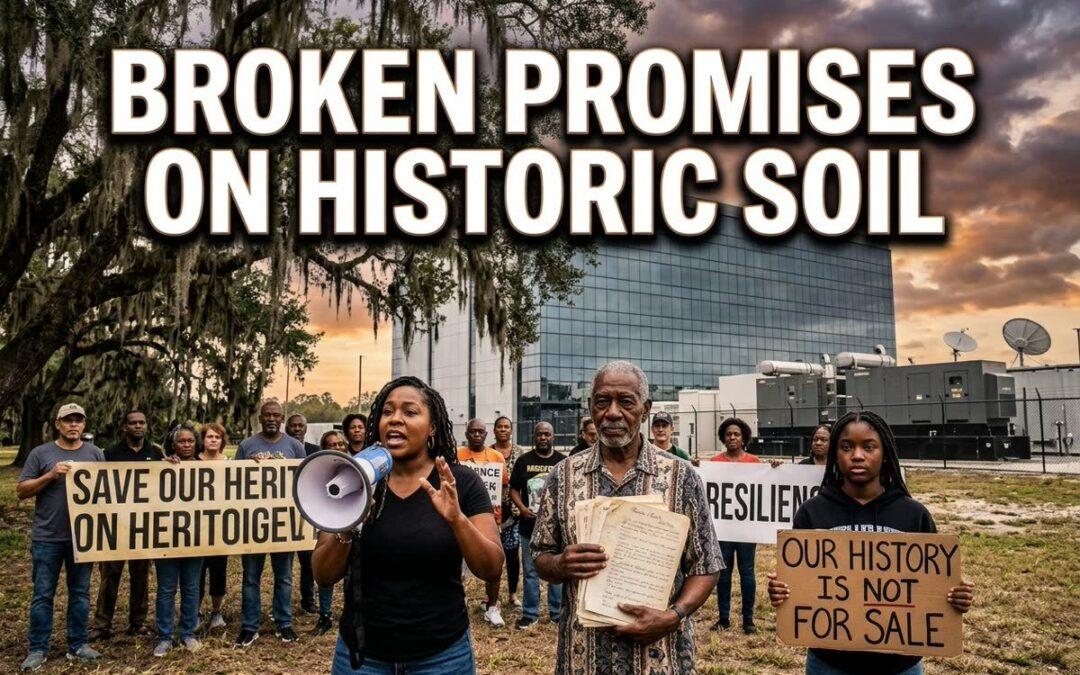
In November 2025, a joint investigative report published by Capital B News in partnership with the Pulitzer Center and the Associated Press exposed deep tensions in Eatonville, Florida (capitalbnews.org, apnews.com). The town of 2,250 residents holds a foundational place in American history as the nation’s oldest incorporated Black municipality (capitalbnews.org, townofeatonville.org). Today, a controversial commercial project known as the Eatonville data center occupies five acres carved out from the historic Robert Hungerford Normal and Industrial School trust (capitalbnews.org, hostdime.com). The seven-story technological outpost was supposed to bring digital equity and economic renewal to a community that anthropologist Zora Neale Hurston once celebrated as a sanctuary of self-determination (capitalbnews.org, capitalbnews.org).
Instead, local residents face a pattern of unfulfilled municipal pledges, including cancelled town-wide residential broadband and unmaterialized educational programs (capitalbnews.org). At the exact moment that commercial tech firms are expanding into historically marginalized towns, proposed federal rules by the Environmental Protection Agency threaten to strip local communities of mandatory public notices regarding air pollution from backup diesel generator fleets (capitalbnews.org, regulations.gov). In response, residents are refusing passive displacement. They are organizing a community land trust to reclaim their historic educational property and protect their environmental future (capitalbnews.org, thevillecdc.org).
Robert Hungerford School History and the Dream of Autonomy
Understanding the modern dispute requires examining the foundation of the town itself. Following the collapse of Reconstruction, 27 Black men established Eatonville on August 15, 1887 (capitalbnews.org, townofeatonville.org). They incorporated the municipality to protect Black political franchise, physical safety, and economic independence from Jim Crow disenfranchisement (capitalbnews.org). Ten years later, in 1897, Russell C. Calhoun and Mary C. Calhoun arrived in Central Florida after graduating from Booker T. Washington’s Tuskegee Institute (capitalbnews.org, 1887first.com). Inspired by visionary educational leaders of the era, the Calhouns sought to construct an enduring training academy for Black youth (capitalbnews.org).
Formally incorporated in 1899, the Robert Hungerford Normal and Industrial School combined classical academic learning with trades like blacksmithing, carpentry, agriculture, and home economics (capitalbnews.org). Named after Robert L. Hungerford, a white physician who died of yellow fever after caring for Black patients, the school quickly expanded through mutual aid and Black philanthropy (capitalbnews.org). Between 1899 and 1911, the Calhoun family and local supporters assembled roughly 337 acres into a private charitable trust (capitalbnews.org, capitalbnews.org). In 1904, Samuel M. and Mattie M. Moseley deeded 80 acres of land to the trustees for just one dollar, ensuring that Eatonville children had permanent access to agricultural and industrial learning commons, reflecting the broader traditions of early Black entrepreneurship and self-reliance (capitalbnews.org).
Hungerford Trust Land Loss Over Time (Acres)
Hungerford Deed Restrictions and the Battle Over Public Trust
By the mid-twentieth century, private funding pressures caused the Hungerford School trustees to transfer the school campus to the Orange County Board of Public Instruction in 1951 for $16,571 (capitalbnews.org, capitalbnews.org). The conveyance included an explicit legal mandate: the site had to be operated as a public school dedicated to the education of Black children, preserving Calhoun’s vocational mission (capitalbnews.org). However, as desegregation orders altered regional school administrative maps during the 1970s, the school board sought relief from those restrictions (capitalbnews.org).
In 1974, a Florida circuit court decree lifted the educational covenant across portions of the estate, enabling commercial sales and the construction of Interstate 4 (capitalbnews.org). That interstate physically bisected the historic municipality and isolated its residential core (capitalbnews.org). Orange County Public Schools closed the historic Hungerford campus entirely in 2009 and demolished its historic brick school buildings in 2020 (capitalbnews.org). These decisions left vacant land that commercial developers viewed as lucrative real estate in the heart of metropolitan Orlando (capitalbnews.org, urban-atlantic.com).
A critical legal question explains why the original restrictions failed to protect the five-acre data center parcel in 2016, but successfully halted a larger 100-acre liquidation in 2023. When Orange County acquired the property in 1951, the vocational covenant was detailed in court records but omitted from the primary deed book page (capitalbnews.org). The 1974 court decree gave the school district procedural cover to carve off parcels without initial municipal resistance (capitalbnews.org). In May 2016, the Eatonville Town Council voted unanimously in favor of a developer agreement with HostDime, hoping for corporate tax revenue and advanced connectivity (capitalbnews.org, capitalbnews.org). Because the municipal leadership endorsed the transaction and no citizens filed an immediate court injunction, the five-acre carve-out moved forward unimpeded (capitalbnews.org).
The situation changed dramatically in late 2022 when the school board attempted to sell the final 100-acre Hungerford tract to a private residential developer for $14 million (capitalbnews.org, cfpublic.org). Unlike the 2016 carve-out, this complete liquidation provoked immediate community resistance (capitalbnews.org). The Association to Preserve the Eatonville Community partnered with legal counsel from the Southern Poverty Law Center to challenge the transfer, arguing that public bodies could not void the 1899 charitable intent of the donors (capitalbnews.org, cfpublic.org). Faced with massive community organizing and legal challenges, the private developer withdrew in March 2023, keeping the remaining 100 acres in public limbo (capitalbnews.org, cfpublic.org).
HostDime Broken Promises in the Commercial Edge Corridor
HostDime Global Corp., led by CEO Manny Vivar, acquired the five-acre parcel along Wymore Road to build a $35 million, 100,000-square-foot flagship edge computing data center (capitalbnews.org, hostdime.com). Sited directly on former Hungerford school soil, the company won public favor by promising transformational digital investments to Eatonville’s citizens (capitalbnews.org). The developer promised high-speed residential Wi-Fi across the entire municipality, a first-floor public STEM education lab to teach computer hardware, and a $1 million technology scholarship pipeline for local youth (capitalbnews.org, capitalbnews.org).
“The developer pitched a grand vision of technological equity to gain community trust, yet the most essential residential public benefits were quietly rolled back when costs increased.”
Source: (capitalbnews.org)
Those commitments were substantially scaled back as construction costs mounted and timelines stretched (capitalbnews.org). Citing installation costs, HostDime leadership announced that town-wide residential internet was no longer sustainable (capitalbnews.org). The company substituted that pledge with an antenna mounted on the facility roof to provide basic public wireless access to adjacent public areas (capitalbnews.org). That alternative falls far short of household broadband connectivity (capitalbnews.org). Meanwhile, the dedicated classroom lab and scholarship structures remain stalled without binding verification (capitalbnews.org).
The developer utilized public, equity-focused New Markets Tax Credits to finance the facility, yet operated without a binding Community Benefits Agreement (capitalbnews.org, bbif.com). Federal New Markets Tax Credits are administered by the Treasury Department to incentivize capital investments within low-income census tracts (capitalbnews.org). However, federal guidelines require only that projects meet demographic and economic distress benchmarks (capitalbnews.org). They do not mandate that developers execute an enforceable agreement directly with local neighborhood groups (capitalbnews.org). Consequently, HostDime made broad promises within a municipal developer agreement with the town council rather than signing an enforceable contract with citizens, leaving residents without direct legal recourse when commitments were modified (capitalbnews.org).
HostDime Community Benefit Commitments vs. Outcomes
Town-Wide Home Wi-Fi
Original pledge of free high-speed residential Wi-Fi downgraded to a single rooftop antenna with limited range.
STEM Museum & Lab
Pledge for a 1st-floor community hardware lab to train local students lacks public curriculum access and launch dates.
$1M Tech Scholarships
Scholarship pipelines into tech careers were not formalized via independent community enforcement mechanisms.
EPA Air Pollution Permits Threaten Local Environmental Health
While Eatonville struggles with broken digital promises, a parallel federal regulatory battle over clean air threatens data center oversight nationwide (capitalbnews.org, regulations.gov). Commercial data centers consume massive baseload electrical power and house large fleets of heavy-duty industrial diesel generators to maintain uptime during grid outages (capitalbnews.org). To avoid complex major source reviews under the Clean Air Act, operators routinely register these installations as minor or synthetic minor sources by agreeing to run them fewer than 500 hours per year (capitalbnews.org, regulations.gov). This regulatory loophole lets data center facilities bypass the strictest Prevention of Significant Deterioration oversight (capitalbnews.org).
The Environmental Protection Agency has proposed rolling back federal requirements under 40 CFR 51.161, which historically mandated a 30-day public notice and public comment window before state agencies can grant minor air pollution permits (capitalbnews.org, regulations.gov). Under the proposed revision, state regulators would decide whether to publish notifications or hold public hearings (capitalbnews.org, momscleanairforce.org). This shift directly affects the division of state and federal power, eroding procedural protections for vulnerable communities (capitalbnews.org, earthjustice.org).
Diesel generator emissions carry serious public health implications (capitalbnews.org, momscleanairforce.org). Clusters of emergency diesel engines release nitrogen oxides, volatile organic compounds, and fine particulate matter known as PM2.5 (capitalbnews.org, ehsleaders.org). These microscopic particles enter deep into human lung tissue and the bloodstream, worsening childhood asthma, cardiovascular disease, and chronic bronchitis (capitalbnews.org, momscleanairforce.org). Removing public notices eliminates the procedural window that allows neighboring communities to review permit applications, hire independent environmental engineers, and demand cleaner emissions controls (capitalbnews.org, earthjustice.org).
Data Center Diesel Generators: Pollutants & Regulatory Gaps
| Pollutant | Primary Source | Health Impact | Regulatory Status |
|---|---|---|---|
| PM2.5 (Soot) | Diesel Exhaust | Asthma, Lung Disease | Synthetic Minor Cap |
| Nitrogen Oxides (NOx) | High-Temp Combustion | Ozone Precursor, Smog | Notice Rollback at Risk |
| Carbon Monoxide | Incomplete Burn | Cardiovascular Stress | Under 500 Hr/Yr Exempt |
Eatonville Community Land Trust Models and Sovereignty
To break this century-long cycle of land loss and political disenfranchisement, Eatonville leaders are establishing a community land trust (capitalbnews.org, thevillecdc.org). Rather than trusting future real estate decisions to school districts or private developers, the community land trust model changes how land is held (capitalbnews.org, thevillecdc.org). It separates title to the ground from the structures built on top of it (thevillecdc.org). The trust holds the underlying land permanently in a non-profit, community-governed entity, preventing speculative real estate development (thevillecdc.org).
A community land trust can enforce the original educational intentions of the 1899 Hungerford deed where past deed covenants failed (capitalbnews.org, thevillecdc.org). In the past, deed restrictions relied on third-party public entities, like the county school board, which petitioned courts to lift or ignore those conditions (capitalbnews.org). In contrast, a community land trust maintains direct fee-simple ownership (thevillecdc.org). The trust enters into 99-year ground leases that mandate specific land uses, such as affordable housing, job training programs, and local cultural centers (thevillecdc.org, thevillecdc.org). If any operator breaches these educational conditions, the lease is terminated, and full control reverts immediately to the community trust (thevillecdc.org).
Furthermore, community land trusts utilize a balanced tripartite governance structure (thevillecdc.org). The governing board is divided equally among three groups: leaseholders who live on the property, residents from the wider Eatonville community, and public interest advisors (thevillecdc.org). This prevents backroom real estate transfers or closed-door municipal votes from liquidating public assets (capitalbnews.org, thevillecdc.org). By partnering with organizations like Dr. Phillips Charities to acquire the remaining 100 acres, Eatonville residents are creating an intentional collective political strategy that combines legal title with grassroots self-determination (capitalbnews.org, thevillecdc.org).
The fight over the historic Hungerford campus demonstrates that real estate development in historic Black communities is never just about building infrastructure (capitalbnews.org). It connects directly to historical sovereignty, public health, and generational self-determination (capitalbnews.org, capitalbnews.org). From Russell Calhoun’s early educational vision to modern fights over clean air notices and computing centers, Eatonville continues to defend its historic soil against outside extraction (capitalbnews.org). By building a community land trust, residents are reclaiming the autonomy that 27 Black founders set out to build nearly 140 years ago (capitalbnews.org, townofeatonville.org).
About the Author
Darius Spearman is a professor of Black Studies at San Diego City College, where he has been teaching for over 20 years. He is the founder of African Elements, a media platform dedicated to providing educational resources on the history and culture of the African diaspora. Through his work, Spearman aims to empower and educate by bringing historical context to contemporary issues affecting the Black community.
