



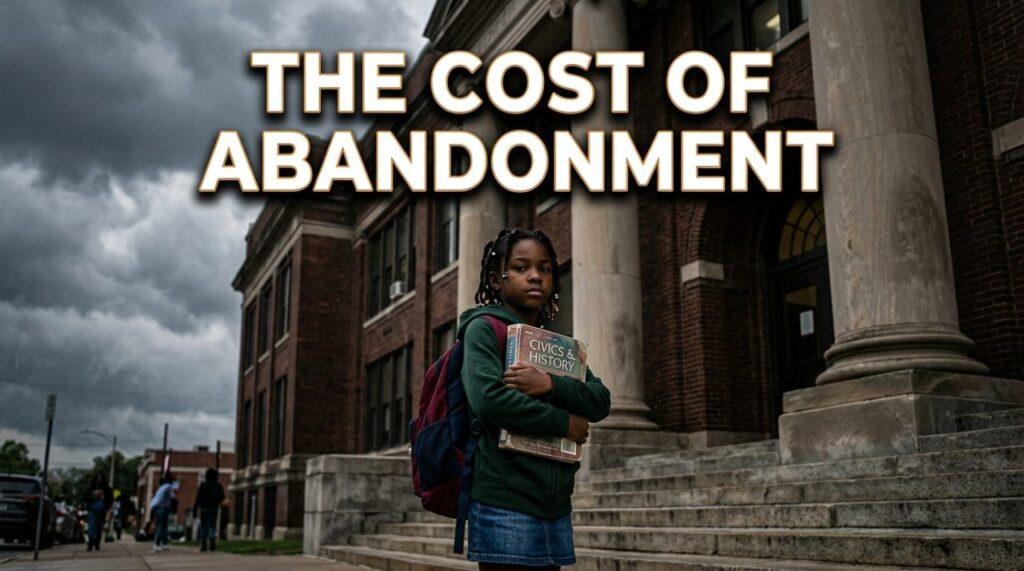
Ending Desegregation: The Cost of Federal Abandonment
By Darius Spearman (africanelements)
Support African Elements at patreon.com/africanelements and hear recent news in a single playlist. Additionally, you can gain early access to ad-free video content.
The United States Justice Department recently announced the formal termination of more than 50 school desegregation consent decrees across the South, Midwest, and Northeast (justice.gov). While the federal government frames these actions as a return to local governance and a relief from bureaucratic red tape, many civil rights advocates perceive a different reality (cbsnews.com). This shift marks a significant departure from decades of federal oversight, leaving school districts to navigate the complex legacy of systemic segregation without the binding protection of court-ordered integration plans (k-12legalinsights.com, aldailynews.com).
Historical Foundations of Desegregation
To understand the current crisis, one must revisit the era of “separate but equal.” Under the 1896 ruling in Plessy v. Ferguson, state-sponsored apartheid in education was legally protected (wikipedia.org). For decades, Black students were forced into underfunded, dilapidated facilities while white schools received the lion’s share of public investment (uchicago.edu). This dual system was not an accident but a product of intentional policy designed to maintain a racial hierarchy (ncsu.edu).
The 1954 landmark decision in Brown v. Board of Education theoretically ended this era by declaring that separate educational facilities are inherently unequal (justia.com). However, the Supreme Court’s follow-up order in Brown II, which allowed for desegregation “with all deliberate speed,” provided Southern segregationists the time necessary to stage “Massive Resistance.” During this period, states shuttered public schools and established private academies to prevent integration, a strategy that often echoes in modern political resistance to educational equity (edweek.org).
Intensely Segregated Schools
The Era of Enforcement and the Green Factors
Meaningful progress began only after the Civil Rights Act of 1964 authorized the Justice Department to file lawsuits against noncompliant districts (justice.gov). This led to the creation of consent decrees—binding agreements where school boards promised to fix their assignment plans and facility investments under court supervision (k-12legalinsights.com). The 1968 Green v. County School Board ruling was a watershed moment, establishing the six “Green Factors” that courts used to measure progress, including faculty hiring, transportation, and extracurricular opportunities (ucla.edu).
These consent decrees served as a crucial backstop for communities seeking to address involuntary servitude patterns that lingered in the classroom (duke.edu). By forcing transparency, these orders ensured that districts could not easily backtrack on their commitments to integration. Today, the dismissal of these cases removes the legal machinery that once compelled school districts to address resource inequality, effectively signaling an end to federal oversight in over 50 jurisdictions (cbsnews.com, ucla.edu).
Judicial Retrenchment and Modern Resegregation
Starting in the 1970s, the judiciary began to narrow the scope of desegregation (justia.com). The 1974 Milliken v. Bradley decision was a turning point, prohibiting inter-district desegregation unless suburban boundaries were found to be drawn with discriminatory intent (uchicago.edu). This ruling essentially insulated suburbs from the integration challenges of urban centers, a political shift that solidified housing-based school segregation (ucla.edu).
Following Milliken, the Supreme Court issued Board of Education v. Dowell in 1991, declaring that desegregation decrees were intended to be temporary (justia.com). This shift made it easier for districts to obtain “unitary status” and exit federal oversight, even when significant racial imbalances remained (heartlandernews.com). As these decrees fall away, many districts are seeing the return of neighborhood-based assignment plans that replicate residential segregation patterns (ucla.edu, newsone.com).
Growth of Monoracial Schools
The Reality of Double Segregation
The consequences of these dismissals are documented in the rise of what researchers call “double segregation,” where students are isolated by both race and socioeconomic status (ucla.edu). When federal oversight ends, high-poverty districts often struggle with teacher turnover and limited access to advanced coursework (urban.org). This is exacerbated by the trend of affluent municipalities creating their own independent school districts, which drain tax wealth and leave the remaining district with fewer resources (ntd.com).
The Justice Department contends that these decades-old orders create unnecessary administrative burdens for modern districts (justice.gov). However, critics such as former Assistant Attorney General Kristen Clarke argue that the campaign to dismantle these decrees is a direct threat to the promise of Brown v. Board of Education (cbsnews.com). Without active court supervision, the burden of challenging discriminatory practices falls entirely on families, who must now navigate a legal landscape that demands proof of intentional discrimination—a much higher standard than proving disparate impact (justia.com, heartlandernews.com).
Status of Desegregation Orders
The Future of Educational Equity
The current movement to dissolve desegregation decrees is not an isolated event but a continuation of a long-term judicial retreat from the goals of the civil rights movement. In districts across Louisiana, Mississippi, and Alabama, the impact of these changes will likely be felt for generations as school systems revert to older, exclusionary models of operation (cbsnews.com, ucla.edu). The loss of federal monitoring removes the only independent party capable of ensuring that marginalized communities are not disproportionately impacted by local board decisions (k-12legalinsights.com, huntsvillecityschools.org).
As the legal shield of federal oversight fades, advocates are left looking for new ways to hold school districts accountable. Some organizations are focusing on administrative complaints, while others are analyzing how to utilize the Equal Protection Clause in a climate that is increasingly skeptical of race-conscious remedies (justia.com). The path ahead is challenging, yet the struggle for an equitable education system remains central to the broader fight for justice in the United States (jbhe.com).
About the Author
Darius Spearman is a professor of Black Studies at San Diego City College, where he has been teaching for over 20 years. He is the founder of African Elements, a media platform dedicated to providing educational resources on the history and culture of the African diaspora. Through his work, Spearman aims to empower and educate by bringing historical context to contemporary issues affecting the Black community.
