
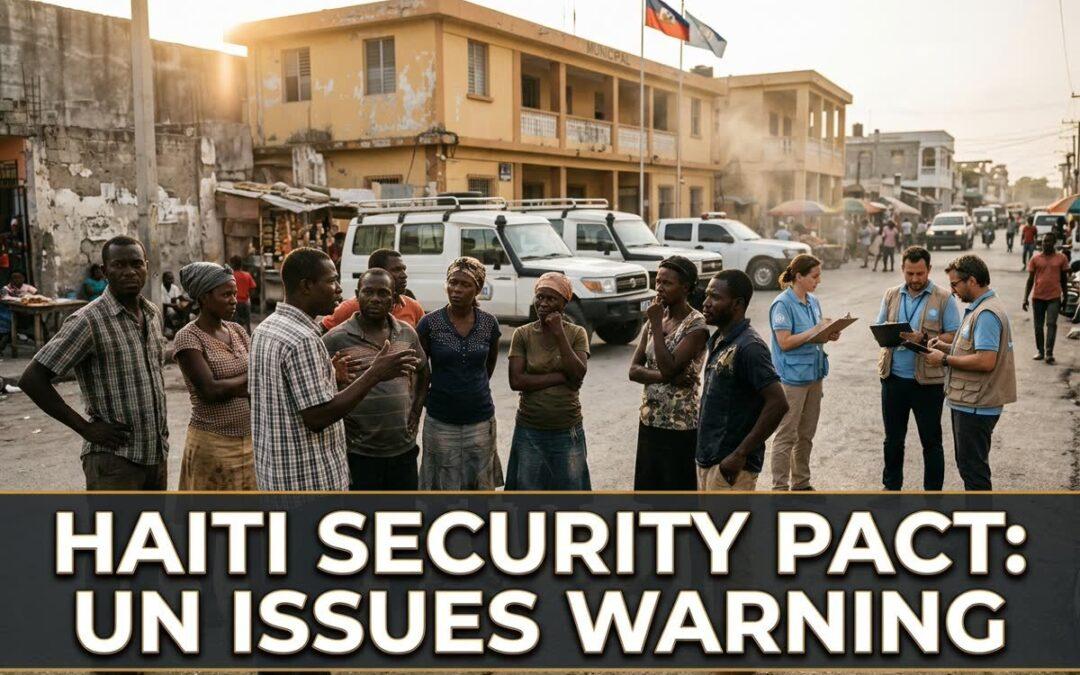

Haiti El Salvador Security Pact Sparks UN Warnings
By Darius Spearman (africanelements)
Support African Elements at patreon.com/africanelements and hear recent news in a single playlist. Additionally, you can gain early access to ad-free video content.
Haitian National Police Collapse Drives Foreign Intervention
On November 17, 2026, Haiti entered an uncharted chapter in its national security policy. The Haitian Council of Ministers, led by transitional Prime Minister Alix Didier Fils-Aimé, formally ratified a bilateral security cooperation agreement with El Salvador (lenouvelliste.com). This formal step occurred after more than 2,000 Salvadoran soldiers arrived on Haitian soil (elsalvadorinenglish.com). The surge followed the October 18 kidnapping of four Salvadoran aviation technicians in Croix-des-Bouquets by the 400 Mawozo gang (elsalvadorinenglish.com, manilatimes.net). That ambush pushed Salvadoran President Nayib Bukele to dispatch special operations forces, expanding the contingent into an international expeditionary deployment (elsalvadorinenglish.com).
The bilateral agreement unfolded against the complete functional collapse of domestic security institutions (oas.org, washingtonpost.com). Over the past three years, the Haitian National Police Collapse has left neighborhoods across the capital completely unprotected. Criminal syndicates now control between 70 percent and 85 percent of Port-au-Prince (cfr.org, cfr.org). Thousands of local residents took to the streets holding signs reading “Merci Bukele” while cheering the arrival of foreign troops (youtube.com). Many beleaguered citizens openly demanded foreign air power and advanced surveillance dogs to crush neighborhood gangs (elsalvadorinenglish.com, youtube.com). Yet, while the streets celebrated direct action, international observers warned that bypassing normal legal standards carries severe consequences (hrw.org, amnesty.org).
Port-au-Prince Territorial Control (2026)
Haiti Gang Violence History From Duvalier to Moïse
The ongoing Port-au-Prince Gang Crisis is not an accidental breakdown of modern society. It is the direct consequence of decades of state fragmentation, external meddling, and institutional neglect (cfr.org, cfr.org). Ever since the Haitian Revolution overthrew colonial enslavement, outside powers have repeatedly isolated and punished the Caribbean republic (wikipedia.org). During the twenty-nine-year dictatorship of François “Papa Doc” Duvalier and his son Jean-Claude, sovereign security did not rest in professional civil hands. The regime relied on the Tonton Macoutes, a ruthless paramilitary militia that blended state violence with political governance (wikipedia.org).
When President Jean-Bertrand Aristide returned to office in 1994 following a military coup, he moved to prevent future mutinies by disbanding the 7,000-member Haitian Armed Forces in 1995 (wikipedia.org). The fledgling police service created in its place was under-resourced and easily manipulated by competing political factions (washingtonpost.com). Political elites organized armed neighborhood youth into groups known as chimères to intimidate rivals and enforce order (wikipedia.org). Following Aristide’s second ouster in 2004, the United Nations deployed the MINUSTAH stabilization mission (wikipedia.org). That thirteen-year deployment ended in 2017 with an agonizing legacy, including an introduced cholera epidemic that claimed 10,000 Haitian lives and left national forces unprepared to maintain order (wikipedia.org, hrw.org).
Between 2018 and 2021, political corruption accelerated this breakdown under President Jovenel Moïse (washingtonpost.com). Weapons smuggled directly from the United States flowed into poor neighborhoods (cfr.org, cfr.org). Former police officer Jimmy “Barbecue” Chérizier unified splintered factions into the G9 Family and Allies coalition, taking control of major ports and fuel depots (washingtonpost.com, cfr.org). Rival syndicates like G-Pèp and 400 Mawozo seized highways and communication routes (cfr.org, cfr.org). When foreign mercenaries assassinated President Moïse in his home on July 7, 2021, constitutional authority dissolved entirely (cfr.org, washingtonpost.com). Haiti Gang Violence History reveals that today’s syndicates are the direct descendants of private political armies built over many generations (wikipedia.org).
Exporting the Bukele Mano Dura Model to the Caribbean
Faced with systemic collapse, the transitional government in Port-au-Prince looked toward Central America for answers (lenouvelliste.com, elsalvadorinenglish.com). The Bukele Mano Dura Model originated in El Salvador as an aggressive response to decades of turf wars between MS-13 and Barrio 18 (amnestyusa.org, latinoamerica21.com). In March 2022, President Nayib Bukele established an indefinite state of exception that suspended core constitutional guarantees (amnestyusa.org, amnesty.org). Salvadoran authorities incarcerated more than 80,000 citizens without individual warrants, warehousing them in the massive Terrorism Confinement Center, known as CECOT (amnestyusa.org, hrw.org). The philosophy represents a rapid shift toward mass incarceration that bypasses traditional due process safeguards.
During the formalization of the bilateral agreement, Haitian Justice Minister Dr. Patrick Pélissier traveled directly to San Salvador to tour the CECOT facility alongside Salvadoran officials (lenouvelliste.com). Pélissier affirmed that Salvadoran forces have no fixed departure date, asserting their deployment is required to stabilize the country before elections (lenouvelliste.com). However, legal analysts point out catastrophic differences between the two nations (latinoamerica21.com, latinoamerica21.com). In El Salvador, the executive branch commanded an operational judicial infrastructure and functional holding facilities (amnestyusa.org, latinoamerica21.com). In Haiti, the judicial branch is paralyzed (oas.org, washingtonpost.com). Courts rarely hold sessions, and prisons are overcrowded ruins (hrw.org, oas.org). Importing an iron-fist carceral model into a country without operational judges risks creating an open-ended human rights disaster (hrw.org, hrw.org).
Private Military Contractors Haiti and the Drone War
The arrival of Salvadoran troops represents only one arm of an increasingly privatized war in Port-au-Prince. The Haitian state has also turned to commercial defense firms to execute direct combat operations (hrw.org, ua.news). Private Military Contractors Haiti became a major element of national strategy through contracts with Vectus Global, an enterprise directed by former Blackwater founder Erik Prince (ua.news, blackagendareport.com). Prince has spent decades designing privatized warfare programs across the Global South (blackagendareport.com). His original firm became infamous during the Iraq War, particularly after the 2007 Nisour Square shooting in Baghdad that killed seventeen unarmed Iraqi civilians (wikipedia.org, blackagendareport.com).
In Port-au-Prince, corporate personnel manage intelligence flights and conduct tactical strikes using explosive drones against gang strongholds (hrw.org, ua.news). These operations run completely outside sovereign military judicial command structures and public oversight (hrw.org, blackagendareport.com). Documented findings from human rights investigators show that explosive drone missions in crowded neighborhoods have caused grave harm (hrw.org). Between mid-2025 and late 2026, targeted aerial drone strikes in dense urban corridors killed at least 87 civilians, including 21 children (hrw.org). Outsourcing lethal military duties to private corporations leaves impacted families without legal channels to seek civil damages or criminal accountability (hrw.org, blackagendareport.com).
Casualties in Security Operations (Q3 2026)
Roots of the Bwa Kale Vigilante Movement
To understand why everyday Haitians welcome foreign forces, one must examine the extreme violence suffered by local communities (cfr.org, genocidewatch.com). In 2026 alone, armed violence claimed at least 4,595 lives and left 2,050 people wounded across the country (hrw.org). More than 1.5 million Haitians have been internally displaced, while 5.8 million face severe food shortages (bignewsnetwork.com, hrw.org). Systematic extortion, kidnapping, and widespread sexual violence have shattered civil life in working-class neighborhoods (hrw.org, genocidewatch.com).
This persistent abandonment sparked the Bwa Kale Vigilante Movement in April 2023 (cfr.org, washingtonpost.com). Frustrated residents formed neighborhood watch groups, pursuing suspected gang members and carrying out public lynchings (cfr.org, washingtonpost.com). While this vigilantism initially drove armed factions out of several districts, it also normalized summary executions and mob justice without trial (cfr.org, washingtonpost.com). When Salvadoran soldiers led an armored assault to retake Stade Sylvio Cator—the national stadium held by armed groups for over two years—the public responded with jubilant celebrations (youtube.com). Years of continuous trauma have conditioned many communities to prioritize immediate physical survival over constitutional safeguards (cfr.org, washingtonpost.com).
The UN Extrajudicial Killings Report and Legal Impunity
While street rallies celebrated aggressive offensives, international human rights monitors documented an alarming pattern of state and paramilitary abuse (hrw.org). The UN Extrajudicial Killings Report, released by the Office of the UN High Commissioner for Human Rights in Geneva, revealed severe operational misconduct (hrw.org). Spokesperson Marta Hurtado confirmed that state security operations caused 514 deaths and 235 injuries between July and September 2026 alone (hrw.org). Even more troubling, UN monitors confirmed 44 targeted extrajudicial executions carried out directly by police personnel against detained suspects (hrw.org).
This surge in violence unfolds within an acute constitutional void regarding the sharing of sovereign power and legal authority. Prime Minister Alix Didier Fils-Aimé governs without an electoral mandate, having ascended to power through executive decrees after previous leadership fractured (lenouvelliste.com, cfr.org). Under Articles 98-3 and 276 of the 1987 Constitution of Haiti, binding international defense treaties and foreign troop deployments require debate and formal ratification by an elected National Assembly (wikipedia.org). Because Haiti currently has no sitting parliament, no elected president, and no operational Supreme Court, this bilateral defense pact lacks constitutional legitimacy (cfr.org, wikipedia.org).
Compounding these concerns, Salvadoran Vice President Félix Ulloa declared that the bilateral agreement text will remain classified from the public (elsalvadorinenglish.com). The United Nations affirmed through spokesman Stéphane Dujarric that the Salvadoran contingent operates entirely outside the UN-mandated Gang Suppression Force (bignewsnetwork.com). The multinational mission led by Kenya has deployed only 1,563 officers out of a planned 5,500 personnel (bignewsnetwork.com, hrw.org). Operating outside this international command frees Salvadoran troops from UN human rights oversight and screening (bignewsnetwork.com, hrw.org). When foreign forces operate without legal oversight, historical experience warns that civilian communities frequently pay the highest price (hrw.org, amnesty.org).
International Deployments in Haiti (Late 2026)
Bukele Mano Dura Model: A Crossroads for Caribbean Sovereignty
The security pact between Port-au-Prince and San Salvador illustrates a deep dilemma facing fragile states (lenouvelliste.com, cfr.org). Exhausted by criminal control and disillusioned by slow international missions, the population has embraced militarized foreign intervention (youtube.com, bignewsnetwork.com). The Nayib Bukele Haiti Mission represents an attempt to bypass traditional diplomatic frameworks in exchange for immediate tactical firepower (lenouvelliste.com, elsalvadorinenglish.com). Yet national elections have already been postponed from 2026 to July 18, 2027, leaving the political establishment without democratic accountability (lenouvelliste.com).
Deploying combat soldiers and private contractors without constitutional checks creates profound risks for the future of Haitian governance (hrw.org, blackagendareport.com). As documented casualties and summary executions continue to mount, short-term military operations risk replacing gang rule with state-sanctioned impunity (hrw.org). The historical record demonstrates that authentic security cannot be imported through unmonitored foreign treaties or commercial weaponry (cfr.org, wikipedia.org). True stability requires restoring the rule of law, rebuilding civil institutions, and respecting the sovereign rights of the Haitian people (cfr.org, oas.org).
About the Author
Darius Spearman is a professor of Black Studies at San Diego City College, where he has been teaching for over 20 years. He is the founder of African Elements, a media platform dedicated to providing educational resources on the history and culture of the African diaspora. Through his work, Spearman aims to empower and educate by bringing historical context to contemporary issues affecting the Black community.
