


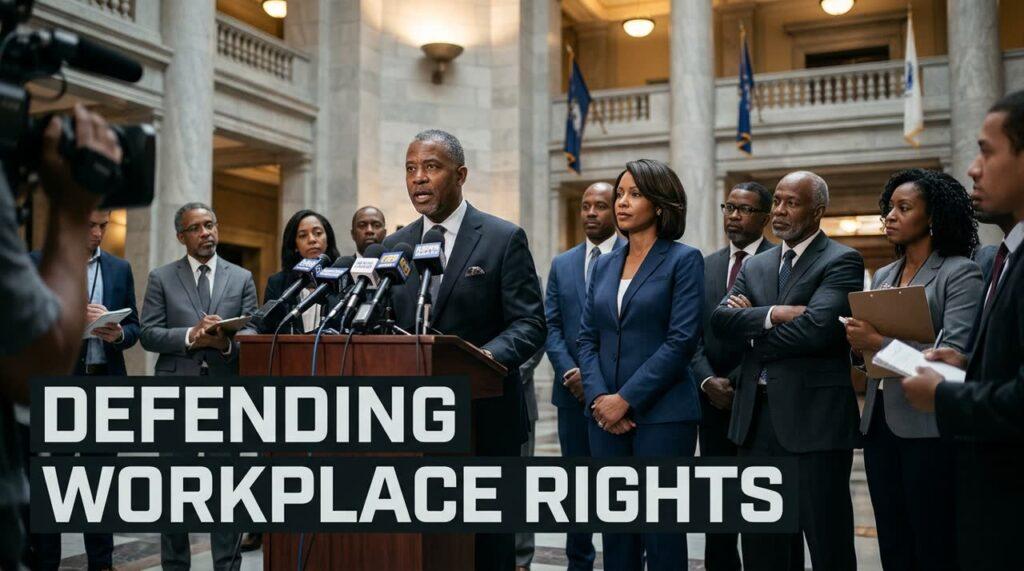
National Urban League Fights Workplace Protection Rollbacks
By Darius Spearman (africanelements)
Support African Elements at patreon.com/africanelements and hear recent news in a single playlist. Additionally, you can gain early access to ad-free video content.
The National Urban League issued a direct challenge against systemic rollbacks in workplace civil rights oversight (uatl.com). Marc H. Morial, president and chief executive officer of the organization, condemned federal regulatory stalls that leave minority employees unprotected (youtube.com, nul.org). Labor advocates warn that freezing civil rights enforcement accelerates immediate financial distress across Black communities. The confrontation connects current mass layoffs to a foundational reality: political rights remain fragile without equal economic protection (stateofblackamerica.org).
Economic indicators reflect a severe reversal of recent gains. The national unemployment rate for Black workers surged toward 7.8 percent, up from a record low of 4.7 percent recorded in early 2023 (uatl.com, stateofblackamerica.org). Over 567,000 Black men and nearly 300,000 Black women lost employment in a brief eighteen-month period (uatl.com). In response to these shifts, the National Urban League formed national alliances to counter rollbacks in corporate inclusion and statutory oversight (nul.org, ulgatl.org). Understanding this moment requires examining how workplace protection developed over the last century.
Great Migration Labor History and the Birth of the League
The National Urban League began directly out of workplace necessity during the early twentieth century. Between 1910 and 1920, the first wave of the Great Migration saw more than one million Black Americans flee Southern agricultural exploitation and racial violence (nps.gov, britannica.com). Families moved north seeking industrial jobs in urban centers like New York, Chicago, and Philadelphia (ku.edu, wikipedia.org). These workers escaped debt peonage only to encounter severe labor market exclusion in Northern cities.
To address these realities, sociologist Dr. George Edmund Haynes and philanthropist Ruth Standish Baldwin established the Committee on Urban Conditions Among Negroes in New York City in 1910 (nps.gov, britannica.com). The organization merged with kindred groups in 1911 to create the National Urban League (nps.gov). While the NAACP focused its primary efforts on courtroom litigation and legal disenfranchisement, the Urban League concentrated on employment access, vocational training, and housing security (thirteen.org, wikipedia.org). The organization confronted early patterns of industrial labor organizing that excluded Black tradespeople from major labor unions.
Federal intervention in fair employment emerged only after intense civil rights pressure. In 1941, labor leader A. Philip Randolph planned a massive March on Washington to protest racial segregation in national defense industries (thirteen.org, african-american-civil-rights.org). To stop the demonstration, President Franklin D. Roosevelt signed Executive Order 8802, creating the Fair Employment Practice Committee (african-american-civil-rights.org). This measure established the first federal body assigned to counter workplace bias, setting an essential precedent for subsequent civil rights legislation.
Title VII Civil Rights Act and the March for Economic Justice
During the 1960s, the Urban League transformed federal equal employment policy under the leadership of Whitney M. Young Jr. (princeton.edu, wikipedia.org). Young served as executive director from 1961 until 1971, guiding the organization into the center of national policymaking (britannica.com, princeton.edu). He co-organized the historic 1963 March on Washington for Jobs and Freedom (princeton.edu, wikipedia.org). Young insisted that voting rights reforms could not solve inequality if employers maintained hiring bans against Black applicants.
Young proposed a Domestic Marshall Plan, calling for federal investments in urban education, employment, and infrastructure (princeton.edu). This visionary framework influenced President Lyndon B. Johnson’s War on Poverty initiatives (princeton.edu, wikipedia.org). League leadership lobbied relentlessly for statutory workplace protections, helping secure the landmark Title VII Civil Rights Act provisions in 1964 (african-american-civil-rights.org). Title VII prohibited employment discrimination based on race, color, religion, sex, or national origin across both the private sector and organized labor.
Title VII created the Equal Employment Opportunity Commission in 1965 to investigate discriminatory workplace practices and enforce federal remedies (african-american-civil-rights.org). That same year, President Johnson signed Executive Order 11246, requiring federal contractors to implement affirmative action in hiring (african-american-civil-rights.org). Through these dual mechanisms, civil rights advocates established that federal contracting dollars and private industry practices must submit to federal anti-discrimination oversight.
Black Worker Unemployment Shift
Comparison of Recent Lows vs. Post-Rollback Unemployment Rates
State of Black America Report Uncovers Escalating Disparities
To measure economic parity systematically, the National Urban League launched its annual audits in the late twentieth century. In 1976, during a period of national stagflation, League President Vernon E. Jordan Jr. published the first State of Black America Report (jbhe.com, nul.org). Jordan recognized that economic contractions inflict severe injury on Black workers before impacting other demographics. The publication created an empirical baseline to measure civil rights progress across economic mobility, health access, education, and political empowerment.
The fiftieth edition of the report, titled “America at 250: Is the American Dream Dead?”, documents a sharp downward trajectory (stateofblackamerica.org). The National Urban League Equality Index stands at 73.9 percent, demonstrating that Black Americans experience an overall 26.1 percent deficit compared to white peers (stateofblackamerica.org). Homeownership gaps remain frozen at approximately 30 percentage points, reflecting persistent inequities unchanged since the passage of the 1968 Fair Housing Act (stateofblackamerica.org).
Income erosion has accelerated rapidly. The report indicates that Black households lost an aggregate eighty-seven billion dollars over two years amid job displacement and curtailed workforce inclusion programs (uatl.com, stateofblackamerica.org). Job cuts fell heavily on educated Black women, who saw approximately 250,000 to 300,000 positions eliminated in professional, corporate, and administrative sectors (uatl.com). These findings illustrate that gains made without lasting institutional mandates can dissolve within a few fiscal quarters.
2025 NUL Equality Index
Relative Economic and Social Parity Index (100% Represents Full Parity)
EEOC Workplace Discrimination Oversight Grinds to a Halt
The core dispute between civil rights advocates and federal authorities focuses directly on enforcement procedures. Marc Morial issued a direct condemnation of the commission, stating publicly that the agency refused to perform its statutory responsibilities and permitted workplace bias to operate unchecked (youtube.com, stateofblackamerica.org). The retreat represents an administrative shift away from systemic investigations toward individual conciliation.
Under established Title VII jurisprudence, systemic pattern-or-practice lawsuits formed the primary mechanism to eliminate institutional exclusion (african-american-civil-rights.org). Originating with the landmark Supreme Court decision in Griggs v. Duke Power Co., civil rights litigators used aggregate demographic metrics to prove disparate impact without relying on explicit expressions of prejudice. Current administrative adjustments have reduced mandatory demographic tracking and curtailed broad pattern-or-practice inquiries, dismantling critical evidence needed to identify enterprise-level disparities.
When the Equal Employment Opportunity Commission deprioritizes systemic oversight, the financial and procedural burden transfers onto individual employees. Private civil rights actions require extensive econometric proof, statistical analysis, and corporate record discovery costing hundreds of thousands of dollars. Furthermore, federal court precedents permit employers to enforce mandatory arbitration agreements and class-action waivers, effectively stopping low-wage employees from consolidating claims. The reduction of federal investigations leaves workers isolated against substantial corporate legal departments.
Section 1981 Civil Rights Lawsuits Invert Reconstruction Protections
Legal challenges have expanded beyond federal administrative bodies to target private philanthropic capital and business investment. Litigators have increasingly turned to Section 1981 Civil Rights Lawsuits to invalidate programs designed to assist marginalized demographics (cof.org, arnoldporter.com). Enacted during Reconstruction under the Civil Rights Act of 1866, Section 1981 aimed to dismantle Southern Black Codes that barred freed individuals from entering contracts or owning property (arnoldporter.com, africanelements.org). The statute was designed to guarantee formerly enslaved people the right to make contracts on an equal basis with white citizens.
Modern federal courts interpreted the statute symmetrically, deciding that the text prohibits contractual race discrimination against any individual regardless of background (arnoldporter.com, faegredrinker.com). Conservative legal foundations mobilized this race-neutral reading following the Supreme Court’s affirmative action ruling in Students for Fair Admissions v. Harvard (cof.org, americanallianceforequalrights.org). In American Alliance for Equal Rights v. Fearless Fund, litigators targeted a venture capital contest granting twenty thousand dollar grants exclusively to Black women entrepreneurs (axios.com, arnoldporter.com).
The United States Court of Appeals for the Eleventh Circuit determined that the contest constituted a contract rather than First Amendment protected speech (arnoldporter.com, uscourts.gov). This legal pressure led the fund to settle and permanently discontinue its grant program (axios.com, faegredrinker.com). The decision produced a chilling effect across the financial sector, causing philanthropic institutions to alter or abandon equity investments out of concern for class-action liability (cof.org, taftlaw.com). These legal developments invert an economic servitude after emancipation statute to dismantle private initiatives supporting Black women organizing for economic equity.
Federal Workplace Protections Dismantled Across the Civil Service
The erosion of protections reaches directly into the federal civil service. Official employment records document that over 327,000 federal civilian positions were eliminated between late 2024 and early 2026, marking a 10.9 percent workforce reduction (bluelinesearch.ai, govexec.com). The cuts were executed through workforce restructuring plans, including the reclassification of protected career employees into at-will status, hiring freezes with strict non-replacement quotas, and deferred resignation initiatives (federalharmstracker.org, govexec.com).
This public sector contraction inflicts immediate harm on Black economic security. Since the desegregation of the federal government under Executive Order 9980 in 1948, public employment has served as an essential engine of Black middle-class advancement (fairfaxcounty.gov). Standardized civil service exams, public transparency, and union protections offered equity rarely matched in private commerce. Black personnel comprise approximately eighteen to twenty percent of the civilian federal workforce, a level substantially higher than their representation in the broader labor force (govexec.com). Eliminating hundreds of thousands of positions closes off an established pathway to generational wealth.
Simultaneously, federal authorities moved to curtail development agencies such as the Minority Business Development Agency and the Community Development Financial Institutions Fund (stateofblackamerica.org, iamempowered.com). These programs provided targeted loans, contract access, and capital reserves to communities underserved by commercial financial institutions. Curtailing these entities compounds the broader interplay of federal and state authority, shifting oversight responsibilities onto under-resourced local jurisdictions.
Federal Civil Service Employment Reductions
Workforce Cuts and Representation Benchmarks (2024 to 2026)
The escalation initiated by the National Urban League demonstrates that contemporary labor rollbacks follow historical cycles. From the formation of the League in 1910 through the civil rights mobilization of the 1960s, minority workers faced institutional barriers whenever federal enforcement weakened. The current loss of hundreds of thousands of jobs and eighty-seven billion dollars in household wealth underscores an enduring truth: equal employment opportunity cannot survive without active, enforceable federal protection.
About the Author
Darius Spearman is a professor of Black Studies at San Diego City College, where he has been teaching for over 20 years. He is the founder of African Elements, a media platform dedicated to providing educational resources on the history and culture of the African diaspora. Through his work, Spearman aims to empower and educate by bringing historical context to contemporary issues affecting the Black community.
