


Pete Hegseth Impeachment: Why Black Leaders Back Massie
By Darius Spearman (africanelements)
Support African Elements at patreon.com/africanelements and hear recent news in a single playlist. Additionally, you can gain early access to ad-free video content.
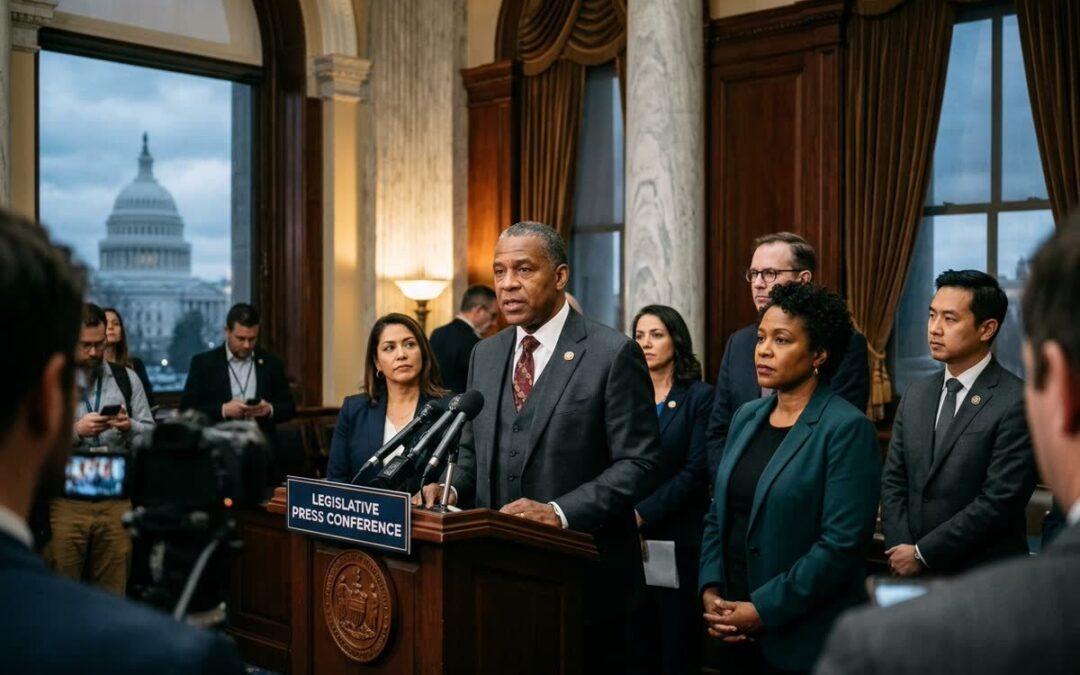
On November 10, 2026, the United States Capitol witnessed an unusual legislative alignment. Prominent Black lawmakers stepped forward to support a resolution introduced by Republican Representative Thomas Massie to remove Defense Secretary Pete Hegseth from office (iheart.com, cbsnews.com). Representatives Ayanna Pressley, Ilhan Omar, and Gregory Meeks stood united with House Democratic leaders against the Pentagon chief (iheart.com, house.gov). The immediate trigger was a nine-month unauthorized military campaign against Iran. However, the coalition drew its deepest momentum from an institutional crisis within the military itself (cnn.com, capitalbnews.org).
For months, lawmakers monitored the systematic removal of high-ranking minority and female military leaders. They observed deep rollbacks in diversity policies and the selective cancellation of promotion lists (militarytimes.com, capitalbnews.org). This clash reflects a broader legacy in Black political power, where civil rights protections at home remain tied to government accountability abroad. The movement to support a Secretary of Defense impeachment bridges constitutional war powers with the long struggle for racial equality in the ranks (justsecurity.org, capitalbnews.org).
The Roots of Equality: Executive Order 9981 Desegregation
The conflict over military promotions touches the raw nerve of a generational civil rights battle. For most of American history, the armed forces enforced strict racial segregation (archives.gov, wikipedia.org). Black soldiers served in segregated units under white commanders. They were largely restricted to manual labor, maintenance, and supply logistics rather than combat arms (wikipedia.org, army.mil). Even decorated service in World War II, exemplified by the Tuskegee Airmen and the 6888th Central Postal Directory Battalion, did not automatically secure equality at home or in uniform (archives.gov, wikipedia.org).
On July 26, 1948, President Harry S. Truman signed Executive Order 9981 desegregation into law (archives.gov). The order mandated equality of treatment and opportunity for all persons in the armed services regardless of race, color, religion, or national origin (archives.gov). Truman acted partly out of moral necessity and partly due to relentless pressure from civil rights leaders like A. Philip Randolph (archives.gov, wikipedia.org). The armed services took decades to dismantle institutional barriers fully. Integration was not instantaneous. It required continuous oversight to ensure Black troops had access to leadership ranks rather than remaining trapped in lower service grades (wikipedia.org, army.mil).
Black Representation in U.S. Armed Forces
Protecting Merit: The DOPMA Merit Promotion System
To end arbitrary promotions and political patronage, Congress stepped in during the post-Vietnam era. Lawmakers passed the Defense Officer Personnel Management Act of 1980, creating the DOPMA merit promotion system (everycrsreport.com). This statutory framework established transparent standards across all branches of service. Under Title 10 of the United States Code, independent boards evaluate officers through competitive, peer-reviewed processes (everycrsreport.com).
The DOPMA structure explicitly forbids racial quotas or numerical set-asides (everycrsreport.com). Instead, the law relies on merit, efficiency ratings, and records of command. In recent years, the Department of Defense adopted blinded selection reviews (militarytimes.com). Boards removed official candidate photographs and demographic details from dossiers to eliminate subconscious bias (militarytimes.com). Once statutory boards complete their evaluations, they submit lists through service secretaries to the Secretary of Defense (everycrsreport.com). By law and decades of unbroken custom, these slates move forward to the White House and the Senate Armed Services Committee without political interference (militarytimes.com, everycrsreport.com).
A critical institutional divide still complicates advancement within the officer corps. General officer ranks are drawn almost exclusively from combat arms branches such as infantry, artillery, and armor (militarytimes.com). Conversely, service support roles handle logistics, administration, and transportation. Because historical policies steered Black troops into support branches, modern military researchers at the Army War College studied why branch disparities persist (militarytimes.com). Examining these patterns is standard talent management. It ensures that structural pipelines do not inadvertently restrict qualified minority officers from combat command tracks (militarytimes.com).
Conscience of the Congress: Congressional Black Caucus Oversight
The alliance between anti-war positions and civil rights protections has deep historical roots. In April 1967, Dr. Martin Luther King Jr. delivered his speech titled “Beyond Vietnam: A Time to Break Silence.” King pointed out that the federal government spent billions of dollars on foreign wars while neglecting poor communities at home. He also noted that Black soldiers fought in disproportionate numbers for freedoms they did not enjoy in their own country.
Four years later, thirteen Black representatives founded the Congressional Black Caucus in 1971. The caucus adopted the moniker “Conscience of the Congress.” Founding members such as Representative Ronald Dellums of California secured seats on the House Armed Services Committee. Dellums exposed racial disparities in military justice, fought against weapons waste, and opposed unauthorized foreign interventions. This legacy established a tradition of rigorous Congressional Black Caucus oversight over the Pentagon.
Contemporary leaders follow this exact lineage. Lawmakers examine how domestic resources are depleted by military interventions abroad while basic community needs go unmet (iheart.com, house.gov). The historical voting and legislative representation championed by Black leaders established that Pentagon spending requires close public scrutiny. When modern representatives challenge defense spending, they act on a fifty-year tradition of legislative oversight (iheart.com, onceuponahill.com).
“If Hegseth was a real patriot and listening to the American people, he should resign.”
— Rep. Gregory Meeks, Ranking Member of the House Foreign Affairs Committee (iheart.com)
Undermining the Brass: Pentagon Military Promotion Purges
The friction between the Pentagon and civil rights advocates escalated sharply throughout 2026. Defense Secretary Pete Hegseth began breaking established military norms by intervening directly in peer-reviewed promotion slates (militarytimes.com, capitalbnews.org). In March 2026, Hegseth struck four vetted officers from an Army Brigadier General slate (militarytimes.com). The individuals removed included two Black male officers and two women (militarytimes.com). One Black armor officer was reportedly targeted simply for publishing an academic paper that examined minority branch selection in the military (militarytimes.com).
In June 2026, similar actions hit the United States Navy. Hegseth removed nine officers from a flag promotion slate, including all three female candidates and two Black officers (militarytimes.com, theguardian.com). The resulting list of twenty-two nominees contained only white male officers (militarytimes.com, theguardian.com). Veteran advocacy groups described these actions as deliberate Pentagon military promotion purges (commondefense.us, meidasplus.com). Hegseth claimed he was removing “DEI quotas” to restore color-blind merit (militarytimes.com, theguardian.com). However, military experts pointed out that the DOPMA system already banned quotas, meaning the removals actually overrode peer-reviewed merit (militarytimes.com, everycrsreport.com).
These actions followed the dismissal of high-ranking minority figures, including General Charles Q. Brown Jr., the second Black officer to serve as Chairman of the Joint Chiefs of Staff (theguardian.com, capitalbnews.org). Flag officers like Rear Admiral Nancy Lacore were also dismissed without substantive justification (theguardian.com). The rollbacks damaged the progression of Black military leadership and stripped away years of institutional gains (theguardian.com, capitalbnews.org). This sustained assault on the brass created deep resentment among civil rights leaders in Congress (iheart.com, onceuponahill.com).
Executive Removals from Promotion Lists (2026)
Statutory Deadlines Broken: War Powers Resolution Iran
While internal personnel conflicts escalated, external military engagements created a constitutional crisis. Congress enacted the War Powers Resolution of 1973 over President Richard Nixon’s veto to restrain executive military overreach (justsecurity.org, justsecurity.org). The statute requires the executive branch to terminate military actions within sixty days unless Congress formally authorizes force or declares war (justsecurity.org, justsecurity.org). Despite these statutory limits, the administration entered into sustained hostilities against Iran without congressional consent (cnn.com, justsecurity.org).
The conflict continued for nine months past statutory deadlines. Hegseth treated the mandatory requirements of the law as discretionary suggestions (justsecurity.org, justsecurity.org). The fighting caused severe regional instability and civilian casualties. On February 28, 2026, a military strike on the Shajareh Tayyebeh Elementary School killed more than one hundred civilians, including dozens of children (theguardian.com, justsecurity.org). This catastrophe violated international norms and statutory protections designed to shield civilians during hostilities (theguardian.com, justsecurity.org).
For Black lawmakers, the unauthorized conflict was deeply concerning. Communities of color bear the economic costs of unchecked defense spending while also supplying the service members sent into combat zones (iheart.com, house.gov). Global security entanglements also mirror broader questions of <a href="https://www.africanelements.org/news/why-black-activists-have-long-supported-the-palestinian-struggle/ across the diaspora. By ignoring the War Powers Resolution Iran mandate, the Pentagon operated outside constitutional governance (justsecurity.org, justsecurity.org).
A Rare Convergence: The Thomas Massie Impeachment Resolution
Representative Thomas Massie introduced a thirty-four-page resolution detailing eight articles of impeachment against Hegseth (cnn.com, reason.com). The charges focused on strict constitutional grounds: unauthorized warfare in Iran, illegal drone strikes in the Caribbean, operations in Yemen, and the detention of Venezuelan President Nicolás Maduro without statutory authorization (justsecurity.org, reason.com). Massie also cited retaliation against political critics, including Senator Mark Kelly (justsecurity.org, reason.com). The Thomas Massie impeachment resolution did not include the personnel purges, as Massie chose to concentrate solely on statutory violations of war powers (justsecurity.org, reason.com).
Cabinet impeachments are exceptionally rare in the history of the United States. Secretary of War William W. Belknap was impeached for corruption in 1876, and Homeland Security Secretary Alejandro Mayorkas faced a party-line impeachment in 2024 (georgetown.edu, medium.com). Unlike those prior proceedings, the push against Hegseth was bipartisan from its inception (cnn.com, cbsnews.com). Prominent Black Democrats seized on Massie’s legal framework to hold the defense secretary accountable (iheart.com, onceuponahill.com).
Representative Ayanna Pressley publicly denounced Hegseth as unfit for leadership (iheart.com, house.gov). Representative Ilhan Omar pointed to gross abuses of office, highlighting civilian casualties and extrajudicial strikes (iheart.com, house.gov). House Democratic Leader Hakeem Jeffries declared himself a firm supporter of the impeachment measure (cbsnews.com, cbsnews.com). Although their motivations combined anti-war principles with the defense of marginalized officers, Black leaders provided critical legislative weight to the resolution (iheart.com, capitalbnews.org).
House Floor Vote on Hegseth Resolution (Nov 10, 2026)
On November 10, House Republican leaders managed to shelve the resolution using a procedural motion to refer it to the Judiciary Committee by a vote of 211 to 204 (cbsnews.com, indiatimes.com). Every voting Democrat and Representative Massie opposed shelving the measure (cbsnews.com, indiatimes.com). While the maneuver protected Hegseth temporarily during the lame-duck session, it set up an immediate confrontation for the incoming 120th Congress (cnn.com, onceuponahill.com). The historic struggle against racial caste systems continues within federal institutions today, demonstrating that the fight for fair representation remains active at the highest levels of national defense.
About the Author
Darius Spearman is a professor of Black Studies at San Diego City College, where he has been teaching for over 20 years. He is the founder of African Elements, a media platform dedicated to providing educational resources on the history and culture of the African diaspora. Through his work, Spearman aims to empower and educate by bringing historical context to contemporary issues affecting the Black community.
