


School Discipline: The Deep History of Racial Inequality
By Darius Spearman (africanelements)
Support African Elements at patreon.com/africanelements and hear recent news in a single playlist. Additionally, you can gain early access to ad-free video content.
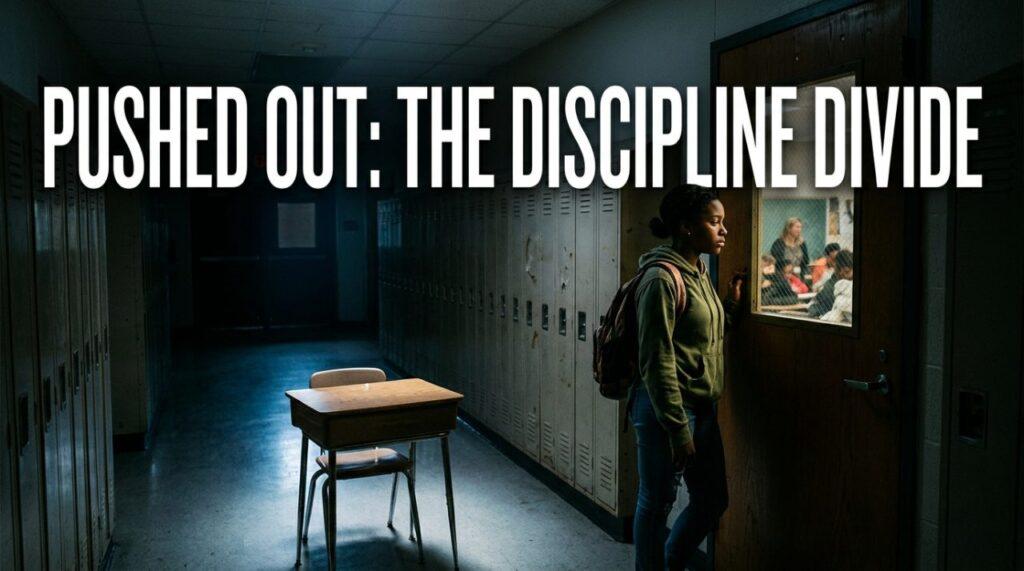
The latest federal civil rights data paints a stark picture of the American education system. Out-of-school suspensions now affect roughly 2.5 million students, resulting in more than 14 million lost instructional days (ed.gov). Most alarming is the profound racial gap that persists despite decades of reform efforts. Black students lose over four times as many instructional days as their white classmates, a disparity largely driven by subjective, non-violent infractions like classroom disruption or dress code violations (ed.gov, ed.gov). While current discourse frames these metrics as a post-pandemic behavioral crisis, the reality is that these figures represent the culmination of a half-century pattern of systemic exclusion (childrensdefense.org, ucla.edu).
The Foundations of Disciplinary Disparity (1968–1975)
The modern obsession with exclusionary discipline was not always the norm. Following the 1954 Brown v. Board of Education decision, public education underwent a seismic, often turbulent transition. As schools integrated, the infrastructure of education shifted, leading to the displacement of tens of thousands of Black educators who had provided a protective cultural buffer for their students (fordhamlawreview.org, learningpolicyinstitute.org). When Black students moved into predominantly white institutions, their cultural norms, communication styles, and modes of expression were frequently misinterpreted by white educators as defiance or hostility (brown.edu, waldenu.edu).
By 1968, the Office for Civil Rights established the Civil Rights Data Collection to monitor compliance with Title VI (ed.gov). It quickly became apparent that schools were not providing equal access. In 1975, the Children’s Defense Fund published a landmark report titled School Suspensions: Are They Helping Children? which revealed that Black students were already being suspended at twice the rate of their white peers (childrensdefense.org). Even then, the research found that suspensions were rarely used for violent acts. Instead, they were used for minor behavioral issues. The report concluded that exclusionary discipline offered no rehabilitative value and effectively pushed children out of the classroom and onto the street (childrensdefense.org, childrensdefense.org).
Black-White Suspension Disparity Trends
The Zero-Tolerance Era and Institutionalized Policing
The political climate of the 1980s and 1990s accelerated the shift to mass incarceration, a phenomenon that bled directly into school policy. Criminologists pushed theories such as “Broken Windows,” which argued that cracking down on minor disorder would prevent serious crime (ucla.edu). Following the passage of the 1994 Gun-Free Schools Act, many districts adopted rigid zero-tolerance policies that applied punitive, exclusionary measures to non-violent behaviors (ed.gov). This era saw the introduction of school-based police, often under the guise of the COPS program, which fundamentally altered the atmosphere of the American school (youthlaw.org).
The “juvenile superpredator” myth served as the ideological fuel for these policies. Although later debunked, this panic encouraged the criminalization of youth behavior (ucla.edu). Schools began to treat classrooms like precincts, and students like suspects. The involuntary servitude legacy of the post-Reconstruction era found a new echo in the school-to-prison pipeline, as exclusionary discipline funneled students directly into the justice system (ucla.edu). Today, more than 55% of out-of-school suspensions are linked to non-violent, subjective conduct, proving that the disciplinary practices born in the 1990s remain the standard operating procedure (ucla.edu).
Suspension Source: Subjective vs Objective
The Mechanism of Adultification Bias and Exclusion
The disproportionate discipline of Black girls serves as a chilling case study in the role of the sexism faced by Black women in American institutions. Research into “adultification bias” confirms that authority figures perceive Black girls as less innocent and more mature than their white peers (nih.gov, nih.gov). This bias leads to the mischaracterization of routine adolescent behavior—such as questioning authority or self-expression—as aggressive or insubordinate (ucla.edu). Consequently, Black girls are suspended at three times the rate of their white counterparts (ucla.edu).
For Black girls and boys alike, the path from classroom to court is often swift. A single suspension increases the probability of dropping out by 77%, and high school dropouts face significantly higher rates of incarceration (learningpolicyinstitute.org, ucla.edu). This cycle of academic alienation and social abandonment is not an accident of the system but rather its intended function (tdl.org). The sharing of power between state and national levels has historically allowed local school districts to maintain punitive practices even when federal guidance suggests otherwise (ed.gov). Consequently, the historical factors that have marginalized Black students continue to operate effectively in the modern era (ucla.edu).
Black Girls’ Disproportionate Discipline
Reclaiming the Classroom: Restorative Justice
Addressing these disparities requires a fundamental rejection of the punitive status quo. Restorative Justice (RJ) represents a critical alternative to traditional discipline. Rather than relying on out-of-school suspensions, RJ practices utilize community circles and facilitated dialogues to address the root causes of conflict (aclu-ms.org). This approach emphasizes repairing harm rather than punishing the individual, keeping students in the classroom where they belong (patch.com).
Structural change requires states to ban exclusionary practices for subjective categories like “willful defiance” (mannersfirst.org). Furthermore, districts must reinvest in counseling and behavioral support systems, moving resources away from law enforcement and into the hands of those trained to support student development (usccr.gov, michigan.gov). The path toward educational equity is clear, yet it demands the courage to dismantle the punitive infrastructure that has defined the American school experience for far too long (ed.gov, aclu-ms.org).
About the Author
Darius Spearman is a professor of Black Studies at San Diego City College, where he has been teaching for over 20 years. He is the founder of African Elements, a media platform dedicated to providing educational resources on the history and culture of the African diaspora. Through his work, Spearman aims to empower and educate by bringing historical context to contemporary issues affecting the Black community.
