

Supreme Court California Ballots: Why the Push Failed
By Darius Spearman (africanelements)
Support African Elements at patreon.com/africanelements and hear recent news in a single playlist. Additionally, you can gain early access to ad-free video content.
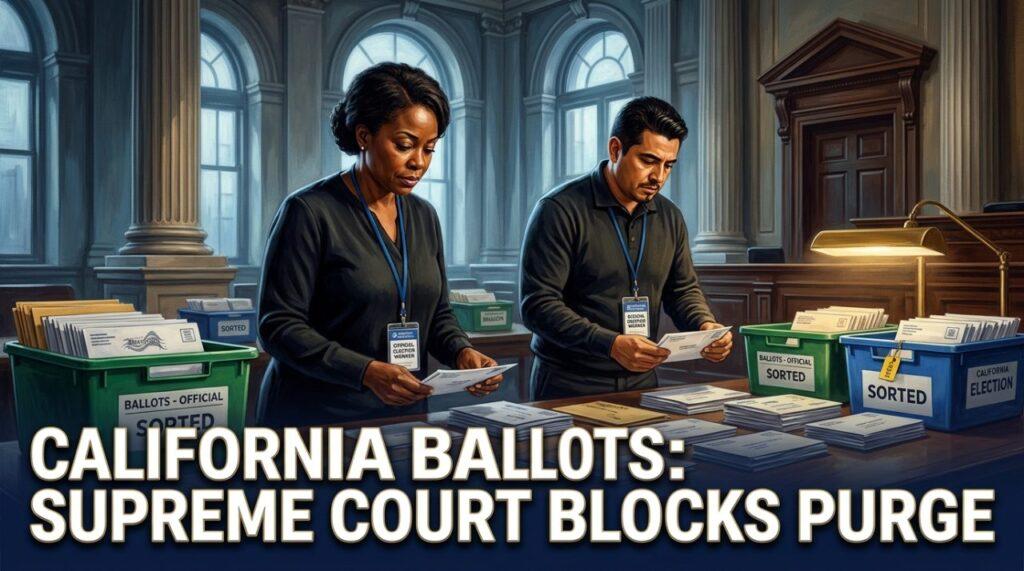
Hours before the opening of polling places across the country, the Supreme Court of the United States brought an abrupt halt to an aggressive federal intervention into state election administration. In a brief, unsigned order issued without public dissents, the justices rejected an emergency application filed by the Department of Justice. The federal government had sought to compel election administrators in California to segregate and withhold more than 20,000 mail-in ballots. Federal attorneys alleged that these ballots belonged to noncitizens (democracydocket.com, washingtonpost.com).
The emergency petition regarding Supreme Court California ballots arrived at the peak of the 2026 midterm election litigation cycle. Federal prosecutors argued that immediate action was necessary to preserve election integrity. Yet federal judges in lower courts found that the government built its case upon deeply flawed data matches that swept up eligible voters. The decision reflects a long legal tradition governing elections, but it also highlights ongoing debates over citizenship, federalism, and the constitutional limits of executive authority (washingtonpost.com, uscourts.gov).
Alien Suffrage History and the Evolution of the Franchise
The debate surrounding California noncitizen voting claims touches upon a long history of shifting legal definitions. In the early decades of the republic, citizenship was not an absolute requirement for casting a ballot. Between 1776 and the 1920s, at least 40 states and federal territories permitted noncitizens to participate in elections. These voters were commonly known as declarant aliens, referring to immigrant residents who had formally stated their intention to naturalize (nypl.org, cambridge.org).
During the nineteenth century, expanding western states deliberately used voting rights to draw European immigrant settlers to agricultural lands. This period of alien suffrage history came to an end during the early twentieth century. Rising nativism following World War I, anxiety surrounding the 1917 Russian Revolution, and political tensions in urban centers led states to restrict the franchise. Arkansas became the final state to eliminate noncitizen voting in statewide contests when it amended its constitution in 1926 (nypl.org, wikipedia.org).
Modern federal statutes established the current framework governing registration and eligibility. In 1996, Congress enacted the Illegal Immigration Reform and Immigrant Responsibility Act. Under 18 U.S.C. Section 611, noncitizens face criminal penalties, imprisonment, and deportation if they vote in federal elections (justice.gov, americanimmigrationcouncil.org). Consequently, the actual rate of noncitizen registration across the United States remains exceedingly rare (brennancenter.org, brennancenter.org).
Historical U.S. Noncitizen Voting Rights (States Permitting)
Voting Rights Act Preclearance and the Legacy of Voter Suppression
Modern efforts to challenge registration records are connected to older disenfranchisement strategies. Following the Reconstruction era, southern states established systematic administrative hurdles designed to prevent Black citizens from voting. These mechanisms included arbitrary registration challenges, literacy exams, and selective record cancellations. The Voting Rights Act of 1965 sought to eliminate these barriers by instituting strong federal oversight (brennancenter.org, brennancenter.org).
Central to that statutory framework was Section 5. Under this provision, jurisdictions with documented histories of discriminatory voting laws had to obtain federal approval before changing election administration practices. This requirement, known as Voting Rights Act preclearance, prevented state and local officials from implementing aggressive, unverified list purges without advance review (brennancenter.org, democracydocket.com). The balance of authority between the states and the national government has long shaped the struggle for civil rights, a dynamic explored in historical assessments of federalism and Black politics.
In the 2013 ruling Shelby County v. Holder, the Supreme Court invalidated the coverage formula that determined which jurisdictions required preclearance. Studies conducted by civil rights organizations showed that voter purge rates rose substantially across formerly covered jurisdictions in the years following that decision (brennancenter.org, brennancenter.org). Without proactive administrative screening, civil rights organizations must rely on reactive litigation to stop rapid list cancellations that threaten lawful voters (brennancenter.org, democracydocket.com).
Faulty Voter Roll Purges and Database Disenfranchisement
The litigation in California mirrors prior state-level efforts that used mismatched administrative records to challenge registered voters. In 2012, Florida officials attempted to review 180,000 registered voters by cross-referencing state driver files with federal immigration registries. That initial list shrank to roughly 2,600 names and finally produced fewer than 100 ineligible records. Almost all of those flagged were lawful naturalized citizens whose records were outdated at the state agency (brennancenter.org, brennancenter.org).
A similar administrative failure occurred in Texas in 2019. The Texas Secretary of State distributed an advisory identifying 95,000 registered voters as potential noncitizens. Civil rights groups filed federal lawsuits demonstrating that between 25,000 and 40,000 of the individuals on the list were naturalized citizens who obtained driver licenses prior to completing naturalization. The state settled the lawsuit, agreed to discard the list, and paid substantial legal fees (texastribune.org, sos.state.tx.us).
These errors stem from the technical limitations of automated matching systems, including the SAVE database citizenship check. The Systematic Alien Verification for Entitlements program operated by the Department of Homeland Security was created to determine eligibility for public benefits. It captures static records from past immigration interactions. If an immigrant becomes a naturalized citizen through U.S. Citizenship and Immigration Services, state motor vehicle records do not always reflect that change automatically (campaignlegal.org, americanimmigrationcouncil.org).
This technical gap causes faulty voter roll purges that disproportionately burden naturalized citizens voting rights. The foreign-born Black population in the United States exceeds 5 million people, with many tracing their origins to nations across the Caribbean and the African continent (migrationpolicy.org, americanimmigrationcouncil.org). Compound naming structures, clerical errors during agency data entry, and frequent residential changes make immigrant communities of color especially vulnerable to false database matches. When election administrators issue removal notices, the burden shifts to lawful citizens to produce original papers on short notice (campaignlegal.org, aclutx.org).
Voter Roll Challenges: False-Match Proportions
The DOJ California Election Lawsuit and the October List
The conflict in California began in mid-October 2026, when officials from Homeland Security Investigations and USCIS compiled a registry that became known in court proceedings as the October List. The document contained approximately 20,930 registered voters in California who were flagged as potential noncitizens. Federal officials transferred this file on a thumb drive to election administrators in Los Angeles and Sacramento counties, demanding that local authorities check their rolls and isolate any mail ballots cast by those individuals (washingtonpost.com, independent.com).
Los Angeles County Registrar-Recorder Dean Logan declined the request, pointing out that the federal government provided no verified evidentiary record to justify setting aside ballots. In response, the federal government initiated the DOJ California election lawsuit to force local compliance. The legal action immediately drew intense scrutiny over the methods used to create the list (independent.com, calmatters.org).
The case went before U.S. District Judge David O. Carter in the Central District of California. Judge Carter denied the government request for a temporary restraining order. Court testimony revealed that federal personnel were instructed to complete citizenship reviews with only 12 minutes allotted per file, relying on conflicting and outdated agency records (washingtonpost.com). Judge Carter ruled that the administrative effort was rife with uncertainty and errors, characterizing the eleventh-hour demand as an unprecedented attempt to bypass state authority (washingtonpost.com, uscourts.gov).
Parallel legal challenges brought by the Coalition for Humane Immigrant Rights revealed further structural defects in the government claims. An independent review conducted by legal teams and academic researchers discovered that more than 40 percent of the individuals listed on the government thumb drive were not even registered on California voting rolls (washingtonpost.com). Among the registered voters who were identified, many were confirmed naturalized citizens who completed registration after taking their oaths of citizenship (democracydocket.com, washingtonpost.com). Questions of racial equity and historical accountability continue to shape the state, as highlighted by debates over reparations in California.
The NVRA 90 Day Quiet Period and Procedural Disenfranchisement
Federal election statutes contain specific timing protections to stop disruptive administrative maneuvers before voting concludes. Section 8 of the National Voter Registration Act of 1993 establishes what is known as the NVRA 90 day quiet period. Under 52 U.S.C. Section 20507(c)(2), states must complete systematic list-maintenance programs aimed at removing ineligible names no later than 90 days prior to a federal election (protectdemocracy.org, brennancenter.org).
The quiet period exists because systematic database checks conducted immediately before an election frequently produce administrative errors that cannot be corrected before ballots are counted. The government demand to segregate ballots was designed to bypass this provision. In election administration, ballot segregation involves physically separating provisional or challenged ballots from the regular counting stream while eligibility is reviewed (campaignlegal.org, uscourts.gov).
While distinct from historical racial segregation, ballot segregation often leads to procedural disenfranchisement. Challenged voters receive provisional ballots that are withheld from certified counts until documentation is presented. Because statutory cure windows are short, voters frequently lack sufficient notice and time to secure replacement naturalization documents before canvass deadlines pass (campaignlegal.org, protectdemocracy.org). The use of administrative systems to restrict civic standing reflects patterns observed in studies of mass incarceration.
When the DOJ appealed Judge Carter’s order, the U.S. Court of Appeals for the Ninth Circuit affirmed the lower court decision in a 2–1 ruling. Judges Mark Bennett and Gabriel Sanchez concluded that setting aside tens of thousands of ballots during an ongoing election where millions of residents had already voted posed a direct threat to lawful voters. The court stressed that the quiet period rules barred such late administrative purges (democracydocket.com, uscourts.gov).
California Electorate vs. DOJ List Size (2026)
Purcell Principle Election Law and the Supreme Court Order
Following its defeat at the Ninth Circuit, the administration submitted an emergency application to the high court. Solicitor General D. John Sauer argued under the Supremacy Clause that commingling disputed ballots would cause irreparable harm to the federal contest. The case reached the justices on the afternoon before Election Day, prompting immediate consideration (democracydocket.com, washingtonpost.com).
The request directly collided with established judicial precedent governing eleventh-hour intervention. Under the doctrine known as the Purcell principle election law, federal courts are instructed not to change state election procedures immediately before an election. Established in the 2006 case Purcell v. Gonzalez, this rule protects voters from confusion and shields election workers from sudden administrative burdens while voting is underway (protectdemocracy.org, electionlawblog.org).
The constitutional architecture of the United States assigns the administration of elections primarily to the states. Under Article I, Section 4 of the U.S. Constitution (the Elections Clause), state legislatures determine the times, places, and manner of holding federal elections, subject to revisions enacted by Congress. The executive branch has no independent constitutional power to dictate specific ballot management rules to county registrars (uscourts.gov, brennancenter.org).
The Supreme Court denied the emergency application without dissent and without requiring California officials to file a responsive brief. The order ended the federal attempt to segregate California ballots, affirming that administrative list sweeps based on faulty databases cannot displace statutory protections and state constitutional authority on the eve of an election (democracydocket.com, washingtonpost.com).
About the Author
Darius Spearman is a professor of Black Studies at San Diego City College, where he has been teaching for over 20 years. He is the founder of African Elements, a media platform dedicated to providing educational resources on the history and culture of the African diaspora. Through his work, Spearman aims to empower and educate by bringing historical context to contemporary issues affecting the Black community.
