


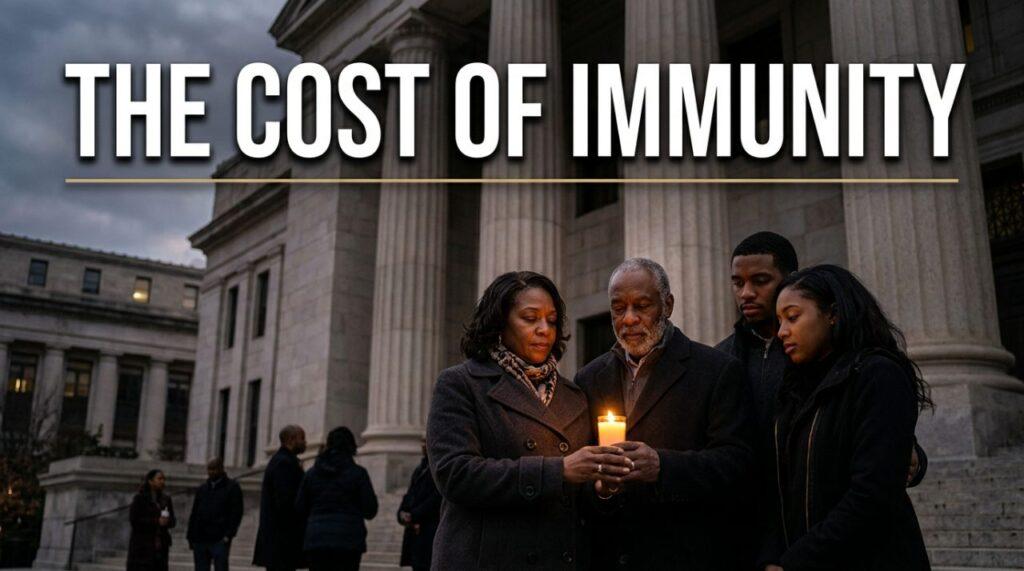
The Fatal Cost of Police Immunity in Mississippi
By Darius Spearman (africanelements)
Support African Elements at patreon.com/africanelements and hear recent news in a single playlist. Additionally, you can gain early access to ad-free video content.
The death of one-year-old Kohen Wiley in Senatobia, Mississippi, represents more than a local tragedy; it serves as a stark reminder of how systemic immunity functions within the American policing apparatus. When Mississippi Attorney General Lynn Fitch recently declared the actions of Sergeant Hunter Foster “justified,” she closed a state-level investigation that had effectively shielded the officer from public scrutiny (attorneygenerallynnfitch.com, mississippifreepress.org). This ruling, delivered without the release of key video evidence, has sparked national outrage and rekindled painful memories of how the state apparatus often fails to provide accountability for Black lives lost at the hands of law enforcement (naacpldf.org, cnn.com).
Police Accountability Reality
The Weight of History: Policing and Racial Friction in Senatobia
To understand the killing of Kohen Wiley, one must examine the environment in which the Senatobia Police Department operates. Senatobia is a small city where African Americans comprise nearly 40 percent of the population, yet the history of the police department is marked by documented racial prejudice (localmemphis.com, veritenews.org). Before the fatal shooting in June 2026, the department faced intense criticism for its aggressive tactics toward Black residents. In 2023, the department made national news when an officer arrested a 10-year-old child for urinating in a parking lot, a move that critics viewed as the criminalization of childhood (13newsnow.com, newpittsburghcourier.com).
These events are not isolated aberrations but are rooted in a broader political shift that prioritized aggressive law enforcement over community welfare. Internal documents later revealed that Police Chief Harold Vanderford routinely used anti-Black racial slurs, highlighting a culture of bias that persisted until his termination in September 2026 (mississippifreepress.org). Sergeant Hunter Foster, who fired the fatal shot, was himself subject to complaints for using racially derogatory language just days before the incident (mpbonline.org). This environment of institutionalized bias creates a dangerous foundation where minor property disputes, such as an alleged shoplifting call, can escalate into lethal encounters.
The Legal Architecture of Immunity
The decision by the Mississippi Attorney General to clear the officer relies on a specific legal structure that often insulates police from criminal liability. Section 45-1-6 of the Mississippi Code, enacted in 2022, effectively centralized the power to investigate and prosecute officer-involved shootings within the office of the Attorney General (ls.state.ms.us, ls.state.ms.us). While lawmakers framed this as a way to avoid local conflicts of interest, civil rights advocates argue that it has created a closed system where the state evaluates its own agents without significant public transparency (mississippifreepress.org).
Legislative Impact
This centralization mirrors historical struggles, such as the era of convict leasing, where legal systems were manipulated to maintain control over marginalized bodies (negrodigest.com). In this current context, the “moving vehicle” doctrine—a tactic frequently used to justify lethal force—serves as a primary tool for securing non-indictment (mappingpoliceviolence.us). Despite national policing standards, such as those from the Police Executive Research Forum, which advise against firing at moving vehicles because it rarely stops the threat and often endangers passengers, the legal justification remains largely intact (security.org, nih.gov). The disconnect between professional best practices and the legal standard of “reasonableness” allowed the Attorney General to conclude that no crime was committed, leaving the family without legal recourse at the state level (attorneygenerallynnfitch.com).
Beyond Local Jurisdictions: The Federal Call to Action
When state processes effectively grant immunity, advocates often look toward federal civil rights statutes, particularly 18 U.S.C. § 242. This federal statute allows the Department of Justice to prosecute individuals who willfully deprive others of their constitutional rights under color of law (findlaw.com). However, the bar for federal intervention is incredibly high, as prosecutors must prove that the officer had a specific intent to violate a constitutional right—an evidentiary threshold that often turns away even the most compelling cases of police misconduct (wbal.com).
The call for an independent federal review by groups like the NAACP Legal Defense Fund highlights a persistent theme: the struggle for justice is rarely limited to a single case (naacpldf.org). Just as historical activists fought against systemic exclusions, the movement to address police violence seeks to dismantle the structures that make such killings possible in the first place (theguardian.com). Public demands for the release of bodycam footage underscore a fundamental lack of trust in official narratives that have, for too long, relied on secrecy to maintain the status quo (mpbonline.org).
Racial Disparity in Police Killings
The path forward requires more than just acknowledging the tragedy; it necessitates a deep structural audit of how municipalities treat their citizens (pbs.org). When an officer can kill a child for an alleged theft of diapers without consequence, the legitimacy of the entire system is brought into question. As civil rights organizations continue to push for an independent investigation, the story of Kohen Wiley becomes a part of the historical record, a marker of a time when the call for accountability finally met the unyielding wall of state power (naacpldf.org, desotocountynews.com).
About the Author
Darius Spearman is a professor of Black Studies at San Diego City College, where he has been teaching for over 20 years. He is the founder of African Elements, a media platform dedicated to providing educational resources on the history and culture of the African diaspora. Through his work, Spearman aims to empower and educate by bringing historical context to contemporary issues affecting the Black community.
