

Why Black Voter Turnout Rises As Trust Collapses
By Darius Spearman (africanelements)
Support African Elements at patreon.com/africanelements and hear recent news in a single playlist. Additionally, you can gain early access to ad-free video content.
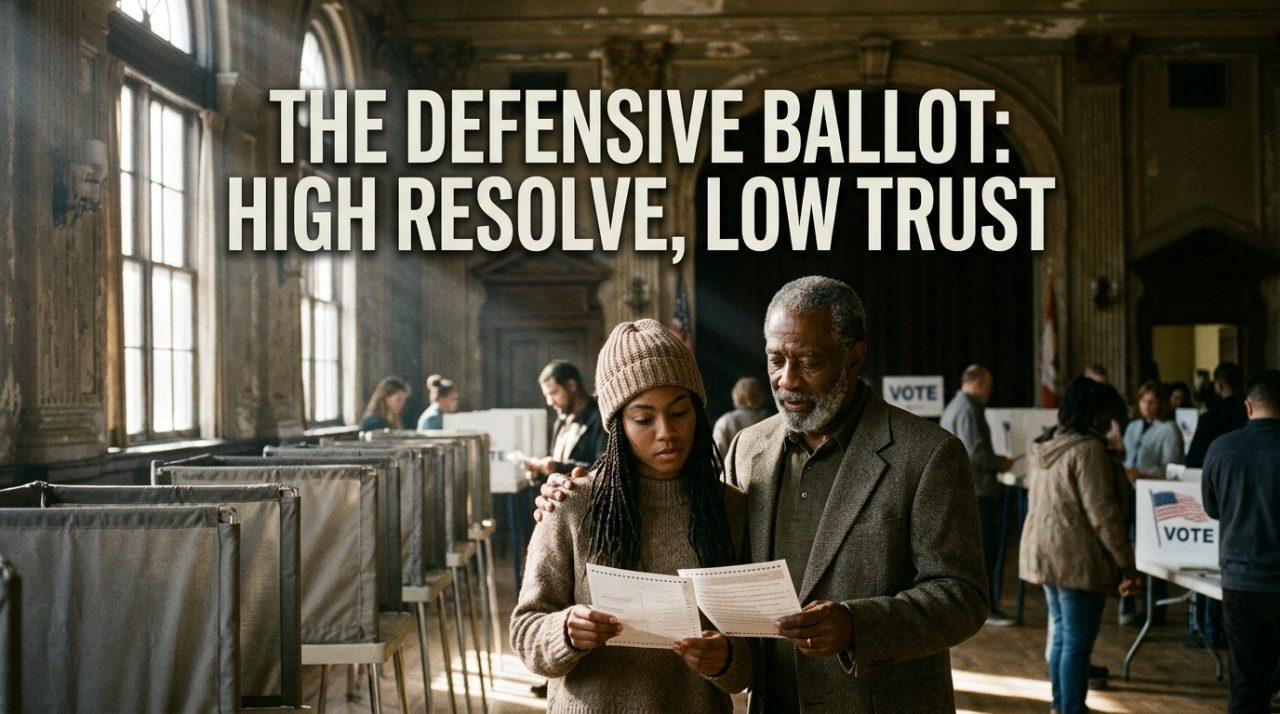
Recent survey data from across the United States reveals a striking contradiction in American civic life. Black Americans report determination to participate in upcoming elections at exceptionally high levels (essence.com). At the same exact moment, their confidence in government institutions has fallen to historic lows (blackenterprise.com). This tension defines the latest findings of the Black Census Project, administered by the Black Futures Lab (blackfutureslab.org, blackfutureslab.org).
The survey gathered responses from across all fifty states and the District of Columbia (essence.com, blackfutureslab.org). Ninety-five percent of surveyed participants stated that they intend to cast a ballot in upcoming electoral contests (essence.com). This high intention spans across generations, showing equal resolve among voters under thirty (blackenterprise.com). Yet, only three percent of respondents reported that they trust the federal government to address their concerns (essence.com). Furthermore, only twenty-two percent expressed confidence in Black elected officials (blackenterprise.com).
Rather than pointing to political apathy, the findings highlight a sophisticated civic philosophy. Black voters continue to cast ballots while remaining deeply skeptical of institutional benevolence. This dynamic reflects long-standing debates on political representation and civic survival. Ballots serve as defensive instruments rather than expressions of trust in systemic fairness.
Civic Participation Versus Institutional Trust
Reconstruction and the Fragile Promise of Enfranchisement
The gap between high voter participation and deep skepticism has long historical origins. Following the American Civil War, constitutional amendments established legal rights for formerly enslaved people. The Thirteenth, Fourteenth, and Fifteenth Amendments abolished chattel slavery, guaranteed equal protection, and prohibited racial discrimination in voting. African Americans mobilized immediately, transforming southern political structures during early Reconstruction.
Between 1865 and 1877, Black civic turnout reached historic heights across the American South. Formerly enslaved citizens organized civic leagues, founded schools, and registered eligible voters. These efforts resulted in the election of more than fifteen hundred Black public officials. States sent leaders such as Hiram Revels and Blanche K. Bruce of Mississippi to the United States Senate. Black legislators served in southern statehouses, passing foundational laws establishing free public education systems.
This period of civic expansion was brief. The Compromise of 1877 removed federal troops from the former Confederacy, ending federal protection. White conservative politicians quickly seized state legislatures and dismantled multiracial governance. Southern states instituted poll taxes, literacy tests, grandfather clauses, and white primaries. These barriers coincided with state-sanctioned violence and post-Civil War labor and legal traps that eliminated basic liberties. This historical betrayal established an enduring truth: rights granted by the federal state could be revoked whenever political priorities shifted.
The Civil Rights Era and the Limits of Symbolic Inclusion
Mid-twentieth-century civil rights movements resumed the battle for voting access with focused urgency. Organizations like the Student Nonviolent Coordinating Committee organized voter registration drives across the rural South. Activists encountered brutal intimidation, police violence, and economic retaliation. Grassroots organizers maintained clear expectations about systemic political parties and their leadership.
In 1964, the Mississippi Freedom Democratic Party mounted an open challenge at the Democratic National Convention. Led by Fannie Lou Hamer, the delegation protested the seating of an all-white, segregationist state delegation. National party leaders offered a compromise of two non-voting, at-large seats to avoid alienating conservative southern delegates. Hamer and her colleagues rejected the offer, observing that token inclusion offered no genuine protection for vulnerable communities. The event exposed how major parties prioritized institutional power over democratic justice.
The Voting Rights Act of 1965 established federal oversight of state voting procedures. Section 5 forced jurisdictions with discriminatory records to submit proposed voting alterations for federal preclearance. Black voter registration rose significantly across the American South within a few short years. Organizers emphasized that voting access alone would not dismantle systemic economic inequality. Access to the ballot box did not automatically deliver equitable public investment or physical safety for Black neighborhoods.
Descriptive Representation and Municipal Realities
In the decades following the civil rights movement, Black political mobilization achieved significant electoral milestones. Pioneering Black mayors won elections in major American cities, including Gary, Cleveland, Detroit, and Atlanta. These victories generated immense community pride and carried expectations of transformative social investment. However, these newly elected officials inherited cities undergoing rapid deindustrialization and widespread white flight.
As corporate entities and wealthier residents fled to suburban areas, municipal tax bases collapsed. City administrations faced severe revenue shortages that constrained public budgets. Executives lacked the capital needed to fund robust redistributive social programs or revitalize aging public infrastructure. Instead, mayors found themselves managing austerity budgets and negotiating financial survival with private lenders and state officials. Public policies frequently prioritized commercial downtown construction and tax incentives for businesses rather than direct community investment.
This dynamic created deep rifts between descriptive representation and substantive outcomes. Having Black officials in office did not shield working-class neighborhoods from systemic decline. Over subsequent decades, federal policies expanded punitive criminal justice systems and reduced housing subsidies. The racial wealth gap widened across the nation while municipal schools faced persistent underfunding. These institutional limits fostered growing disillusionment with political figures who aligned with party establishments rather than enacting redistributive measures.
The Dilemma of Electoral Capture
Political scientists describe the relationship between Black voters and mainstream institutions as electoral capture. Over the late twentieth century, Black voters coalesced solidly behind the Democratic Party. This alignment created a predictable voting bloc that routinely decided national, state, and local contests. Yet, steady loyalty produced mixed returns in federal public policy.
Under electoral capture, one party takes a constituency for granted because that group has limited viable alternatives. Meanwhile, the competing political party largely ignores or actively disenfranchises that same community. Consequently, national campaigns regularly depend on high Black voter turnout while offering vague commitments rather than binding legislation. This pattern has driven deep discussions regarding Black politics and power dynamics inside national party coalitions.
The findings of the Black Census Project document widespread resistance to this dynamic (blackfutureslab.org, blackfutureslab.org). Today, twenty-eight percent of Black respondents identify as politically independent, up seven percentage points from 2022 (essence.com, blackfutureslab.org). Sixty-one percent identify as Democrats, seven percent align with third parties, and four percent identify as Republicans (essence.com). The expansion of independent registration reflects a clear refusal to grant unconditional partisan loyalty without guaranteed policy results.
Black Voter Political Identification
The Ballot as a Defensive Tool in the Post-Shelby Era
Why do Black voters turn out in overwhelming numbers despite holding profound distrust toward government institutions? The answer lies in modern judicial retrenchment. In the 2013 decision Shelby County v. Holder, the United States Supreme Court eliminated key safeguards from the Voting Rights Act (fairelectionscenter.org). The court struck down Section 4(b), the coverage formula that determined which states required federal preclearance before changing voting laws (fairelectionscenter.org).
The removal of preclearance unleashed a wave of restrictive election statutes across former covered jurisdictions (fairelectionscenter.org). State legislatures swiftly passed strict photo identification requirements and reduced early voting periods (fairelectionscenter.org). Election officials closed thousands of neighborhood polling stations in predominantly non-white precincts (fairelectionscenter.org). Furthermore, aggressive voter roll purges removed eligible citizens from active voter registries without adequate notice (fairelectionscenter.org).
These actions demonstrated that voting rights remain vulnerable to rollbacks by state authorities. In response, Black communities approach voting as a defensive necessity rather than an affirmation of the political system. Casting a ballot acts as a vital safeguard against hostile policies, judicial appointments, and legal retrenchment. Participation is an act of self-defense aimed at preserving basic civil protections.
Economic Survival Over Partisan Loyalty
The latest findings from the Black Census Project clarify community policy priorities. Respondents consistently prioritize material security and tangible economic policies over rhetorical party appeals (blackfutureslab.org). Thirty-eight percent of surveyed participants identified low wages that fail to support a family as their primary concern (blackfutureslab.org). Rising costs of living, housing instability, and insufficient healthcare access dominated respondent answers across regional lines (essence.com, blackfutureslab.org).
This economic focus highlights dissatisfaction with symbolic gestures. In past decades, political campaigns frequently treated descriptive racial representation as sufficient progress. Yet, having Black leaders in public office has not eliminated systemic racial wealth disparities. Survey respondents demand structural policies that build household wealth, fund public schools, and provide reliable community healthcare (blackfutureslab.org). Voters seek concrete measures that improve daily living conditions.
Furthermore, respondents demand direct institutional reform. Twenty-three percent of surveyed voters who express low trust in government support structural changes such as abolishing the Electoral College (essence.com). The historical connection between institutional neglect and economic hardship remains central to modern civic awareness. Contemporary voters view economic stability and political self-determination as deeply interconnected struggles.
Reported Policy Demands and Priorities
Implementing Co-Governance Beyond the Election Cycle
To overcome systemic neglect, community organizers advocate for a transition away from transactional campaign mobilization. Traditional political operations focus on contacting Black voters only during the weeks immediately preceding an election. Once polls close, campaign infrastructure recedes, leaving residents without direct access to decision-making processes. This recurring cycle has deepened institutional distrust across generations.
In response, modern civic organizations emphasize models of co-governance. Co-governance integrates grassroots community organizations directly into the design, budgeting, and implementation of public policies. Rather than remaining passive voters, residents participate directly in legislative and administrative decisions. This approach echoes historical ideological debates on liberation that stressed self-determination and independent community power over establishment alliances.
Practical examples of co-governance exist across several American municipalities:
- Participatory Budgeting: Cities such as New York and Chicago enable neighborhood residents to deliberate, draft, and vote directly on how to spend millions of dollars in municipal capital funds.
- People’s Assemblies: Grassroots coalitions in Jackson, Mississippi, established recurring public assemblies where community members review proposed municipal policies and vet economic development plans.
- Independent Oversight Boards: Community-led boards establish enforceable policies governing local law enforcement, housing codes, and zoning regulations prior to official city council votes.
The Future of Black Civic Mobilization
The findings from the Black Census Project document a decisive shift in modern civic engagement (blackfutureslab.org, blackfutureslab.org). Black voters continue to mobilize with exceptional discipline while discarding uncritical trust in public institutions (essence.com, blackenterprise.com). This dual posture combines high civic action with deep skepticism, forged through more than a century of broken legislative promises and retracted constitutional protections.
By treating the ballot as an urgent defensive tool, Black communities defend hard-won political gains against systematic retrenchment. At the same time, the steady expansion of political independence demonstrates that future civic support will not be granted automatically (essence.com). Future engagement depends on the delivery of tangible economic investments, living wages, and genuine co-governance models (blackfutureslab.org). The ballot remains an essential mechanism for community protection, wielded with full awareness of the structural limitations of the American state.
About the Author
Darius Spearman is a professor of Black Studies at San Diego City College, where he has been teaching for over 20 years. He is the founder of African Elements, a media platform dedicated to providing educational resources on the history and culture of the African diaspora. Through his work, Spearman aims to empower and educate by bringing historical context to contemporary issues affecting the Black community.
