

Why Did Courts Block Racial Justice Act Records?
By Darius Spearman (africanelements)
Support African Elements at patreon.com/africanelements and hear recent news in a single playlist. Additionally, you can gain early access to ad-free video content.
A Critical Ruling on Systemic Bias and Public Records
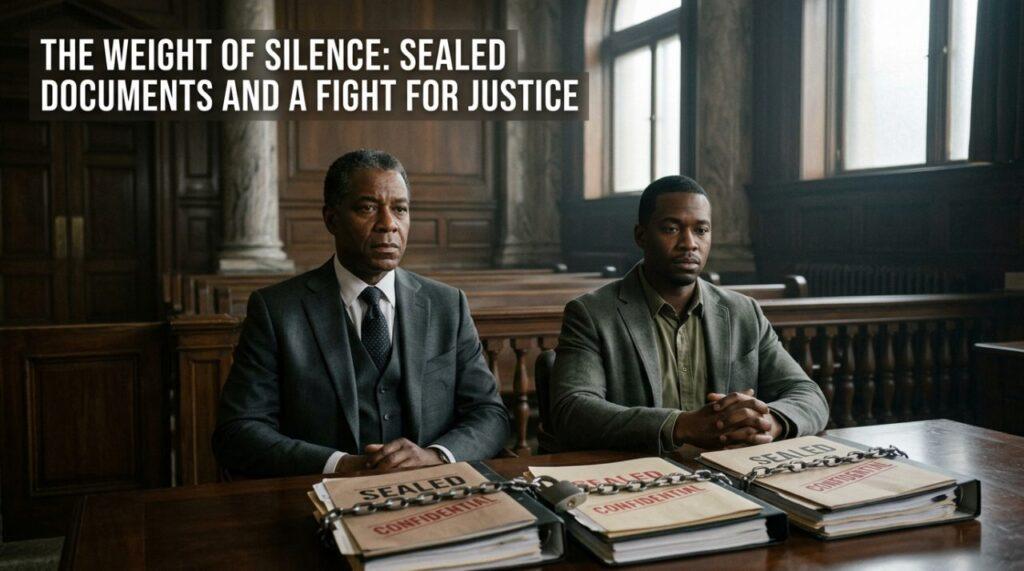
A California appellate court recently delivered a significant blow to criminal justice reform. The decision in People v. Superior Court (Davis) blocked Christopher Davis, a Black incarcerated man, from viewing county charging records (davisvanguard.org, casemine.com). Davis sought historical files to demonstrate racial bias under the historic California Racial Justice Act (davisvanguard.org, statecourtreport.org). He has served two decades of a life sentence for possessing a handgun (casemine.com).
Davis requested records from the Riverside County District Attorney to prove discriminatory prosecution (davisvanguard.org). A trial court initially granted his request for this crucial evidence (casemine.com). However, the Fourth District Court of Appeal reversed that order (davisvanguard.org). This appellate ruling created intense debate across the legal community. Advocacy organizations in the Davis Vanguard warned that the ruling erects a major barrier for Black defendants seeking equal justice (davisvanguard.org, davisvanguard.org).
Black Representation in California Justice System
The Ghost of McCleskey: A Shadow Over Federal Precedent
To understand this modern dispute, one must examine long-standing federal precedent. In 1987, the United States Supreme Court delivered the landmark ruling in McCleskey v. Kemp (eji.org, wikipedia.org). Warren McCleskey was a Black man facing capital punishment in Georgia (eji.org). His legal team presented an exhaustive statistical inquiry known as the Baldus study (wikipedia.org, naacpldf.org). That empirical study examined more than two thousand Georgia homicide prosecutions (wikipedia.org). It demonstrated that killers of white victims faced far greater odds of capital sentencing (eji.org, wikipedia.org).
Despite these clear numbers, the high court rejected his equal protection claim (eji.org, wikipedia.org). Justice Lewis Powell wrote that raw statistical disparities do not prove constitutional violations (eji.org, wikipedia.org). Instead, the high court required defendants to demonstrate conscious, purposeful discrimination by individual prosecutors or jurors (wikipedia.org, naacpldf.org). In his historic dissent, Justice William Brennan warned that this ruling accepted racism as an unavoidable reality (eji.org, wikipedia.org). Consequently, the decision created an insurmountable wall for civil rights claims across the United States (berkeley.edu, eji.org). In many ways, discussions concerning the balance of federalism illustrate how federal court rulings systematically restrict state-level protections.
The Punitive Turn: California Three Strikes Regime
While federal courts closed doors to statistical challenges, California lawmakers launched punitive penal experiments (berkeley.edu, roseinstitute.org). In 1994, voters and legislators approved Proposition 184, commonly known as the Three Strikes law (roseinstitute.org, findlaw.com). The law was passed during an era of racialized panic over urban crime (roseinstitute.org, prisonpolicy.org). It imposed mandatory terms of twenty-five years to life for any third felony conviction (roseinstitute.org, findlaw.com). The statute applied regardless of whether the final commitment offense was violent or serious (roseinstitute.org, findlaw.com).
Christopher Davis encountered this harsh framework in 2004 when authorities charged him with being a felon with a gun (casemine.com). Because he had prior convictions from years earlier, prosecutors invoked the Three Strikes statute (casemine.com). Although his crime caused no physical injury, the court sentenced him to twenty-five years to life (casemine.com). The state continued to operate under foundational racial policies that produced staggering inequities in confinement (prisonpolicy.org, stanford.edu). Black citizens represent five percent of California residents but nearly half of all prisoners serving third-strike life terms (prisonpolicy.org, stanford.edu).
The Legislative Antidote: The California Racial Justice Act
In response to decades of institutional bias, California passed Assembly Bill 2542 in 2020 (asmdc.org, statecourtreport.org). Known as the California Racial Justice Act, this law explicitly repudiated the federal McCleskey standard (statecourtreport.org, berkeley.edu). Authored by Assemblymember Ash Kalra, the legislation permitted defendants to challenge racial disparities without showing subjective hostility (asmdc.org, berkeley.edu). Furthermore, lawmakers affirmed that implicit bias and institutional inequities cause severe harm in court proceedings (asmdc.org, berkeley.edu).
The statute established four distinct grounds under California Penal Code section 745(a) (statecourtreport.org, ca.gov). Individuals can obtain relief if attorneys or officers demonstrate bias, use coded racial language, or seek disparate charges against specific racial groups (statecourtreport.org, ca.gov). Two years later, the legislature passed Assembly Bill 256 to make these protections retroactive (asmdc.org, statecourtreport.org). Known as the Racial Justice Act for All, this reform allowed previously sentenced individuals like Davis to petition for relief (asmdc.org, casemine.com). This legislative effort coincided with broader public demands for addressing historical state racial disparities across California institutions.
California Incarcerated Population Enhancement Status
Enhancements and Wobblers: The Engines of Disparity
To identify how systemic discrimination operates, one must look closely at prosecutorial choices (berkeley.edu, capolicylab.org). In California criminal law, sentencing enhancements are statutory provisions that add consecutive prison years to an underlying conviction (capolicylab.org). Line prosecutors can choose to stack gun allegations or prior convictions to inflate prison terms dramatically (capolicylab.org). More than one-third of incarcerated individuals in the state have sentences lengthened by enhancements (capolicylab.org).
Similarly, offenses known as wobblers allow prosecutors to exercise unchecked charging power (scu.edu, berkeley.edu). Under California Penal Code section 17(b), wobblers can be charged as either low-level misdemeanors or strike-eligible felonies (scu.edu). Because prosecutors operate without uniform rules, implicit biases inevitably direct their decisions (berkeley.edu, scu.edu). Consequently, Black defendants regularly face felony charges and enhancement stacking for conduct that yields lighter alternatives for white counterparts (capolicylab.org, cbs8.com). This selective discretion functions as an unseen pipeline to mass incarceration (prisonpolicy.org, capolicylab.org).
The Proposition 36 Exclusion: Why Davis Remained Behind Bars
California voters attempted to curb the severity of the Three Strikes law in 2012 by approving Proposition 36 (roseinstitute.org, findlaw.com). Known as the Three Strikes Reform Act, this initiative allowed people serving life terms for nonviolent crimes to petition for resentencing (roseinstitute.org, findlaw.com). The reform aimed to release individuals who posed no threat to society (roseinstitute.org). Nevertheless, Christopher Davis remained disqualified from this relief under technical statutory exceptions (casemine.com).
Under Penal Code section 1170.126(e)(2), resentencing is prohibited if a person was armed with a deadly weapon during their commitment crime (findlaw.com, casemine.com). State courts interpreted constructive possession of a firearm as being armed under this statutory exemption (findlaw.com, casemine.com). Additionally, trial judges retain broad authority to reject applicants if they consider them a risk to public safety (findlaw.com). Because of these strict limits, Davis could not shorten his life sentence through Proposition 36, leaving the Racial Justice Act as his sole remaining remedy (casemine.com).
The Evidentiary Battleground: Discovery Under Section 745(d)
Proving a systemic disparity under the Racial Justice Act requires robust comparative information (statecourtreport.org, berkeley.edu). However, county prosecutors maintain internal charging files behind closed doors (davisvanguard.org, berkeley.edu). Recognizing this reality, the legislature enacted Penal Code section 745(d) to enable discovery upon a showing of good cause (statecourtreport.org, ca.gov). In 2022, the First District Court of Appeal clarified this requirement in Young v. Superior Court (justia.com, findlaw.com).
The Young decision established that defendants only need a plausible factual foundation to obtain public records (justia.com, findlaw.com). That standard was designed to be accessible because defendants cannot prove systemic bias without the government data itself (justia.com, berkeley.edu). The court explained that discovery is merely the initial gathering step, not final adjudication (justia.com, findlaw.com). Therefore, civil rights lawyers believed that the law had finally dismantled the old barriers erected by historical federal rulings (statecourtreport.org, berkeley.edu).
Comparative Felony Sentence Length by Race
Why the Appellate Court Rejected Davis’s Comparators
The Fourth District Court of Appeal departed sharply from this accessible standard in People v. Superior Court (Davis) (davisvanguard.org, casemine.com). In his discovery motion, Davis presented two non-Black defendants, named Gonzales and Bonilla, who faced similar charges in Riverside County (casemine.com). Those individuals received short determinate prison terms rather than life sentences (casemine.com). Davis also submitted academic studies showing that Black defendants consistently face longer terms (davisvanguard.org, casemine.com).
Nonetheless, the appellate panel ruled that his comparators were not legally similarly situated (casemine.com). First, the judges stated that Davis provided insufficient details concerning the factual conduct of those comparisons (casemine.com). Second, the court noted that the district attorney charged strike priors against all three men equally (casemine.com). The lighter sentences given to Gonzales and Bonilla occurred because the trial judge exercised discretionary authority to dismiss strikes under People v. Superior Court (Romero) (casemine.com). Finally, the record revealed that the comparators entered open pleas to the court rather than negotiated settlements (casemine.com). For those reasons, the panel vacated the discovery order (davisvanguard.org, casemine.com).
The Evidentiary Catch-22: Critique from Legal Advocates
The appellate ruling in Davis ignited immediate criticism from legal scholars and advocates in the Davis Vanguard (davisvanguard.org, davisvanguard.org). Critics argued that the court created an impossible legal paradox (davisvanguard.org). By requiring exhaustive proof of comparable culpability before granting discovery, the panel forced Davis to prove his entire case prematurely (davisvanguard.org, davisvanguard.org). Yet, the exact records needed to satisfy that requirement remain locked in the prosecutor’s possession (davisvanguard.org, berkeley.edu).
This barrier mirrors historical tactics that neutralised equal protection litigation after the Civil Rights movement (naacpldf.org, wikipedia.org). Defense attorneys maintain that this standard transforms a discovery request into an insurmountable trial on the merits (davisvanguard.org, berkeley.edu). Similar patterns appear across the nation when federal courts restrict civil rights remedies, as seen in ongoing discussions surrounding Supreme Court decisions that curtail structural remedies. Without access to historical plea bargaining records, defendants cannot reveal systemic inequalities (davisvanguard.org, berkeley.edu).
The Road Forward for California Justice
The split between Young v. Superior Court and People v. Superior Court (Davis) will likely demand intervention by the California Supreme Court (davisvanguard.org, findlaw.com). If left unaddressed, the Davis precedent threatens to hollow out the Racial Justice Act (davisvanguard.org, davisvanguard.org). Prosecutors will continue to shield internal files, claiming that disclosure represents an administrative burden (berkeley.edu, berkeley.edu). In doing so, counties can insulate discretionary charging choices from public review (berkeley.edu, capolicylab.org).
The promise of the California Racial Justice Act was to confront historical injustices directly (asmdc.org, berkeley.edu). Christopher Davis has served more than twenty years for possessing a handgun (casemine.com). His ongoing legal struggle demonstrates that systemic reform requires more than progressive legislative declarations (davisvanguard.org, statecourtreport.org). As this battle moves forward, California must decide whether it will open its justice system to genuine transparency or allow historical patterns of racial exclusion to endure (davisvanguard.org, berkeley.edu).
About the Author
Darius Spearman is a professor of Black Studies at San Diego City College, where he has been teaching for over 20 years. He is the founder of African Elements, a media platform dedicated to providing educational resources on the history and culture of the African diaspora. Through his work, Spearman aims to empower and educate by bringing historical context to contemporary issues affecting the Black community.
