

Why NYC Disbanded the NYPD Strategic Response Group
By Darius Spearman (africanelements)
Support African Elements at patreon.com/africanelements and hear recent news in a single playlist. Additionally, you can gain early access to ad-free video content.
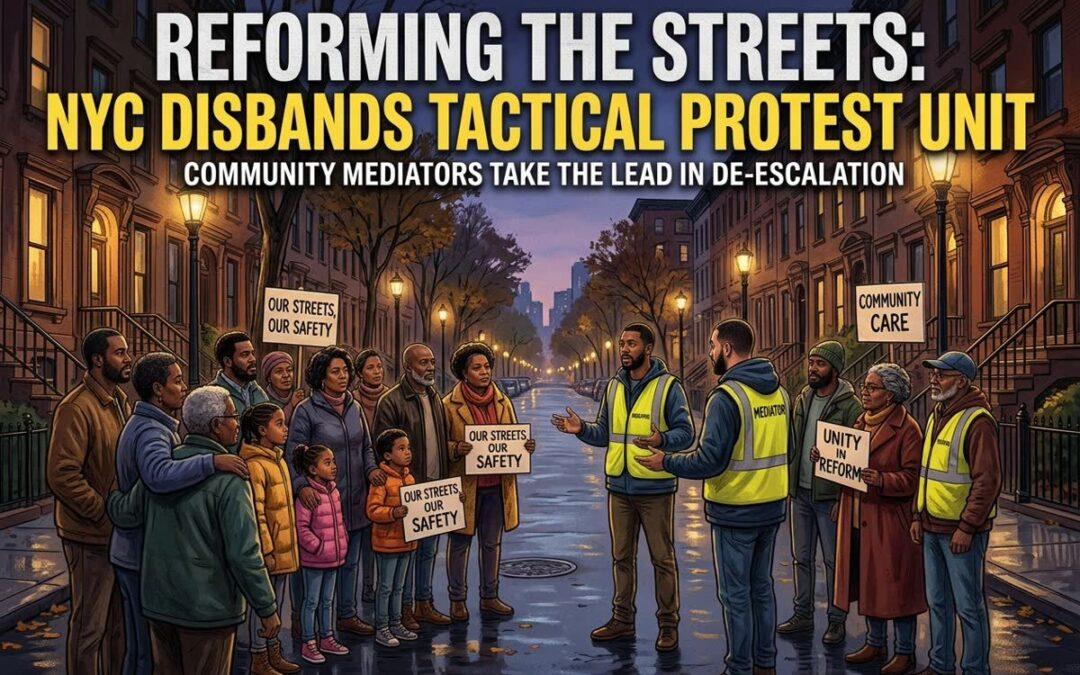
On November 16, 2026, New York City leadership announced a sweeping structural transformation of municipal law enforcement. Mayor Zohran Mamdani and NYPD Commissioner Jessica Tisch formally disbanded the department’s heavily militarized rapid-deployment formation, the NYPD Strategic Response Group (nyc.gov, cnn.com). The dissolution of the unit delivered on a major municipal pledge to remove counterterrorism personnel from First Amendment protest policing across the five boroughs (cbsnews.com).
For more than a decade, community organizers and legal advocates documented aggressive tactics deployed by this specialized squad against demonstrations led by Black and Brown New Yorkers (nyclu.org, bds.org). The administrative order eliminates the unit entirely. It replaces tactical response squads with a civilian mediation apparatus and institutes strict administrative prohibitions against crowd containment tactics and chemical irritants (nyc.gov, thefreelancenews.org). To grasp the full weight of this transition, one must examine the long institutional lineage of militarized municipal policing in New York City (wikipedia.org).
Tactical Patrol Force History and Paramilitary Roots
The institutional architecture behind rapid tactical crowd control did not begin in the twenty-first century. Its direct lineage reaches back to 1959 with the establishment of the Tactical Patrol Force (wikipedia.org). Police commanders designed that mobile strike division to move quickly across precinct boundaries. Department leaders recruited physically imposing officers to suppress localized civil disorder in working-class neighborhoods (wikipedia.org). Throughout the 1960s, city authorities deployed the unit against civil rights marches, anti-war demonstrations, and community rebellions in Harlem and Bedford-Stuyvesant (wikipedia.org).
Widespread community condemnation and high rates of physical brutality complaints ultimately forced the city to disband the unit in the 1970s (wikipedia.org, wikipedia.org). For nearly four decades, decentralized borough task forces handled large gatherings. That structural separation eroded following the 2014 protests in Ferguson, Missouri, which energized nationwide demands for racial accountability (nyclu.org, cityandstateny.com). In January 2015, then-NYPD Commissioner William J. Bratton announced the creation of the Strategic Response Group under the Special Operations Bureau (cityandstateny.com, theguardian.com).
Bratton initially pitched the force as a hybrid counterterrorism division designed to confront active shooter emergencies and manage public demonstrations (cityandstateny.com). Civil rights organizations immediately noted the inherent danger of conflating political assemblies with national security threats (nyclu.org). Although police executives briefly promised that the unit would handle only counterterrorism, armored personnel arrived at demonstrations against police killings within months (nyclu.org, theguardian.com). The unit expanded from an initial annual allocation of $13 million into an operational apparatus consuming between $90 million and $133 million annually, deploying hundreds of officers armed with riot armor, semi-automatic rifles, and acoustic sound cannons (nyclu.org, thefreelancenews.org).
Estimated Annual SRG Budget Growth (2015-2025)
Mott Haven Protests Kettling and the Crucible of 2020
The contradiction between domestic counterterrorism equipment and public assembly reached a flashpoint in the summer of 2020. Across the nation, millions demonstrated against police killings following the murder of George Floyd in Minneapolis (hrw.org). In New York City, tactical police units responded with militarized crowd suppression techniques (nyclu.org, bds.org).
The most severe documented incident took place on June 4, 2020, in the Mott Haven neighborhood of the South Bronx (bds.org, hrw.org). Mott Haven is a low-income community with a demographic composition that is over 95 percent Black and Latino (cssny.org). For decades, the area has endured systematic municipal neglect, elevated rates of pediatric asthma, and intensive surveillance from the 40th Precinct (cssny.org, phr.org). In the spring of 2020, the neighborhood also suffered catastrophic illness and death rates during the initial wave of the COVID-19 pandemic (phr.org, hrw.org). These historic inequities mirror the broader patterns analyzed in debates on racial injustice in New York.
Ten minutes prior to an 8:00 p.m. municipal curfew, tactical officers and bicycle units blocked both ends of East 136th Street, intentionally sealing off every exit route (bds.org, hrw.org). This maneuver, known as kettling, left hundreds of peaceful marchers trapped without any opportunity to disperse (bds.org, hrw.org). As the curfew arrived, officers charged directly into the immobilized crowd (hrw.org). Officers struck trapped demonstrators with batons, sprayed pepper spray into faces at close range, and drove bicycles into individuals before executing mass detentions (bds.org, hrw.org). An investigation by Human Rights Watch concluded that this operation was premeditated and represented a gross violation of international human rights standards (hrw.org).
NYC Police Misconduct Settlement Costs (2019-2025)
Strategic Response Group Lawsuits and Federal Court Mandates
The events in Mott Haven and across New York sparked intense legal challenges. Multiple civil rights claims merged under federal oversight in litigation titled Payne v. de Blasio, pursued by the Legal Aid Society, the New York Civil Liberties Union, and New York State Attorney General Letitia James (nyclu.org, courthousenews.com, legalaidnyc.org). In 2023, the city agreed to pay individual financial settlements of roughly $21,500 to each person kettled on East 136th Street (bds.org, legalaidnyc.org). The total compensation exceeded $10 million, marking one of the largest collective payouts for an individual protest demonstration in American history (bds.org, courthousenews.com).
Municipal liability extended across years of litigation. Between 2019 and 2025, New York City disbursed more than $796 million to settle police misconduct claims (ny.gov, ny.gov). Excessive-use-of-force complaints filed with the Civilian Complaint Review Board jumped 49 percent between 2022 and 2023 (nyc.gov). Federal courts stepped in to mandate procedural changes. In early 2024, Senior U.S. District Judge Colleen McMahon ratified a binding tiered-response settlement over formal objections from police unions (nyclu.org, nyclu.org). The court order barred tactical units from routine political protests, restricting their presence to rare situations involving serious criminal offenses or property destruction (nyclu.org).
Legal challenges also targeted specialized weapons deployed against public gatherings, notably the Long Range Acoustic Device (LRAD) (wikipedia.org, lethalindisguise.org). Engineered originally for naval warfare and military hailing operations, LRAD systems emit directional acoustic beams reaching levels between 136 and 160 decibels (wikipedia.org). When used as crowd weapons, they inflict severe ear trauma, migraine pain, and irreversible inner-ear cell destruction (phr.org, lethalindisguise.org). In Edrei v. Bratton, the U.S. Court of Appeals for the Second Circuit established that pointing sound cannons at peaceful demonstrators at dangerous volumes violates Fourteenth Amendment rights against unreasonable physical force (justia.com, findlaw.com). Federal settlements eventually restricted the sound systems strictly to vocal announcements, establishing a ceiling of 90 decibels (findlaw.com).
Acoustic Device Decibels vs. Physical Thresholds
NYPD Crowd Control Reforms and Banned Tactical Weapons
The institutional changes announced in late 2026 put an official end to numerous controversial tactics. Central to this directive is an absolute administrative prohibition against kettling (nyc.gov, cbsnews.com). Officers are barred from encircling crowds or barricading marchers unless individuals inside face arrest based on individualized probable cause (nyclu.org, nyclu.org). Escape corridors must remain open during any dispersal directive, and audible instructions must be repeated before enforcement begins (nyclu.org).
The revised patrol standards place binding restrictions on specific equipment during constitutionally protected demonstrations (nyc.gov):
- Chemical irritants, including tear gas, are entirely barred from public assembly management (nyc.gov, cbsnews.com).
- Pepper spray cannot be used as a broad dispersal tool against crowds (nyc.gov).
- Long guns, assault rifles, and combat armor are excluded from demonstration zones (nyc.gov, cbsnews.com).
- Police bicycles may no longer serve as mobile barricades or offensive ramming weapons (nyc.gov).
- Acoustic devices cannot deploy weaponized alert frequencies and must stay beneath the 90-decibel limit (nyc.gov, findlaw.com).
These policy changes reflect lessons drawn from centuries of civic mobilization. From early labor actions to twentieth-century civil rights campaigns, state forces have regularly weaponized emerging technologies to restrict dissent. Readers can examine similar historic struggles within our review of the long tradition of labor and civil rights. Codifying weapon bans into official departmental regulations represents an effort to break that historic continuum (nyc.gov, thefreelancenews.org).
Community Dialogue Division NYPD and De-escalation Overhaul
To oversee demonstrations without militarized intervention, the city established a new institutional apparatus. City Hall created the Community Dialogue and De-escalation Division within the civilian-run Mayor’s Office of Community Safety (nyc.gov). Members of this division do not carry firearms, wear tactical armor, or possess arrest powers (nyc.gov, thefreelancenews.org). Instead, these civilian mediators arrive at rallies to open communication channels with event marshals, coordinate logistical details, and de-escalate tensions before misunderstandings spiral into physical confrontations (nyc.gov).
Within the police department itself, leadership created the First Amendment Support Team under the Community Affairs Bureau (nyc.gov). This unit comprises 30 uniformed officers specifically trained in non-violent dispute resolution, peer intervention, and crowd facilitation (nyc.gov, cbsnews.com). For general operational assignments, including the New York City Marathon, community parades, and severe weather mobilizations, the city formed the Patrol Support Division under the Patrol Services Bureau (nyc.gov). Officers assigned to this support unit must clear background evaluations and internal screening checks (nyc.gov, nypdonline.org).
Despite these formal structural changes, several systemic concerns persist among grassroots organizers and legal oversight groups (bds.org, nyclu.org). The reorganization reassigns approximately 500 to 700 armed officers into regular precincts and specialized divisions without automatic disciplinary reviews (thefreelancenews.org, cbsnews.com). Civilian Complaint Review Board records indicate that members of tactical units carried disproportionate misconduct complaint rates (nyclu.org, nyc.gov). Under New York state law, the police commissioner retains final, unilateral discretion to dismiss or reduce disciplinary recommendations issued by civilian boards (cbsnews.com). Reallocating tactical personnel into neighborhood precincts without independent reviews creates ongoing community safety concerns in areas that already experience heavy street enforcement (bds.org, nyclu.org). These governance debates connect directly to broader discussions regarding tensions in Black political mobilization.
Police Reform Under Mamdani and the Legislative Battle Ahead
The disbanding of the tactical unit fulfills a cornerstone platform plank for Mayor Zohran Mamdani (cnn.com, cbsnews.com). Throughout his campaign, Mamdani argued that true municipal stability relies on social investment rather than expanding paramilitary responses in working-class neighborhoods (cnn.com, cssny.org). Alongside Police Commissioner Jessica Tisch, the administration maintained that safeguarding constitutional assembly strengthens civic confidence (nyc.gov, cnn.com). Commissioner Tisch argued publicly that modern urban policing must evolve to remain credible in diverse communities (nyc.gov). These policy shifts echo similar legislative debates highlighted in state-level civil rights initiatives across the country.
The structural changes faced immediate opposition from police labor organizations. Patrick Hendry, president of the Police Benevolent Association, publicly criticized the dissolution of the tactical division (newsday.com). Hendry argued that eliminating a centralized, mobile strike force places patrol officers at risk during sudden public disorders (newsday.com). Union representatives argued that specialized units are necessary to protect public infrastructure when spontaneous gatherings overwhelm neighborhood precinct resources (cbsnews.com, newsday.com).
Civil rights attorneys and community coalitions emphasize that executive orders remain vulnerable to future political changes (thefreelancenews.org, theguardian.com). An incoming mayoral administration could restore tactical formations through administrative fiat. Consequently, reform advocates are lobbying City Council Speaker Julie Menin and Council lawmakers to pass the Communities United to Reject Brutality (CURB) Act (thefreelancenews.org). The proposed statute would write bans on kettling, tear gas, and sonic weapons directly into the New York City Administrative Code (thefreelancenews.org). Enacting statutory mandates remains the most reliable barrier against returning to militarized protest tactics (thefreelancenews.org, theguardian.com).
About the Author
Darius Spearman is a professor of Black Studies at San Diego City College, where he has been teaching for over 20 years. He is the founder of African Elements, a media platform dedicated to providing educational resources on the history and culture of the African diaspora. Through his work, Spearman aims to empower and educate by bringing historical context to contemporary issues affecting the Black community.
